The Developer's Guide to Cookie Consent API Integration in 2026
Consent is not a UI component. It is a critical data state that belongs in your core infrastructure. For too long, engineers have treated compliance as a third-party script problem rather than a core technical requirement. Implementing a robust cookie consent api for developers is the only way to bridge the gap between privacy law and system performance. You shouldn't have to choose between a fast site and a compliant one.
You've likely felt the frustration of bloated CMP scripts dragging down your Core Web Vitals or the headache of syncing consent states across a fragmented stack. It's a common struggle. This guide provides the blueprint to master the technical implementation of consent APIs. You will learn to build compliant, high-performance data pipelines that respect user rights while protecting your revenue. We'll walk through seamless integrations with Google Consent Mode v2 and IAB TCF 2.3. We will also explore how to gain programmatic access to consent analytics so you can finally see how privacy choices impact your bottom line without the guesswork.
Key Takeaways
- Move beyond static banners and treat compliance as part of your core stack by implementing a robust cookie consent api for developers.
- Sync your tech stack with the latest industry standards including Google Consent Mode v2 and the mandatory IAB TCF 2.3 framework.
- Build efficient event-driven workflows that use status-change triggers to activate or block tracking scripts without degrading performance.
- Quantify how privacy choices affect your earnings by using programmatic A/B testing and built-in revenue impact analytics.
- Choose the right infrastructure for your team, whether it's the convenience of a managed cloud or the sovereignty of self-hosted open consent infrastructure.
Beyond the Banner: Why Developers Need a Robust Cookie Consent API
Compliance is not a visual overlay. It is a technical foundation. In 2026, the industry has moved past the era of binary "Yes" or "No" buttons. Consent is now a multi-state matrix of purposes, vendors, and legal bases. Hard-coding these logic trees into your frontend is a maintenance trap. It creates technical debt that breaks every time a regulation shifts or a new vendor is added to your stack. A robust cookie consent api for developers is the necessary bridge between abstract legal requirements and concrete technical execution. It transforms compliance from a UI checkbox into a reliable, queryable data stream.
Transparency is the new standard. This is why source-available infrastructure is critical for modern engineering teams. It allows you to build a privacy stack that is actually trustworthy because the logic is visible. It is not hidden behind a vendor's proprietary wall. By treating consent as infrastructure, you ensure that your data pipelines are principled and egalitarian by design.
The Limitations of Legacy CMP Scripts
Traditional CMPs are often performance killers. They are heavy, third-party scripts that bloat your bundle and degrade your Largest Contentful Paint (LCP). They often cause Cumulative Layout Shift (CLS) as they inject banners late into the document lifecycle, frustrating users and hurting SEO. Beyond performance, legacy tools present a "Black Box" problem. You cannot easily audit the logic behind why a specific script was blocked or allowed. This lack of transparency makes complying with the General Data Protection Regulation (GDPR) a guessing game rather than a rigorous process. You need to see the code to trust the outcome.
Consent as a Programmable State
Modern development requires flexibility. If you are building Single Page Applications (SPAs), mobile apps, or headless environments, a standard script tag is insufficient. You need headless consent management. An API allows you to treat consent as a programmable state that persists across subdomains and microservices. It is about synchronization. When a user updates their preferences on a landing page, your backend services must know immediately. Programmatic access also enables automated compliance audits. Instead of manual checks, you can write tests to verify that your data pipelines respect user choices in real-time. This is how you build a GDPR-compliant infrastructure that scales. For maximum control and data sovereignty, many teams now choose to self-host their cookie consent manager to keep their logic and data close to home.
Architecting Your Consent Flow: Hooks, Events, and Callbacks
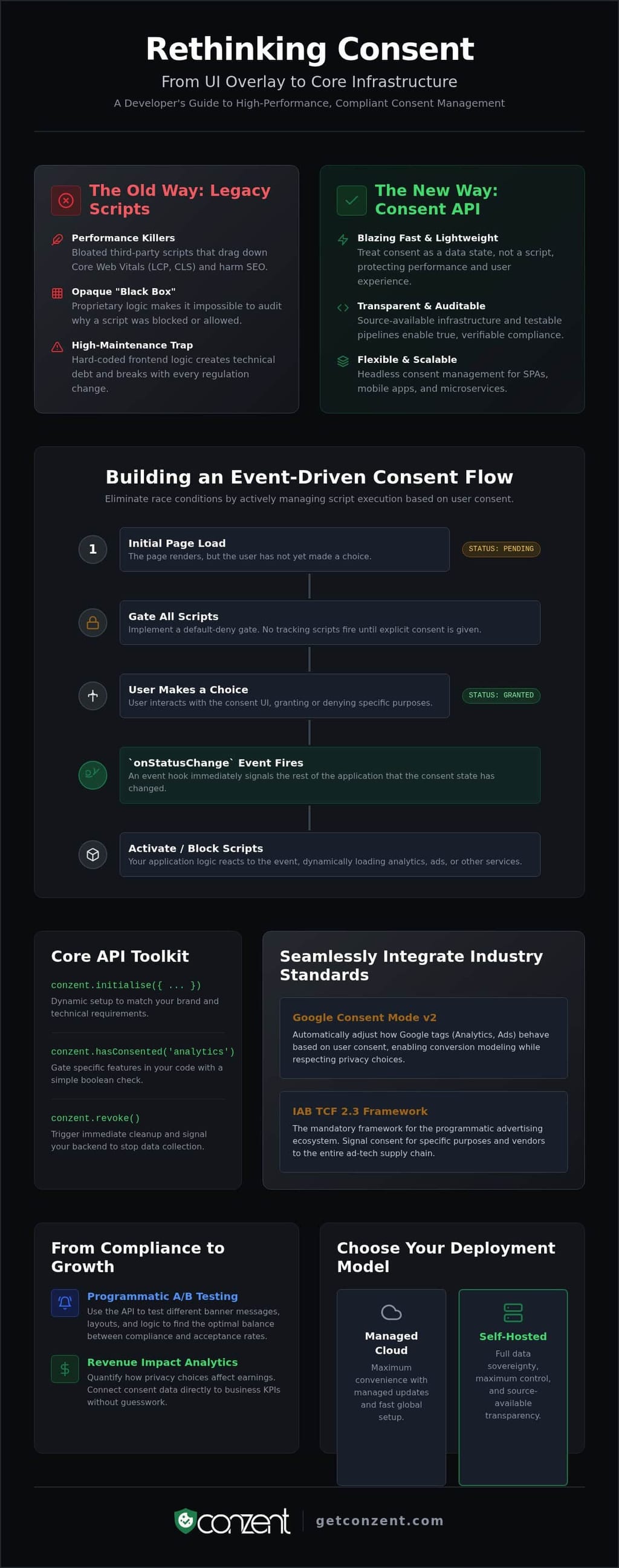
Consent is a sequence. It is not a static event. Your architecture must handle the critical gap between the initial page load and the moment a user makes a choice. Static configurations are often too rigid for modern stacks. They fail to account for dynamic environment variables or user-specific context. A professional cookie consent api for developers allows for dynamic initialization. This ensures your CMP is not just a hard-coded script but a responsive part of your application lifecycle.
Race conditions are the primary enemy of compliant tracking. If your analytics tags fire at the DOMContentLoaded event while the consent state is still "pending," you are already in breach. You must implement a gate. This requires a shift from passive script loading to active, event-driven execution. Your system should also decide where to persist this state. Local storage offers the lowest latency for the frontend, but server-side records are essential for legal audits and cross-device synchronization.
Core JavaScript API Methods
A functional API must provide granular control over the user experience. The initialise() method should accept custom configuration objects to match your brand's technical requirements. Beyond the visuals, the hasConsented() method is your most valuable tool. It allows you to gate specific functional logic in your code directly. If a user withdraws their choice, the revoke() method must trigger an immediate cleanup. It should clear cookies and signal your backend to stop data collection. This level of control is a standard, not a luxury.
Event-Driven Consent Management
Compliance in 2026 demands a sophisticated handle on data signals. The onStatusChange pattern is the industry standard for real-time synchronization. When a user updates their preferences, your API should broadcast an event that your Google Tag Manager (GTM) or Matomo instance can consume. This is particularly vital when integrating with the IAB Transparency & Consent Framework (TCF) 2.3. As of February 28, 2026, the mandatory enforcement of TCF 2.3 requires precise handling of the "Disclosed Vendors" segment. Your API hooks must be able to parse this TC String and pass it to ad vendors without delay. If you are looking for a platform that simplifies these complex integrations, you can review our flexible pricing tiers for managed or self-hosted infrastructure.
Partial consent scenarios add another layer of complexity. A user might allow functional cookies but reject marketing ones. Your callback logic must be surgical. It should enable or disable scripts on a per-category basis. This ensures you respect the user's intent while maximizing the utility of the data you are permitted to collect.
Implementing Advanced Standards: IAB TCF 2.3 and Google Consent Mode v2
Standards are not suggestions. They are the protocols that keep the open web functional. By July 2026, the mandatory adoption of IAB TCF 2.3 has redefined how we handle vendor transparency. For engineers, this means moving beyond simple script blocking. You must now manage complex strings that communicate user intent across the entire ad tech ecosystem. A modern cookie consent api for developers acts as a translator. It takes a user's click and converts it into a standardized signal that every downstream partner can understand. This is a technical necessity for any site relying on ad monetization.
The Developer's Role in TCF 2.3 Compliance
TCF 2.3 introduced a mandatory "Disclosed Vendors" segment to the TC string. This change isn't just a UI update. It requires you to programmatically access the __tcfapi command queue to ensure vendor-specific data is accurate and available. When you use an IAB TCF 2.3 Certified CMP, your primary task is ensuring the library initializes before any ad requests fire. You need to handle the nuance between 'Explicit Consent' and 'Legitimate Interest' via the API. This ensures you don't accidentally block functional vendors while remaining strictly compliant with global standards and the California Consumer Privacy Act (CCPA). It's about precision, not just broad strokes.
Google Consent Mode v2 Programmatic Integration
Google Consent Mode v2 is essential for maintaining accurate measurement in a privacy-first world. It introduces granular parameters like ad_user_data and ad_personalization that require direct mapping from your CMP categories. Implementation starts in the <head>. You must set default consent states to denied before any other scripts load. This prevents data leaks. It ensures a "privacy-first" baseline for every session before the user even sees a banner.
Once the user interacts with your banner, use the cookie consent api for developers to trigger a gtag('consent', 'update', ...) call. This dynamic update allows Google's tags to adjust their behavior in real-time. If you encounter issues, use the browser console to inspect the global google_tag_data object. Debugging these signals is critical. A single misconfigured parameter can lead to significant data loss or compliance failures. We believe this level of technical transparency should be accessible to everyone. This is why our infrastructure focuses on open standards rather than proprietary silos. It's about empowering developers to build better, more ethical systems.
Optimizing for Growth: A/B Testing and Revenue Impact via API
Compliance is not just a legal shield. It is a performance metric. If your opt-in rates are low, your analytics are incomplete and your marketing spend is inefficient. Developers must care about these numbers because they directly influence the quality of the data pipelines they build. By using a cookie consent api for developers, you can treat the consent banner like any other part of the conversion funnel. You shouldn't guess when you can test.
Programmatically triggering different variants for cookie consent A/B testing allows you to identify which layouts and messaging drive the highest acceptance without compromising ethics. You can use API hooks to broadcast consent events to your internal BI tools or data lakes. This provides a clear view of how specific configurations affect the user journey. It is about moving from compliance-by-default to optimization-by-design. When you treat consent as a queryable data state, you gain the power to refine the user experience based on evidence rather than assumptions.
Technical Implementation of Consent A/B Tests
Start by defining your test groups. Your CMP configuration should allow you to pass a variant ID through the API during the initialization phase. This lets you track performance metrics such as opt-in rates, bounce rates, and the time-to-consent for each distinct group. You might find that a centered modal performs better than a bottom bar, or that specific terminology increases trust. Once you've identified a statistically significant winner, don't update it manually. Automate the rollout. Integrate the winning configuration into your CI/CD pipeline. This ensures your production environment always uses the most effective, compliant setup. This approach reduces manual overhead and keeps your infrastructure lean and responsive.
Measuring the Real Cost of Compliance
You cannot manage what you do not measure. Denied tracking represents "lost" revenue, but it doesn't have to be a blind spot. By correlating consent states with conversion data via API callbacks, you can calculate the precise revenue impact of your privacy policies. This is where compliant ad revenue tracking becomes essential. It helps you reclaim insights from anonymized signals without violating user trust. We recommend building a custom dashboard that combines CMP status codes with your financial metrics. This provides a single source of truth for both your engineering and growth teams. It makes the value of your compliance efforts visible to the entire organization. To start optimizing your own data sovereignty, explore our managed and self-hosted plans.
Infrastructure Choices: Managed Cloud vs. Self-Hosted API
Your infrastructure is your integrity. Choosing where your consent data lives is a decision between total control and operational speed. It isn't a matter of luxury; it's a matter of technical strategy. A professional cookie consent api for developers must offer flexibility in deployment to meet different organizational needs. You should own your stack, not just rent it. By treating consent as a core part of your architecture, you ensure that user privacy is baked into your system rather than bolted on as an afterthought.
Security is the silent driver of this choice. Keeping consent records within your own infrastructure minimizes the surface area for data breaches. It ensures that sensitive user preferences never leave your controlled environment. This is the foundation of the Open Consent Infrastructure (OCI) mission. We believe in providing a public good that prioritizes transparency and data sovereignty. Our Danish-engineered platform is built to be a standard, not a proprietary secret.
Self-Hosting for Maximum Performance
Deploying our source-available platform on your own cloud, whether it is AWS, GCP, or Azure, gives you full sovereignty. It is the ultimate choice for teams that prioritize extreme performance. When you are self-hosting your cookie consent manager, you eliminate the latency associated with third-party script requests. This directly improves your Core Web Vitals. There is no waiting for a distant server to respond before your banner can initialize. You manage the updates and the maintenance. You control the uptime. This level of autonomy is essential for high-traffic applications that cannot afford a single millisecond of unnecessary delay. It is infrastructure that respects both the developer and the end user.
The Managed Cloud Advantage
Not every project requires the overhead of self-managed nodes. The managed cloud offers a streamlined alternative that maintains full API flexibility. It provides zero-config scaling for global traffic. When your site grows, the infrastructure grows with it. You receive automatic updates, ensuring your cookie consent api for developers always supports the latest legal requirements and technical standards without manual intervention. Our sponsorship tiers are designed to lower the barrier to entry for the developer community. You get access to advanced cloud-based analytics and multi-language support out of the box. It is about reducing DevOps friction while maintaining a principled approach to privacy. Whether you choose the cloud or your own servers, the goal remains the same: a faster, more transparent web for everyone.
Owning the Future of Privacy Infrastructure
The shift toward a privacy-first web is not a burden. It is an opportunity to build more resilient systems. You have seen how moving beyond static banners to a programmable cookie consent api for developers allows for seamless integration and superior site performance. By mastering event-driven flows and the latest standards like IAB TCF 2.3 and Google Consent Mode v2, you ensure your stack is both compliant and high-performing without sacrificing the user experience.
Infrastructure choice remains the final piece of the puzzle. Whether you opt for the convenience of the managed cloud or the absolute sovereignty of self-hosted open consent infrastructure, the goal is transparency. We provide source-available tools and built-in revenue impact analytics because compliance must be accessible to every engineer. It is time to treat consent as a core technical asset rather than a legal afterthought. You now have the knowledge to build a faster, more ethical data pipeline.
Explore the Conzent API documentation and get started today. Build with confidence.
Frequently Asked Questions
What is the difference between a CMP API and a standard cookie banner script?
A standard script primarily handles the visual layer and simple cookie blocking. A CMP API provides programmatic access to the user's consent state. It allows you to treat consent as a queryable data state within your own application logic. This gives you the control to trigger specific backend or frontend functions based on real-time user choices.
How do I integrate Google Consent Mode v2 using the Conzent API?
Integration involves setting default consent states to denied in your site header. You then use the API to map your CMP categories to Google's specific parameters like ad_user_data and analytics_storage. When a user makes a selection, the API triggers a gtag('consent', 'update', ...) call to synchronize the state with Google's services.
Can I customize the UI of the cookie banner entirely through the API?
Yes. You can use the API in a headless configuration to build your own custom UI components. This allows you to maintain complete brand consistency while the API manages the underlying logic, persistence, and compliance requirements. You aren't forced to use a pre-styled banner if it doesn't fit your design system.
Is the Conzent API compatible with React, Vue, and other modern frameworks?
The cookie consent api for developers is framework-agnostic. It works via standard JavaScript hooks and event listeners that integrate seamlessly with React effects, Vue watchers, or Svelte stores. This ensures that your consent management remains reactive and synchronized across your entire frontend stack.
How does using an API-based CMP help with Core Web Vitals?
Using a cookie consent api for developers improves performance by eliminating heavy, render-blocking third-party scripts. You control the initialization sequence. This prevents the layout shifts often caused by injected banners and keeps your Largest Contentful Paint (LCP) within optimal ranges. Self-hosting the infrastructure further reduces DNS lookups and execution latency.
What happens if the CMP API fails to load on the user's browser?
Your application should implement a fail-safe state. If the API fails to initialize, all tracking and non-essential cookies must remain disabled by default. This ensures you remain compliant even during technical failures. The site stays functional, but privacy is protected until a valid consent state is confirmed.
Does the Conzent API support IAB TCF 2.3 for programmatic advertising?
Yes, the platform is fully certified for IAB TCF 2.3. It provides programmatic access to the __tcfapi command queue. This allows you to manage the complex TC strings required by ad tech vendors and ensures you are meeting the mandatory February 2026 transparency requirements for disclosed vendors.
How can I track the revenue impact of user consent programmatically?
You can use API callbacks to send consent status codes to your internal analytics or BI tools. By correlating these states with your transaction data, you can calculate the exact value of consented versus non-consented traffic. This technical transparency helps you optimize your opt-in rates and understand the financial health of your privacy strategy.
Frequently Asked Questions
What is the difference between a CMP API and a standard cookie banner script?
A standard script primarily handles the visual layer and simple cookie blocking. A CMP API provides programmatic access to the user's consent state. It allows you to treat consent as a queryable data state within your own application logic. This gives you the control to trigger specific backend or frontend functions based on real-time user choices.
How do I integrate Google Consent Mode v2 using the Conzent API?
Integration involves setting default consent states to denied in your site header. You then use the API to map your CMP categories to Google's specific parameters like ad_user_data and analytics_storage. When a user makes a selection, the API triggers a gtag('consent', 'update', ...) call to synchronize the state with Google's services.
Can I customize the UI of the cookie banner entirely through the API?
Yes. You can use the API in a headless configuration to build your own custom UI components. This allows you to maintain complete brand consistency while the API manages the underlying logic, persistence, and compliance requirements. You aren't forced to use a pre-styled banner if it doesn't fit your design system.
Is the Conzent API compatible with React, Vue, and other modern frameworks?
The cookie consent api for developers is framework-agnostic. It works via standard JavaScript hooks and event listeners that integrate seamlessly with React effects, Vue watchers, or Svelte stores. This ensures that your consent management remains reactive and synchronized across your entire frontend stack.
How does using an API-based CMP help with Core Web Vitals?
Using a cookie consent api for developers improves performance by eliminating heavy, render-blocking third-party scripts. You control the initialization sequence. This prevents the layout shifts often caused by injected banners and keeps your Largest Contentful Paint (LCP) within optimal ranges. Self-hosting the infrastructure further reduces DNS lookups and execution latency.
What happens if the CMP API fails to load on the user's browser?
Your application should implement a fail-safe state. If the API fails to initialize, all tracking and non-essential cookies must remain disabled by default. This ensures you remain compliant even during technical failures. The site stays functional, but privacy is protected until a valid consent state is confirmed.
Does the Conzent API support IAB TCF 2.3 for programmatic advertising?
Yes, the platform is fully certified for IAB TCF 2.3. It provides programmatic access to the __tcfapi command queue. This allows you to manage the complex TC strings required by ad tech vendors and ensures you are meeting the mandatory February 2026 transparency requirements for disclosed vendors.
How can I track the revenue impact of user consent programmatically?
You can use API callbacks to send consent status codes to your internal analytics or BI tools. By correlating these states with your transaction data, you can calculate the exact value of consented versus non-consented traffic. This technical transparency helps you optimize your opt-in rates and understand the financial health of your privacy strategy.