Cookie Consent for Advertisers: Protecting Ad Revenue and Compliance in 2026
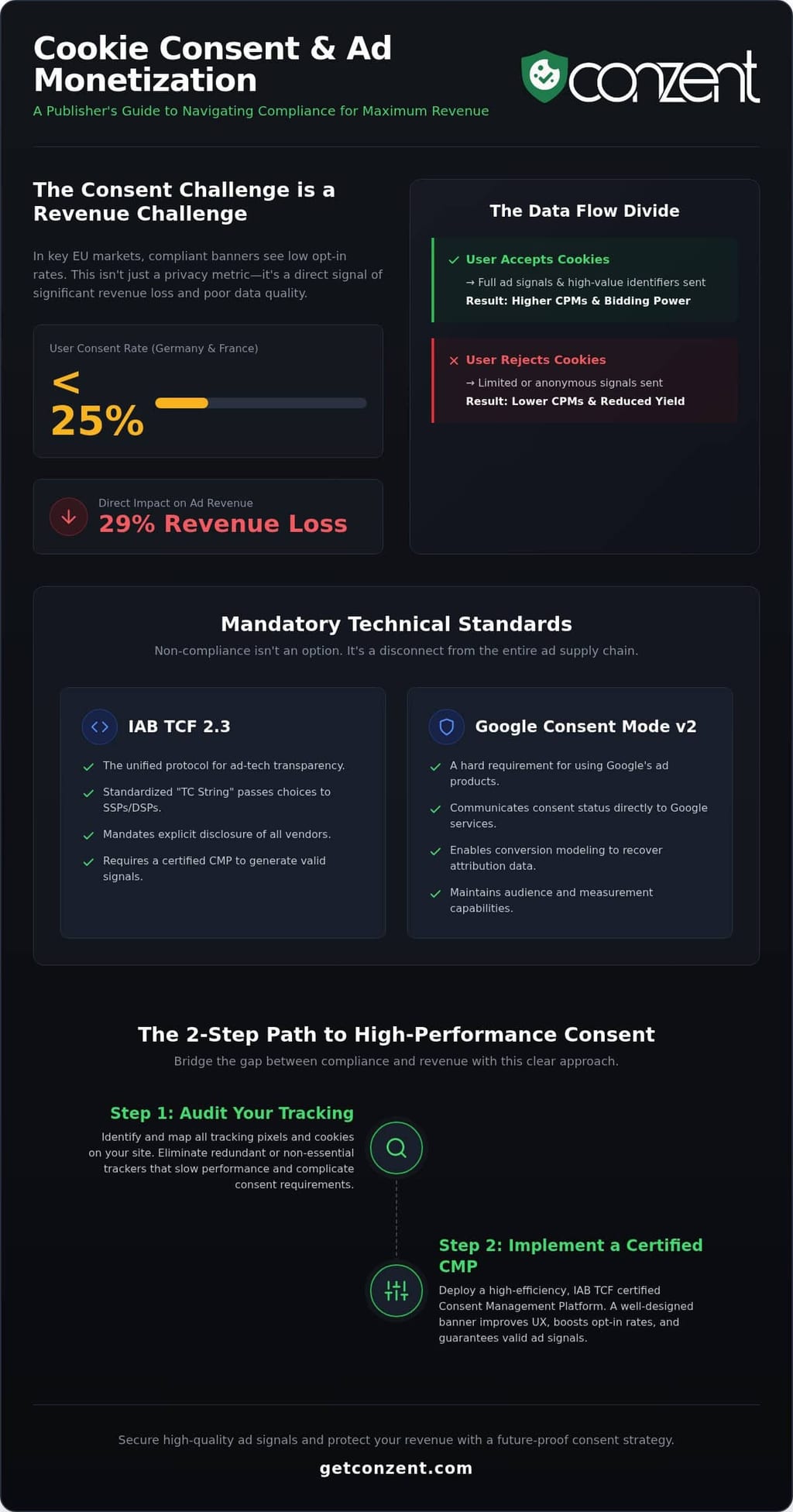
In Germany and France, fewer than 25% of users accept cookies when they see a compliant banner. For most publishers, this isn't just a privacy metric; it's a signal of a 29% revenue loss. Effective cookie consent for ad monetization is no longer about checking a legal box. It's about protecting your attribution data in an era where the "reject all" button is just as prominent as the "accept" one. Compliance is not a hurdle. It is the primary filter for high-quality ad signals and revenue stability.
You're likely struggling with the shifting sands of IAB TCF 2.3 and the mandatory requirements of Google Consent Mode v2. It's frustrating to watch attribution accuracy decline while the fear of GDPR fines remains a constant pressure. This guide shows you how to balance strict privacy standards with high-performance ad monetization. We'll break down the technical difference between "accept" and "reject" data flows and show you how to implement a future-proof CMP infrastructure. You can maintain your revenue while staying 100% compliant.
Key Takeaways
- Bridge the gap between user privacy and data collection without using deceptive "dark patterns" that invite regulatory action.
- Decode the technical requirements of IAB TCF 2.3 and Google Consent Mode v2 to maintain accurate attribution signals.
- See how high-performance cookie consent for ad monetization improves your bottom line by boosting opt-in rates and overall yield.
- Follow a two-step optimization process to audit your tracking pixels and implement a certified, high-efficiency consent banner.
- Compare managed and self-hosted consent infrastructure to solve the "black box" problem and reduce latency in your ad stack.
Why Cookie Consent is the Core of Modern Ad Monetization
Cookie consent is not a legal hurdle. It is the bridge between a user's right to privacy and an advertiser's need for data. For years, the industry relied on intrusive third-party tracking. That era is over. In 2026, cookie consent for ad monetization is the only way to secure high-quality first-party signals. We've moved from an age of data quantity to an age of signal quality. If your signals are unverified, they're essentially worthless to modern bidders.
Authentic compliance is a competitive advantage. Using "dark patterns" to trick users into clicking "accept" is a short-term gamble with long-term consequences. Regulators like the CNIL in France and the ICO in the UK are now actively investigating banners that make rejection difficult. Compliant data collection is a transparent dialogue. It's not a technical trick designed to bypass user intent. By prioritizing transparency, you secure the longevity of your ad revenue and protect your brand from aggressive enforcement actions.
The shift from third-party cookies to consent-based first-party signals is now complete. In this environment, the quality of the consent signal determines the value of the impression. Advertisers are no longer looking for the most data. They're looking for the most reliable data. A robust consent framework ensures that every byte of information you collect is actionable, legal, and high-value.
The Link Between Opt-in Rates and Bidding Power
Higher consent rates directly fuel your bidding power. When a user provides consent, the ad tech supply chain receives a full set of identifiers. This allows real-time bidding (RTB) algorithms to value the impression accurately. Without consent, your traffic is often treated as anonymous. This results in lower CPMs and reduced yield. Industry data shows that removing cookies can reduce revenue by 29.1%. A high-performance cookie banner mitigates this loss by maximizing legitimate opt-ins through better user experience and clear communication. RTB algorithms in 2026 are highly sensitive to consent strings; a missing TCF 2.3 string can lead to immediate bid rejection by major DSPs.
GDPR and ePrivacy: More Than Just Fines
Compliance is about more than avoiding the €6 billion in total GDPR fines issued as of 2026. It's about building a brand that users trust. The ePrivacy Directive set the foundation for how we handle digital identifiers in Europe. Today, meeting these standards reduces user bounce rates. Users stay longer on sites that respect their choices and provide clear information. You can explore our GDPR compliance page to see how these frameworks protect both your business and your audience. True compliance is an ethical standard, not a premium luxury. It makes complex requirements attainable for every publisher.
Technical Standards: Decoding IAB TCF 2.3 and Google Consent Mode v2
Technical standards in 2026 aren't suggestions. They're hard requirements. If you want to maintain cookie consent for ad monetization, you must speak the language of the global ad supply chain. This language is now defined by IAB TCF 2.3. This framework isn't a luxury for elite publishers. It's a necessary standard for anyone who wants their inventory to remain visible to high-value bidders. As of February 28, 2026, any consent string that doesn't conform to version 2.3 is considered non-compliant. This results in immediate ad serving blocks from major demand-side platforms.
Success depends on using a certified CMP. A certified platform ensures that your technical signals are valid and recognized by every partner in your stack. Without this certification, your site is a "black box" to advertisers. They won't bid on traffic they can't verify. This isn't just about avoiding fines; it's about staying connected to the global economy of digital advertising.
IAB TCF 2.3: The Publisher-Advertiser Handshake
TCF 2.3 serves as the unified protocol for ad-tech transparency. It creates a standardized "TC string" that passes user choices directly to Supply-Side Platforms (SSPs) and Demand-Side Platforms (DSPs). A critical update in this version is the mandatory "Disclosed Vendors" section. This eliminates ambiguity by forcing the explicit disclosure of every vendor involved in the transaction. While "Legitimate Interest" still exists as a legal basis for some processing, 2026 has seen a decisive shift toward explicit consent for almost all advertising purposes. Following the ICO guidance on cookies is essential here, as regulators increasingly demand clear, affirmative action from users before any tracking occurs.
Google Consent Mode v2: Bridging the Measurement Gap
Google Consent Mode v2 (GCM v2) is the primary tool for recovering data lost when users opt out. It uses conversion modeling to fill the gaps in your GA4 and Google Ads reports. As of June 15, 2026, the ad_storage signal has become the exclusive control for advertising data flow. You have two implementation choices:
- Basic Mode: Tags are blocked entirely until consent is granted. No data is sent to Google if the user rejects cookies.
- Advanced Mode: Tags fire even without consent, but they send "pings" instead of cookies. This provides the raw data needed for Google’s AI to model lost conversions accurately.
Measuring the Revenue Impact of Cookie Consent
Revenue isn't a vague byproduct of traffic. It's the direct result of how well your infrastructure handles user choices. When you optimize cookie consent for ad monetization, you're managing three critical variables: opt-in rates, CPMs, and overall yield. Many publishers focus solely on the opt-in rate, but that's only part of the story. If your consent banner is compliant but slow, or if it fails to pass the correct TCF string, your CPMs will crater regardless of how many users click "accept."
Consent UX is the lever that controls your bottom line. It's the difference between an anonymous visitor and a high-value impression. To stop revenue leaks, you need more than a simple banner. You need transparency. Tools like revenue impact analytics allow you to see exactly how consent choices correlate with bid density and auction pressure. This isn't just about tracking data; it's about understanding the financial health of your ad stack in real time.
Signal Loss vs. Revenue Loss
Losing a cookie doesn't always mean losing a sale. In 2026, probabilistic modeling and contextual signals fill the gaps left by users who opt out. While some industry studies suggest privacy tech only recovers about 4.2% of lost revenue, this often ignores the power of a properly configured stack. High-quality consent signals can actually increase CPMs by providing bidders with the deterministic data they crave for high-stakes auctions. When a bidder sees a valid TCF 2.3 string, they have the confidence to bid higher. They aren't just buying an impression; they're buying a verified, compliant signal. This makes your "consented" traffic significantly more valuable than the unverified traffic of your competitors.
A/B Testing: The Secret Weapon for Advertisers
You shouldn't guess which banner works. You should test it. Finding the balance between strict compliance and high opt-in rates requires a data-driven approach to design. Small changes in placement, button colors, or the clarity of your wording can lead to double-digit shifts in acceptance. Using consent A/B testing allows you to run experiments that respect user rights while maximizing your monetization potential. It's about moving away from "dark patterns" and toward a user experience that feels honest and efficient. Testing ensures that your compliance strategy is an asset to your revenue, not a drain on it. By treating the consent banner as a performance element of your site, you turn a legal requirement into a competitive advantage.
How to Optimize Your Consent Strategy for Better Performance
Legal checklists are the floor, not the ceiling. Most publishers treat compliance as a chore, but for advertisers, it’s a performance lever. Optimizing cookie consent for ad monetization requires a systematic approach that prioritizes signal recovery and user trust. If your setup is messy, your data is messy. A clean implementation ensures that every consented user generates maximum value for your ad stack.
Follow these five steps to refine your strategy:
- Audit your tracking: List every pixel and script on your site. Rogue scripts that fire without consent create legal risk and muddy your attribution data.
- Deploy a TCF 2.3 certified banner: Use a cookie banner that speaks the industry standard language. This ensures your signals are legible to major bidders.
- Configure GCM v2: Activate Google Consent Mode v2 to recover signals through conversion modeling. This is essential for maintaining GA4 and Google Ads accuracy.
- A/B test your design: Don’t guess which colors or placements work. Use data to find the balance between compliance and high opt-in rates.
- Monitor weekly: Review your revenue impact data every seven days. Ad ops is a moving target; your consent strategy must be just as agile.
UX Patterns That Drive Opt-ins
Design is a trust signal. Clear, non-intrusive banners reduce "consent fatigue" and keep users engaged. If a banner feels like a barrier, users will bounce or reject everything. Transparency is an ethical responsibility, but it’s also a business strategy. For global publishers, multi-language support is not optional. You must communicate in the user’s native tongue to secure meaningful consent. You can find more details in our Multi-Language Cookie Consent Resource.
Advanced Debugging for Ad Ops
Consent leaks are silent revenue killers. These occur when tags fire before permission is granted, leading to non-compliance and data corruption. Open your browser console to verify that TCF strings are passing correctly to your partners. Ensure your CMP integrates seamlessly with your CMS, whether you use WordPress or Shopify. A technical error here can block your ad serving entirely. If you're ready to move beyond generic tools, see our pricing options to find a professional-grade solution that fits your infrastructure.
Managed vs. Self-Hosted: The Future of Consent Infrastructure
Infrastructure is the final piece of the puzzle. Most advertisers are currently trapped in a "Black Box" model. They use traditional SaaS CMPs that provide convenience but withhold control. In this setup, you don't own the code, and you don't own the data. If the vendor’s server lags, your ad call lags. This is a technical bottleneck. For a high-performance strategy, cookie consent for ad monetization must be built on a foundation of speed and ownership. Every millisecond saved in the browser is a millisecond gained in the real-time bidding auction.
Choosing to self-host your consent infrastructure eliminates third-party latency. It places the consent logic on your own servers, ensuring zero-latency ad calls. This isn't a premium luxury; it's a necessary standard for enterprise publishers who refuse to let vendor performance dictate their yield. Conzent’s Open Consent Infrastructure (OCI) offers this level of control. It's an ethical, source-available alternative to the restrictive SaaS models of the past. You get the transparency of open standards with the efficiency of a managed platform.
Data Sovereignty and Ad Tech
Owning your consent data is a competitive advantage. When you rely on third-party vendors, you're at the mercy of their changing terms and privacy policies. Data sovereignty means you control the audit trail. This reduces your dependency on external entities and hardens your compliance posture. It's about building a resilient ad stack that doesn't break when a vendor pivots. For those who want the benefits of ownership without the overhead of manual maintenance, our Managed Cloud Consent Platform Guide explains how to scale privacy without the black box. It's the middle ground where ease meets total control.
Scaling Compliance Without the Complexity
Managing privacy across multiple domains shouldn't be a manual nightmare. A modern infrastructure allows you to oversee dozens of sites from a single, unified dashboard. This streamlines your workflow and ensures that a policy update on one domain propagates to all others instantly. We've also introduced a corporate sponsorship model to lower the barrier to entry for high-level compliance. This makes professional-grade tools accessible to everyone, regardless of their resource level. It's a principled approach to digital rights. You can check Conzent's pricing and sponsorship model to see how we're making ethical cookie consent for ad monetization a standard for the entire industry.
Future-Proof Your Ad Revenue Infrastructure
The landscape of 2026 demands more than passive compliance. It requires a technical architecture that prioritizes signal quality over raw data volume. By adopting IAB TCF 2.3 and Google Consent Mode v2, you ensure your inventory remains visible and valuable to the global ad supply chain. You've seen how effective cookie consent for ad monetization transforms a legal burden into a filter for high-performance data.
Success in this environment depends on transparency and ownership. Whether you choose the speed of a self-hosted setup or the efficiency of a managed cloud, your infrastructure must be built on open standards. Conzent provides the tools you need to succeed; this includes built-in Revenue Impact Analytics and full Open Consent Infrastructure (OCI) support. Our IAB TCF v2.3 certified platform is designed to demystify complex requirements while protecting your bottom line.
Don't let technical debt or "black box" SaaS models drain your yield. You can scale your ad revenue with Conzent's Managed Cloud Platform today. Take control of your data, respect your users, and build a sustainable future for your digital advertising.
Frequently Asked Questions
Is a cookie banner required for all advertisers in 2026?
Yes, if you process traffic from the EEA, UK, or several US states. It's not just a suggestion; it's a legal requirement for processing personal data. Without a banner, you can't generate the TCF 2.3 strings required by major ad networks. Non-compliance leads to blocked ad serving and aggressive fines. A compliant banner is now the mandatory entry point for any commercial digital presence.
Can I still track conversions if a user rejects cookies?
Yes, you can use conversion modeling through Google Consent Mode v2. When a user rejects cookies, the system sends "pings" instead of storing persistent identifiers. Google's AI uses these signals to estimate lost conversions in GA4 and Google Ads. This process is a vital part of cookie consent for ad monetization, as it recovers about 65% of attribution data that would otherwise vanish.
What happens if my CMP is not IAB TCF certified?
Major ad networks will stop serving ads on your site. As of February 28, 2026, IAB TCF 2.3 is the mandatory standard for the ad tech supply chain. If your CMP isn't certified, your TC strings will be rejected by bidders. This causes immediate revenue drops as high-value programmatic bidders exit your auctions. Certification isn't a premium feature; it's a prerequisite for revenue stability.
How does Google Consent Mode v2 differ from the original version?
The primary difference is the addition of two mandatory parameters: ad_user_data and ad_personalization. These signals are now required for audience building and remarketing in the EEA. V2 also removes fallback controls like Google Signals. This makes the ad_storage signal the exclusive control for advertising data flow. It's a more granular and strict approach to user permission than the previous version.
Does a cookie banner negatively impact my SEO or Core Web Vitals?
Only if it's poorly coded. A heavy, third-party SaaS banner can hurt your Cumulative Layout Shift (CLS) or Largest Contentful Paint (LCP) scores. However, a self-hosted or optimized CMP has a negligible impact. Google treats compliant banners as necessary overlays. They won't penalize your rankings as long as the banner doesn't block search bots from indexing your primary content.
What is the best way to increase cookie opt-in rates without being deceptive?
Use A/B testing to optimize your design and copy. Clear, transparent language that explains the value of personalized ads often performs better than complex legal jargon. Avoid "dark patterns" like hidden reject buttons. Focus on high-contrast "accept" and "reject" buttons that give users a genuine choice. This builds the trust necessary for long-term engagement and higher overall acceptance rates.
Can I host my own cookie consent manager to improve site speed?
Yes, and it's the most efficient choice for performance-focused publishers. Self-hosting your consent infrastructure eliminates the latency caused by calling external SaaS servers. This leads to faster page loads and zero-latency ad calls. It's an ethical way to own your data while ensuring that cookie consent for ad monetization doesn't slow down your user experience or hurt your Core Web Vitals.
How do I fix Google Consent Mode v2 errors in my ad account?
Most errors occur when tags fire before consent is processed. Check your Tag Manager triggers to ensure they respect the default consent states. Use the Tag Assistant to verify that ad_storage and ad_user_data signals pass the correct values. If errors persist, verify that your CMP is correctly integrated with the GCM v2 API. Proper sequencing is the key to a clean implementation.
Frequently Asked Questions
Is a cookie banner required for all advertisers in 2026?
Yes, if you process traffic from the EEA, UK, or several US states. It's not just a suggestion; it's a legal requirement for processing personal data. Without a banner, you can't generate the TCF 2.3 strings required by major ad networks. Non-compliance leads to blocked ad serving and aggressive fines. A compliant banner is now the mandatory entry point for any commercial digital presence.
Can I still track conversions if a user rejects cookies?
Yes, you can use conversion modeling through Google Consent Mode v2. When a user rejects cookies, the system sends "pings" instead of storing persistent identifiers. Google's AI uses these signals to estimate lost conversions in GA4 and Google Ads. This process is a vital part of cookie consent for ad monetization, as it recovers about 65% of attribution data that would otherwise vanish.
What happens if my CMP is not IAB TCF certified?
Major ad networks will stop serving ads on your site. As of February 28, 2026, IAB TCF 2.3 is the mandatory standard for the ad tech supply chain. If your CMP isn't certified, your TC strings will be rejected by bidders. This causes immediate revenue drops as high-value programmatic bidders exit your auctions. Certification isn't a premium feature; it's a prerequisite for revenue stability.
How does Google Consent Mode v2 differ from the original version?
The primary difference is the addition of two mandatory parameters: ad_user_data and ad_personalization. These signals are now required for audience building and remarketing in the EEA. V2 also removes fallback controls like Google Signals. This makes the ad_storage signal the exclusive control for advertising data flow. It's a more granular and strict approach to user permission than the previous version.
Does a cookie banner negatively impact my SEO or Core Web Vitals?
Only if it's poorly coded. A heavy, third-party SaaS banner can hurt your Cumulative Layout Shift (CLS) or Largest Contentful Paint (LCP) scores. However, a self-hosted or optimized CMP has a negligible impact. Google treats compliant banners as necessary overlays. They won't penalize your rankings as long as the banner doesn't block search bots from indexing your primary content.
What is the best way to increase cookie opt-in rates without being deceptive?
Use A/B testing to optimize your design and copy. Clear, transparent language that explains the value of personalized ads often performs better than complex legal jargon. Avoid "dark patterns" like hidden reject buttons. Focus on high-contrast "accept" and "reject" buttons that give users a genuine choice. This builds the trust necessary for long-term engagement and higher overall acceptance rates.
Can I host my own cookie consent manager to improve site speed?
Yes, and it's the most efficient choice for performance-focused publishers. Self-hosting your consent infrastructure eliminates the latency caused by calling external SaaS servers. This leads to faster page loads and zero-latency ad calls. It's an ethical way to own your data while ensuring that cookie consent for ad monetization doesn't slow down your user experience or hurt your Core Web Vitals.
How do I fix Google Consent Mode v2 errors in my ad account?
Most errors occur when tags fire before consent is processed. Check your Tag Manager triggers to ensure they respect the default consent states. Use the Tag Assistant to verify that ad_storage and ad_user_data signals pass the correct values. If errors persist, verify that your CMP is correctly integrated with the GCM v2 API. Proper sequencing is the key to a clean implementation.