WordPress Cookie Consent Plugin: A/B Testing & Optimization Guide (2026)
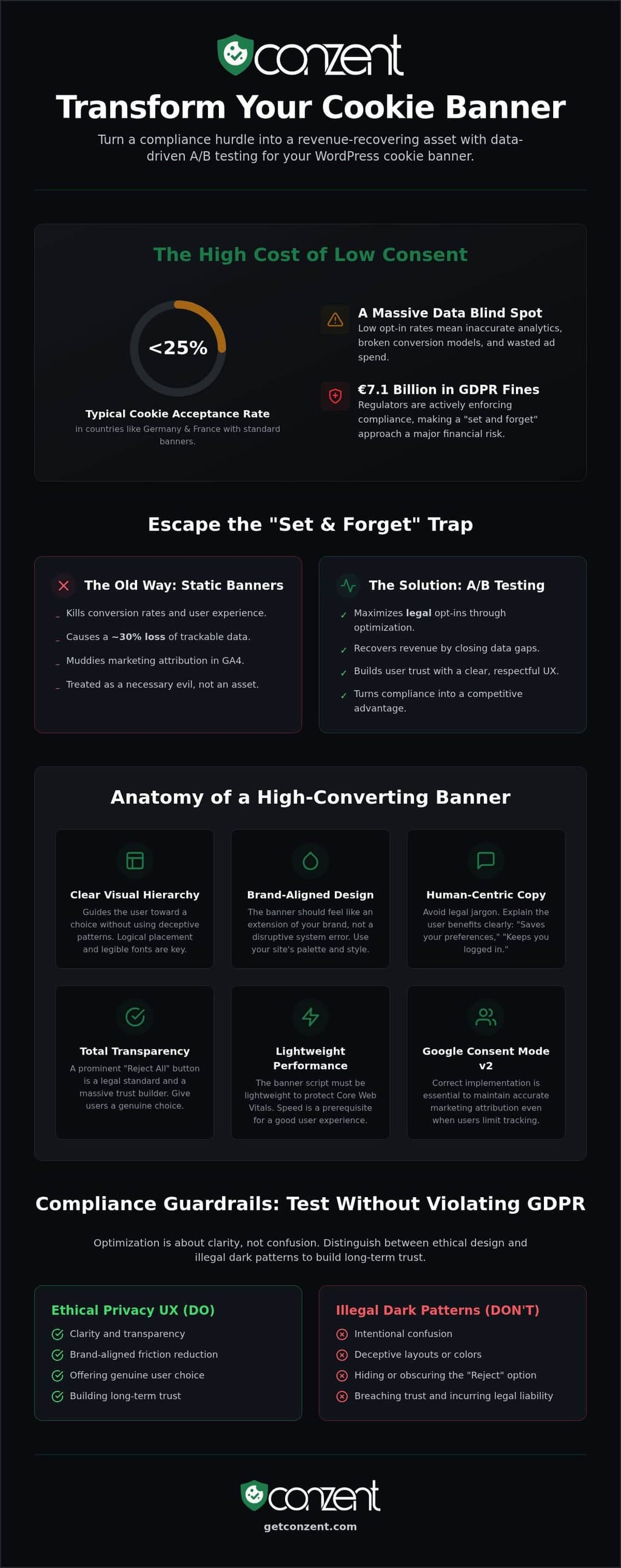
Fewer than 25% of users in Germany and France accept cookies when they encounter a standard, compliant banner. That isn't just a technical gap; it's a massive blind spot in your marketing data. Most site owners see their wordpress cookie consent plugin as a necessary evil that kills conversion rates and muddies attribution. You're likely tired of seeing your data vanish while worrying about the €7.1 billion in cumulative GDPR fines already issued by regulators.
We believe compliance shouldn't be a hurdle. It should be a standard that builds trust and protects digital rights. This guide will show you how to transform your banner from a compliance checkbox into a revenue-recovering asset. You don't have to choose between legal safety and marketing performance. We'll explore how data-driven A/B testing can lift your opt-in rates while maintaining total transparency and avoiding illegal dark patterns.
We're going to break down the mechanics of Google Consent Mode v2 integration and show you how to design a professional banner that matches your brand. You'll see exactly how to use revenue impact analytics to prove that ethical privacy is actually good for your bottom line.
Key Takeaways
- Use A/B testing to identify the specific banner designs and copy that maximize legal opt-ins for your wordpress cookie consent plugin.
- Distinguish between brand-aligned friction reduction and illegal dark patterns to ensure your optimization remains fully GDPR compliant.
- Implement Google Consent Mode v2 correctly to maintain accurate marketing attribution even when users choose limited tracking.
- Evaluate the trade-offs between Managed Cloud platforms for agency efficiency and Self-Hosted Infrastructure for total data sovereignty.
Why Your WordPress Cookie Consent Plugin Needs A/B Testing
Most site owners treat their wordpress cookie consent plugin as a static legal requirement. They install it, check a few boxes, and never look at it again. This "set and forget" mentality is expensive. A/B testing for consent banners is the systematic comparison of layout, color, and copy to maximize legal opt-ins. It's the difference between a user who ignores your site and a user who trusts your brand. Compliance is not a finish line; it's a baseline for performance.
In 2026, marketing depends on high consent rates. Google Consent Mode v2 requires explicit signals to power your analytics. Without them, you lose visibility. Generic "Accept/Reject" banners often result in a 30% loss of trackable data. This happens because the banner feels like an interruption rather than an invitation. Every HTTP cookie blocked without consideration represents a missed opportunity to understand your customer's journey. Optimization isn't about trickery. It's about clarity.
The Link Between Consent Rates and Ad Revenue
Low consent rates create massive "data gaps" in Google Analytics 4. When users opt out, your conversion modeling becomes less accurate. You're left guessing which ads actually drove sales. For WordPress e-commerce sites, "consent fatigue" is a silent revenue killer. If your banner is intrusive or confusing, users bounce before even seeing your products. High opt-in rates aren't just about compliance; they're about maintaining the integrity of your ad spend. Accurate data is a public good for your business growth.
Beyond the "Set and Forget" Mentality
A one-size-fits-all banner fails because global audiences have different expectations. A minimalist footer bar might work for a niche blog, while a center modal overlay could be more effective for a high-intent SaaS landing page. Testing these layouts is essential to find what resonates with your specific visitors. You can track exactly how design changes impact your bottom line through Revenue Impact Analytics.
We're seeing a clear shift from "dark patterns" to "Privacy UX" as a competitive advantage. Manipulating users into clicking "Accept" is a legal liability and a breach of trust. Designing a clear, brand-aligned experience that respects their choice is the new standard. It builds long-term loyalty. It recovers lost revenue. By choosing a sophisticated wordpress cookie consent plugin and testing your approach, you turn a legal hurdle into a high-performing asset.
The Anatomy of a High-Converting WordPress Cookie Banner
A high-converting banner is not a trap. It is a clear interface that respects user agency while maintaining brand integrity. To build an effective wordpress cookie consent plugin implementation, you must master visual hierarchy. This means guiding the user toward a choice without using deceptive patterns. Contrast and color should align with your site’s palette. A banner that looks like a system error invites rejection. A banner that feels like an extension of your brand invites engagement. Use logical placement and typography that is legible on all devices to ensure the user understands their options immediately.
Transparency is your strongest asset. Including a clearly visible "Reject All" button is now a legal standard; it's also a trust builder. Users are more likely to consent when they feel they have a genuine choice. There are significant ethical considerations in A/B testing these elements. You should optimize for clarity, not for confusion. Performance is the final pillar. Your banner script must be lightweight to protect your Core Web Vitals. If the banner delays your Largest Contentful Paint, you lose the user before they even see the choice. Speed is a prerequisite for trust.
Copywriting for Compliance and Conversion
Stop using legal jargon. Replace "functional optimization" with "saving your preferences." Human-centric language creates a value exchange. Explain how cookies actually help the user, such as keeping them logged in or remembering their shopping cart. Staccato fragments of text can highlight these benefits: Faster loading. Personalized content. Secure login. For deeper insights into this approach, explore our guide on Privacy UX Design Patterns. Clear communication is the shortest path to consent.
Technical Stability in the WordPress Ecosystem
WordPress presents unique challenges for consent management. Your banner must load before any third-party tracking scripts, or you risk non-compliance from the first second of a page view. It also needs to play well with caching and minification tools. A broken banner is a legal liability. We designed our solution to integrate directly with the WordPress Plugin architecture. This ensures seamless deployment without technical conflicts or performance bottlenecks. If you're managing multiple sites and need to scale these optimizations, you can evaluate our different management options to see which fits your workflow.
5 Real-World Cookie Consent A/B Test Examples
Most site owners accept the default settings of their wordpress cookie consent plugin. They assume the factory design is optimal. It rarely is. Optimization is a duty to your data integrity. Testing allows you to move beyond assumptions and use evidence to drive consent. Here are five practical A/B tests that reveal how small changes impact user behavior.
- Example 1: Minimalist Footer Bar vs. Center Modal Overlay. A footer bar is less intrusive but easy to ignore. A center modal demands a decision. Tests often show higher engagement with modals, though they may increase initial bounce rates if not designed well.
- Example 2: "Standard Legal" vs. "Brand-First" messaging. Contrast cold legal definitions with a human voice. "We use cookies for analytics" vs. "Help us build a faster experience for you." A brand-first approach often establishes a stronger value exchange.
- Example 3: Three-Button Layout vs. Two-Button Layout. Compare "Accept/Reject/Manage" against a simple "Accept/Reject." While three buttons offer more control, they can cause decision paralysis. Two buttons are direct and efficient.
- Example 4: High-Contrast "Accept" Button vs. Neutral Tones. Guide the user's eye ethically. A primary brand color for "Accept" and a neutral outline for "Reject" can reduce friction without being deceptive.
- Example 5: Immediate Load vs. 3-Second Delayed Trigger. Does the banner need to appear the millisecond a page loads? Delaying the trigger can sometimes reduce "shock" bounces, but it requires careful technical timing to ensure no tracking occurs before the choice.
Layout and Placement Impact
Placement determines visibility. Bottom-left placements often suffer from "banner blindness" because users associate that corner with chat widgets or social icons. Conversely, full-screen "walls" ensure a choice is made but can feel aggressive. You must find the balance between being noticed and being annoying. We recommend using A/B testing features to find the specific layout that resonates with your unique WordPress audience.
Messaging and Tone Analysis
Micro-copy is where trust is won or lost. In many tests, the phrase "Help us improve" outperforms "We use cookies" because it focuses on the benefit to the community rather than the technology of the banner. The language on your "Manage Preferences" screen is equally critical. It should be a place of clarity, not a maze of legal jargon. If you find your current design is driving users away, read our guide on how to reduce cookie banner bounce rate. Transparency is the most effective conversion tool you have.
Compliance Guardrails: Testing Without Violating GDPR
A common myth suggests that A/B testing your consent banner is inherently illegal. This is false. Optimization is a legitimate pursuit, provided your methodology respects the user's rights from the first byte. When you configure a wordpress cookie consent plugin for testing, you aren't just comparing colors. You are refining the way you communicate digital rights. Compliance is the foundation of this process, not an obstacle to it. Ethical testing is a necessary standard for any modern business.
The "Strictly Necessary" debate often centers on the cookie used to track the test variant itself. A cookie that merely remembers which version of a banner a user saw is generally considered exempt. It is a functional requirement for the consent mechanism to work. However, this is not a license for broad data collection. Data minimization is the rule here. You should only track the specific metrics needed to determine a winner, such as click-through rates on "Accept" versus "Reject" buttons. Do not use this as a backdoor for marketing profiling.
Avoiding dark patterns is a moral and legal obligation. Your "Reject" option must be as easy to find and click as your "Accept" option. Contrastive structures help clarify this: testing for clarity is acceptable; testing for confusion is not. If your optimization relies on making the "Reject" button invisible or buried in a sub-menu, you have failed the compliance test. True optimization improves the user experience without compromising their autonomy. During these tests, you must accurately map signals to Google Consent Mode v2 to ensure your analytics remain honest.
Danish and EU Regulatory Perspectives
The Danish Data Protection Authority, Datatilsynet, has been clear about banner design prominence. They emphasize that users should not be "nudged" through visual trickery. Transparency is the gold standard. You must disclose that you are using a Consent Management Platform (CMP) to handle these choices. Equal prominence for all options is not just a suggestion in 2026. It is a requirement for valid consent. A principled approach to design builds the trust that generic, manipulative banners destroy.
Debugging Your Test Implementation
Technical precision is required to avoid data corruption. You must ensure that ad_storage and analytics_storage signals are passed correctly for every variant in your test. A common error is double-counting visitors who see different banner versions, which ruins your statistical significance. You also need to validate IAB TCF v2.3 strings across all variants to maintain compatibility with the advertising ecosystem. If you are ready to implement these high-standard guardrails on your own site, you can view our platform options to find the right fit for your technical needs.
Implementing Conzent on WordPress: Managed vs. Self-Hosted
Choosing a wordpress cookie consent plugin involves more than just selecting a design. You must decide where your consent data lives and who manages the infrastructure. This choice defines your technical sovereignty and your operational overhead. We offer two distinct paths to ensure that every site owner, regardless of their resources, can meet the highest standards of digital ethics. Infrastructure is not a luxury; it is a necessity for a transparent web.
Our Managed Cloud Consent Platform is the fast-track for agencies and e-commerce sites. It removes the burden of maintenance. We handle the updates, the security patches, and the server performance. This allows you to focus on your core business while we ensure your compliance remains airtight. For those who require total control, our Self-Hosted Open Consent Infrastructure (OCI) provides a source-available alternative. This is the choice for security-conscious users who want to host their own consent data and invitation logic. You own the stack. You own the data. You own the trust.
Performance is non-negotiable. A slow banner kills conversions before the user even sees your content. We utilize a global CDN to deliver your banner in sub-100ms load times. This speed protects your Core Web Vitals and ensures a seamless user journey. Once active, our built-in Revenue Impact Analytics show you the tangible results of your optimization. You don't have to guess if your A/B tests are working. You can see the exact amount of trackable revenue you've recovered through better opt-in rates.
The WordPress Integration Workflow
Getting started is a matter of minutes, not hours. You can choose between a one-click script deployment or a manual hook integration if you prefer to keep your codebase lean. The Conzent WordPress Plugin is designed to configure Google Consent Mode v2 (GCM v2) automatically. It maps your user choices to the correct storage signals without requiring custom development. You can launch your first A/B test in under 10 minutes. Identify a problem. Deploy a variant. Measure the impact. It's that simple.
Scalability and Pricing
We believe in an egalitarian approach to privacy. Our model includes sponsorships that help lower compliance costs for the entire community. This makes high-level technical efficiency attainable for everyone. Partnering with a Danish-based entity offers significant advantages for EU businesses. We operate under a GDPR-first mindset because it's our home territory, not just a foreign regulation we try to follow. Our infrastructure is built on these principles from the ground up. If you're ready to transform your banner into a performance asset, you can check Conzent pricing to find the tier that matches your scale.
Turn Your Consent Strategy Into a Competitive Advantage
Your wordpress cookie consent plugin should do more than just block scripts. It should be a tool for clarity and growth. We've explored how systematic A/B testing and principled design can bridge the gap between legal safety and marketing performance. By moving away from manipulative patterns and toward a transparent value exchange, you protect your users and your attribution data simultaneously.
The era of "set and forget" compliance is over. Whether you choose our Managed Cloud for agency efficiency or our source-available infrastructure for total control, the goal remains the same: building trust through technical excellence. Our IAB TCF v2.3 and GCM v2 certified platform gives you the legal foundation. Our built-in Revenue Impact Analytics give you the practical proof that ethical privacy works.
It's time to stop guessing and start measuring. You can start optimizing your WordPress consent rates with Conzent today. Secure your data, respect your users, and recover the revenue you've been losing to consent fatigue.
Frequently Asked Questions
Do I need consent to run an A/B test on my WordPress cookie banner?
You don't need prior consent to drop a strictly necessary cookie that remembers which test variant a user saw. This is a functional requirement for the banner to operate. However, the purpose of the test is to determine when you can legally drop other cookies. Ensure your wordpress cookie consent plugin only tracks the minimum data required to measure the conversion rate of the banner itself.
How long should a cookie consent A/B test run for statistical significance?
Most tests require a duration of two to four weeks to reach statistical significance. This timeline accounts for fluctuations in weekly traffic patterns and ensures you have a diverse sample size. If your site has lower traffic, you might need to extend the test period. Rushing a test leads to inaccurate data and poor long-term design choices.
What is the average opt-in rate for a GDPR-compliant banner in 2026?
In 2026, the average cookie consent rate in the European Union sits between 55% and 65%. This varies significantly by region and industry. For instance, news and media sites often see rates as low as 30%. Using a high-quality wordpress cookie consent plugin to optimize your design can help you stay at the higher end of these industry averages.
Does A/B testing my cookie banner affect my Core Web Vitals or SEO?
A/B testing only impacts your Core Web Vitals if the implementation is inefficient. Avoid scripts that cause Cumulative Layout Shift (CLS) or delay the Largest Contentful Paint (LCP). A lightweight, CDN-delivered banner ensures that your SEO remains protected. Performance is a technical standard that should never be sacrificed for the sake of a design test.
Can I A/B test the "Reject All" button visibility on WordPress?
You can test the color, size, and label of the "Reject All" button, but you cannot test its presence. Regulators require equal prominence for accept and reject options. Testing a variant that hides the reject button is a legal violation, not an optimization. Focus on making the choice clear and brand-aligned rather than trying to obscure the user's rights.
How does Google Consent Mode v2 interact with different banner variants?
Google Consent Mode v2 requires your banner to pass specific signals like ad_storage and analytics_storage based on the user's choice. Every banner variant in your test must trigger these signals identically. If Variant A sends a signal but Variant B fails to do so, your analytics data will become corrupted. Technical consistency is the foundation of any valid design experiment.
What are the most common dark patterns to avoid in WordPress plugins?
Common dark patterns include pre-ticked boxes and making the "Reject" option harder to find than the "Accept" button. Avoid using "legitimate interest" as a hidden way to track users without their knowledge. These practices are illegal and carry heavy fines. Principled design prioritizes transparency and respects the user's autonomy as a necessary standard for modern web infrastructure.
Is it better to self-host my cookie consent manager or use the cloud?
Cloud-based solutions offer global speed and zero maintenance, which is ideal for agencies and fast-growing sites. Self-hosting is better for organizations that demand total data sovereignty and want to own their infrastructure. Both paths are valid; the right choice depends on whether you prioritize operational efficiency or technical control over your internal compliance data.
Frequently Asked Questions
Do I need consent to run an A/B test on my WordPress cookie banner?
You don't need prior consent to drop a strictly necessary cookie that remembers which test variant a user saw. This is a functional requirement for the banner to operate. However, the purpose of the test is to determine when you can legally drop other cookies. Ensure your wordpress cookie consent plugin only tracks the minimum data required to measure the conversion rate of the banner itself.
How long should a cookie consent A/B test run for statistical significance?
Most tests require a duration of two to four weeks to reach statistical significance. This timeline accounts for fluctuations in weekly traffic patterns and ensures you have a diverse sample size. If your site has lower traffic, you might need to extend the test period. Rushing a test leads to inaccurate data and poor long-term design choices.
What is the average opt-in rate for a GDPR-compliant banner in 2026?
In 2026, the average cookie consent rate in the European Union sits between 55% and 65%. This varies significantly by region and industry. For instance, news and media sites often see rates as low as 30%. Using a high-quality wordpress cookie consent plugin to optimize your design can help you stay at the higher end of these industry averages.
Does A/B testing my cookie banner affect my Core Web Vitals or SEO?
A/B testing only impacts your Core Web Vitals if the implementation is inefficient. Avoid scripts that cause Cumulative Layout Shift (CLS) or delay the Largest Contentful Paint (LCP). A lightweight, CDN-delivered banner ensures that your SEO remains protected. Performance is a technical standard that should never be sacrificed for the sake of a design test.
Can I A/B test the "Reject All" button visibility on WordPress?
You can test the color, size, and label of the "Reject All" button, but you cannot test its presence. Regulators require equal prominence for accept and reject options. Testing a variant that hides the reject button is a legal violation, not an optimization. Focus on making the choice clear and brand-aligned rather than trying to obscure the user's rights.
How does Google Consent Mode v2 interact with different banner variants?
Google Consent Mode v2 requires your banner to pass specific signals like ad_storage and analytics_storage based on the user's choice. Every banner variant in your test must trigger these signals identically. If Variant A sends a signal but Variant B fails to do so, your analytics data will become corrupted. Technical consistency is the foundation of any valid design experiment.
What are the most common dark patterns to avoid in WordPress plugins?
Common dark patterns include pre-ticked boxes and making the "Reject" option harder to find than the "Accept" button. Avoid using "legitimate interest" as a hidden way to track users without their knowledge. These practices are illegal and carry heavy fines. Principled design prioritizes transparency and respects the user's autonomy as a necessary standard for modern web infrastructure.
Is it better to self-host my cookie consent manager or use the cloud?
Cloud-based solutions offer global speed and zero maintenance, which is ideal for agencies and fast-growing sites. Self-hosting is better for organizations that demand total data sovereignty and want to own their infrastructure. Both paths are valid; the right choice depends on whether you prioritize operational efficiency or technical control over your internal compliance data.