
High-Converting Cookie Banner Design: The 2026 Guide to Compliance & Revenue

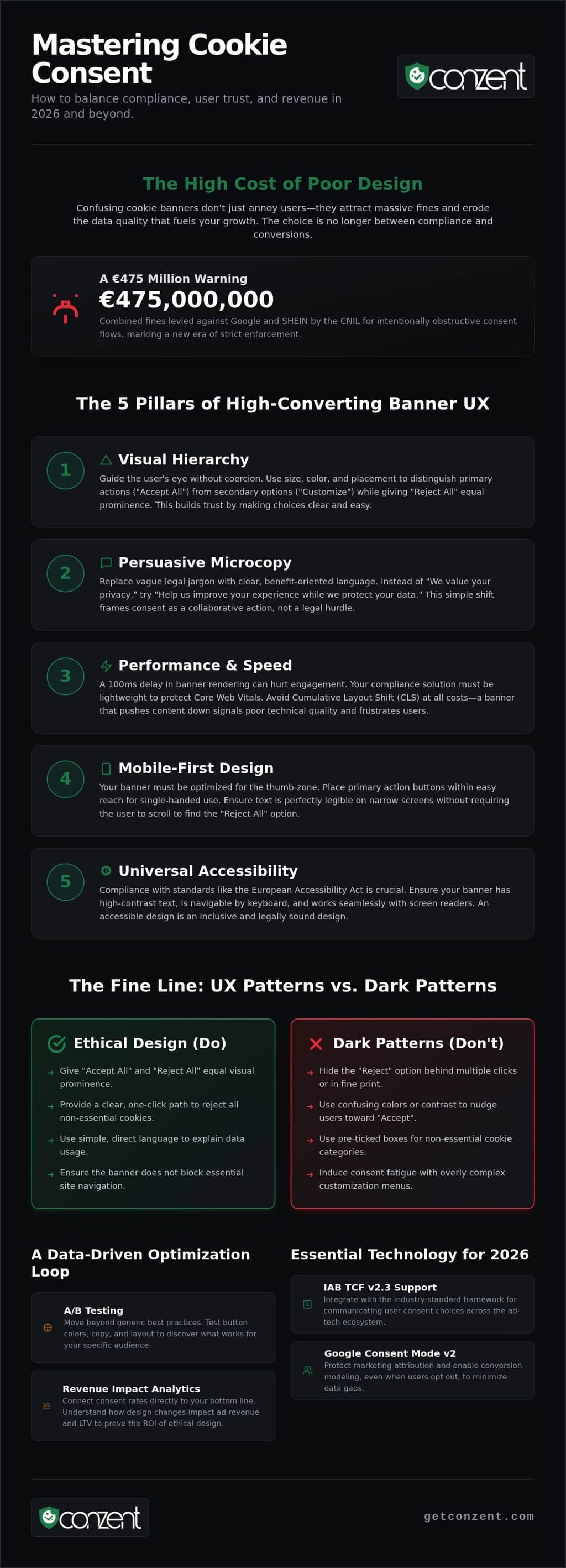
A "Reject All" button shouldn't be a revenue killer. In late 2025, the CNIL levied a combined €475 million in fines against Google and SHEIN because their consent flows were intentionally obstructive. For most brands, the fear of these penalties leads to defensive, clunky designs that drive opt-in rates into the dirt. You don't have to choose between legal safety and your balance sheet. Achieving a high-converting cookie banner design is about radical transparency, not digital trickery.
You likely feel the pressure of declining ad revenue as more users choose to opt out. It's a common struggle to balance the strict requirements of the European Accessibility Act with the need for clean, brand-aligned performance. This guide will teach you how to master the technical and aesthetic nuances of consent to maximize your opt-in rates while ensuring total compliance. We'll break down the shift to IAB TCF v2.3, the necessity of Google Consent Mode v2, and how to use revenue impact analytics to turn your compliance layer into a measurable competitive advantage.
Key Takeaways
- Privacy-first design is a competitive advantage. It builds user trust and protects your marketing attribution in an increasingly regulated digital landscape.
- Visual hierarchy and honest microcopy are the foundations of a high-converting cookie banner design. Learn to guide users without resorting to illegal coercion or deceptive patterns.
- Equal prominence is non-negotiable in 2026. Making "Reject All" as accessible as "Accept All" is the only way to avoid regulatory scrutiny and massive fines.
- Stop relying on generic best practices. Use A/B testing and revenue impact analytics to discover what actually works for your specific audience and site performance.
- High-performance infrastructure is essential for data integrity. Implement solutions that support IAB TCF v2.3 and Google Consent Mode v2 to keep your ad revenue flowing.
Beyond the 'Accept' Button: Why Cookie Banner Design Matters in 2026
In 2026, compliance isn't a legal tax. It's a bridge to your audience. For years, businesses treated consent as a hurdle to clear, often hiding it behind clunky, generic pop-ups. This strategy is failing. A high-converting cookie banner design now serves as a primary trust signal. It directly impacts your bottom line by securing the data you need for accurate marketing attribution and efficient ad spend. When you prioritize clarity, you protect your long-term customer lifetime value (LTV).
Generic banners are the leading cause of consent fatigue. When a visitor encounters a confusing, brand-detached interface, they don't just click "Reject". They often leave the site entirely. This spike in bounce rates is avoidable. To understand why this matters on a technical level, you should first grasp What is an HTTP cookie? and how it facilitates the tracking that fuels your growth. Managing these cookies with transparency turns a legal requirement into a loyalty-building moment.
The Direct Link Between Design and Data Quality
Low opt-in rates create blind marketing budgets. If 60% of your traffic refuses consent because your interface feels deceptive, you're optimizing your business based on a fraction of the truth. This data gap is why Google Consent Mode v2 has become essential for modern stacks. It allows for basic conversion modeling even when users opt out of tracking. Consent Rate Optimization (CRO) is the strategic refinement of your consent UI to maximize user agreement while maintaining absolute regulatory integrity. It's no longer an optional task; it's a core marketing KPI for 2026.
Regulatory Evolution: From GDPR to Global Standards
Regulations have moved past simple binary choices. The 2025 French regulatory crackdown, which resulted in €475 million in combined fines for tech giants like Google and SHEIN, signaled the end of "dark patterns." Regulators now demand equal prominence for "Accept All" and "Reject All" buttons. This shift has made revenue impact analytics a vital tool for proving that ethical design doesn't have to hurt your margins. Transparency is the new standard. Source-available infrastructure is replacing proprietary black boxes because it offers the auditability that modern users and regulators expect.
The 5 Pillars of High-Converting Cookie Banner UX
Effective design is a balance of psychology and technical precision. A high-converting cookie banner design doesn't hide choices; it clarifies them. When users feel in control, they're more likely to trust your brand with their data. This trust is the engine of your marketing machine. To build it, you must focus on five core pillars: visual hierarchy, microcopy, performance, mobile-first responsiveness, and universal accessibility.
Pillar 1 & 2: Hierarchy and Persuasive Microcopy
Your banner's visual hierarchy should guide the eye without using illegal coercion. This means using contrast to distinguish between primary actions, like "Accept All," and secondary ones, like "Customize Settings." According to the official ICO guidance on cookies, users shouldn't be nudged toward a specific choice through confusing design. Instead, use clear, non-legalistic language. Replace "We value your privacy" with "Help us improve your experience while we protect your data." This builds immediate rapport. You can explore how Conzent's customizable cookie banner features allow you to tweak these elements to match your brand's unique voice while staying compliant.
Pillar 3 & 4: Speed and Mobile Optimization
Performance is a conversion metric. A 100ms delay in your banner rendering can lead to a measurable drop in user engagement. If your compliance script is heavy, it drags down your Core Web Vitals. Specifically, you must avoid Cumulative Layout Shift (CLS). When a banner pops up and pushes content down, it frustrates the user and signals a lack of technical polish. In 2026, mobile-first is the only way to design. Your banner must fit the modern smartphone's thumb-zone. This means placing action buttons within easy reach of a single hand and ensuring text remains legible on narrow screen ratios without excessive scrolling.
Universal accessibility is the final pillar. Under the European Accessibility Act (EAA), banners must meet WCAG 2.2 standards. This includes maintaining a 4.5:1 color contrast ratio and ensuring full keyboard navigation for screen reader users. Designing for everyone isn't just about avoiding fines; it's about expanding your reachable audience. As you refine these pillars, it's helpful to consider how different service tiers might support your growth. You can view our transparent pricing options to find a plan that fits your infrastructure needs.
UX Patterns vs. Dark Patterns: The Fine Line of Compliance
Compliance is not the enemy of conversion. It is the foundation of it. In 2026, the European Data Protection Board (EDPB) and the FTC have drawn a hard line between persuasive design and illegal deception. Deception is a short-term hack that leads to long-term failure. Persuasion, however, relies on clarity and trust. A high-converting cookie banner design succeeds because it respects the user's agency, not because it tricks them into a specific choice.
The "Equal Prominence" rule is now the global standard for ethical interfaces. If your "Accept" button is a vibrant brand color while your "Reject" button is hidden in a footer or camouflaged against the background, you are using a dark pattern. Regulators don't just look at what buttons exist; they look at how easily a user can find them. Making "Reject All" as accessible as "Accept All" is a legal requirement that also happens to reduce user frustration and site abandonment. The cost of non-compliance has shifted. It's no longer just about the risk of fines. It's about the permanent damage to your brand reputation when users feel manipulated by your UI.
Common Deceptive Designs to Eradicate
Deceptive designs often hide behind complexity. Multi-layered customization traps, where a user must click through three different screens just to find a "Disable All" toggle, are explicitly forbidden. Pre-ticked boxes are another relic of the past; consent must be an affirmative, clear action by the user. Implied consent through scrolling is a myth that will trigger immediate regulatory scrutiny. Under IAB TCF v2.3, the "Reject All" button must be present on the first layer of the banner and must carry the same visual weight as the "Accept All" option. Anything less is considered a failure of transparency.
Ethical Persuasion: The Conzent Approach
Ethical persuasion wins by providing value. Instead of hiding your data practices, use brand-aligned colors that signal safety and professionalism. Use "just-in-time" explanations to tell users exactly why a specific cookie category matters. For example, explain how functional cookies remember their login preferences to save them time. This approach moves the conversation from "tracking" to "utility." When you treat your users like partners, they respond with higher opt-in rates. For a deeper look at how this impacts your bottom line, read our guide on the Revenue Impact of Cookie Consent: Optimization Strategies. Transparency is your most effective conversion tool.
Data-Driven Optimization: A/B Testing Your Way to Higher Opt-In Rates
Best practices are assumptions. They are not certainties. While industry standards provide a baseline, a truly high-converting cookie banner design is forged through local data. Your audience in Berlin reacts differently than your audience in San Francisco. If you rely on generic templates, you are leaving revenue on the table. Optimization is an active process of discovery. It is not a one-time setup.
Effective testing follows a methodical four-step cycle: hypothesize, deploy, measure, and refine. You might hypothesize that a center modal increases visibility but also increases bounce rates. You test this against a subtle bottom bar. You measure the results using Google Consent Mode v2 to ensure your conversion modeling remains intact even for users who opt out. Finally, you implement the winner. This cycle ensures your compliance layer evolves with your user behavior rather than becoming a static obstacle.
What to Test: High-Impact Variables
Small design shifts yield significant performance changes. Banner placement is often the most impactful variable you can manipulate. A side drawer might feel less intrusive than a center modal, potentially lowering your bounce rate while maintaining high consent. Button labeling is equally critical. Is "I Agree" more effective than "Accept All"? Or does "Allow Tracking" build more trust? You don't have to guess. Use A/B testing for cookie consent to pit these variants against each other in real-time environments. Contrast these results against your baseline to see which combinations drive the most affirmative action.
Analyzing the Results: The Revenue Impact Framework
Acceptance rates are a vanity metric if they don't correlate with profit. A banner that achieves 95% consent but drives half your users away is a liability. You must look at the intersection of consent and ad spend efficiency. Identifying "Revenue Leaks" means finding exactly where users drop off in the consent flow and understanding how that loss affects your remarketing lists and attribution accuracy. By using Conzent Revenue Impact Analytics, you can see the direct line between a UI change and your actual ROI. Stop treating compliance as a cost center. It is a performance lever. To start optimizing your infrastructure today and secure your marketing data, view our platform pricing and features.
Implementing High-Performance Banners with Conzent's Managed Infrastructure
Infrastructure is the foundation of user experience. A high-converting cookie banner design depends on the speed of the underlying code. If your compliance script delays your page load, your conversion rates will suffer. You must choose an infrastructure that scales with your traffic without compromising your site's performance. Our platform is built for speed and technical clarity. It is not just a widget; it is a revenue-first compliance engine.
Conzent offers a choice between a Managed Cloud Consent Platform and Self-Hosted Open Consent Infrastructure. Managed cloud is built for scale. It handles the heavy lifting of automated updates and global delivery. Self-hosting provides total data sovereignty. Both paths ensure you meet the latest standards, including IAB TCF v2.3 and Google Consent Mode v2. This infrastructure reduces your compliance overhead by centralizing your cloud-based analytics and automating the most complex technical requirements.
Technical Efficiency and Core Web Vitals
SEO in 2026 is inseparable from page speed. Conzent's lightweight script is essential for maintaining high search rankings. Unlike legacy platforms that load heavy, bloated libraries, our infrastructure is streamlined for efficiency. Transparency is at the core of our code. Our source-available Open Consent Infrastructure (OCI) allows your technical team to audit exactly how data is handled. This level of openness builds the trust that proprietary "black box" solutions cannot match. For a deeper dive into the mechanics, see our Google Consent Mode v2 Implementation: The 2026 Technical Guide. Technical excellence should be a standard, not a premium feature.
Getting Started with Conzent
Moving away from legacy CMPs is a necessary step for revenue-focused growth. Many older platforms focus on compliance as a legal shield, ignoring the data loss that occurs when banners are clunky or slow. Conzent shifts this focus. Our platform is designed to help you achieve a high-converting cookie banner design that protects your ad spend. We follow a Danish-led mission to make open consent infrastructure accessible to all businesses, regardless of their size or resources.
Our mission-driven pricing ensures that you don't have to overpay for ethical data practices. You can even leverage sponsorships to lower your SaaS subscription fees. This egalitarian approach makes high-level compliance attainable for everyone. It is time to stop viewing consent as a hurdle and start using it as a performance lever. Explore Conzent's pricing and start optimizing your revenue today. We are the voice of a knowledgeable peer who invites scrutiny and collaboration. Join us in building a more transparent web.
Turning Privacy into a Performance Lever
The era of treating consent as a legal burden is over. In 2026, a high-converting cookie banner design serves as your most important trust signal and a vital tool for data integrity. By prioritizing radical transparency over deceptive dark patterns, you don't just avoid fines; you build a stronger rapport with your audience. This trust translates directly into cleaner marketing attribution and more efficient ad spend. It's not just about staying compliant. It's about outperforming competitors who still rely on clunky, obstructive interfaces.
Your infrastructure must be as fast as your design is clear. Leveraging high-performance tools allows you to maintain Core Web Vitals while securing the consent signals your business needs to thrive. Conzent offers the mission-driven infrastructure required for this transition. Our platform is IAB TCF v2.3 Certified and Google Consent Mode v2 Ready, with Revenue Impact Analytics included to help you track your ROI in real-time. Stop leaving revenue to chance and start treating compliance as a core marketing KPI. Scale your privacy strategy with Conzent's Managed Cloud Platform and join the movement toward a more transparent, efficient, and ethical web. You've the tools to lead; now it's time to deploy them.
Frequently Asked Questions
Is it legal to A/B test my cookie banner design?
Yes, A/B testing is legal as long as every variant remains compliant with regional laws like GDPR or CCPA. You can test button colors, microcopy, or placement to achieve a high-converting cookie banner design. However, you cannot test "dark patterns" against compliant designs to see which tricks users better. Testing should focus on clarity and user experience, not coercion. It's about optimizing for honesty, not deception.
What is the average cookie banner acceptance rate in 2026?
While rates vary by industry, many sites report opt-in rates between 60% and 80% when using ethical design patterns. High-traffic sites using IAB TCF v2.3 often see slightly lower rates if their "Reject All" button is highly prominent, but they recover data through modeling. Your specific rate depends on your audience's trust and the technical speed of your infrastructure. Trust is the primary driver of these metrics.
Does a 'Reject All' button decrease ad revenue?
It doesn't necessarily decrease revenue if you implement Google Consent Mode v2 correctly. While direct tracking stops for users who reject cookies, Consent Mode uses conversion modeling to recover a significant portion of ad-click-to-conversion journeys. Transparency builds long-term LTV. This often outweighs the short-term loss of granular tracking data from users who value their privacy. Clear choices lead to better data quality.
How do I make my cookie banner WCAG accessible?
You must ensure a minimum color contrast ratio of 4.5:1 for all text and UI elements to meet WCAG 2.2 standards. The banner must be fully operable via keyboard navigation and compatible with screen readers. Accessible design is now a legal requirement under the European Accessibility Act. This makes inclusivity a core component of any high-converting cookie banner design. Compliance is a standard for everyone, not a luxury.
Can I use my brand's custom fonts in a Conzent cookie banner?
Yes, our platform supports custom CSS and font-face declarations to ensure your banner feels like a native part of your site. Maintaining visual consistency reduces user suspicion. By aligning the banner's typography with your brand identity, you create a seamless transition. This encourages users to engage with your privacy choices rather than bouncing. A brand-aligned banner is a trust-building tool, not a generic afterthought.
What are the most common dark patterns to avoid in cookie consent?
Avoid unequal button prominence, such as making the "Accept" button larger or brighter than the "Reject" button. Other prohibited patterns include pre-ticked boxes, hidden "Customize" links, and "cookie walls" that block content until a user agrees. Regulators now specifically target these deceptive designs. Recent fines from late 2025 prove that trickery is a liability. Focus on radical transparency to keep your brand safe.
How does banner design affect Google Consent Mode v2 performance?
Design determines the volume of "granted" signals sent to Google's servers, which feeds the machine learning models used for attribution. A clear, trustworthy design increases the number of users who provide explicit consent. When more users opt in, Google's models have a larger dataset to work with. This results in more accurate conversion reporting and better ad spend optimization. Better design equals better data for your marketing engine.
Why is my cookie banner causing a high bounce rate?
High bounce rates often stem from intrusive placement or slow rendering speeds that interrupt the user's journey. If your banner covers the entire screen or causes significant layout shifts, users will leave before the page loads. Lightweight scripts and non-obstructive placements, like bottom bars, help keep users on your site. Speed is a conversion metric. Respect the user's time and they'll respect your data requests.