
IAB TCF vs Google Consent Mode: Understanding the 2026 Compliance Stack

If you think you have to choose between IAB TCF and Google Consent Mode, you're looking at the problem through the wrong lens. These aren't rival products fighting for your website real estate. They're complementary layers of a unified privacy infrastructure. The industry debate of IAB TCF vs Google Consent Mode is actually about building a technical standard that respects digital rights while protecting your bottom line. Privacy isn't a premium luxury or a legal hurdle. It's the baseline for doing business in 2026.
It's natural to feel overwhelmed by the technical weight of this stack. The acronyms are piling up, and the fear of a misconfigured tag tanking your ad revenue is real. GDPR enforcement is accelerating: our own audit of real consent banners found a third were still setting cookies before visitors gave consent. You need tracking accuracy in Google Analytics, but you can't afford the risk of non-compliance. We're here to demystify the complexity and restore your confidence.
This guide explains the critical differences and the powerful synergies between IAB TCF v2.3 and Google Consent Mode v2. You'll gain a clear compliance roadmap to restore your data precision. We'll show you how to ensure seamless ad delivery to IAB vendors while maintaining the transparency your community deserves.
Key Takeaways
- Understand why IAB TCF vs Google Consent Mode is not a choice between two rivals but a layered strategy for a robust 2026 compliance stack.
- Learn how to map TCF v2.3 purposes to Google-specific consent types to maintain tracking accuracy and protect your ad revenue.
- Identify the functional differences between a broad transparency framework and a technical API built for the Google ecosystem.
- Follow a practical checklist to audit your vendors and configure your CMP for both standards without technical errors.
- Explore how open source infrastructure provides a transparent and ethical alternative to traditional black box consent management platforms.
What are IAB TCF and Google Consent Mode?
To understand the current landscape of IAB TCF vs Google Consent Mode, you must first recognize their different origins. They solve the same core problem from opposite directions. One is a legal consensus; the other is a technical implementation. In 2026, compliance isn't about choosing one or the other. It's about layering them to create a resilient data strategy that respects user rights while maintaining revenue.
The IAB Transparency and Consent Framework (TCF)
The Interactive Advertising Bureau Europe designed the TCF to bring order to a fragmented digital industry. It's a cross-industry standard that creates a common language for publishers, advertisers, and tech vendors. v2.3 is the current standard. Its primary tool is the Global Vendor List (GVL), which identifies thousands of ad-tech providers. When a user makes a choice on your site, the framework generates a TC String. This is a compact, encoded record of those choices. As of February 28, 2026, every TC String must include the "disclosedVendors" segment to remain valid. You can learn more about how we handle these technical requirements on our IAB TCF compliance page.
Google Consent Mode (GCM)
Google Consent Mode v2 is a technical specification rather than a broad legal framework. It's an API that communicates user consent states directly to Google tags, such as Tag Manager and Analytics. It focuses on specific consent types like ad_storage and analytics_storage. The real power of GCM lies in conversion modeling. When users deny consent, GCM allows Google to fill data gaps using non-identifying signals. This helps you recover lost insights without compromising privacy. For a deeper look at the technical setup, visit our GCM v2 integration guide.
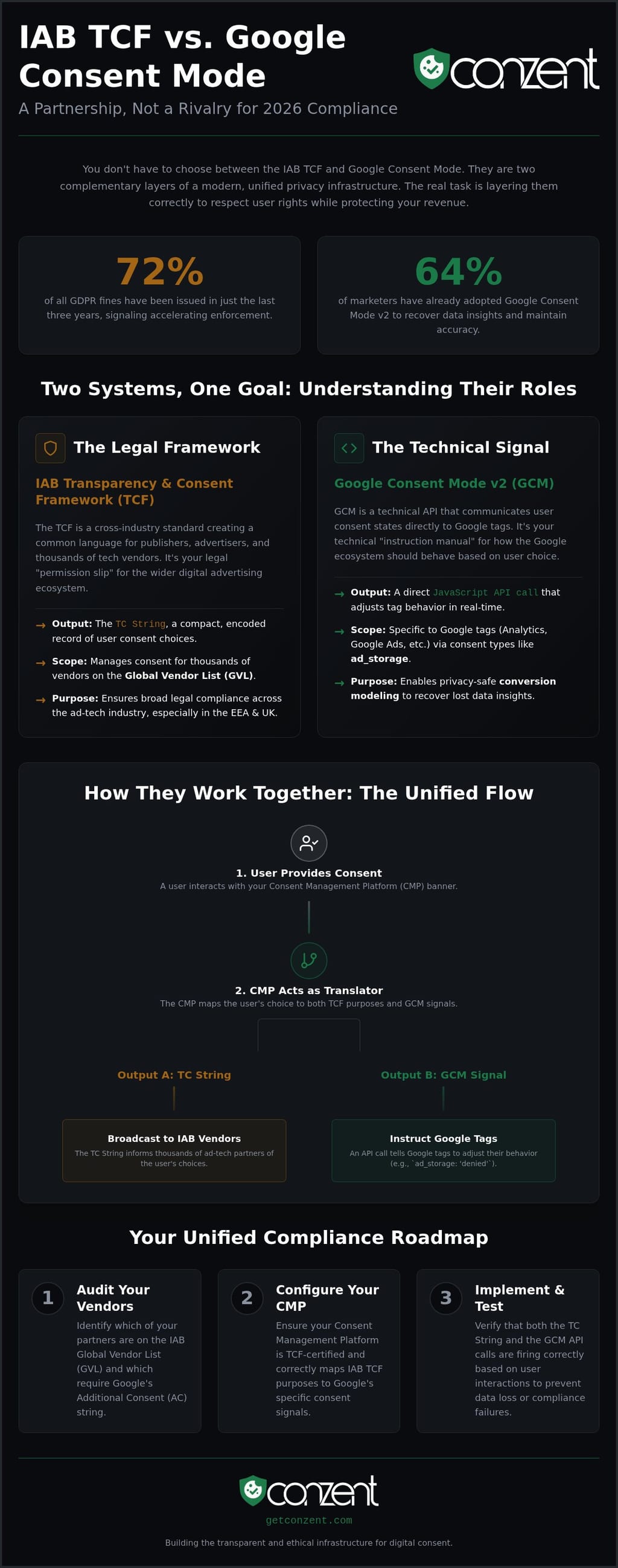
The contrast is clear. TCF is your legal "permission slip" for thousands of vendors. GCM is your technical "instruction manual" for the Google ecosystem. TCF uses encoded strings to signal consent across the web; GCM uses JavaScript API calls to adjust tag behavior. In the 2026 compliance stack, you don't pick a side. You use TCF to manage the broad legal requirements of the EEA and UK, and you use GCM to ensure your Google marketing tools function accurately within those rules. This unified approach is the only way to stay ahead of accelerating GDPR enforcement while protecting your tracking accuracy.
Complementary Layers: How They Work Together
The relationship between these two systems is one of technical translation. When a user interacts with your consent banner, they aren't just clicking a button. They're triggering a sequence of signals that must travel through your entire ad-tech ecosystem. Your Consent Management Platform (CMP) acts as the central translator in this exchange. It takes the specific legal purposes defined by the IAB and maps them to the technical categories Google understands. This synchronization is vital. Without it, you risk sending conflicting instructions that lead to data loss or technical failures.
For publishers in the EEA and UK, this integrated approach isn't optional. Google requires a TCF-certified CMP for anyone serving ads in these regions. This mandate ensures that every player in the ad-tech chain has a clear, verifiable signal of user intent. It's a standard designed to protect the industry from the fallout of frameworks that were previously found to breach GDPR. By using both, you create a safety net that covers broad legal requirements while satisfying specific technical needs. Privacy isn't a barrier to your growth; it's the foundation of modern digital infrastructure.
The TC String and the GCM API
The TC String is the heavy lifter for the IAB framework. It carries user preferences to thousands of vendors simultaneously in an encoded format. However, Google Consent Mode requires a more direct API call to adjust how its tags behave in real time. A modern CMP uses the TC String to inform the default states of the GCM API. If a user rejects marketing cookies, the CMP tells GCM to set "ad_storage" to "denied" automatically. This ensures the two systems never provide conflicting instructions.
There's a common point of confusion regarding vendors who aren't on the IAB's Global Vendor List. This is where Google Additional Consent Mode, powered by the "Additional Consent (AC) String," becomes essential. The AC String acts as a bridge for Google Ad Tech Providers who aren't part of the GVL. This ensures no vendor is left in the dark. If you're looking for a setup that handles these nuances with total transparency, you can view our transparent pricing for managed or self-hosted options.
Impact on Data Quality and Ad Delivery
The synergy of IAB TCF vs Google Consent Mode directly impacts your bottom line. TCF compliance is often the key that unlocks premium ad inventory. Many high-value advertisers won't bid on your space unless they see a valid TC String. At the same time, Google Consent Mode uses conversion modeling to recover insights that would otherwise be lost when users opt out of tracking. Instead of seeing a total blackout of performance data, you get a privacy-safe view of how your campaigns are performing.
The goal is a seamless flow where both layers work in tandem. This setup ensures your ad-tech ecosystem receives the signals it needs while your analytics stay as accurate as possible. To see how this works in practice, you can learn about our IAB TCF v2.3 Integration and how it streamlines this technical hand-off.
Key Differences: Framework vs. Technical Specification
The core of the IAB TCF vs Google Consent Mode debate lies in governance and intent. TCF is an industry-led framework. It acts as a collective legal shield for thousands of vendors. Google Consent Mode is a corporate-led technical specification. It is Google's own response to a new way to track you on the web. One provides a standardized language for the entire ad-tech market. The other optimizes performance within a specific, massive ecosystem.
Mechanism matters here. TCF relies on the TC String. This is a compact, encoded record of user choices that travels across the bidding chain. GCM uses JavaScript API calls. These signals tell Google tags exactly how to behave based on the user's consent state. TCF is often a hard mandate. If you want to serve ads through major networks in the EEA, you don't have a choice. GCM is technically optional but practically essential for performance. Without it, your conversion data becomes a black hole.
Legal Scope and Regulatory Alignment
TCF is built for strict alignment with the GDPR and the ePrivacy Directive. It's about the user's right to say no to thousands of specific vendors. GCM is about meeting Google's EU User Consent Policy. The choice between Basic and Advanced GCM is a critical fork in the road. Basic mode blocks tags entirely until consent is granted. Advanced mode sends anonymous pings for modeling even without consent. This choice defines your legal risk profile. It's the difference between total data silence and privacy-safe estimation.
Technical Implementation Barriers
Managing the Global Vendor List (GVL) manually is a fool's errand. There are thousands of entries to track. TCF v2.3 requires a Google-certified CMP to function. You can't just wing it with a custom script anymore. Governance matters. While the IAB serves as a community-driven arbiter, Google operates with the singular focus of its own infrastructure. Managing these technical hurdles requires a methodical approach, as detailed in our Google Consent Mode v2 Implementation Guide.
Transparency is the only way forward. TCF provides the framework for that transparency across the industry. GCM provides the technical bridge to keep your marketing tools functional. They aren't competing for the same space. They're solving different parts of the same puzzle. Using them together is the only way to satisfy both the law and your performance goals.
Implementation Checklist: Avoiding Conflict in 2026
Setting up a reliable IAB TCF vs Google Consent Mode stack requires more than just installing a script. It's about technical precision and ensuring your legal and technical layers communicate without friction. First, audit your vendor list. If you serve ads in the EEA or UK, you likely need the TCF layer to communicate with the thousands of ad-tech providers on the Global Vendor List. Next, configure your CMP to support both TCF v2.3 and GCM v2 simultaneously. This ensures your signals are in sync across the entire ecosystem.
You must set default consent states before any tags fire. This is where the choice between Basic and Advanced implementation happens. Basic mode keeps tags dormant until the user clicks "Accept". Advanced mode allows for conversion modeling by sending cookieless pings. Once configured, test your signal propagation. Use Google Tag Assistant to verify GCM signals and the TCF API to ensure your TC strings are being read correctly by third-party vendors. Finally, monitor your Google Ads and Analytics accounts for "Consent Mode" errors. These alerts are often the first sign of a misconfiguration that could lead to data loss.
Unified Signal Configuration
Your cookie banner must be the single source of truth. When a user clicks "Accept", that choice must map to both the TCF purposes and the GCM consent types like ad_storage. To verify a TC string is valid in 2026, you must ensure it includes the "disclosedVendors" segment as required by the v2.3 update. If signals don't align, you'll see discrepancies in your reports. You can Fix Google Consent Mode Errors by ensuring your CMP is certified and correctly integrated with your tag manager.
Optimizing for Ad Revenue
Compliance shouldn't come at the cost of your business. Use A/B testing to find the banner design that delivers the highest opt-in rates without being deceptive. High opt-in rates directly correlate with better data quality and higher eCPMs. By measuring the impact of TCF on your ad revenue, you can make data-driven decisions about your vendor list. For a deeper look at these metrics, read our guide on the Revenue Impact of Cookie Consent.
We believe technical efficiency should be accessible to everyone. Our platform is built to handle these complex translations for you, so you can focus on growth instead of troubleshooting. To get started with a compliant, high-performance stack, explore our managed and self-hosted pricing options.
Scaling Compliance with Conzent's Managed Infrastructure
Compliance shouldn't be a "black box" tax on your digital operations. Most Consent Management Platforms (CMPs) force you into proprietary ecosystems that hide their logic and lock your data behind a paywall. Conzent is the egalitarian choice for modern compliance. We believe that technical efficiency and digital rights should be accessible to everyone, regardless of their resource level. By providing a unified stack for IAB TCF vs Google Consent Mode, we remove the friction of manual configuration and let you focus on your mission.
Our infrastructure is designed for flexibility. You can choose between our Managed Cloud service for immediate, hands-off deployment or our self-hosted option for total environmental control. Both paths offer integrated support for IAB TCF v2.3 and GCM v2 out of the box. Our mission is to lower the barrier to entry for ethical tracking. We achieve this through a unique model where corporate sponsorships help drive down costs for the entire community. Privacy is a standard, not a premium luxury.
Source-Available Compliance
For DevOps-heavy teams, data sovereignty is non-negotiable. Our Open Consent Infrastructure (OCI) allows you to host the CMP on your own servers. This approach avoids vendor lock-in and ensures that your user's consent data never leaves your controlled environment. It's a developer-first solution featuring lightweight scripts and an API-driven architecture. You get the transparency of open-source standards with the reliability of a professional compliance tool.
Managed Performance and Analytics
Standard SaaS providers often leave you scrambling when frameworks change. With our Managed Cloud service, you receive automatic updates as IAB and Google standards evolve. You don't have to worry about the next TCF versioning update or GCM technical shift. We handle the translation layer so your ad delivery remains seamless. Beyond basic compliance, we help you understand the "why" behind your data. Our Revenue Impact Analytics allow you to visualize how your consent choices affect your bottom line in real time.
Stop guessing about your compliance status and start building on a transparent foundation. Whether you need the ease of the cloud or the control of a self-hosted stack, we provide the tools to protect your revenue and your users. To find the right fit for your organization, view pricing and managed cloud options today.
Building a Resilient Privacy Standard
The 2026 landscape of IAB TCF vs Google Consent Mode is defined by cohesion, not conflict. You've seen how these layers work together to bridge the gap between legal frameworks and technical data modeling. One provides the broad consensus of the advertising industry. The other ensures your Google tags continue to drive performance through conversion modeling. Ignoring either layer is no longer a viable strategy for publishers or advertisers who value their ad revenue.
Choosing the right infrastructure is the final step in securing your data sovereignty. Whether you need the control of source-available open infrastructure or the simplicity of enterprise cloud hosting, your stack must be ready for the current IAB TCF v2.3 and GCM v2 standards. Compliance isn't a hurdle. It's an opportunity to build trust with your community through transparency and speed.
For a closer look at how badly this goes wrong in practice, see our audit of real consent banners and why free tools can't fix the gap.
Start scaling your privacy infrastructure with Conzent and gain access to certified support that respects your resources. You have the roadmap. Now it's time to implement a solution that works for your users and your bottom line.
Frequently Asked Questions
Do I need a CMP to use Google Consent Mode v2?
Yes, effectively. While you can technically write custom code, Google requires a certified CMP to pass the necessary signals for ad personalization and measurement in the EEA and UK. Using a certified platform ensures that you avoid technical errors and revenue loss. It's the standard for maintaining data accuracy without manual scripting. We believe this level of technical efficiency should be a baseline standard for every website owner, not a premium luxury.
What happens if I use IAB TCF but not Google Consent Mode?
If you use IAB TCF vs Google Consent Mode in isolation, you create a signal gap. Your IAB vendors will receive consent signals, but Google's own tags will not understand the user's choices. This leads to broken tracking and reduced ad performance. Without GCM, Google cannot perform conversion modeling. You lose the ability to recover insights from opted-out users. This fragmentation is exactly what a unified compliance stack is designed to prevent.
Is IAB TCF v2.3 mandatory for publishers in 2026?
Yes. It's mandatory for publishers using Google's advertising services in the EEA, UK, or Switzerland. The deadline for implementation was February 28, 2026. Failure to use a certified CMP that integrates with TCF v2.3 results in restricted ad delivery. You'll see a drop in ad revenue as premium bidders require a valid TC String. This isn't just a recommendation. It's a requirement to participate in the modern ad-tech ecosystem.
Can I implement Google Consent Mode without a cookie banner?
No. Google Consent Mode is a technical API that communicates choices, but it doesn't collect them. You still need a user-facing interface, like a cookie banner, to obtain explicit consent under GDPR. GCM acts as the bridge. It tells Google's tags how to behave based on what the user selected in your banner. Thinking you can skip the banner is a legal risk that ignores the fundamental requirement for user transparency.
What is the difference between Basic and Advanced Consent Mode?
Basic mode prevents Google tags from sending any data until the user provides consent. Advanced mode allows tags to load immediately but only sends cookieless pings if consent is denied. This choice defines your legal risk profile. Advanced mode enables conversion modeling to fill data gaps. Basic mode results in a total data blackout for opted-out users. We provide the tools to test both approaches so you can make an informed, ethical decision.
How do I check if my TCF string is working correctly?
Use the Google Tag Assistant or the browser console to inspect the TCF API. Look for the tcString value in the network requests. In 2026, a valid string must include the disclosedVendors segment. If this segment is missing, ad vendors cannot process the signal. This leads to failed ad auctions and lost revenue. Monitoring this technical detail is essential for maintaining a healthy, transparent relationship with your ad-tech partners.
Does Google Consent Mode affect my Google Analytics data?
Yes. It improves data accuracy through conversion modeling. When users deny consent, GCM allows Google Analytics 4 to estimate behavior using non-identifying signals. This restores tracking accuracy that would otherwise be lost. Without this bridge, your reports show a significant undercount of traffic and conversions. It's about restoring the truth in your data while respecting the privacy choices of your community. Transparency and accuracy can coexist.
Is Conzent a certified IAB TCF 2.3 CMP?
Yes. Conzent is fully certified and provides out-of-the-box integration for IAB TCF v2.3 and Google Consent Mode v2. We offer a source-available infrastructure for both managed cloud hosting and self-hosted deployments. This ensures your compliance stack meets the 2026 requirements for transparency and efficiency. We are a community-focused advocate for digital rights. We make these complex requirements attainable for all users, regardless of their resources or technical background.