Lightweight Cookie Consent Scripts: Performance-First Compliance in 2026
Performance is not a luxury. It's a fundamental privacy feature. For too long, the web has accepted a false trade-off between legal compliance and site speed. You shouldn't have to choose between protecting your users' data and maintaining your Core Web Vitals. Heavy, opaque trackers often add up to 600ms to your Largest Contentful Paint, effectively punishing visitors for your commitment to privacy. A lightweight cookie consent script changes this dynamic by prioritizing efficiency as an ethical standard. It's time to stop letting bloated third-party code dictate your user experience.
You likely feel the frustration of managing complex requirements like Google Consent Mode v2 and the IAB TCF 2.3 deadline without slowing your site to a crawl. We agree that compliance should be transparent, accessible, and fast. It shouldn't require a compromise on technical excellence. This article shows you exactly how to achieve full GDPR compliance with a sub-10kb solution that respects your users and your metrics. We'll outline a clear path to self-hosting your consent infrastructure and mastering the 2026 data control standards without the typical corporate overhead.
Key Takeaways
- Stop treating compliance as a performance tax. Learn why sub-10kb scripts are now essential for maintaining LCP and INP benchmarks in 2026.
- Master the integration of Google Consent Mode v2 and IAB TCF 2.3 through streamlined code rather than heavy, opaque libraries.
- Identify the core components of a high-performance, lightweight cookie consent script that executes in under 10ms with zero external dependencies.
- Compare the advantages of managed cloud platforms versus self-hosted open infrastructure to gain total control over your data and delivery speed.
- Move beyond simple banners to a source-available infrastructure that prioritizes transparency and digital rights for all users.
Beyond the Banner: Why Script Weight is a Privacy Liability
Compliance is not a tax. It is a standard of care. Most websites treat cookie banners as a legal checkbox while ignoring the technical cost. A heavy script is a privacy liability. It drains battery. It consumes data. It frustrates the visitor. In 2026, the web demands a shift from opaque, proprietary tools to transparent, efficient infrastructure. We must stop viewing consent as a "necessary evil" that slows down the user experience. Instead, we must recognize that a fast, responsive site is the first step in respecting a user's digital rights.
The technical implementation of how we manage an HTTP cookie directly reflects our brand values. If your compliance tool is bloated, you are telling the user that your legal safety is more important than their time. A lightweight cookie consent script is the foundation of a modern, ethical web. It ensures that you meet global standards without the performance penalties that drive users away. High bounce rates and poor Core Web Vitals are often the hidden costs of choosing the wrong compliance partner.
The Real Cost of "Free" Proprietary Scripts
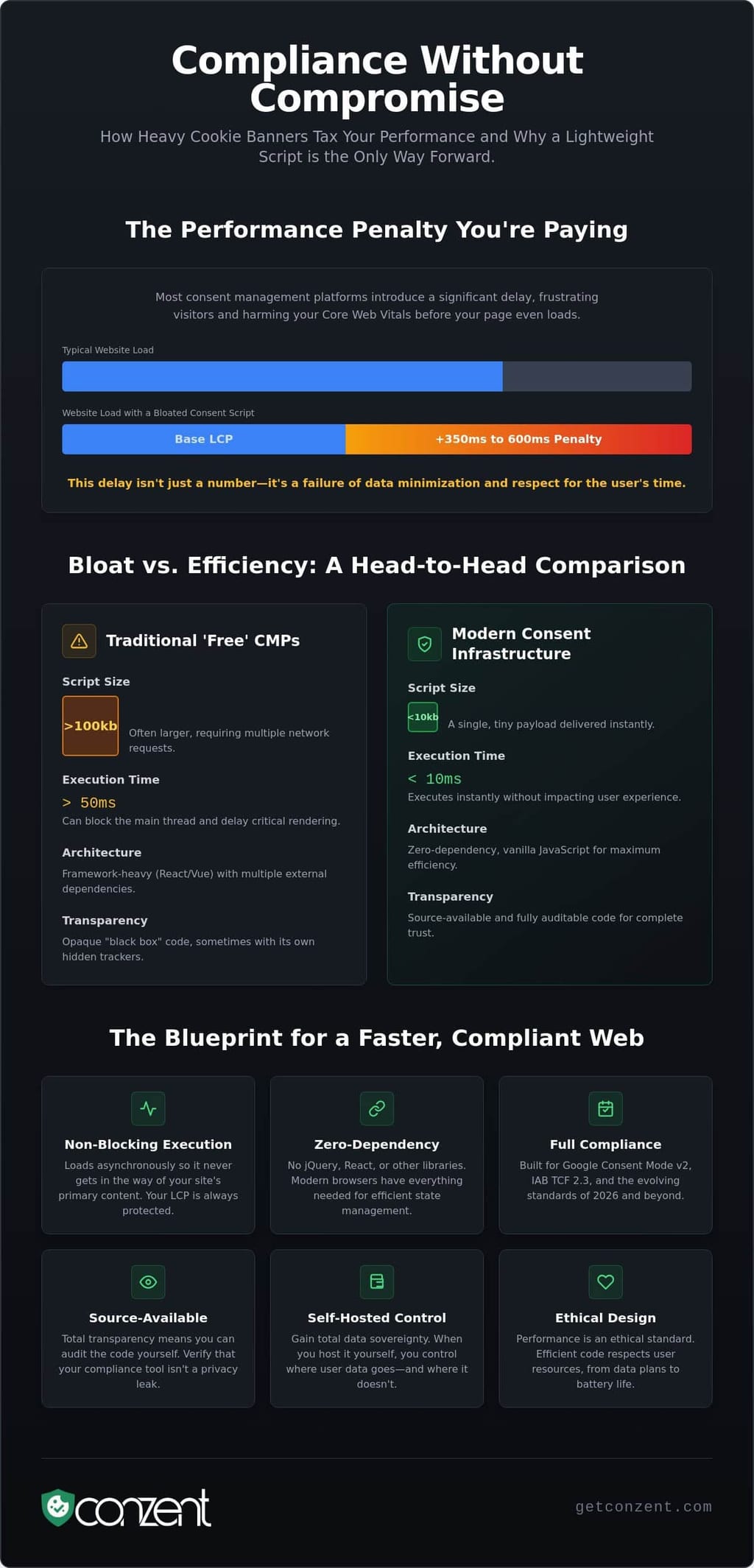
The word "free" is often a distraction in the CMP market. Many proprietary scripts are "black boxes" that include hidden tracking pixels. They track the trackers. This creates a massive performance tax. Research indicates that unoptimized scripts can add 350ms to 600ms to your Largest Contentful Paint (LCP). This delay isn't just a technical glitch; it is a failure of GDPR compliance principles like data minimization. When you use closed-source providers, you surrender data sovereignty. You cannot audit what you cannot see. Choosing an open, source-available infrastructure is the only way to ensure your compliance tool isn't actually a privacy leak.
Performance as an Ethical Standard
Respecting a user's device resources is a form of privacy respect. Efficient code is inclusive code. It works on older hardware and restricted data plans. We believe that making compliance attainable for everyone is a public good. There is a clear link between technical efficiency and user trust. Studies show that 94% of consumers will abandon a brand that fails to protect their data. A lightweight cookie consent script builds that trust from the first millisecond. Fast loading times lead to higher opt-in rates because users don't feel like the site is struggling to manage their preferences. Performance is the most visible proof of your commitment to a better, faster, and more private web.
The Anatomy of a High-Performance Cookie Consent Script
The term "lightweight" is frequently abused in modern web development. It is often treated as a vague marketing promise rather than a technical specification. We define a truly lightweight cookie consent script by its impact on the browser. It must execute in under 10 milliseconds. It must carry zero external dependencies. To ensure instant delivery over HTTP/3 protocols, the total payload should remain under 10kb. Anything larger is not just code; it is a bottleneck. Many Consent Management Platforms (CMPs) ship with framework-heavy wrappers built in React or Vue. This is a fundamental error. A consent banner is a functional UI component, not a complex application. It does not require the overhead of a virtual DOM or heavy reconciliation processes.
Execution strategy matters as much as file size. Asynchronous loading is a non-negotiable requirement for performance-first compliance. Your consent manager should never block the Document Object Model (DOM). If a script forces the browser to pause while it fetches data, your Largest Contentful Paint (LCP) will suffer. We prioritize non-blocking execution to keep the main thread available for your site's primary content. This approach treats the user's time as a finite resource that must be protected. Organizations that value this level of technical precision can explore our infrastructure tiers to find a solution that fits their performance budget.
Zero-Dependency Architecture
There is no reason a consent manager should require jQuery or massive external libraries. Modern browsers provide robust, native APIs for CSS injection and state management. By leveraging the Fetch API and localStorage, we eliminate the need for legacy dependencies. This strategy significantly reduces the number of network requests during the initial page load. Fewer requests mean fewer points of failure and less data for the user to download. This isn't just about speed. It's about building resilient, self-contained systems that don't rely on third-party reliability.
Optimizing for Core Web Vitals in 2026
Performance metrics have shifted. In 2026, user experience is measured by stability and responsiveness. Preventing Cumulative Layout Shift (CLS) requires pre-defined banner dimensions in your CSS. If your banner "pops" into view and shifts the page content, you've failed the user. Interaction to Next Paint (INP) has become the gold standard for responsiveness. We minimize INP by using passive event listeners and optimized execution loops. This ensures the interface remains snappy even as the lightweight cookie consent script processes complex signals. For those demanding the absolute limit of performance, server-side rendering (SSR) of consent states allows the UI to reflect the user's choice before the first byte of client-side JavaScript even fires.
Compliance Without Bloat: Navigating GCM v2 and IAB TCF 2.3
Google Consent Mode v2 is no longer a suggestion. It is a technical gatekeeper. As of March 2024, Google made this framework mandatory for any site serving ads or monitoring behavior in the EEA. By June 15, 2026, Google consolidated these controls, making Consent Mode the single point of truth for Google Ads data. Many developers react to these requirements by adding heavy, "all-in-one" compliance libraries. This is a mistake. You don't need a massive JavaScript payload to communicate with a Google tag. A lightweight cookie consent script should act as a precise translator, not a bloated middleman.
The challenge lies in balancing granular user choice with a minimal code footprint. Regulations like the IAB TCF 2.3, which became mandatory for all CMPs on February 28, 2026, demand complex vendor management. However, complexity in the law shouldn't equal complexity in your source code. We believe that efficient compliance is a digital right. It's about providing the necessary signals to ad tech providers without sacrificing the visitor's device performance or data plan.
Lean Google Consent Mode v2 Integration
Mapping consent signals to GCM v2 doesn't require extra helper scripts. You can implement the `gtag` command queue using native JavaScript to update `ad_storage` or `analytics_storage` states instantly. Whether you choose "Basic" or "Advanced" implementation, the logic should remain lean. Advanced mode allows for anonymous data pings before consent, but it shouldn't come with a performance tax. For a deep dive into technical execution, consult our GCM v2 compliance guide. We focus on making these signals attainable for every site, regardless of their technical resources.
The TCF 2.3 Challenge for Publishers
The IAB TCF 2.3 framework is notoriously heavy because of the Global Vendor List (GVL). Most CMPs force the browser to download this entire list, often exceeding several hundred kilobytes. This is a primary cause of high Interaction to Next Paint (INP) scores. A high-performance lightweight cookie consent script fetches only the specific vendor data required for your stack on demand. This ensures your IAB TCF compliance doesn't bloat your mobile UX. By using lean API calls instead of static file downloads, you maintain a fast, responsive interface that respects the user's time and attention. Compliance is a standard, not a barrier to speed.
Deployment Strategies: CDN Snippets vs. Self-Hosted Infrastructure
Deployment is a declaration of intent. It is the bridge between your code and your user's browser. Choosing how to deliver your lightweight cookie consent script depends on your devops capacity and your commitment to total data sovereignty. For many small to medium sites, a CDN-based snippet offers unmatched speed. It ensures the script is delivered from an edge location nearest to the user, minimizing latency. However, for those who view privacy as a non-negotiable standard, self-hosting is the only viable path. It is the difference between managing a tool and owning your infrastructure.
Every third-party request is a potential privacy leak. When you load a script from an external domain, you introduce a DNS lookup and a dependency on another entity's reliability. Auditing your site is the only way to verify what is actually running. You must look beyond the UI and inspect the network tab. A transparent solution invites this scrutiny. To verify your script's integrity, we recommend a simple audit process:
- Monitor the Network tab in your browser's developer tools for unauthorized domains.
- Check for script injections that occur after the initial page load.
- Validate that no cookies are set before the user provides explicit consent.
The Case for Self-Hosting Your CMP
Self-hosting eliminates the "black box" problem common in proprietary tools. By using Open Consent Infrastructure (OCI), you own your data. You don't just manage consent; you control the pipes it flows through. This approach removes third-party DNS lookups entirely. It hardens your security posture by keeping your compliance logic within your own perimeter. If you are ready to take full ownership of your technical stack, read The Ultimate Guide to Self-Hosted Cookie Consent Managers for a deep dive into this model.
Managed Cloud: The Best of Both Worlds
Not every team has the resources to manage their own servers. Managed infrastructure provides a way to scale privacy without the maintenance burden of a self-hosted setup. Conzent's Managed Cloud is designed for performance. It is a partnership in digital efficiency. This platform handles automated updates for shifting regulations, such as the 2026 ePrivacy updates. You get the benefits of a lightweight cookie consent script with the reliability of a global network. It makes high-level compliance attainable for everyone. Compare our deployment options to see which infrastructure fits your mission.
Conzent: Open Infrastructure for a Faster, Compliant Web
Conzent is not a banner. It is a standard. We provide source-available infrastructure designed for a web that values speed as much as privacy. Most CMPs are opaque "black boxes" that hide their logic and bloat your site. We offer a different path. Our lightweight cookie consent script provides the transparency that modern developers demand. It is built for those who refuse to compromise on performance for the sake of a legal checkbox. In an era where 94% of consumers will abandon brands that don't appear to protect data, your choice of infrastructure is a statement of integrity.
Transparency is our core value. By providing source-available code, we invite scrutiny. We encourage collaboration. This community-driven approach ensures that our standards evolve with the web, not just the ad tech industry. We don't act as a distant vendor. We are a knowledgeable peer. Our pricing model reflects this egalitarian mission. It scales with your growth. It supports the wider ecosystem of digital rights and technical efficiency. We believe that making compliance attainable for all users is a public good, not a premium luxury.
Features for Modern Development Teams
Compliance should empower your business. It shouldn't hinder it. We provide tools that turn privacy into a competitive advantage. You can use native A/B testing for consent banners to find the design that resonates with your audience. This data-driven approach helps optimize opt-in rates without relying on manipulative dark patterns. It's about finding the balance between user trust and marketing needs.
Understanding the bottom line is essential for any business owner. Our real-time revenue impact analytics allow you to see the exact cost of privacy. You can measure how consent choices affect your specific conversion goals. Deployment is seamless regardless of your stack. We offer dedicated integrations for WordPress, Wix, and other major platforms. This ensures that a lightweight cookie consent script is accessible to everyone, regardless of their technical resources.
Join the Open Consent Mission
We are on a mission to lower the cost of compliance for everyone. Privacy should not be a gatekept resource. Our model relies on corporate sponsorships to fund open-source privacy tools. This ensures that the infrastructure remains robust and free from the influence of data brokers. When you choose Conzent, you aren't just buying a script. You are investing in a faster, more ethical web. We invite you to be part of this shift. Stop settling for bloated, proprietary code that slows your site and tracks your users. View our fair pricing and start your integration today. It's time to make performance a priority.
Prioritize Performance as a Digital Right
The web is at a turning point. We've moved past the era where compliance was a valid excuse for slow sites. You now have the blueprints to implement a lightweight cookie consent script that protects your Core Web Vitals while meeting the strictest global standards. By choosing source-available infrastructure over opaque proprietary tools, you reclaim control of your site's technical destiny. You don't have to sacrifice user trust for legal safety. Speed is the ultimate form of user respect.
As Copenhagen-based privacy experts, we're on a mission to make high-performance compliance attainable for everyone. Our infrastructure is IAB TCF v2.3 and Google Consent Mode v2 certified; this ensures you stay ahead of 2026's shifting regulations without the typical code bloat. Whether you choose our Managed Cloud or our Self-Hosted Open Consent Infrastructure, you're joining a community that values transparency and speed. It's time to stop treating privacy as a performance tax. Start building a faster, more ethical web today. Explore Conzent Pricing and OCI Sponsorships to find your path forward.
Frequently Asked Questions
What makes a cookie consent script "lightweight" in 2026?
A script is truly lightweight when it prioritizes technical efficiency over unnecessary features. In 2026, this means a payload under 10kb and an execution time below 10ms. It uses vanilla JavaScript instead of heavy frameworks like React or Vue. This approach minimizes the impact on the main thread. It's about delivering compliance without the performance tax often associated with proprietary "black box" tools that bloat your site.
Can a lightweight script still support Google Consent Mode v2?
Yes, a lightweight cookie consent script can fully support Google Consent Mode v2. Compliance is about the signals you send, not the size of the library sending them. Efficient scripts map user choices to the `gtag` command queue using native browser APIs. This ensures you meet Google's mandatory EEA requirements without adding unnecessary bloat to your initial page load or sacrificing your site speed.
How does script weight affect my Google Search rankings?
Script weight directly impacts your Core Web Vitals, which are critical ranking factors. Heavy scripts often delay the Largest Contentful Paint (LCP) by several hundred milliseconds. They also increase Interaction to Next Paint (INP) latency by clogging the main thread. Google prioritizes fast, responsive sites. By reducing the weight of your consent manager, you improve these metrics. This leads to a better user experience and a stronger technical SEO foundation.
Is it better to self-host my cookie consent script or use a CDN?
Self-hosting is the superior choice for organizations seeking total data sovereignty. It eliminates third-party DNS lookups and keeps compliance logic within your own perimeter. However, a CDN is often faster for smaller sites without dedicated devops resources. It delivers the script from edge locations nearest to the user. The right choice depends on whether you prioritize absolute infrastructure control or ease of deployment for global speed.
Do lightweight scripts support IAB TCF v2.3 for publishers?
Yes, but the implementation must be precise. IAB TCF v2.3 requires managing the Global Vendor List, which is traditionally very heavy. High-performance scripts fetch only the specific vendor data required for your stack on demand through lean API calls. This avoids the massive payload of a static vendor file. It allows publishers to remain compliant with industry frameworks while protecting the mobile user experience from significant performance degradation.
Will using a lightweight script reduce my cookie banner bounce rate?
Improving site speed often correlates with lower bounce rates and higher engagement. When a banner loads instantly and doesn't cause layout shifts, users feel more in control. A fast, stable interface builds immediate trust. If the site feels sluggish due to a heavy script, visitors are more likely to click "reject all" or leave entirely. Respecting the user's time is the most effective way to encourage positive interaction.
How do I audit my current cookie consent script for performance lag?
Start by using your browser's Developer Tools. Open the Network tab and filter by JavaScript to see the total payload size of your CMP. Use Google Lighthouse or PageSpeed Insights to check for "Main Thread Work" and "Long Tasks" caused by consent scripts. If your current tool adds more than 50ms to your total blocking time, it's a candidate for replacement with a more efficient, lightweight cookie consent script.
Does Conzent offer a free version of its lightweight script?
We believe in making privacy accessible to everyone. Our Self-Hosted Open Consent Infrastructure is designed for teams that want to manage their own environment and own their data. While our Managed Cloud Consent Platform is a premium service for those seeking a maintenance-free experience, we actively support the open ecosystem. Our mission is to lower the barrier to compliance. You can explore our infrastructure options to find the model that fits your standards.
Frequently Asked Questions
The Real Cost of "Free" Proprietary Scripts
Many "free" third-party consent managers aren't actually free. They trade your users' data for a banner. These tools often include hidden tracking pixels that monitor your traffic, creating a massive conflict of interest. If you use a tool to manage how an HTTP cookie is stored, that tool shouldn't be dropping its own unauthorized trackers in the process. Then there's the performance tax. A typical proprietary script can easily exceed 50kb. On a slow mobile connection, this bloat delays the first meaningful paint and creates a jagged, unprofessional experience. Using centralized, closed-source providers also raises data sovereignty issues. You don't own the code, and you don't control where the consent logs are stored. In 2026, this lack of transparency is a risk most businesses can't afford to take.
Performance as an Ethical Standard
Respecting a user's device resources is a form of privacy respect. When a script hogs the CPU to render a simple pop-up, it drains battery life and slows down the hardware. We believe compliance is a public good, not a corporate hurdle. Framing it this way changes how you build your stack. We advocate for Self-Hosted Open Consent Infrastructure because it puts the power back in the hands of the site owner. The data is clear. Fast-loading sites see higher consent opt-in rates. When the interface is snappy and the intent is clear, users feel empowered rather than trapped. Efficiency is the ultimate form of transparency. By choosing a lightweight cookie consent script, you prove that your commitment to privacy isn't just a legal checkbox. It is a technical reality. "Lightweight" is often used as a vague marketing buzzword. We define it with technical precision. A true lightweight cookie consent script must execute in under 10ms and carry a payload under 10kb. This ensures instant delivery over modern HTTP/3 protocols, even on congested mobile networks. Most mainstream Consent Management Platforms (CMPs) ship 50kb to 150kb of code. That is not a tool; it is a bottleneck. When a script is that heavy, it competes with your hero images and primary content for bandwidth. We advocate for pure Vanilla JavaScript. Framework-heavy implementations using React or Vue wrappers add unnecessary abstraction layers. These layers increase the Time to Interactive (TTI) and bloat the browser's main thread with overhead that serves no functional purpose for the end user. By using asynchronous loading, you ensure the script never blocks the DOM from rendering. Your content should always come first. Compliance should follow quietly in the background.
Zero-Dependency Architecture
Your consent manager should not require jQuery or external libraries to function. Dependencies are security risks and performance drains. A modern, efficient script leverages native browser APIs for state management and CSS injection. This approach drastically reduces the number of network requests during the critical initial page load. When you cut the cord to external libraries, you gain total control over your execution environment. Following the ICO guidance on cookies doesn't require a bloated tech stack; it requires smart, minimalist engineering.
Optimizing for Core Web Vitals in 2026
Core Web Vitals are the yardstick for digital quality. In 2026, user experience is synonymous with speed. Cumulative Layout Shift (CLS) is a common casualty of poorly coded banners. You can prevent this by using pre-defined banner dimensions in your CSS. This ensures the browser reserves space before the script even fires, preventing that jarring "jump" as the banner appears. Interaction to Next Paint (INP) is equally vital. Efficient event listeners ensure that when a user clicks "Accept," the response is immediate and the browser stays responsive. We also recommend server-side rendering (SSR) for consent states where possible. By checking the user's consent status on the server, you can serve a tailored page that already knows whether to fire specific tracking scripts. This eliminates the "flash" of unconsented content and provides a seamless transition. If you are ready to move beyond bloated "black box" solutions, you can view our flexible plans for managed or self-hosted deployment. Compliance is not a negotiation. It is a requirement. In 2026, the digital ecosystem demands more than just a simple banner; it requires a sophisticated way to manage data signals across global networks. Most CMPs solve this by dumping massive JavaScript libraries onto your site. This approach is lazy. It ignores the impact on Core Web Vitals that every extra kilobyte causes. You can achieve full compliance with a lightweight cookie consent script that prioritizes architectural efficiency over developer convenience. The challenge lies in balancing granular user choice with a minimal code footprint. This isn't just about avoiding fines. It's about respecting the visitor's hardware. When you minimize the code required to process consent, you create a more egalitarian web where even users on low-end devices can access your content without delay. Efficiency is a privacy value that many proprietary providers have forgotten.
Lean Google Consent Mode v2 Integration
Google Consent Mode v2 became mandatory for EEA and UK advertisers on March 6, 2024. On June 15, 2026, it becomes the single point of control for data collection as Google Signals is retired. A smart implementation doesn't need a heavy wrapper. It uses the native gtag command queue to pass the four required signals: ad_storage, analytics_storage, ad_user_data, and ad_personalization. Our GCM v2 compliance guide details how to handle Advanced and Basic modes without injecting third-party dependencies. This ensures your analytics remain accurate while your page stays fast.
The TCF 2.3 Challenge for Publishers
The IAB TCF 2.3 update, which became mandatory on February 28, 2026, introduces the mandatory Disclosed Vendors segment. This change provides greater transparency by ensuring every vendor receiving data is explicitly named in the TC string. However, fetching the full Global Vendor List (GVL) can be a performance nightmare. A lightweight cookie consent script should only fetch necessary vendor segments through lean API calls. Ensuring your IAB TCF compliance doesn't bloat your mobile UX requires a shift from black box solutions to open, efficient infrastructure. By fetching data on demand, you avoid the layout shifts and long tasks that frustrate users and hurt your rankings. Choosing how to deliver your lightweight cookie consent script is a strategic decision. It is not just about convenience. It is about performance and ownership. Small sites often prioritize speed of implementation. Enterprise platforms often prioritize data sovereignty. Both paths are valid, but they require different technical commitments. Your choice will dictate how much control you maintain over your users' data and your site's loading sequence. CDN delivery is the standard for a reason. It is fast. It is easy. For small to medium sites, a global content delivery network ensures that your consent banner loads from a server physically close to your user. This minimizes latency. However, it introduces a third-party dependency. Every time a user visits, their browser must talk to a domain you don't control. In an era where third-party requests are under increasing scrutiny, this is a trade-off you must weigh carefully.
The Case for Self-Hosting Your CMP
Self-hosting is the ultimate statement of digital independence. It eliminates DNS lookups to third-party compliance domains. When you host your own infrastructure, you remove the "middleman" from the privacy equation. We built our Open Consent Infrastructure (OCI) specifically for this purpose. It allows you to own your consent logs and your script execution environment entirely. You aren't just managing cookies; you are securing your perimeter. By keeping everything in-house, you ensure that no third party can sneak tracking pixels into your compliance tool. This is a common risk with the "free" scripts we analyzed in earlier sections. If you want to dive deeper into the technical setup and hardware requirements, read The Ultimate Guide to Self-Hosted Cookie Consent Managers. This path requires more devops capacity, but the reward is total data sovereignty.
Managed Cloud: The Best of Both Worlds
Not every team has the resources to maintain self-hosted servers. This is where Conzents Managed Cloud fills the gap. It provides the performance of a lightweight cookie consent script with the ease of a managed service. You get the speed of a global CDN without the "black box" mentality of traditional vendors. We provide the infrastructure; you provide the site. This model is particularly useful for staying ahead of shifting regulations. For example, the 2026 ePrivacy updates will likely introduce new requirements for how consent is recorded and stored. A managed cloud platform handles these updates automatically. You get compliant code without the maintenance burden. Auditing your script remains essential. Use your browser's network tab to verify that only authorized requests are firing. If you are ready to choose your deployment path, you can compare our managed and self-hosted plans to see which fits your technical goals. Conzent is not a widget. It is infrastructure. Most vendors sell you a black box and ask for your blind trust. We don't. We provide source-available code that you can audit, host, and control. This isn't a luxury for elite development teams; it's a necessary standard for a transparent web. If you care about digital rights, you must care about the code that manages them. We've moved past the era of "set it and forget it" banners that hide tracking behind a wall of proprietary JavaScript. Our lightweight cookie consent script is the antithesis of the industry status quo. It is built for speed, but it is also built for honesty. By using community-driven standards, we ensure that your compliance doesn't rely on a single vendor's secrets. You get a tool that executes in milliseconds and respects your user's autonomy. Performance is not just a metric; it is an ethical commitment to every person who visits your site.
Features for Modern Development Teams
Efficiency doesn't mean a lack of features. We've built tools that help you understand the intersection of privacy and profit. You can use native A/B testing for consent banners to find the exact language and design that maximizes your opt-in rates without using dark patterns. This data-driven approach allows you to optimize your strategy based on evidence rather than guesswork. We also provide real-time revenue impact analytics. This gives you a clear view of how privacy choices affect your bottom line. It demystifies the cost of compliance. Whether you are using WordPress, Wix, or a custom stack, our integrations are designed to be seamless and non-intrusive. We handle the heavy lifting so your site stays fast.
Join the Open Consent Mission
We believe in lowering the cost of compliance for everyone. Privacy is a right, not a premium feature. High-quality tools shouldn't be locked behind enterprise paywalls that only the largest corporations can afford. Our pricing model is designed to scale with your growth, ensuring that even small creators have access to top-tier performance and legal safety. This is about building a more egalitarian digital world. Corporate sponsorships help us fund open-source privacy tools that benefit the entire ecosystem. When you choose a lightweight cookie consent script from Conzent, you're supporting a mission to make the web faster and more transparent for everyone. It's time to stop compromising on your site's speed and your users' rights. You can view our fair pricing and start your integration today to see the difference that open infrastructure makes. The digital landscape in 2026 doesn't tolerate slow websites. Compliance is not a burden to be managed with heavy, proprietary code. It is an opportunity to respect your users. By choosing a lightweight cookie consent script, you eliminate the performance tax that kills SEO and frustrates mobile visitors. You can meet the strict requirements of Google Consent Mode v2 and IAB TCF v2.3 while maintaining a sub-10kb footprint. We are Copenhagen-based privacy experts on a mission to make digital rights accessible to everyone. Our source-available Open Consent Infrastructure (OCI) is certified for the latest global standards; it's built by developers who refuse to compromise on speed. You don't have to choose between legal safety and a fast site. You can have both. It's time to move away from black-box vendors and embrace transparent, efficient infrastructure. Explore Conzent Pricing and OCI Sponsorships to join our mission for a faster, more ethical web. You have the technical path forward. Now it's time to build.
What makes a cookie consent script "lightweight" in 2026?
A lightweight cookie consent script is defined by technical efficiency rather than marketing buzzwords. In 2026, this means a payload under 10kb and an execution time below 10ms. It achieves this by using zero external dependencies and leveraging native browser APIs for state management. This approach ensures your site remains fast for all users, regardless of their device hardware or connection speed.
Can a lightweight script still support Google Consent Mode v2?
Yes, a lightweight script fully supports Google Consent Mode v2. It accomplishes this by directly communicating with the gtag command queue to pass the four mandatory consent signals. You don't need a massive JavaScript library to handle these requirements. You only need a script that correctly maps user choices to Google's technical architecture without adding unnecessary bloat to your main thread.
How does script weight affect my Google Search rankings?
Script weight directly impacts your Core Web Vitals, which are essential for Google Search rankings. Heavy scripts often delay the Largest Contentful Paint (LCP) and increase Interaction to Next Paint (INP) latency. By reducing the weight of your consent manager, you improve your performance scores. Google rewards fast, responsive sites with better visibility because they provide a superior experience for the end user.
Is it better to self-host my cookie consent script or use a CDN?
The choice depends on your technical capacity and long-term goals. A CDN offers ease of use and low latency for small to medium sites by serving files from nearby edge locations. However, self-hosting your lightweight cookie consent script provides total data sovereignty. It eliminates third-party DNS lookups and ensures your compliance infrastructure is entirely within your own security perimeter and control.
Do lightweight scripts support IAB TCF v2.3 for publishers?
Modern lightweight scripts support IAB TCF v2.3 by using lean API calls to fetch vendor data. Instead of loading the entire Global Vendor List (GVL) upfront, these scripts fetch only the necessary vendor segments on demand. This ensures you remain compliant with the latest transparency standards without sacrificing the speed of your mobile user experience or clogging the browser's processing power.
Will using a lightweight script reduce my cookie banner bounce rate?
A faster site generally leads to lower bounce rates. When your cookie banner renders instantly without causing Cumulative Layout Shift (CLS), users are less likely to get frustrated. A snappy, professional interface reduces the friction often associated with compliance. By prioritizing performance, you create a smoother journey that encourages users to engage with your content rather than bouncing due to a laggy experience.
How do I audit my current cookie consent script for performance lag?
You can audit your script using standard browser developer tools. Open the Network tab to see the total payload size and transfer time of your consent script. Then, use the Performance tab to record a page load. Look for Long Tasks or excessive main-thread execution time specifically attributed to your CMP. This data proves whether your current solution is a performance liability.
Does Conzent offer a free version of its lightweight script?
We focus on providing high-quality managed and self-hosted infrastructure that supports our mission of a transparent web. Our pricing model is designed to be fair and accessible for sites of all sizes, from small creators to large enterprises. We suggest reviewing our current plans to see how our Open Consent Infrastructure can fit your specific needs while supporting the broader community ecosystem.