The Ultimate Guide to Self-Hosted Cookie Consent Managers in 2026
Privacy is infrastructure, not a subscription service that taxes your growth. If you feel like you're being penalized with escalating fees every time your traffic spikes, you're right. Traditional platforms have turned compliance into a "consent tax" that drains your budget and leaks your user data to third-party vendors. Deploying a self-hosted cookie consent manager is the necessary standard for any business that values data sovereignty and technical efficiency in 2026.
We agree that you shouldn't have to choose between legal compliance and site performance. You deserve a solution that scales with you without the burden of per-session fees or external script lag. This guide promises to show you how to reclaim control of your privacy stack and eliminate those recurring costs for good. We will walk through the technical deployment of your own privacy infrastructure, ensuring full compatibility with IAB TCF 2.3 and Google Consent Mode v2.
Key Takeaways
- Reclaim your data sovereignty by transitioning from a third-party subscription to owned privacy infrastructure that you control.
- Stop paying "consent taxes" and learn why per-session pricing is an obsolete model for growing businesses in 2026.
- Understand the frontend and backend architecture needed to run a self-hosted cookie consent manager without impacting your Core Web Vitals.
- Ensure your site meets the strict technical requirements of IAB TCF 2.3 and Google Consent Mode v2 through certified implementation.
- Use Docker and CI/CD integration to automate your compliance updates and maintain a secure, versioned consent log for legal defensibility.
Why a Self-Hosted Cookie Consent Manager is Essential in 2026
A self-hosted CMP is privacy infrastructure you deploy on your own servers. It is not a third-party script you rent; it is a system you own. By hosting your own solution, you reclaim control over the most sensitive part of your user journey: the moment they decide what data to share. This shift from "software as a service" to "infrastructure as a standard" is a necessity for modern digital rights.
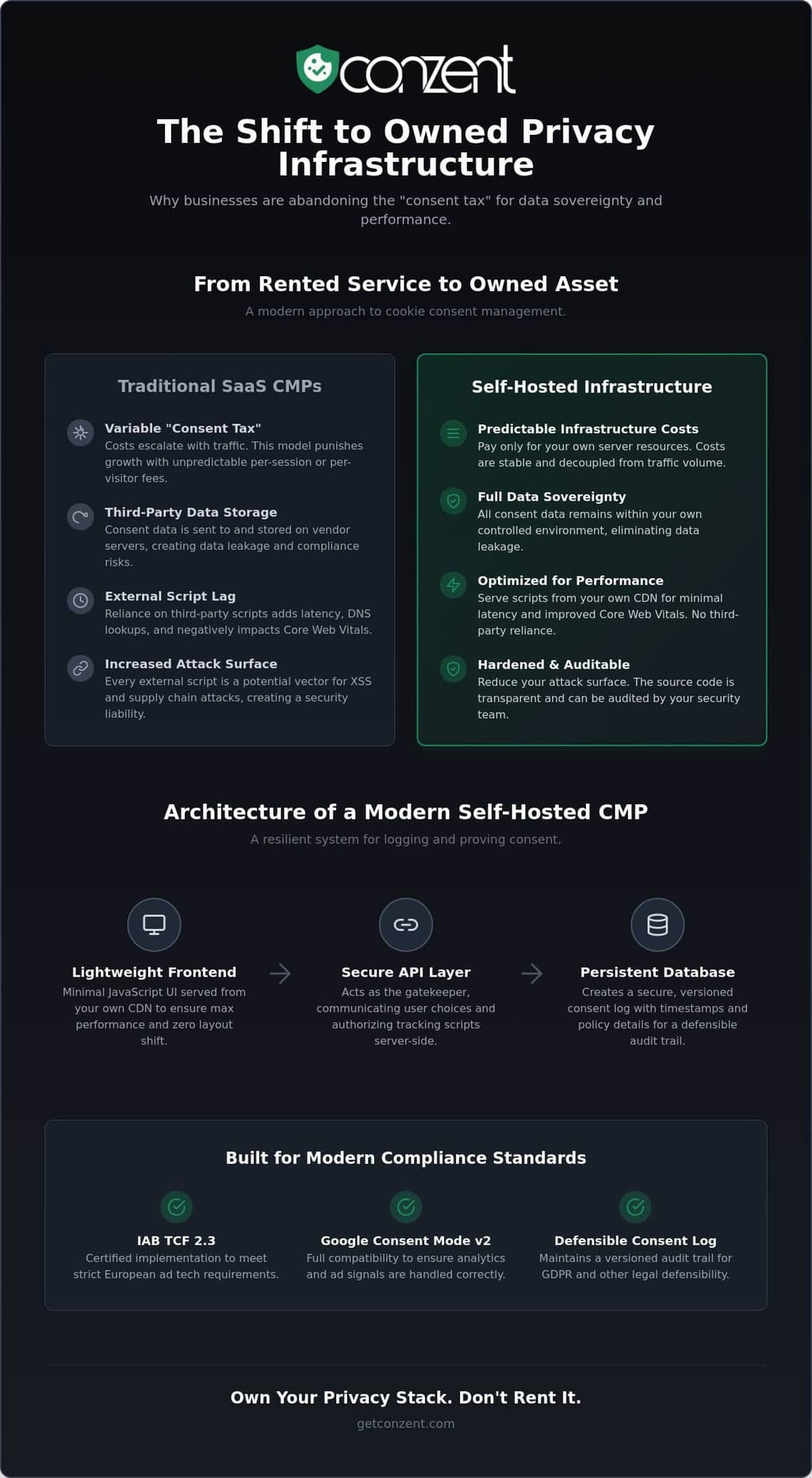
The industry is currently trapped in a "consent tax" cycle. Traditional vendors charge you more as your traffic grows. This model punishes success. A self-hosted cookie consent manager breaks this cycle by decoupling compliance from traffic volume. You pay for your own server resources, not for every visitor who interacts with a banner. It is a more honest way to handle Consent Management in an era where data privacy is a non-negotiable requirement.
Data sovereignty is the primary driver for this transition. When you use a third-party vendor, your users' consent strings are stored on external servers. This creates unnecessary data leakage. Self-hosting ensures that consent data stays within your controlled environment. It eliminates the risk of a vendor's database breach becoming your compliance nightmare. You keep the records. You maintain the audit trail. You own the relationship with your users. Privacy is not a luxury. It is a baseline.
Performance also takes center stage. External scripts often cause layout shifts and latency. By serving your consent engine from your own CDN, you reduce round-trip times and improve Core Web Vitals. Efficiency shouldn't be sacrificed for compliance. Self-hosting provides:
- Faster script execution through local caching.
- Zero reliance on third-party uptime.
- Reduced DNS lookup overhead.
Eliminating the Compliance Subscription Trap
Traditional CMPs scale their pricing based on your growth. If a marketing campaign goes viral, your compliance bill spikes unexpectedly. This is an outdated approach to business software. We advocate for source-available privacy tools that prioritize accessibility over extraction. Moving to Self-Hosted Open Consent Infrastructure allows you to trade variable monthly fees for predictable infrastructure costs. You are building equity in your technical stack rather than paying a never-ending rent. It is a more sustainable model for any scaling enterprise.
The Security Case for Self-Hosting
Every external script you load is a potential security risk. Third-party dependencies are common targets for Cross-Site Scripting (XSS) attacks. Reducing these dependencies hardens your site's perimeter. Self-hosting allows your security team to audit the source code directly. Transparency is the only real way to build trust with a technically literate audience. It also simplifies compliance with GDPR data localization rules. You don't have to wonder where your data is stored because you are the one hosting it. You aren't just checking a box; you are building a defensible perimeter.
Technical Architecture of a Modern Self-Hosted CMP
A self-hosted cookie consent manager is not a cosmetic layer. It's a technical stack. Most "free" banners are just scripts that inject a UI. A true infrastructure approach requires a frontend, an API layer, and a persistent database. This isn't just about showing a banner; it's about building a system that stands up to scrutiny. You're deploying a distributed system designed for resilience and legal proof.
The frontend must be lightweight. It should not tank your Core Web Vitals or block the main thread. We recommend using vanilla JavaScript or a minimal component library. Avoid heavy frameworks that add unnecessary bloat to every page load. Your UI should be accessible, responsive, and served from your own infrastructure to eliminate third-party latency. Efficiency is a core value, not a secondary feature.
The backend handles the heavy lifting of consent logging and versioning. Since US Regulators Got Serious About Cookie Consent, having a bulletproof audit trail is no longer optional. Every consent event needs a timestamp, a version ID of the policy accepted, and a secure hash. For the database, SQL is often the better choice for structured audit trails where relational integrity matters. However, NoSQL works well for high-volume environments that need to ingest millions of consent events per day without bottlenecking.
Your API layer acts as the gatekeeper. It communicates user choices to your server-side logic and ensures that tracking scripts only fire when authorized. If this architecture feels complex to build from scratch, you can explore our flexible deployment options to find a balance between ownership and ease of use.
Integrating Google Consent Mode v2
Google Consent Mode v2 is a signal-based bridge between privacy and measurement. It works by mapping user choices directly to specific storage states like ad_storage and analytics_storage. In a "Basic" implementation, tags are blocked until consent is granted. In an "Advanced" implementation, tags send cookieless pings to allow for data modeling. Your self-hosted system must be able to update these states dynamically in the browser to maintain compliance with the EU Digital Markets Act.
Server-Side Consent Management
Server-side tagging is the gold standard for 2026. By moving consent logic off the client's browser, you reduce the processing load on mobile devices. This improves user experience and security simultaneously. A server-side setup allows you to synchronize consent across multiple subdomains and platforms through a single source of truth. It prevents "consent fatigue" by ensuring a user's choice on your main site is respected across your entire ecosystem. You aren't just managing cookies; you're managing a unified privacy signal.
Compliance Standards: IAB TCF 2.3 and Beyond
IAB TCF 2.3 is the mandatory standard for any site that relies on programmatic advertising. As of the February 28, 2026 enforcement deadline, all CMPs must support this version to ensure ads continue to serve in regulated markets. This protocol isn't just about a "yes" or "no" button. It's a complex communication layer between your site and hundreds of ad-tech vendors. Deploying a self-hosted cookie consent manager that supports TCF 2.3 gives you the power to manage these relationships without letting a third-party vendor sit in the middle of your revenue stream.
Technical certification is rigorous. You must handle the Global Vendor List (GVL) with precision. In a self-hosted environment, this means your infrastructure must regularly fetch and cache the latest GVL to ensure you're disclosing the most current list of vendors. You also need to generate a compliant Transparency and Consent (TC) string. This string encodes user preferences into a format that the entire ad ecosystem understands. It's about interoperability and trust, not just checking a box.
Legal defensibility goes beyond just saving a "granted" state in a database. You need to log the exact UI version and vendor list the user interacted with at the time of consent. If a regulator audits your site, a simple timestamp isn't enough. You need to prove what was disclosed. This level of IAB TCF compliance is what separates a professional privacy stack from a basic script. Ownership of this data ensures that your audit trail is never locked behind a vendor's paywall.
TCF 2.3 vs. Standard GDPR Banners
A standard GDPR banner usually offers a binary choice. TCF 2.3 is different; it provides granular control over specific purposes and vendors. It also handles the complex "Legitimate Interest" legal basis required for many ad-funded models. You need a certified CMP if you use any major IAB-participating vendor. Simple banners suffice for internal analytics, but they fail the requirements of the modern ad ecosystem. We believe granular transparency should be the baseline for all digital interactions, regardless of your business model.
Global Privacy Control (GPC) Support
Global Privacy Control is a browser-level signal that tells websites not to sell or share personal data. It's a cornerstone of US state laws like the CCPA and CPRA. Your self-hosted stack must automatically detect and respect these signals. This isn't just about current laws in states like Indiana or Kentucky; it's about future-proofing for 2027 and beyond. You can find more details on the evolving privacy legislation landscape to stay ahead of these requirements. Supporting GPC shows you respect user intent by default, which is the most effective way to build long-term trust.
Operational Guide: Deploying and Maintaining Your CMP
Deploying a self-hosted cookie consent manager is a commitment to operational excellence. It is not a "set it and forget it" widget. We recommend containerization using Docker to ensure your privacy infrastructure remains consistent across development, staging, and production environments. This approach eliminates the "it works on my machine" excuse and allows your DevOps team to manage compliance as code. Maintaining a self-hosted cookie consent manager requires the same level of oversight as your core application.
Integration with your CI/CD pipeline is the next logical step. Automating updates ensures that your Global Vendor List remains current without manual intervention. It also allows you to run automated regression tests to confirm that new site features don't break your consent logic. If a deployment fails to meet compliance standards, the build should fail. Security and privacy are part of the build, not an afterthought. You are building a system that must be as reliable as your primary database.
Monitoring and alerting are non-negotiable. If your consent banner fails to load, your site is likely out of compliance. You need real-time visibility into the health of your CMP. We recommend setting up automated alerts for:
- 404 errors on critical script loads.
- Spikes in database latency for consent logging.
- Failed fetch attempts for the IAB Global Vendor List.
Scaling consent logs to millions of records requires a clear retention strategy. Use database partitioning to keep your audit trails performant. This ensures that legal defensibility doesn't come at the cost of system speed.
Choosing Your Hosting Environment
Your choice between on-premise servers and private cloud providers like AWS or GCP depends on your existing stack. However, edge computing is the future of privacy delivery. Edge deployment is critical for minimizing Cumulative Layout Shift (CLS) because it executes the consent logic at the network's perimeter, ensuring the banner renders before the main page content shifts. This creates a seamless experience that respects both the user's time and their rights.
A/B Testing and UX Optimization
Self-hosters often focus so much on the technical deployment that they forget about the user. A compliant banner that nobody understands is a failure. You should set up local A/B tests to measure which layouts and copy drive the highest opt-in rates. Balancing legal requirements with clean design is a technical challenge, but it is also an ethical one. You can compare our self-hosted and managed plans to see which operational model best supports your optimization goals. Efficiency in code must be matched by efficiency in user choice.
Conzent: The Source-Available Solution for Enterprise
Conzent is built on the belief that privacy is a public good. We provide a self-hosted cookie consent manager that combines open-source values with enterprise-grade features. By using a source-available model, we offer the transparency of open source with the stability required by modern DevOps teams. You get the code. You get the control. You get the community support. This isn't a walled garden; it's an open ecosystem. We believe that privacy infrastructure should be accessible to all, not just those with the largest budgets.
One common criticism of self-hosting is the lack of visibility into business performance. We solve this through Revenue Impact Analytics. Most platforms hide the true cost of your privacy settings behind vague metrics. We show you exactly how your consent configuration affects your bottom line. This data allows you to optimize for both compliance and conversion without guesswork. Privacy doesn't have to be a blind spot for your growth. It can be a measurable part of your strategy.
Our sponsorship model is designed to lower the cost of compliance for everyone. By supporting the project, enterprise users fund the development of features that benefit the entire community. It is a principled way to build software. We prioritize technical efficiency over extractive licensing. We don't just sell a product; we advocate for a more transparent internet. This collaborative approach ensures that our tools remain cutting-edge and ethically grounded.
From Self-Hosted to Managed Cloud
We understand that not every team has the resources to manage their own infrastructure. That's why we offer a seamless transition from a self-hosted cookie consent manager to our managed cloud service. There is full feature parity between the two models. We don't paywall critical compliance features. Managed hosting simply reduces the operational overhead for smaller teams. This allows you to focus on your core business while we handle the maintenance and updates. You can check our pricing structure to see which path fits your current scale.
The Danish Standard of Privacy
Our Copenhagen roots inform everything we do. Denmark has some of the highest standards for data protection and transparency in the world. This principled approach is baked into our code. When you use Conzent, you get direct access to the developers building the infrastructure. We are knowledgeable peers, not distant vendors. We invite you to join us in setting a new standard for digital rights. Deploy Conzent on your own infrastructure today and take back control of your privacy stack.
Take Control of Your Privacy Infrastructure
Privacy is a fundamental right, not a subscription service. You've learned how to eliminate the "consent tax" and reclaim your data sovereignty by moving away from restrictive vendor models. Deploying a self-hosted cookie consent manager is the most effective way to ensure your compliance stack is as resilient as your core business applications. Ownership is the standard; renting is the compromise.
By choosing source-available infrastructure that is IAB TCF 2.3 Certified and Google Consent Mode v2 Ready, you're future-proofing your site against the evolving regulatory landscape of 2026. You don't have to sacrifice performance for legal safety. You don't have to leak data to third parties. You just need the right tools to build a transparent and efficient ecosystem. Efficiency is a choice you make today for a better digital future tomorrow.
The path to digital rights starts with your own servers. Start self-hosting with Conzent for free and join a community that values technical openness and ethical responsibility. You've got the roadmap. Now it's time to build.
Frequently Asked Questions
Is a self-hosted cookie consent manager really free?
The source code for a self-hosted cookie consent manager is free to download and deploy under source-available licenses. You eliminate per-session fees and recurring subscription taxes paid to external vendors. You are only responsible for your own infrastructure costs, such as server hosting and the internal resources needed for maintenance. It is a shift from variable operational expenses to predictable infrastructure overhead.
Can a self-hosted CMP be IAB TCF 2.3 certified?
Yes, certification is tied to the software architecture rather than the hosting environment. Conzent is IAB TCF v2.3 certified with CMP ID #446 and is a recognized Google CMP Partner. This means your self-hosted deployment meets the exact same technical and legal standards as any major SaaS provider. You get full compliance without giving up control of your data pipeline.
How does self-hosting impact website performance?
Self-hosting typically improves performance by reducing reliance on third-party servers. You serve the consent engine from your own CDN, which eliminates additional DNS lookups and reduces round-trip latency. This control allows your team to optimize script execution and minimize the impact on Core Web Vitals. Efficiency is a natural byproduct of owning your technical stack.
Is Google Consent Mode v2 supported in self-hosted versions?
Full support for Google Consent Mode v2 is a standard feature in modern self-hosted infrastructure. It is a technical necessity for complying with the EU Digital Markets Act. Your system will correctly map user choices to ad_storage and analytics_storage signals. This ensures your measurement remains accurate while respecting the user's privacy preferences at the browser level.
What technical skills are required to host a CMP?
Your team needs standard DevOps skills to manage the deployment effectively. Familiarity with Docker, container orchestration, and database management is essential for a stable setup. While the initial deployment is straightforward, ongoing maintenance requires an understanding of how to integrate updates into your existing CI/CD pipeline. It is a task for developers, not general administrative staff.
How do I handle updates and new regulations with a self-hosted solution?
You manage updates by pulling the latest source code and redeploying through your automated build pipeline. When the IAB updates the Global Vendor List or new laws take effect, the software is updated to reflect these changes. This process ensures your self-hosted cookie consent manager remains current. You maintain the same level of protection as a managed service but keep the code on your own terms.
Can I migrate from a SaaS CMP to a self-hosted one easily?
Migration involves replacing the vendor's script with your own and mapping your existing configurations to the new system. You'll need to transfer your list of active vendors and purpose disclosures to ensure continuity. Most organizations find the technical swap is simple; the primary work lies in ensuring your internal database is ready to ingest the new consent logs. It's a clean break from vendor lock-in.
Does self-hosting help with GDPR data localization requirements?
Self-hosting is the gold standard for meeting data localization and sovereignty requirements. It ensures that sensitive consent strings and audit logs stay within your specified geographic region. You don't have to worry about a third-party vendor moving your data across borders without your knowledge. You own the servers, you own the data, and you own the compliance record.
Frequently Asked Questions
Eliminating the Compliance Subscription Trap
Traditional CMPs scale their pricing based on your growth. If a marketing campaign goes viral, your compliance bill spikes unexpectedly. This is an outdated approach to business software. We advocate for source-available privacy tools that prioritize accessibility over extraction. Moving to Self-Hosted Open Consent Infrastructure allows you to trade variable monthly fees for predictable infrastructure costs. You are building equity in your technical stack rather than paying a never-ending rent. It is a more sustainable model for any scaling enterprise.
The Security Case for Self-Hosting
Every external script you load is a potential security risk. Third-party dependencies are common targets for Cross-Site Scripting (XSS) attacks. Reducing these dependencies hardens your site's perimeter. Self-hosting allows your security team to audit the source code directly. Transparency is the only real way to build trust with a technically literate audience. It also simplifies compliance with GDPR data localization rules. You don't have to wonder where your data is stored because you are the one hosting it. You aren't just checking a box; you are building a defensible perimeter. A self-hosted cookie consent manager is not a cosmetic layer. It's a technical stack. Most "free" banners are just scripts that inject a UI. A true infrastructure approach requires a frontend, an API layer, and a persistent database. This isn't just about showing a banner; it's about building a system that stands up to scrutiny. You're deploying a distributed system designed for resilience and legal proof. The frontend must be lightweight. It should not tank your Core Web Vitals or block the main thread. We recommend using vanilla JavaScript or a minimal component library. Avoid heavy frameworks that add unnecessary bloat to every page load. Your UI should be accessible, responsive, and served from your own infrastructure to eliminate third-party latency. Efficiency is a core value, not a secondary feature. The backend handles the heavy lifting of consent logging and versioning. Since US Regulators Got Serious About Cookie Consent, having a bulletproof audit trail is no longer optional. Every consent event needs a timestamp, a version ID of the policy accepted, and a secure hash. For the database, SQL is often the better choice for structured audit trails where relational integrity matters. However, NoSQL works well for high-volume environments that need to ingest millions of consent events per day without bottlenecking. Your API layer acts as the gatekeeper. It communicates user choices to your server-side logic and ensures that tracking scripts only fire when authorized. If this architecture feels complex to build from scratch, you can explore our flexible deployment options to find a balance between ownership and ease of use.
Integrating Google Consent Mode v2
Google Consent Mode v2 is a signal-based bridge between privacy and measurement. It works by mapping user choices directly to specific storage states like ad_storage and analytics_storage. In a "Basic" implementation, tags are blocked until consent is granted. In an "Advanced" implementation, tags send cookieless pings to allow for data modeling. Your self-hosted system must be able to update these states dynamically in the browser to maintain compliance with the EU Digital Markets Act.
Server-Side Consent Management
Server-side tagging is the gold standard for 2026. By moving consent logic off the client's browser, you reduce the processing load on mobile devices. This improves user experience and security simultaneously. A server-side setup allows you to synchronize consent across multiple subdomains and platforms through a single source of truth. It prevents "consent fatigue" by ensuring a user's choice on your main site is respected across your entire ecosystem. You aren't just managing cookies; you're managing a unified privacy signal. IAB TCF 2.3 is the mandatory standard for any site that relies on programmatic advertising. As of the February 28, 2026 enforcement deadline, all CMPs must support this version to ensure ads continue to serve in regulated markets. This protocol isn't just about a "yes" or "no" button. It's a complex communication layer between your site and hundreds of ad-tech vendors. Deploying a self-hosted cookie consent manager that supports TCF 2.3 gives you the power to manage these relationships without letting a third-party vendor sit in the middle of your revenue stream. Technical certification is rigorous. You must handle the Global Vendor List (GVL) with precision. In a self-hosted environment, this means your infrastructure must regularly fetch and cache the latest GVL to ensure you're disclosing the most current list of vendors. You also need to generate a compliant Transparency and Consent (TC) string. This string encodes user preferences into a format that the entire ad ecosystem understands. It's about interoperability and trust, not just checking a box. Legal defensibility goes beyond just saving a "granted" state in a database. You need to log the exact UI version and vendor list the user interacted with at the time of consent. If a regulator audits your site, a simple timestamp isn't enough. You need to prove what was disclosed. This level of IAB TCF compliance is what separates a professional privacy stack from a basic script. Ownership of this data ensures that your audit trail is never locked behind a vendor's paywall.
TCF 2.3 vs. Standard GDPR Banners
A standard GDPR banner usually offers a binary choice. TCF 2.3 is different; it provides granular control over specific purposes and vendors. It also handles the complex "Legitimate Interest" legal basis required for many ad-funded models. You need a certified CMP if you use any major IAB-participating vendor. Simple banners suffice for internal analytics, but they fail the requirements of the modern ad ecosystem. We believe granular transparency should be the baseline for all digital interactions, regardless of your business model.
Global Privacy Control (GPC) Support
Global Privacy Control is a browser-level signal that tells websites not to sell or share personal data. It's a cornerstone of US state laws like the CCPA and CPRA. Your self-hosted stack must automatically detect and respect these signals. This isn't just about current laws in states like Indiana or Kentucky; it's about future-proofing for 2027 and beyond. You can find more details on the evolving privacy legislation landscape to stay ahead of these requirements. Supporting GPC shows you respect user intent by default, which is the most effective way to build long-term trust. Deploying a self-hosted cookie consent manager is a commitment to operational excellence. It is not a "set it and forget it" widget. We recommend containerization using Docker to ensure your privacy infrastructure remains consistent across development, staging, and production environments. This approach eliminates the "it works on my machine" excuse and allows your DevOps team to manage compliance as code. Maintaining a self-hosted cookie consent manager requires the same level of oversight as your core application. Integration with your CI/CD pipeline is the next logical step. Automating updates ensures that your Global Vendor List remains current without manual intervention. It also allows you to run automated regression tests to confirm that new site features don't break your consent logic. If a deployment fails to meet compliance standards, the build should fail. Security and privacy are part of the build, not an afterthought. You are building a system that must be as reliable as your primary database. Monitoring and alerting are non-negotiable. If your consent banner fails to load, your site is likely out of compliance. You need real-time visibility into the health of your CMP. We recommend setting up automated alerts for: Scaling consent logs to millions of records requires a clear retention strategy. Use database partitioning to keep your audit trails performant. This ensures that legal defensibility doesn't come at the cost of system speed.
Choosing Your Hosting Environment
Your choice between on-premise servers and private cloud providers like AWS or GCP depends on your existing stack. However, edge computing is the future of privacy delivery. Edge deployment is critical for minimizing Cumulative Layout Shift (CLS) because it executes the consent logic at the network's perimeter, ensuring the banner renders before the main page content shifts. This creates a seamless experience that respects both the user's time and their rights.
A/B Testing and UX Optimization
Self-hosters often focus so much on the technical deployment that they forget about the user. A compliant banner that nobody understands is a failure. You should set up local A/B tests to measure which layouts and copy drive the highest opt-in rates. Balancing legal requirements with clean design is a technical challenge, but it is also an ethical one. You can compare our self-hosted and managed plans to see which operational model best supports your optimization goals. Efficiency in code must be matched by efficiency in user choice. Conzent is built on the belief that privacy is a public good. We provide a self-hosted cookie consent manager that combines open-source values with enterprise-grade features. By using a source-available model, we offer the transparency of open source with the stability required by modern DevOps teams. You get the code. You get the control. You get the community support. This isn't a walled garden; it's an open ecosystem. We believe that privacy infrastructure should be accessible to all, not just those with the largest budgets. One common criticism of self-hosting is the lack of visibility into business performance. We solve this through Revenue Impact Analytics. Most platforms hide the true cost of your privacy settings behind vague metrics. We show you exactly how your consent configuration affects your bottom line. This data allows you to optimize for both compliance and conversion without guesswork. Privacy doesn't have to be a blind spot for your growth. It can be a measurable part of your strategy. Our sponsorship model is designed to lower the cost of compliance for everyone. By supporting the project, enterprise users fund the development of features that benefit the entire community. It is a principled way to build software. We prioritize technical efficiency over extractive licensing. We don't just sell a product; we advocate for a more transparent internet. This collaborative approach ensures that our tools remain cutting-edge and ethically grounded.
From Self-Hosted to Managed Cloud
We understand that not every team has the resources to manage their own infrastructure. That's why we offer a seamless transition from a self-hosted cookie consent manager to our managed cloud service. There is full feature parity between the two models. We don't paywall critical compliance features. Managed hosting simply reduces the operational overhead for smaller teams. This allows you to focus on your core business while we handle the maintenance and updates. You can check our pricing structure to see which path fits your current scale.
The Danish Standard of Privacy
Our Copenhagen roots inform everything we do. Denmark has some of the highest standards for data protection and transparency in the world. This principled approach is baked into our code. When you use Conzent, you get direct access to the developers building the infrastructure. We are knowledgeable peers, not distant vendors. We invite you to join us in setting a new standard for digital rights. Deploy Conzent on your own infrastructure today and take back control of your privacy stack. Privacy is a fundamental right, not a subscription service. You've learned how to eliminate the "consent tax" and reclaim your data sovereignty by moving away from restrictive vendor models. Deploying a self-hosted cookie consent manager is the most effective way to ensure your compliance stack is as resilient as your core business applications. Ownership is the standard; renting is the compromise. By choosing source-available infrastructure that is IAB TCF 2.3 Certified and Google Consent Mode v2 Ready, you're future-proofing your site against the evolving regulatory landscape of 2026. You don't have to sacrifice performance for legal safety. You don't have to leak data to third parties. You just need the right tools to build a transparent and efficient ecosystem. Efficiency is a choice you make today for a better digital future tomorrow. The path to digital rights starts with your own servers. Start self-hosting with Conzent for free and join a community that values technical openness and ethical responsibility. You've got the roadmap. Now it's time to build.
Is a self-hosted cookie consent manager really free?
The source code for a self-hosted cookie consent manager is free to download and deploy under source-available licenses. You eliminate per-session fees and recurring subscription taxes paid to external vendors. You are only responsible for your own infrastructure costs, such as server hosting and the internal resources needed for maintenance. It is a shift from variable operational expenses to predictable infrastructure overhead.
Can a self-hosted CMP be IAB TCF 2.3 certified?
Yes, certification is tied to the software architecture rather than the hosting environment. Conzent is IAB TCF v2.3 certified with CMP ID #446 and is a recognized Google CMP Partner. This means your self-hosted deployment meets the exact same technical and legal standards as any major SaaS provider. You get full compliance without giving up control of your data pipeline.
How does self-hosting impact website performance?
Self-hosting typically improves performance by reducing reliance on third-party servers. You serve the consent engine from your own CDN, which eliminates additional DNS lookups and reduces round-trip latency. This control allows your team to optimize script execution and minimize the impact on Core Web Vitals. Efficiency is a natural byproduct of owning your technical stack.
Is Google Consent Mode v2 supported in self-hosted versions?
Full support for Google Consent Mode v2 is a standard feature in modern self-hosted infrastructure. It is a technical necessity for complying with the EU Digital Markets Act. Your system will correctly map user choices to ad_storage and analytics_storage signals. This ensures your measurement remains accurate while respecting the user's privacy preferences at the browser level.
What technical skills are required to host a CMP?
Your team needs standard DevOps skills to manage the deployment effectively. Familiarity with Docker, container orchestration, and database management is essential for a stable setup. While the initial deployment is straightforward, ongoing maintenance requires an understanding of how to integrate updates into your existing CI/CD pipeline. It is a task for developers, not general administrative staff.
How do I handle updates and new regulations with a self-hosted solution?
You manage updates by pulling the latest source code and redeploying through your automated build pipeline. When the IAB updates the Global Vendor List or new laws take effect, the software is updated to reflect these changes. This process ensures your self-hosted cookie consent manager remains current. You maintain the same level of protection as a managed service but keep the code on your own terms.
Can I migrate from a SaaS CMP to a self-hosted one easily?
Migration involves replacing the vendor's script with your own and mapping your existing configurations to the new system. You'll need to transfer your list of active vendors and purpose disclosures to ensure continuity. Most organizations find the technical swap is simple; the primary work lies in ensuring your internal database is ready to ingest the new consent logs. It's a clean break from vendor lock-in.
Does self-hosting help with GDPR data localization requirements?
Self-hosting is the gold standard for meeting data localization and sovereignty requirements. It ensures that sensitive consent strings and audit logs stay within your specified geographic region. You don't have to worry about a third-party vendor moving your data across borders without your knowledge. You own the servers, you own the data, and you own the compliance record.