
Privacy-by-Design Consent Management: The 2026 Implementation Guide

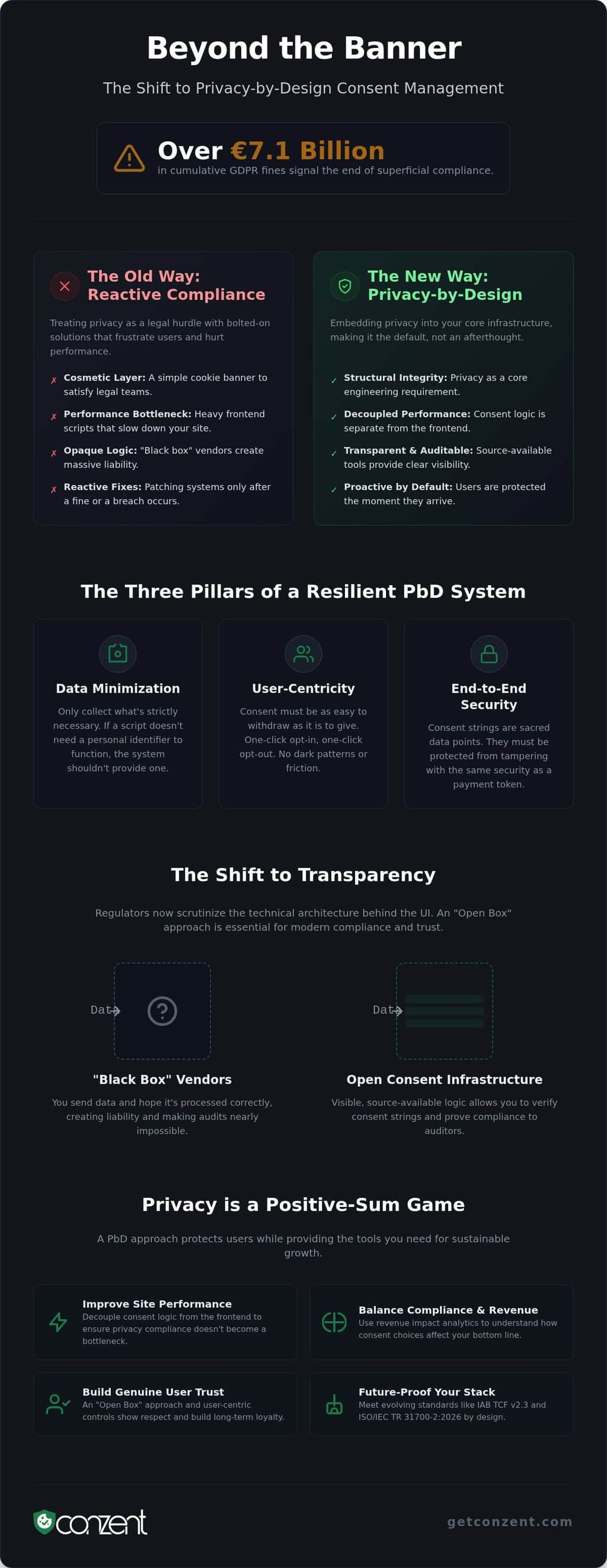
With over €7.1 billion in cumulative GDPR fines as of early 2026, the era of "compliance via cookie banner" is officially dead. Most businesses still treat privacy as a UI afterthought, but regulators now demand a deeper level of privacy-by-design consent management. You've likely felt the frustration of opaque SaaS vendors that hide their data processing logic or consent banners that destroy your site's performance. It's a constant, exhausting struggle to balance strict GDPR compliance with the practical need for ad revenue.
You deserve a system that works for your users and your bottom line. We agree that privacy shouldn't be a premium luxury or a technical bottleneck; it's a fundamental right and a technical standard. This guide will teach you how to move beyond superficial fixes and build a built-in, compliant consent infrastructure. You'll learn to implement a transparent, high-performance system that fully complies with IAB TCF v2.3 and the latest ISO/IEC TR 31700-2:2026 standards. We'll walk through using source-available tools that provide clear visibility into how consent affects your revenue, ensuring your digital rights advocacy doesn't come at the cost of growth.
Key Takeaways
- Shift from reactive cookie banners to proactive, embedded privacy frameworks that protect users by default.
- Build a resilient privacy-by-design consent management infrastructure that decouples logic from the frontend to improve site performance.
- Use revenue impact analytics to balance strict compliance with your bottom line, proving that privacy is not a zero-sum game.
- Leverage source-available standards like Open Consent Infrastructure (OCI) to ensure full transparency and meet IAB TCF v2.3 requirements.
Table of Contents
What is Privacy-by-Design Consent Management?
Privacy-by-Design (PbD) isn't a feature you toggle on. It's a framework that embeds privacy into the very fabric of your technology stack. For too long, the industry has treated consent as a cosmetic layer; a bolted-on banner designed to satisfy legal teams while frustrating users. True privacy-by-design consent management rejects this superficiality. It makes privacy the default setting for data collection, not an optional preference that users must fight to activate.
Standard Consent Management Platforms (CMPs) treat privacy as a legal hurdle to clear. They focus on the minimum viable compliance needed to keep a website operational. In contrast, a PbD system treats privacy as a core engineering requirement. It's about structural integrity. If you want to understand the foundational principles, exploring What is Privacy-by-Design reveals a philosophy where user rights are protected automatically. This approach aligns with strict GDPR compliance standards by moving the responsibility from the individual to the infrastructure.
The Shift from Compliance to Built-in Privacy
By August 2026, the regulatory environment has moved past simple disclosures. With the full implementation of the EU AI Act and the release of ISO/IEC TR 31700-2:2026 in July 2026, a visible banner is no longer a shield against liability. Regulators now scrutinize the technical architecture behind the UI. They want to see how data flows, not just how the buttons look.
There's a critical difference between Privacy by Policy and Privacy by Design. Privacy by Policy is a promise written in a document. Privacy by Design is a technical reality enforced by code. This shift builds genuine trust with your audience. It reduces long term legal liability by ensuring that even if a policy is misinterpreted, the system itself cannot violate user rights. It's about being an ethical expert rather than a compliant follower.
Core Components of a PbD Consent System
A robust system isn't built on complexity; it's built on discipline. To achieve effective privacy-by-design consent management, your infrastructure must prioritize three specific pillars:
- Data minimization: Only collect what's strictly necessary for the specific task. If a script doesn't need a personal identifier to function, the system shouldn't provide one.
- User-centricity: Consent must be as easy to withdraw as it is to give. If a user can opt-in with one click, they must be able to opt-out just as fast. No dark patterns. No friction.
- End-to-end security: Consent strings must be protected from tampering. A user's choice is a sacred data point that requires the same level of security as a payment token.
The 7 Principles of Privacy by Design Applied to CMPs
Applying the seven principles of PbD to privacy-by-design consent management transforms a legal obligation into a technical advantage. Most vendors operate reactively. They patch bugs after a breach or update their UI only after a fine. A PbD approach is proactive. It anticipates risks. It builds a system where privacy is the default setting. A visitor shouldn't need to click a button to be safe. They should be protected the moment they arrive.
Privacy is not a feature you add. It is essential functionality. We reject the idea that privacy destroys business value. It is a positive-sum game. You can achieve Balancing Compliance with Revenue by using high-performance infrastructure that respects the user while providing the data you need for growth. When privacy is embedded into the design, it doesn't slow down the site. It streamlines the data flow and ensures that compliance doesn't become a bottleneck for your marketing team.
Visibility and Transparency: The "Open Box" Approach
Transparency is the antidote to regulatory risk. Many SaaS vendors operate as "Black Boxes." You send them data, and you hope they process it correctly. This creates a massive liability for your organization. For a legitimate PbD audit, source-available code is essential. You need to see the logic. You need to verify the consent strings. This is why we champion the Open Consent Infrastructure. It moves consent from a hidden vendor script to a transparent, auditable part of your own stack. It ensures that the "how" and "why" of data processing are never a mystery to your users or auditors.
Respect for User Privacy: Keeping it User-Centric
Respect isn't just about following the law. It's about the human experience. Dark patterns like hidden "Reject" buttons or confusing color schemes are a betrayal of trust. They create consent fatigue and damage your brand's reputation. A user-centric CMP provides granular control without the headache. It respects the user's time and their rights. It doesn't trick them into consent. It earns it through clarity and honesty. If you are ready to build a system that values people over clicks, you can explore our pricing options to find the right fit for your organization.
Decoupling Consent: Why Infrastructure is the Real Privacy Frontier
Bolted-on banners are fragile. They are mere accessories to a website. Infrastructure is resilient. It is the foundation. Most businesses treat consent as a UI problem, but it is actually a systems problem. True privacy-by-design consent management requires moving logic away from the fragile frontend and into a decoupled, structural layer. When you decouple consent, you ensure that privacy rules are enforced at the architectural level, not just the visual one. This approach prevents the "race conditions" where tracking scripts fire before a banner even loads.
This separation of concerns provides a significant technical advantage. It ensures that data collection only happens after a valid consent string is verified at the system level. You aren't just showing a banner; you are building a gatekeeper. This structural approach is the real frontier of digital rights. It moves the conversation from "what the user sees" to "how the system behaves." Your privacy posture depends entirely on where that logic lives and who controls the underlying data flow.
Self-Hosting for Ultimate Sovereignty
Enterprise teams often face strict requirements regarding third-party data transfers. For these organizations, the ability to self-host your CMP is a necessity, not a luxury. Self-hosting keeps every consent string and user interaction on your own servers. It removes the middleman. This eliminates the risk of a third-party vendor becoming a single point of failure or a target for data harvesters. In this model, DevOps becomes a key player in the privacy lifecycle. They treat privacy as code, ensuring it is tested and deployed with the same rigour as any other critical system.
Managed Cloud: Principled Efficiency
Not every team has the resources to manage their own infrastructure, but everyone deserves high-performance privacy. The Conzent Managed Cloud Consent Platform simplifies scaling without sacrificing transparency. We leverage Danish-grade security standards to provide a service that feels like a public good. A managed service doesn't have to be a "Black Box." Since our tools are source-available, you can inspect the logic even if we handle the hosting. You get the efficiency of the cloud with the integrity of an open system. It's a principled way to scale digital rights across your entire digital footprint.
Balancing Compliance with Revenue: The PbD Optimization Framework
Most businesses treat privacy and revenue as enemies. They assume a compliant site is a broke site. This is a false dichotomy. Effective privacy-by-design consent management is not about restriction; it's about optimization. When you build a system on trust, you create a more resilient revenue model. You stop fighting your users and start respecting them. This framework allows you to maximize your data quality without resorting to the deceptive tactics that invite regulatory scrutiny and damage your brand reputation.
Optimization follows a methodical, logical sequence. You cannot optimize what you do not measure, and you cannot measure fairly without a clean baseline. Follow these four steps to align your digital rights advocacy with your commercial goals:
- Step 1: Establish a strict baseline. Start with "Privacy by Default" settings. No pre-ticked boxes. No hidden "Reject" buttons.
- Step 2: Use Consent A/B Testing to improve the user experience. Experiment with banner placement and copy without using coercive language.
- Step 3: Measure the Revenue Impact of different consent states. Understand exactly how opt-in rates correlate with your bottom line.
- Step 4: Refine the UI. Use the data from your tests to create a clear, fast, and respectful interface that users actually trust.
Ethical A/B Testing for Consent UX
Moral clarity is the foundation of ethical testing. We don't test to see how many users we can trick into clicking "Accept All." We test to see which designs provide the most clarity and the least friction. Your primary metrics should be the opt-in rate, the bounce rate, and the revenue per user. If a specific banner design causes a spike in bounces, it's a UX failure. If a transparent design leads to a steady opt-in rate, it's a structural success. High-performance consent doesn't require dark patterns; it requires technical efficiency and honest communication.
Integrating with Google Consent Mode v2 & IAB TCF 2.3
Modern ad-tech stacks require precise signals. You can use Google Consent Mode v2 as a PbD-compliant signal to recover data insights while respecting user choices. It allows for cookieless pings that maintain your analytics without violating privacy. For publishers, implementing the IAB TCF 2.3 provides a standardized way to communicate consent across the entire ecosystem. It ensures that every vendor in your stack receives a verified, tamper-proof signal. This prevents data leaks and ensures your compliance is as robust as your revenue. To see how these integrations fit your budget, explore our pricing today.
Implementing Your Privacy-First Strategy with Conzent
You have the framework. Now you need the tools. Conzent is the ethical expert in consent infrastructure. We don't just provide a banner; we provide the foundation for digital rights. Our privacy-by-design consent management platform is built for speed and moral clarity. It's not a premium luxury. It's a necessary standard for anyone serious about transparency. We believe that privacy should be accessible, not hidden behind complex contracts and opaque pricing models.
Our platform is source-available for a reason. We invite scrutiny. We want you to see the logic that governs your users' data. This is how we move from "Privacy by Policy" to "Privacy by Design." Our infrastructure is designed for technical efficiency. It doesn't bloat your site or slow down your page loads. It's a streamlined solution for a complex problem. Whether you choose our Managed Cloud or our Self-Hosted Open Consent Infrastructure, you're getting a tool that respects the reader's time and the user's rights.
We also follow an egalitarian pricing model. We are a Danish company following strict EU standards, and we treat privacy as a public good. As corporate sponsorships increase, our managed cloud costs decrease for everyone. This isn't typical corporate behavior. It's a mission-driven approach to democratize compliance. Ready to build? You can start by exploring our Managed Cloud or Self-Hosted options today.
Why Conzent is the Standard for PbD
We were built in Denmark, but we are designed for the world. Our approach contains no corporate fluff. We use high-impact, declarative language in our code and our communication. We position our tools as a necessary standard rather than a luxury add-on. This community-driven infrastructure lowers the barrier to entry. It ensures that even small businesses can afford the same level of protection as global enterprises. We are a transparent disruptor. We aren't afraid to challenge industry norms that prioritize vendor lock-in over user freedom.
Next Steps for Your Team
The first step is a simple audit. Look at your current CMP. Is it a fragile feature or a resilient infrastructure? If you can't see the source code, you don't truly own your compliance. It's a "Black Box" that creates liability. You should explore our integrations for WordPress, Drupal, and more to see how a decoupled system functions in practice. Join the mission to democratize privacy. Stop treating consent as a legal hurdle and start treating it as a core engineering requirement. Your users deserve nothing less.
Building the Future of Digital Rights
The shift toward structural privacy is no longer optional. By moving beyond the surface level of cookie banners, you're choosing a resilient architecture that values users as people. We've shown that decoupling your logic and embracing privacy-by-design consent management isn't just about avoiding fines. It's about building a foundation of trust that supports your long term growth. You can maintain full compliance with IAB TCF 2.3 and Google Consent Mode v2 without sacrificing the performance of your digital stack.
True transparency requires source-available tools and a commitment to the public good. You don't have to navigate these requirements alone or settle for opaque SaaS vendors. Our egalitarian pricing model ensures that high impact privacy is attainable for everyone regardless of their size. It's time to stop treating consent as a legal burden and start treating it as a technical standard for ethical business. We believe in a web where transparency is the default, not a premium feature.
View Conzent Pricing and Start Building Ethical Consent. Let's build a more transparent digital ecosystem together.
Frequently Asked Questions
What is the main difference between Privacy by Design and standard GDPR compliance?
Privacy by Design is a proactive engineering standard while standard compliance is often a reactive legal check. Standard compliance usually involves bolting on a UI layer like a cookie banner after the site is built. PbD ensures that data protection is an essential functionality of the system itself. It moves the responsibility from the user's choice to the system's default behavior, ensuring privacy is never an afterthought.
Can I implement Privacy by Design without a dedicated CMP?
You can build your own logic, but it's technically demanding. Implementing privacy-by-design consent management manually means engineering every script to wait for a validated signal. Most teams find this inefficient. Using a source-available framework like our Open Consent Infrastructure gives you the architectural benefits of PbD without the massive development overhead. It provides a resilient, auditable foundation for your digital rights strategy.
Does Privacy by Design hurt my website conversion rates?
It doesn't have to. In fact, ethical design often improves long term trust and brand reputation. Dark patterns and deceptive banners might boost short term opt-ins, but they increase bounce rates and user frustration. By using Consent A/B Testing, you can find the balance between clarity and performance. Respectful interfaces prove that privacy and revenue are a positive-sum game, not a zero-sum trade-off.
How does self-hosting a consent manager improve my privacy posture?
Self-hosting removes the third-party middleman. When you use a standard SaaS CMP, your users' consent strings are often processed on the vendor's servers. This creates a data transfer risk. Self-hosting keeps every interaction on your own infrastructure. It ensures you have total sovereignty over your data and eliminates the risk of vendor lock-in or third-party breaches affecting your compliance status.
Is Google Consent Mode v2 compatible with Privacy by Design principles?
It is compatible when used as a transparency tool. Google Consent Mode v2 allows you to communicate user preferences to ad-tech stacks using cookieless pings. This supports the "Full Functionality" principle of PbD by maintaining analytics without compromising user privacy. It ensures that no data is stored on the user's device without explicit permission, making it a powerful component of a principled consent strategy.
What are the 7 principles of Privacy by Design in simple terms?
These principles are the blueprint for ethical tech. They include being proactive rather than reactive, making privacy the default setting, and embedding privacy into the design. You must also ensure full functionality with no trade-offs, maintain end-to-end security, and prioritize visibility and transparency. Finally, keep the system user-centric. These steps ensure that privacy-by-design consent management is a fundamental part of your technical infrastructure.
How do I audit a CMP for Privacy by Design compliance?
Start by looking under the hood. A true PbD audit requires checking if the CMP's logic is transparent and source-available. You must verify that the default state is non-consenting and that data minimization is strictly enforced. If the vendor hides their processing logic in a "black box," they fail the transparency test. Ensure the system allows users to withdraw consent as easily as they gave it.
Why is source-available code important for my DPO?
Transparency is the foundation of trust. A Data Protection Officer (DPO) cannot effectively audit a system they can't see. Source-available code allows your DPO to verify how consent strings are generated and stored. It removes the need to trust a vendor's marketing claims. By providing an "open box," you empower your compliance team to prove that your infrastructure meets the highest ethical and legal standards.