
Reduce Consent Banner Bounce Rate: 2026 Privacy UX Guide

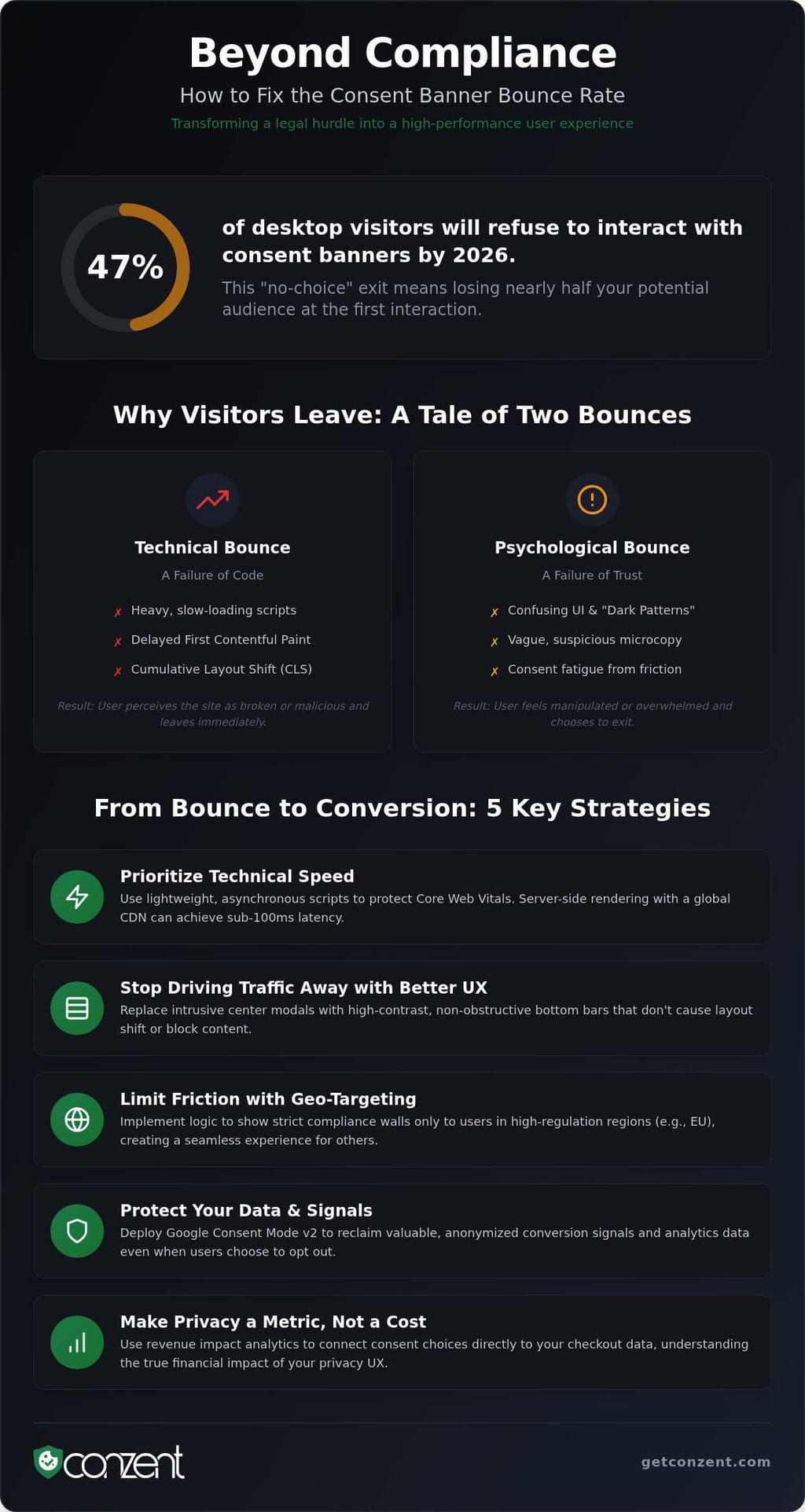
Nearly 47% of desktop visitors in 2026 simply refuse to interact with consent banners, choosing a "no-choice" exit over engaging with your brand. It's a frustrating reality for digital teams. You've spent months perfecting your content and site speed, only to lose up to a quarter of your traffic at the very first click. Most businesses treat privacy as a legal hurdle that inevitably breaks the user experience. You likely feel caught between strict GDPR mandates and the desperate need to reduce consent banner bounce rate to protect your bottom line.
Privacy compliance isn't a tax on your growth; it's a standard for technical excellence. We'll show you how to balance IAB TCF v2.4 requirements with ethical design patterns that actually invite user participation. You'll discover how to leverage technical speed and A/B testing to recover lost data and improve retention. This guide breaks down the transition from intrusive scripts to high-performance infrastructure that keeps your Core Web Vitals healthy and your data accurate. We're moving past the era of messy legal compromises into a future of transparent, high-speed digital rights.
Key Takeaways
- Prioritize technical speed. Use lightweight, asynchronous scripts that protect your Core Web Vitals and prevent layout shifts.
- Stop driving traffic away. Reduce consent banner bounce rate by replacing intrusive center modals with high-contrast, non-obstructive bottom bars.
- Limit friction. Implement geo-targeting to ensure strict compliance walls only appear for users in high-regulation regions like the EU.
- Protect your data. Deploy Google Consent Mode v2 to reclaim conversion signals even when users choose to opt out.
- Privacy isn't a cost; it's a metric. Use revenue impact analytics to connect consent choices directly to your checkout data.
Understanding the Consent Bounce: Why Visitors Leave
A "Consent Bounce" is a specific type of failure. It happens when a user terminates their session specifically because of the privacy interface. This isn't a content problem; it's a gateway problem. In 2026, users treat privacy as a fundamental right. They expect control without friction. When a website presents a messy, slow, or confusing interface, the visitor exits. To reduce consent banner bounce rate, you must stop viewing compliance as a legal chore and start viewing it as a core component of your user experience.
We see a sharp divide between technical and psychological bounces. A technical bounce is a failure of code. It happens when scripts are too heavy or load in the wrong order. A psychological bounce is a failure of trust. It occurs when the user feels manipulated or overwhelmed by the interface. Every HTTP cookie your site uses requires a transparent request for permission, but that request should never feel like a tax on the user's time. Privacy is not a barrier to entry; it's a standard of service.
The Performance Factor: Latency and CLS
Speed is the foundation of digital rights. Heavy external scripts often delay the First Contentful Paint, leaving the user with a blank screen while the banner "thinks." This latency is a conversion killer. Even worse is the impact of Cumulative Layout Shift (CLS). When a banner pops in late and pushes your content down, it creates a sense of instability. A slow, shifting banner is often interpreted as a broken or malicious website. To maintain high Core Web Vitals, your consent infrastructure must be as fast as your primary content. If your cookie banner lags, the user leaves before they even see your value proposition.
The Trust Factor: UX and Microcopy
Consent fatigue is real and measurable. By June 2026, research indicated that nearly 47% of desktop visitors ignore banners entirely. When users are forced to interact, they often choose the path of least resistance: leaving. Dark patterns, such as hiding the "Reject" button or using deceptive colors, are not solutions. They are liabilities. These tactics might offer a temporary boost in opt-ins, but they inflict permanent damage on brand reputation. Vague language like "we use cookies to improve your experience" is no longer enough. Privacy-conscious users find this suspicious. Clear, declarative microcopy that explains the "why" of data collection is the only way to build lasting trust. Using consent A/B testing allows you to find the exact language that resonates with your specific audience without sacrificing compliance.
Technical Strategies to Reduce Banner Latency
Latency is a silent conversion killer. When a user lands on your site, every millisecond counts toward their decision to stay or leave. To reduce consent banner bounce rate, your technical implementation must prioritize speed above all else. This starts with lightweight scripts. Many legacy platforms load massive JavaScript bundles that bloat your page size and tank your Core Web Vitals scores. Modern infrastructure uses asynchronous loading to ensure your primary content renders before the banner even appears. This prevents the "blank screen" effect that triggers immediate exits.
Efficiency requires moving logic away from the user's browser. Server-side consent checks and global CDN edge locations allow you to serve banners with sub-100ms latency. By processing the consent state closer to the user, you eliminate the heavy lifting on the client side. This technical agility ensures that compliance doesn't come at the cost of performance. Compliance is a technical standard, not a performance tax.
Managed Cloud vs. Self-Hosting for Speed
Choosing your infrastructure is a strategic decision. Managed cloud consent platforms are built for optimization. They handle delivery, scaling, and maintenance, ensuring your banner is always served from the fastest available node. This approach minimizes third-party DNS lookups, which can shave off critical milliseconds from your load time. It is the streamlined path to high-speed compliance.
Alternatively, you can choose to self-host your CMP. This provides total infrastructure control and allows you to integrate consent logic directly into your own stack. While it requires more internal resources, it eliminates external dependencies entirely. Regardless of your choice, staying aligned with ICO guidance on cookies is essential to ensure your speed optimizations remain legally sound. If you're looking for a solution that balances these technical needs, you can explore our pricing options to find the right fit for your traffic volume.
Optimizing for Mobile Performance
Mobile users are less patient than desktop users. While mobile consent rates reached 80.6% in 2026, these users will bounce up to three times faster if the interface is sluggish. You must adapt banner payloads for limited mobile bandwidth. A mobile banner should be a featherweight version of its desktop counterpart. It is also vital to manage the viewport. A banner that covers 100% of the mobile screen feels like an ad or a technical error. Keep the interface non-obstructive to allow users to see the value of your content while they make their choice.
Optimizing UX: Design Patterns That Build Trust
Center modals are an obstacle. Bottom bars are an invitation. Many legacy guides suggest "hiding" the banner or using dark patterns to force a click, but these tactics fail the modern user. To reduce consent banner bounce rate, you must align your design with the fundamental principles of bounce rates: clarity over confusion, and speed over friction. A center modal stops the user's journey dead. A high-contrast bottom bar allows the content to remain visible while presenting the choice clearly. This approach respects the visitor's intent while fulfilling your legal obligations.
Trust is built through visual equality. Regulators in 2026 are cracking down on deceptive button designs. Your "Accept" and "Reject" buttons must have equal visual weight. If one is a bold primary color and the other is a ghost button, you are signaling a lack of transparency. Use declarative microcopy. Instead of saying "We use cookies," explain how that data improves the user's specific experience. Once the choice is made, provide a persistent, small icon. This allows users to change their settings at any time, reinforcing that their privacy is a right, not a one-time transaction.
A/B Testing Your Consent Banner
Guessing is not a strategy. You should never assume which layout or copy will perform best for your specific audience. Implementing cookie consent A/B testing allows you to measure the impact of every design change with precision. Focus on the relationship between opt-in rates and session duration. A high opt-in rate is useless if it comes at the cost of a high bounce rate. Testing ensures you find the balance between compliance and retention without compromising on technical efficiency.
Reducing Friction with Categorized Consent
Information overload triggers exits. When a user sees a list of hundreds of unknown vendors, they bounce. Grouping these into clear categories like "Analytics" or "Marketing" reduces cognitive load. Utilizing the IAB TCF v2.3 framework provides a standardized way to communicate these choices transparently. For the most privacy-sensitive users, always provide an "Essential Only" path. It is a quick-exit option that respects their time while keeping them on your site. This level of transparency is the most effective way to reduce consent banner bounce rate across all traffic segments.
Advanced Tactics: Geo-Targeting and Consent Mode v2
One-size-fits-all privacy is a strategic mistake. If you treat a visitor from Tokyo like a visitor from Berlin, you're introducing friction where none is legally required. Implementing geo-targeting allows you to show strict, high-regulation banners only to users in regions like the EU or UK. For others, you can employ lighter interfaces or purely informational notices. This is a primary method to reduce consent banner bounce rate for global brands. You protect your data integrity in strict jurisdictions while maximizing retention in regions with fewer restrictions. Privacy is a right, but its implementation should be surgical.
Beyond simple visibility, you must manage how data flows when a user opts out. Google Consent Mode v2 is the industry standard for this challenge. It doesn't simply block all data; it uses behavioral modeling to fill the gaps in your analytics. This ensures you maintain accurate conversion data without violating user choice. Contextual consent further refines this by triggering banners only when a specific feature, like an embedded video or map, requires it. This keeps the initial landing experience clean and focused on your content.
Regional Compliance Customization
Differentiating between GDPR, CCPA/CPRA, and other global laws is essential for technical efficiency. You can reduce cookie banner bounce rate by relaxing banner requirements for non-EU traffic. For example, users in regions without "prior consent" mandates shouldn't face a wall before they see your value proposition. Automating these regional rules through a global managed cloud consent platform ensures that your site remains compliant everywhere without manual intervention. It's about being as strict as necessary and as open as possible.
Integrating with Google Consent Mode v2
The technical requirements for Google Consent Mode v2 implementation changed significantly on June 15, 2026. Google consolidated its data controls, making the ad_storage parameter the sole authority for all advertising data collected for linked Ads accounts. If your configuration is incorrect, you risk massive data loss or compliance errors. Proper GCM v2 signals allow for compliant ad revenue tracking even when users decline cookies. It turns a "no" into a modeled data point rather than a total loss of insight. Ready to optimize your global compliance? Check our pricing and infrastructure options to see how we handle these complex integrations for you.
Measuring Success with Revenue Impact Analytics
Bounce rate is a symptom. Revenue is the diagnosis. While tracking how many users leave your site is a start, it doesn't tell the whole story of your privacy performance. To truly reduce consent banner bounce rate, you must understand the financial weight of every exit. Most legacy tools treat consent as a binary "yes" or "no" event. We view it as a critical junction in the customer journey. Measuring the actual cost of consent allows you to move beyond guesswork and into a strategy of precision.
Our approach utilizes revenue impact analytics to connect consent choices directly to your checkout data. This isn't about generic metrics. It is about identifying which specific banner variants lead to the highest lifetime value (LTV). By analyzing how different design patterns affect the final purchase, you can optimize for both compliance and growth. Transparency is not a barrier to sales; it is a catalyst for long-term customer retention. When users trust how you handle their data, they are more likely to return, creating a sustainable revenue stream that dark patterns can never match.
Data-Driven Privacy Decisions
Analyzing the drop-off point in your consent funnel reveals exactly where you are losing trust. For ad-supported media, where consent rates can dip as low as 23-30%, every design choice matters. Publishers can use cookie consent for publishers to justify UX changes with hard numbers rather than assumptions. This data-driven mindset allows you to build a privacy-first growth strategy. You aren't just checking a legal box; you're engineering a high-performance entry point for your brand.
The Future of Ethical Compliance
The 2026 privacy landscape demands a shift from closed systems to radical transparency. Source-available and open infrastructure is becoming the new standard for businesses that value technical integrity. We invite you to join the Open Consent Infrastructure mission. It is a commitment to making digital rights attainable for everyone, regardless of their technical resources. As you finalize your 2026 strategy, use this checklist to ensure your interface is an asset, not a liability:
- Speed: Ensure your banner loads in under 100ms via global CDN edge locations.
- Trust: Use declarative microcopy and equal visual weight for all choices.
- Measurement: Connect every consent interaction to its ultimate revenue impact.
Privacy is a necessary standard, not a premium luxury. By focusing on these three pillars, you ensure that your website respects the user's rights while protecting your commercial future.
Reclaiming Your Traffic with Ethical Design
Privacy is no longer a legal hurdle to clear; it's a technical standard to meet. By focusing on sub-100ms delivery and ethical design patterns, you can effectively reduce consent banner bounce rate while maintaining total compliance. We've moved past the era of intrusive modals and dark patterns. The 2026 landscape rewards brands that respect user autonomy through clear microcopy and high-performance infrastructure.
Success requires more than just a visible banner. It demands a strategy that integrates IAB TCF 2.3 certification with deep revenue impact analytics. When you treat data rights as a public good rather than a commercial burden, you build a foundation of trust that drives long-term retention. You don't have to choose between legal safety and site performance. Our source-available transparency ensures that your compliance remains as open and efficient as the rest of your stack.
Ready to transform your compliance interface into a growth engine? Start optimizing your consent UX with Conzent Cloud today. Our platform includes revenue impact analytics to help you grow with confidence. Your visitors deserve speed and respect. It's time to give them both.
Frequently Asked Questions
Does a cookie banner always increase my bounce rate?
A cookie banner adds a layer of friction, but it doesn't have to trigger a mass exit. High bounce rates are usually caused by slow loading times or intrusive center modals that block content. If your banner loads in under 100ms and uses a non-obstructive design, you can keep the impact minimal. In 2026, users expect privacy controls. Providing them transparently can actually build the trust necessary to keep visitors on your site.
How can I measure the bounce rate specifically caused by my consent banner?
You need to isolate the "Consent Bounce" from standard page exits. This is done by tracking user interactions with the banner as a specific event in your analytics funnel. By using A/B testing, you can compare different layouts and microcopy to see which version keeps users engaged longer. Revenue impact analytics go a step further by connecting these early exits to your actual checkout data, showing the true cost of your privacy interface.
Is it legal to delay the cookie banner until a user scrolls?
Most regulators, including those following GDPR standards, require "prior consent." This means you can't fire non-essential cookies before a user makes a choice. If you delay the banner until a scroll but fire tracking scripts immediately, you are in violation. While we don't provide legal representation, technical standards suggest that the banner should be the first interaction to ensure both compliance and data accuracy from the very start of the session.
What is the best position for a cookie banner to avoid bounces?
Bottom bars are currently the most effective design pattern for retention. Unlike center modals, which act as a wall between the user and your content, a bottom bar allows the visitor to see the value of your page while they decide. This reduces the psychological urge to hit the "back" button. Ensure your "Accept" and "Reject" buttons have equal visual weight to stay compliant while you work to reduce consent banner bounce rate.
Can I show different banners to users in different countries?
Yes, geo-targeting is a highly effective advanced tactic. It allows you to automate regional rules, showing strict IAB TCF v2.3 integrated banners only to users in high-regulation zones like the EU. For visitors in other regions, you can serve less intrusive notices or skip the banner entirely where legal. This surgical approach ensures you don't punish your global traffic with unnecessary friction, helping you reduce consent banner bounce rate across all jurisdictions.
Does Google Consent Mode v2 help reduce bounce rates?
Google Consent Mode v2 doesn't directly change the banner's UI, but it fundamentally changes how you handle the "data gap." By using behavioral modeling, GCM v2 allows you to reclaim conversion signals even when users choose to opt out. This reduces the negative impact of a bounce or a rejection on your marketing insights. It turns a potential loss of data into a modeled insight, making your overall growth strategy more resilient and accurate.
How does banner loading speed affect my SEO rankings?
Loading speed is a critical component of SEO because it impacts Core Web Vitals. Heavy, unoptimized consent scripts delay the First Contentful Paint and often cause Cumulative Layout Shift (CLS) when the banner pops in late. Google uses these performance metrics as direct ranking signals. Using a managed cloud platform ensures your banner is served from the edge, protecting your rankings while keeping your site compliant and fast for every visitor.
Are dark patterns effective for reducing bounce rate in the long run?
Dark patterns are a short-term gamble with long-term consequences. While hiding the "Reject" button might temporarily lower your bounce rate or increase opt-ins, it destroys brand trust and invites regulatory scrutiny. Ethical design and radical transparency are the new standards for 2026. Users who feel respected are more likely to return, leading to higher lifetime value. Principled growth is always more sustainable than growth built on user manipulation.