
Self-Hosted vs. Managed Consent Platform: Choosing Your Privacy Infrastructure in 2026

Privacy is not a premium luxury. It's a fundamental digital right. Yet, many organizations treat their consent strategy like a rented apartment, subject to the sudden updates and rising costs of distant SaaS vendors. If you're tired of paying high subscription fees for a cookie banner that drags down your Core Web Vitals, it's time to rethink your stack. The choice between a self-hosted vs managed consent platform determines whether you truly own your user data or merely lease a temporary compliance fix.
We understand the weight of compliance debt. It feels like a never-ending cycle of technical patches for Google Consent Mode v2 and IAB TCF 2.3. This guide provides a definitive look at weighing the total control of self-hosting against the streamlined efficiency of managed cloud infrastructure. We'll show you how to eliminate script lag, secure data sovereignty, and maintain high performance. You'll finish with a clear roadmap to a privacy setup that offers predictable costs and automated peace of mind.
Key Takeaways
- Decide whether you'll own your privacy data or rent your compliance by evaluating the core differences between a self-hosted vs managed consent platform.
- Secure total data sovereignty through self-hosted infrastructure that ensures user signals never leave your controlled environment.
- Eliminate the maintenance burden of IAB TCF v2.3 and Google Consent Mode v2 by opting for a managed cloud solution.
- Use a clear decision matrix to compare total cost of ownership, from SaaS subscription fees to the hidden costs of developer maintenance.
- Discover a principled approach to privacy that balances mission-driven ethics with technical efficiency for any organization size.
The Evolution of Consent Management: Why Hosting Matters in 2026
Consent management is no longer a cosmetic choice. It is a structural requirement. In 2026, your Consent Management Platform (CMP) is the foundation of your digital ecosystem. It is the filter through which all user data must pass. The days of "set and forget" banners are over. Today, compliance requires active communication with ad-tech stacks and regulatory databases. Privacy is a digital right, not a line item, and your infrastructure must reflect that reality.
The debate over a self-hosted vs managed consent platform has shifted from a technical preference to a strategic necessity. With cumulative GDPR fines passing €7.1 billion by early 2026, the stakes of mismanaged data are clear. Organizations now prioritize data sovereignty. They want to ensure that consent signals remain under their direct control rather than being processed by a third-party black box. Choosing how you host this infrastructure determines who actually owns the truth of your users' intent.
Consent is No Longer a Static Script
Modern privacy requires more than a simple "Accept" button. Requirements like Google Consent Mode v2 demand that your site sends specific signals to Google's servers based on user choice. Similarly, the ad-tech world relies on IAB TCF v2.3 to authorize data processing across thousands of vendors. These aren't static scripts; they are dynamic engines. They must update in real-time to reflect new vendor lists and API changes. If your infrastructure can't handle these updates instantly, your revenue and compliance are both at risk.
The Privacy Paradox: Control vs. Convenience
Developers often lean toward self-hosting. It offers total data ownership and prevents third-party scripts from slowing down the site. Marketing teams, however, need the agility of a managed solution. They want revenue impact analytics and easy A/B testing without waiting for a sprint cycle. This tension is heightened by new US state laws in Indiana and Kentucky that took effect on January 1, 2026. These regulations demand precise handling of personal data across every touchpoint.
There is a dangerous middle ground: the unmaintained self-hosted script. While it avoids monthly fees, it accumulates massive compliance debt. Without regular security patches and API updates, these scripts become broken gates. True efficiency comes from choosing a model that balances technical integrity with operational speed. It isn't just about the banner. It's about the infrastructure behind it.
Self-Hosted Consent Infrastructure: Total Ownership and Data Sovereignty
Ownership is the ultimate form of privacy. When you choose an Open Consent Infrastructure (OCI), you stop renting compliance and start owning it. Self-hosting means you are the sole curator of your user's data. Every consent signal, preference, and timestamp stays on your own infrastructure. It's not just a banner. It's a fortress around user trust. The choice between a self-hosted vs managed consent platform isn't just a technical detail. It's a decision about who holds the keys to your digital integrity.
A source-available model offers transparency that proprietary SaaS cannot match. You can inspect the code. You can verify how data flows. This level of openness is essential for meeting the NIST Privacy Framework standards for data governance. It transforms privacy from a legal checkbox into a technical reality. You are no longer reliant on a vendor's "black box" to handle sensitive user choices. You have total visibility.
The Case for Data Sovereignty
Data sovereignty in 2026 is the legal and technical assurance that a user's consent signal never touches a third-party server during the decision-making process. Hosting the consent database yourself eliminates the risk of third-party data leaks. It's the only way to satisfy the rigorous security audits required by government agencies or enterprise clients. You don't have to trust a vendor's promise. You have the logs to prove your compliance. This setup ensures that your privacy stack remains resilient against changing cross-border data transfer rules.
Managing the Technical Debt
Control comes with a cost. Self-hosting requires a robust stack, typically involving Docker containers, server-side execution, and dedicated database management. You become responsible for the uptime. You must also track the constant updates to IAB TCF and Google Consent Mode v2. This isn't a project you finish once. It's an ongoing commitment to infrastructure health.
Internalizing these DevOps hours is a significant investment. While some community forums suggest self-hosting is always cheaper, they often ignore the price of manual maintenance. You need a team that can deploy security patches and update APIs the moment regulations change. If you have the technical resources, this path offers unmatched sovereignty. If you're weighing the total cost of ownership, you must account for these engineering hours. For teams ready to build, we've outlined the technical requirements in our guide to Self-Hosting Your CMP: A Guide for DevOps Teams.
Managed Cloud Consent Platforms: Compliance as a Service
A Managed Cloud Consent Platform represents the efficiency play for scaling businesses. It is a friction-free compliance solution. While self-hosting offers total data sovereignty, the managed model offers speed. It eliminates the need for dedicated engineering resources to monitor every regulatory shift. In the self-hosted vs managed consent platform debate, the cloud option wins on agility. It is about choosing a partner to handle the complexity so you can focus on your core mission.
There is a valid debate regarding the "Black Box" nature of many SaaS providers. Some vendors hide their logic, making it impossible to audit how consent is actually processed. We advocate for "Managed Transparency." This approach combines the convenience of the cloud with the openness of source-available code. You get the benefit of a managed service without sacrificing the ability to scrutinize the engine. You can Build Customer Trust Through Data Privacy by being open about how you manage user choices. Transparency is the only way to turn compliance into a competitive advantage.
Zero-Maintenance Compliance
The maintenance burden of modern privacy is immense. APIs like IAB TCF 2.3 and Google Consent Mode v2 require constant versioning. A managed platform handles this heavy lifting automatically. It ensures your scripts maintain 99.9% uptime. This stability is critical. If your consent banner fails, your ad revenue stops. Utilizing an IAB TCF 2.3 Certified CMP in a managed environment ensures you stay compliant with the latest industry standards without lifting a finger.
Advanced Analytics and Revenue Optimization
Managed platforms do more than just show a banner. They provide deep insights into your compliance health. You can use Revenue Impact Analytics to see exactly how consent choices affect your bottom line. If opt-in rates are low, Cookie Consent A/B Testing allows you to experiment with different designs. This data-driven approach helps you recover lost revenue. It turns a legal requirement into a tool for growth. You can visualize global compliance health through a single cloud-based dashboard.
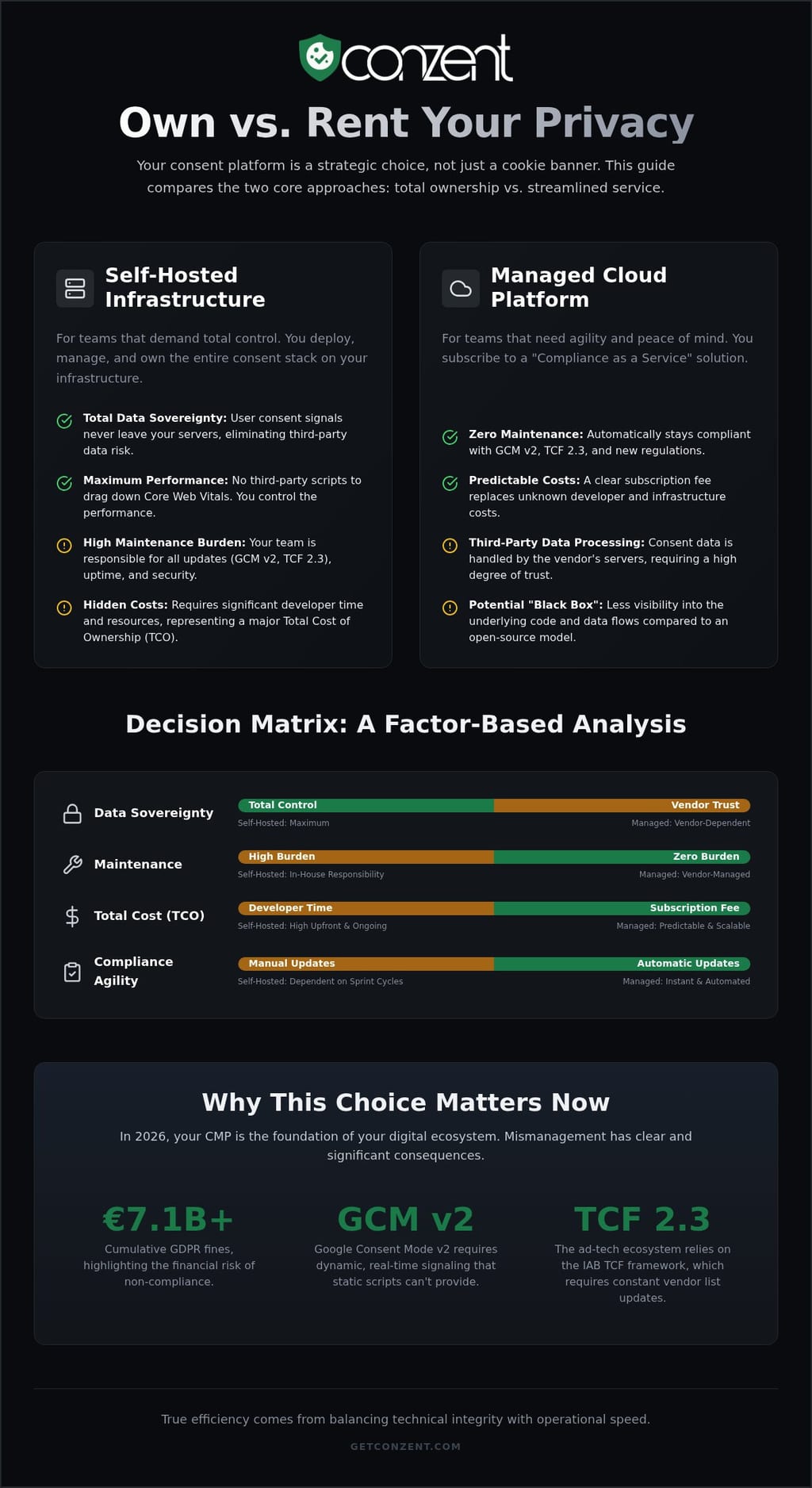
The Decision Matrix: Cost, Maintenance, and Legal Liability
Choosing between a self-hosted vs managed consent platform is a decision about where you want your team to spend their energy. It is not just about the monthly invoice. It is about Total Cost of Ownership (TCO). Many organizations view self-hosting as a "free" or "low-cost" alternative because there is no recurring SaaS fee for the software itself. This is a narrow view that ignores the reality of modern infrastructure. You must account for the hidden costs of engineering time, security patches, and the high price of downtime.
Compliance is a moving target. It requires constant vigilance. If your team is manually updating scripts every time Google or the IAB releases a new API version, you are accumulating massive technical debt. This is time that could be spent on your core product. In 2026, the choice of infrastructure is a choice of focus. You are either building your business or you are maintaining a cookie banner.
Total Cost of Ownership (TCO) Comparison
Calculate the true cost of maintenance. If a senior developer spends just four hours a month on infrastructure updates, the internal cost often exceeds a standard managed subscription. There is also the financial risk of "Consent Mode" errors. If your self-hosted script fails to communicate correctly with Google's servers, your ad spend efficiency drops immediately. You aren't just losing user data; you are wasting your marketing budget on unoptimized traffic. Managed platforms mitigate this risk through automated testing and 99.9% uptime guarantees. To find a model that balances these costs without the typical SaaS markup, explore our Pricing Page to see how sponsorships keep compliance affordable.
Legal Liability and Audit Trails
Legal risk is the final, most critical pillar. If a regulator questions a user's consent status, the burden of proof is on you. Building a legally defensible audit trail in a self-hosted environment is a significant technical challenge. You must ensure that every consent signal is timestamped and stored in an immutable log. In 2026, regulators in states like Indiana and Rhode Island prioritize these immutable records during audits. Managed platforms provide these "Audit-Ready" logs automatically. They handle the storage and verification of consent signals, ensuring you have a clear paper trail if a dispute arises. You can view our managed plans to see how we automate this legal transparency for your peace of mind.
Conzent: Bridging the Gap Between Open Infrastructure and Managed Service
Conzent does not just sell software. We provide a public good. Privacy is a fundamental right. It is not a premium feature. Our "Principled Privacy" approach removes the barriers that usually separate technical control from operational ease. The debate over a self-hosted vs managed consent platform usually ends in a compromise, but it doesn't have to. We offer a path, not a cage. Whether you need the absolute data sovereignty of our Open Consent Infrastructure (OCI) or the zero-maintenance speed of our Managed Cloud Consent Platform, the choice is yours.
Many vendors force a binary choice: total ownership with high maintenance or a proprietary black box with high fees. Conzent bridges this gap. Our infrastructure is source-available. You can inspect the engine even if we are the ones running it for you. This transparency is the core of our mission. It ensures that compliance is never a mystery. By choosing Conzent, you are investing in a self-hosted vs managed consent platform strategy that respects both your developers and your marketing team.
Why Conzent is the Disruptor in Consent Management
We are community advocates for digital rights. We avoid the corporate coldness that defines most SaaS vendors. Our mission is to democratize privacy. We do this through an egalitarian model that treats every user with respect. Conzent’s unique sponsorship pricing model allows us to lower compliance costs by partnering with ethical organizations that want to support a more transparent web. This isn't about selling data. It's about funding infrastructure that works for everyone. We believe that privacy should be a standard, not a luxury. By leveraging sponsorships, we provide high-performance compliance tools that remain attainable regardless of your resource levels. It is a community-focused ecosystem, not a cold corporate vendor.
Starting Your Journey: From Self-Hosted to Managed
Your needs will change as you scale. You might start with a Self-Hosted Cookie Consent Manager to maintain total control over your early data flows. As your traffic grows, the maintenance burden of IAB TCF v2.3 and Google Consent Mode v2 might become too heavy for your internal team. We make the transition effortless.
Migration is seamless. You can move to our Managed Cloud Consent Platform without losing your configurations or historical data. You gain access to premium support and automated infrastructure maintenance while keeping the transparency of our source-available code. This transition removes the technical weight of managing Docker containers or server-side databases yourself. You get the same principled privacy with none of the maintenance debt. Stop fighting with complex API versioning and start focusing on your mission. Get started with Conzent today and join a community that values digital rights as much as you do.
Own Your Privacy Infrastructure
Privacy is not a legal hurdle to clear. It is a technical foundation to build upon. Your choice between a self-hosted vs managed consent platform defines your relationship with your users. You can prioritize the total data sovereignty of our Open Consent Infrastructure or the streamlined efficiency of our Managed Cloud. Both options eliminate compliance debt and ensure you are ready for the future of digital rights. Ownership of your data is a standard, not a luxury.
We provide the tools to make this attainable for everyone. Our platform is IAB TCF 2.3 Certified and Google Consent Mode v2 Ready. Built with Danish Privacy Engineering, it offers the transparency you need and the speed your users deserve. You don't have to choose between ethics and performance. You can have both.
Take the next step toward principled data management. Choose your path to compliance. Try Conzent Managed Cloud or Self-Host for Free. Building a trustworthy digital ecosystem starts with the right infrastructure. We are here to help you build it.
Frequently Asked Questions
Is a self-hosted consent manager really more private than a managed one?
Yes, because user data stays exclusively on your hardware. In a self-hosted vs managed consent platform comparison, self-hosting provides the ultimate level of data sovereignty. You don't have to trust a third-party vendor's storage practices because you own the logs and the infrastructure. This setup prevents third-party data leaks and ensures signals never leave your controlled environment during processing. It turns privacy from a promise into a technical reality.
Does self-hosting a CMP affect my website's loading speed?
It can improve speed if configured correctly. Self-hosting removes the need to fetch scripts from a third-party domain, which reduces DNS lookups and TLS handshakes. However, if your server is underpowered or poorly optimized, it could introduce latency. Our Open Consent Infrastructure is built for high performance, ensuring that privacy requirements don't compromise your Core Web Vitals or user experience. You gain speed by keeping everything in-house.
Can I use Google Consent Mode v2 with a self-hosted platform?
You can. Our Open Consent Infrastructure is fully ready for Google Consent Mode v2. It allows your self-hosted setup to communicate user choices directly to Google's APIs. This ensures you maintain accurate conversion tracking and ad spend efficiency without relying on a cloud provider. You get the control of a self-hosted environment with the technical capabilities required by the modern ad-tech ecosystem. It's a professional standard for 2026.
What are the main maintenance tasks for a self-hosted cookie banner?
Maintenance involves several core responsibilities:
- Monitoring and applying security patches to your server and Docker containers.
- Updating the platform when APIs like IAB TCF 2.3 or Google Consent Mode v2 change.
- Managing your own database backups and immutable audit logs.
These tasks ensure your infrastructure remains secure and compliant as global privacy standards evolve throughout 2026. This ongoing commitment is the primary cost of total data ownership.
Is Conzent's managed platform GDPR compliant?
Absolutely. Compliance is our standard, not a premium feature. We are a Danish-based company, which means we adhere to the highest global privacy standards. Our Managed Cloud Consent Platform includes automated audit trails and immutable consent logs that help you meet strict regulatory requirements. These features provide the documentation you need for potential audits. We handle the technical complexity so you can focus on your business with peace of mind.
How does the sponsorship model reduce my monthly SaaS fees?
We treat privacy as a public good. Our sponsorship model partners with ethical organizations that fund the development and maintenance of our infrastructure. These partnerships allow us to offer high-performance compliance tools at a lower cost to our users. Instead of passing every operational expense to you, we use corporate sponsorships to keep our Managed Cloud accessible. It is an egalitarian approach to digital rights that makes compliance attainable for everyone.
Can I switch from self-hosted to managed without losing my data?
Yes, the transition is seamless. You can migrate your existing configurations and historical consent data from our Open Consent Infrastructure to our Managed Cloud. This allows you to start with total sovereignty and move to a zero-maintenance model as your traffic scales. You keep the transparency of our source-available code while gaining the benefit of our managed infrastructure and premium support. It is the perfect path for growing organizations.
Does Conzent support IAB TCF 2.3 in both versions?
Yes, IAB TCF 2.3 support is integrated into both our self-hosted and managed offerings. Whether you are weighing a self-hosted vs managed consent platform, you will have access to the latest ad-tech compliance standards. Our platform is an IAB TCF 2.3 Certified CMP. This ensures your site can communicate user preferences to thousands of vendors across the global advertising ecosystem without technical friction. You get the same technical integrity in either version.