Server-Side Cookie Consent: The Architect’s Guide to First-Party Compliance
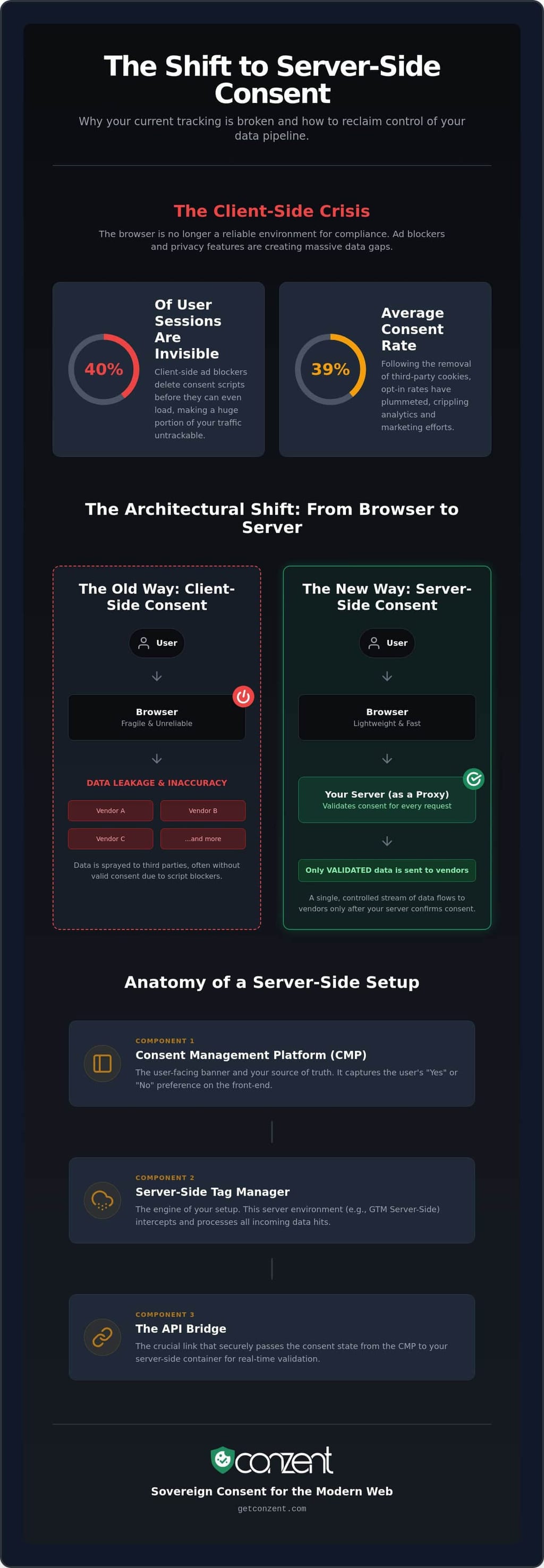
Over 40% of user sessions in key markets are now invisible to standard tracking because client-side ad blockers simply delete your consent scripts before they even load. It's a hard truth for technical leaders; the browser is no longer a reliable place to manage your privacy infrastructure. You've likely seen your analytics data plummet as average cookie consent rates dropped to just 39% following the removal of third-party cookies in Chrome. This isn't just a minor data gap. It's a loss of control.
We agree that the current client-side model is broken. It's fragile and slow. It puts your compliance at the mercy of browser updates and third-party script bloat. Transitioning to server side cookie consent isn't a luxury; it's the only way to reclaim data accuracy and own your privacy stack. This guide provides the blueprint to move your logic to the server so you can recover lost data while staying 100% GDPR compliant. We'll explore how to replace fragile browser scripts with a robust architecture that improves performance and future-proofs your infrastructure against further browser restrictions.
Key Takeaways
- Stop relying on fragile browser environments. Learn to move your consent validation logic to a secure, server-side infrastructure.
- Master the technical request flow of server side cookie consent to ensure data only moves after a verified validation check.
- Reclaim your site performance by eliminating heavy client-side scripts that bloat your front-end and hurt your SEO metrics.
- Follow a practical roadmap for migrating your tracking tags to a more resilient managed cloud or self-hosted environment.
- Shift from a vendor-dependent model to a sovereign data strategy built on transparent, source-available code.
What is Server-Side Cookie Consent?
Server-side cookie consent is the strategic relocation of your compliance logic. It moves the "permission gate" from the user's volatile browser to your own controlled infrastructure. Traditionally, businesses relied on the browser to execute consent scripts and block tracking tags. This approach is now failing. In a server-side model, your server acts as the primary validator. It intercepts data before it ever reaches a third-party vendor; ensuring that information only flows if a valid consent signal exists.
The 2026 digital landscape has made this shift a necessity rather than a luxury. With average consent rates dropping to 39% and ad blockers neutralizing scripts in over 40% of sessions; the client-side model is too brittle to support a professional data strategy. Relying on the browser means you're building your house on someone else's shifting sand. Moving to server side cookie consent is about reclaiming sovereignty over your data pipeline. It is a move from passive collection to intentional, server-verified stewardship.
The Core Difference: Client vs. Server Logic
In a client-side setup, the browser is the gatekeeper. This gatekeeper is often biased or broken by privacy extensions and Intelligent Tracking Prevention (ITP). If the browser fails to load your consent banner, tracking might fire anyway, or legitimate data might be lost. In a server-side setup, your infrastructure is the gatekeeper. No data is dispatched to Google, Meta, or LinkedIn until your server confirms the user's choice.
There is a common myth that server-side tracking allows you to bypass the need for a banner. This is false. Transparency is not optional. Server-side architecture does not mean "banner-less" tracking; it means your banner's instructions are actually respected at the source. It ensures that an HTTP cookie is only set or read when the user has explicitly allowed it, providing a much higher level of legal certainty.
Key Components of a Server-Side Setup
A robust server-side architecture requires three foundational elements to function effectively:
- The Consent Management Platform (CMP): This remains your source of truth for user preferences. It captures the "Yes" or "No" on the front end.
- The Server-Side Tag Manager: This is the engine. Whether you use GTM Server-side or an Open Consent Infrastructure (OCI), this environment processes the data hits.
- The API Bridge: This connects your CMP to your server-side container, passing the consent state along with every data event to ensure real-time validation.
By centralizing this logic, you eliminate the "JavaScript tax" on your site's performance while gaining a definitive audit trail for GDPR compliance. You aren't just following the rules; you're building a system that makes the rules impossible to break.
The Technical Architecture: How Server-Side Consent Functions
Understanding the architecture is the first step toward implementation. When a user interacts with your site, the data flow doesn't immediately exit to a third-party vendor. Instead, it hits your server first. This server acts as a secure proxy. It validates the user's consent state before a single data packet leaves your domain. This setup allows you to achieve better privacy compliance with server-side tracking by masking IP addresses and stripping away sensitive user-agent strings that could lead to unauthorized fingerprinting.
The request flow is straightforward but powerful. A user action triggers an event. Your server-side container intercepts this event and checks the current consent status stored in a first-party cookie or a server-side session. If the user has declined tracking, the server terminates the request. The vendor never sees the hit. For teams operating within the Google ecosystem, integrating Google Consent Mode v2 is essential. It enables modeled data recovery, ensuring you maintain measurement accuracy even when users opt out of traditional tracking.
Hybrid vs. Pure Server-Side Implementations
Most organizations find the Hybrid model most effective for their tech stack. It utilizes a standard browser-based banner to collect the user's choice, which then communicates that state directly to a server-side container. It's a pragmatic balance of front-end ease and back-end control. A Pure Server-Side implementation handles the entire UI and logic via server-side rendering (SSR). While this model is more complex to build, it offers the highest level of performance and data sovereignty. It removes almost all third-party JavaScript from the client, which is a massive win for site speed.
Security and Data Redaction
Security is where server side cookie consent proves its value. You can redact PII (Personally Identifiable Information) on your own hardware before sending any data to external partners. This creates a "Clean Room" environment where only anonymized, consented data survives the journey. It's a proactive defense against data leaks. To maintain industry alignment, it's vital to ensure your CMP is IAB TCF 2.3 certified. This certification ensures your server-side logic respects the latest transparency and consent frameworks required by global ad exchanges.
Building this infrastructure doesn't have to be a multi-month engineering project. If you're looking for a platform that simplifies this transition, you can view our transparent pricing to see how we help architects scale their privacy efforts.
Why Move Consent to the Server? The Strategic Benefits
The move to the server isn't just a technical upgrade. It is a strategic pivot. By shifting the logic away from the browser, you eliminate the single point of failure that compromises most privacy setups. This shift delivers three primary advantages: data integrity, site performance, and absolute governance over your data pipeline. You aren't just following rules; you're building a more resilient business.
Site speed is no longer a luxury; it is a search engine requirement. Every third-party script you load in the browser adds to the "JavaScript tax" that slows down your page and frustrates your users. By moving this processing to the server, you significantly reduce the front-end load, directly improving your Core Web Vitals. Beyond speed, server-side logic provides a firewall against data leakage. You decide exactly which data points reach each vendor, ensuring that no unauthorized PII (Personally Identifiable Information) slips through the cracks of a browser-based container.
Understanding the financial stakes is equally important. Many businesses operate in the dark, unaware of the tracking they lose to technical friction and browser restrictions. Using revenue impact analytics allows you to quantify exactly what you were missing. It turns compliance from a cost center into a data recovery engine, proving that ethical data collection is also more profitable.
Bypassing the "Ad Blocker Trap"
Ad blockers and privacy extensions are more aggressive than ever. Research from 2025 shows that over 40% of sessions in key markets are now blocked by client-side tools. Many of these users are perfectly willing to consent, but your browser-based banner never even loads to ask them. This creates a massive hole in your attribution data for paid media spend, making your marketing look less effective than it actually is.
When you implement server side cookie consent, the validation happens on your own hardware, making it immune to browser-based script blockers that would otherwise skew your opt-in rates. You stop being invisible to your most privacy-conscious users while maintaining full legal integrity. It ensures that a "Yes" from the user is actually recorded and respected, regardless of which browser extensions they use.
Ownership of the Consent Signal
Most consent tools are "black boxes." They own your logs, your data, and the infrastructure that manages your legal liability. This creates a dangerous dependency. Moving to an Open Consent Infrastructure ensures that you own the consent signal from start to finish. It is about long-term sovereignty, not temporary workarounds.
You shouldn't have to choose between scalability and transparency. A Managed Cloud Consent Platform offers the best of both worlds; providing the power of the cloud without the opacity of traditional SaaS vendors. This approach ensures your privacy infrastructure remains an asset you control, not a liability you rent from a distant provider.
Implementation Roadmap: Setting Up Server-Side Consent
Deploying server side cookie consent requires a methodical shift in how you view your data pipeline. It is not a "set and forget" plugin installation. It is an engineering project that centralizes your privacy logic. You are moving from a reactive browser model to a proactive server model. This roadmap ensures your transition is both technically sound and legally resilient.
- Step 1: Audit your tags. Review your current client-side container. Identify which tags handle sensitive PII and which are essential for site functionality. Not every script needs to move to the server on day one; prioritize high-value analytics and advertising pixels.
- Step 2: Deploy infrastructure. Decide between a Managed Cloud environment for ease of use or a Self-Hosted infrastructure for maximum data residency control. Your choice here dictates your long-term maintenance overhead.
- Step 3: Configure your CMP. Your Consent Management Platform must be able to broadcast the user's choice. This is usually done via a first-party cookie or a direct API call that your server container can read in real-time.
- Step 4: Map consent signals. Create triggers in your server-side container that correspond to specific consent categories. For example, ensure your Google Analytics 4 tags only fire when the "analytics_storage" signal is explicitly granted.
- Step 5: Validate and debug. Use server logs to confirm that data is being redacted or blocked as expected. With 67% of Consent Mode v2 setups failing to meet compliance standards in 2025, rigorous validation using A/B testing is the only way to guarantee accuracy.
Choosing Your Infrastructure
The infrastructure you choose defines your relationship with your data. A Managed Cloud Consent Platform offers zero maintenance and automatic updates. It is the egalitarian choice for teams that want high-tier privacy without a dedicated DevOps squad. Conversely, self-hosting provides the ultimate level of sovereignty. It eliminates vendor lock-in and keeps your data logs entirely within your own perimeter. For a deeper dive into these options, read our Ultimate Guide to Self-Hosted Cookie Consent Managers in 2026.
Debugging Server-Side Signals
Debugging on the server is different from the browser. You can't just open the browser console to see what's happening. Common pitfalls include cookie syncing issues where the server doesn't recognize the user's previous choice, leading to data gaps. Use the preview modes in your server container to inspect every incoming request. Consent Passthrough is the process of relaying the user's consent status from the client side to the server container so the server knows exactly which tags it is permitted to fire. Without this passthrough, your server is flying blind.
Ready to reclaim your data accuracy? You can view our transparent pricing to find the infrastructure that fits your scale.
Conzent: Sovereign Consent for the Modern Web
Conzent is built on the principle that high-tier privacy infrastructure should not be a luxury reserved for those with massive engineering budgets. It is a necessary standard for any business that values data integrity and user rights. We don't believe in "black box" solutions that hide logic behind proprietary walls. Our mission is to democratize server side cookie consent by providing a transparent, source-available foundation that invites scrutiny and collaboration. You shouldn't have to trust a vendor blindly; you should be able to verify the code that manages your legal liability.
Our platform bridges the gap between the user's browser and your secure server infrastructure. While legacy tools struggle with script-blocking and data loss, Conzent ensures your consent signals are captured accurately and enforced at the source. It is about moving from a fragile, client-side dependence to a robust, sovereign data strategy. Our Managed Cloud Consent Platform delivers enterprise-grade performance and automatic updates; removing the DevOps headache while keeping you 100% compliant with global regulations like GDPR and the India DPDP Act.
From Compliance to Optimization
Compliance is the floor, not the ceiling. Once your infrastructure is secure, you can move from merely "avoiding fines" to active optimization. By using Consent A/B Testing, you can identify which banner designs respect user choice while maintaining high opt-in rates. This isn't about manipulation; it's about clarity. Combined with Revenue Impact Analytics, you can finally justify your privacy spend to stakeholders by showing exactly how much data you've recovered. For those focused on site speed, our lightweight cookie consent scripts ensure that your compliance layer never hurts your Core Web Vitals.
Getting Started with Conzent
Transitioning from a legacy CMP to a modern, server-side ready platform is a straightforward process with the right partner. We provide the tools to map your existing tags and migrate them to a more resilient environment without disrupting your current workflows. Whether you require a managed cloud solution or prefer the total control of a self-hosted setup, we have a model that fits your technical requirements. You can explore our pricing and sponsorship models to find the right entry point for your scale. Don't let browser restrictions dictate your data strategy. Build your Open Consent Infrastructure with Conzent today.
Reclaim Your Data Sovereignty
The browser is no longer a reliable environment for your privacy strategy. By adopting server side cookie consent, you move beyond fragile client-side workarounds and build a foundation based on technical certainty. This proactive approach to data security is often complemented by Managed MXDR services UK, which offer deeper visibility and protection for your broader infrastructure. You've seen how this shift recovers lost attribution data and slashes the performance-killing JavaScript tax on your front-end. It's a fundamental move from renting your compliance from a black-box vendor to owning your own infrastructure.
Achieving true digital sovereignty often requires looking beyond technical infrastructure to manage your existing online footprint. For those who need to address historical data issues or protect their brand's digital presence, Content Removal provides expert assistance in eliminating harmful or unwanted online content.
True data sovereignty shouldn't be complicated or opaque. Whether you require the ease of a Managed Cloud or the total control of a Self-Hosted Open Consent Infrastructure, you deserve a system built on source-available transparency. Our platform ensures you remain fully GDPR and IAB TCF v2.3 compliant while maintaining the flexibility your tech stack demands. You don't have to choose between speed and responsibility. It's time to treat privacy as a core component of your architecture rather than a front-end afterthought.
Start your journey toward Open Consent Infrastructure today. Build a resilient future where your data accuracy and your users' privacy are finally on the same side.
Frequently Asked Questions
Do I still need a cookie banner if I use server-side tracking?
Yes, you still need a visible banner to collect the user's initial choice. Server-side tracking is a method of processing data, not a legal loophole to bypass transparency requirements. You must provide a clear interface for users to opt in or out before any data is sent to your server-side container. The law requires informed consent regardless of where the technical validation happens.
Is server-side cookie consent more GDPR compliant than client-side?
It offers a higher degree of control by preventing "data leakage" where scripts might fire before consent is fully loaded in the browser. Because you own the server, you have a definitive audit trail of how data was handled. This centralized governance makes it easier to prove compliance than the chaotic and often biased environment of a user's browser.
How does server-side consent interact with Google Consent Mode v2?
Your server-side container reads the GCM v2 flags passed from the client and decides whether to forward the hit to Google's servers. It can also send a "cookieless ping" for modeled data if the user opts out. This ensures your server side cookie consent setup remains compatible with Google's mandatory 2024 requirements for European advertisers while maintaining measurement accuracy.
Will moving to server-side consent improve my website speed?
Yes, moving consent logic and tag execution to the server reduces the "JavaScript tax" on your front-end. By offloading heavy processing to your own infrastructure, you decrease the main-thread work in the browser. This leads to faster page loads and improved Core Web Vitals; which is a direct benefit for both your SEO rankings and your user experience.
Can ad blockers still block server-side consent signals?
No, most ad blockers cannot see the communication between your website and your own first-party server. Since the data flows to a domain you control, it is not flagged as a third-party tracking script. This allows you to recover data from the 40% of sessions typically lost to client-side blockers while still strictly respecting the user's actual consent choice.
What is the cost difference between managed cloud and self-hosted server-side consent?
Managed cloud options involve a recurring fee that covers infrastructure maintenance, scaling, and automatic updates. Self-hosting requires you to manage your own server costs and internal engineering resources. While self-hosting offers maximum sovereignty and no vendor lock-in, it demands a higher level of technical expertise to maintain the infrastructure over the long term.
How do I handle third-party scripts that don’t support server-side APIs?
You can use a hybrid approach where you keep legacy scripts on the client-side while moving modern tags to the server. Your CMP serves as the central orchestrator, sending a "kill switch" signal to both environments simultaneously. This ensures that even scripts running in the browser only fire when the server-verified consent state allows it, maintaining a unified compliance posture.
What happens to my data if the server-side CMP goes down?
Your architecture should include a fail-safe logic that defaults to a "denied" state if the CMP is unreachable. This means no non-essential data is processed until a valid consent signal is confirmed. High-availability managed cloud platforms minimize this risk; but a principled setup always prioritizes user privacy over data collection in the event of a system failure.
Frequently Asked Questions
The Core Difference: Client vs. Server Logic
In a client-side setup, the browser is the gatekeeper. This gatekeeper is often biased or broken by privacy extensions and Intelligent Tracking Prevention (ITP). If the browser fails to load your consent banner, tracking might fire anyway, or legitimate data might be lost. In a server-side setup, your infrastructure is the gatekeeper. No data is dispatched to Google, Meta, or LinkedIn until your server confirms the user's choice. There is a common myth that server-side tracking allows you to bypass the need for a banner. This is false. Transparency is not optional. Server-side architecture does not mean "banner-less" tracking; it means your banner's instructions are actually respected at the source. It ensures that an HTTP cookie is only set or read when the user has explicitly allowed it, providing a much higher level of legal certainty.
Key Components of a Server-Side Setup
A robust server-side architecture requires three foundational elements to function effectively: By centralizing this logic, you eliminate the "JavaScript tax" on your site's performance while gaining a definitive audit trail for GDPR compliance. You aren't just following the rules; you're building a system that makes the rules impossible to break. Understanding the architecture is the first step toward implementation. When a user interacts with your site, the data flow doesn't immediately exit to a third-party vendor. Instead, it hits your server first. This server acts as a secure proxy. It validates the user's consent state before a single data packet leaves your domain. This setup allows you to achieve better privacy compliance with server-side tracking by masking IP addresses and stripping away sensitive user-agent strings that could lead to unauthorized fingerprinting. The request flow is straightforward but powerful. A user action triggers an event. Your server-side container intercepts this event and checks the current consent status stored in a first-party cookie or a server-side session. If the user has declined tracking, the server terminates the request. The vendor never sees the hit. For teams operating within the Google ecosystem, integrating Google Consent Mode v2 is essential. It enables modeled data recovery, ensuring you maintain measurement accuracy even when users opt out of traditional tracking.
Hybrid vs. Pure Server-Side Implementations
Most organizations find the Hybrid model most effective for their tech stack. It utilizes a standard browser-based banner to collect the user's choice, which then communicates that state directly to a server-side container. It's a pragmatic balance of front-end ease and back-end control. A Pure Server-Side implementation handles the entire UI and logic via server-side rendering (SSR). While this model is more complex to build, it offers the highest level of performance and data sovereignty. It removes almost all third-party JavaScript from the client, which is a massive win for site speed.
Security and Data Redaction
Security is where server side cookie consent proves its value. You can redact PII (Personally Identifiable Information) on your own hardware before sending any data to external partners. This creates a "Clean Room" environment where only anonymized, consented data survives the journey. It's a proactive defense against data leaks. To maintain industry alignment, it's vital to ensure your CMP is IAB TCF 2.3 certified. This certification ensures your server-side logic respects the latest transparency and consent frameworks required by global ad exchanges. Building this infrastructure doesn't have to be a multi-month engineering project. If you're looking for a platform that simplifies this transition, you can view our transparent pricing to see how we help architects scale their privacy efforts. The move to the server isn't just a technical upgrade. It is a strategic pivot. By shifting the logic away from the browser, you eliminate the single point of failure that compromises most privacy setups. This shift delivers three primary advantages: data integrity, site performance, and absolute governance over your data pipeline. You aren't just following rules; you're building a more resilient business. Site speed is no longer a luxury; it is a search engine requirement. Every third-party script you load in the browser adds to the "JavaScript tax" that slows down your page and frustrates your users. By moving this processing to the server, you significantly reduce the front-end load, directly improving your Core Web Vitals. Beyond speed, server-side logic provides a firewall against data leakage. You decide exactly which data points reach each vendor, ensuring that no unauthorized PII (Personally Identifiable Information) slips through the cracks of a browser-based container. Understanding the financial stakes is equally important. Many businesses operate in the dark, unaware of the tracking they lose to technical friction and browser restrictions. Using revenue impact analytics allows you to quantify exactly what you were missing. It turns compliance from a cost center into a data recovery engine, proving that ethical data collection is also more profitable.
Bypassing the "Ad Blocker Trap"
Ad blockers and privacy extensions are more aggressive than ever. Research from 2025 shows that over 40% of sessions in key markets are now blocked by client-side tools. Many of these users are perfectly willing to consent, but your browser-based banner never even loads to ask them. This creates a massive hole in your attribution data for paid media spend, making your marketing look less effective than it actually is. When you implement server side cookie consent, the validation happens on your own hardware, making it immune to browser-based script blockers that would otherwise skew your opt-in rates. You stop being invisible to your most privacy-conscious users while maintaining full legal integrity. It ensures that a "Yes" from the user is actually recorded and respected, regardless of which browser extensions they use.
Ownership of the Consent Signal
Most consent tools are "black boxes." They own your logs, your data, and the infrastructure that manages your legal liability. This creates a dangerous dependency. Moving to an Open Consent Infrastructure ensures that you own the consent signal from start to finish. It is about long-term sovereignty, not temporary workarounds. You shouldn't have to choose between scalability and transparency. A Managed Cloud Consent Platform offers the best of both worlds; providing the power of the cloud without the opacity of traditional SaaS vendors. This approach ensures your privacy infrastructure remains an asset you control, not a liability you rent from a distant provider. Deploying server side cookie consent requires a methodical shift in how you view your data pipeline. It is not a "set and forget" plugin installation. It is an engineering project that centralizes your privacy logic. You are moving from a reactive browser model to a proactive server model. This roadmap ensures your transition is both technically sound and legally resilient.
Choosing Your Infrastructure
The infrastructure you choose defines your relationship with your data. A Managed Cloud Consent Platform offers zero maintenance and automatic updates. It is the egalitarian choice for teams that want high-tier privacy without a dedicated DevOps squad. Conversely, self-hosting provides the ultimate level of sovereignty. It eliminates vendor lock-in and keeps your data logs entirely within your own perimeter. For a deeper dive into these options, read our Ultimate Guide to Self-Hosted Cookie Consent Managers in 2026.
Debugging Server-Side Signals
Debugging on the server is different from the browser. You can't just open the browser console to see what's happening. Common pitfalls include cookie syncing issues where the server doesn't recognize the user's previous choice, leading to data gaps. Use the preview modes in your server container to inspect every incoming request. Consent Passthrough is the process of relaying the user's consent status from the client side to the server container so the server knows exactly which tags it is permitted to fire. Without this passthrough, your server is flying blind. Ready to reclaim your data accuracy? You can view our transparent pricing to find the infrastructure that fits your scale. Conzent is built on the principle that high-tier privacy infrastructure should not be a luxury reserved for those with massive engineering budgets. It is a necessary standard for any business that values data integrity and user rights. We don't believe in "black box" solutions that hide logic behind proprietary walls. Our mission is to democratize server side cookie consent by providing a transparent, source-available foundation that invites scrutiny and collaboration. You shouldn't have to trust a vendor blindly; you should be able to verify the code that manages your legal liability. Our platform bridges the gap between the user's browser and your secure server infrastructure. While legacy tools struggle with script-blocking and data loss, Conzent ensures your consent signals are captured accurately and enforced at the source. It is about moving from a fragile, client-side dependence to a robust, sovereign data strategy. Our Managed Cloud Consent Platform delivers enterprise-grade performance and automatic updates; removing the DevOps headache while keeping you 100% compliant with global regulations like GDPR and the India DPDP Act.
From Compliance to Optimization
Compliance is the floor, not the ceiling. Once your infrastructure is secure, you can move from merely "avoiding fines" to active optimization. By using Consent A/B Testing, you can identify which banner designs respect user choice while maintaining high opt-in rates. This isn't about manipulation; it's about clarity. Combined with Revenue Impact Analytics, you can finally justify your privacy spend to stakeholders by showing exactly how much data you've recovered. For those focused on site speed, our lightweight cookie consent scripts ensure that your compliance layer never hurts your Core Web Vitals.
Getting Started with Conzent
Transitioning from a legacy CMP to a modern, server-side ready platform is a straightforward process with the right partner. We provide the tools to map your existing tags and migrate them to a more resilient environment without disrupting your current workflows. Whether you require a managed cloud solution or prefer the total control of a self-hosted setup, we have a model that fits your technical requirements. You can explore our pricing and sponsorship models to find the right entry point for your scale. Don't let browser restrictions dictate your data strategy. Build your Open Consent Infrastructure with Conzent today. The browser is no longer a reliable environment for your privacy strategy. By adopting server side cookie consent, you move beyond fragile client-side workarounds and build a foundation based on technical certainty. You've seen how this shift recovers lost attribution data and slashes the performance-killing JavaScript tax on your front-end. It's a fundamental move from renting your compliance from a black-box vendor to owning your own infrastructure. True data sovereignty shouldn't be complicated or opaque. Whether you require the ease of a Managed Cloud or the total control of a Self-Hosted Open Consent Infrastructure, you deserve a system built on source-available transparency. Our platform ensures you remain fully GDPR and IAB TCF v2.3 compliant while maintaining the flexibility your tech stack demands. You don't have to choose between speed and responsibility. It's time to treat privacy as a core component of your architecture rather than a front-end afterthought. Start your journey toward Open Consent Infrastructure today. Build a resilient future where your data accuracy and your users' privacy are finally on the same side.
Do I still need a cookie banner if I use server-side tracking?
Yes, you still need a visible banner to collect the user's initial choice. Server-side tracking is a method of processing data, not a legal loophole to bypass transparency requirements. You must provide a clear interface for users to opt in or out before any data is sent to your server-side container. The law requires informed consent regardless of where the technical validation happens.
Is server-side cookie consent more GDPR compliant than client-side?
It offers a higher degree of control by preventing "data leakage" where scripts might fire before consent is fully loaded in the browser. Because you own the server, you have a definitive audit trail of how data was handled. This centralized governance makes it easier to prove compliance than the chaotic and often biased environment of a user's browser.
How does server-side consent interact with Google Consent Mode v2?
Your server-side container reads the GCM v2 flags passed from the client and decides whether to forward the hit to Google's servers. It can also send a "cookieless ping" for modeled data if the user opts out. This ensures your server side cookie consent setup remains compatible with Google's mandatory 2024 requirements for European advertisers while maintaining measurement accuracy.
Will moving to server-side consent improve my website speed?
Yes, moving consent logic and tag execution to the server reduces the "JavaScript tax" on your front-end. By offloading heavy processing to your own infrastructure, you decrease the main-thread work in the browser. This leads to faster page loads and improved Core Web Vitals; which is a direct benefit for both your SEO rankings and your user experience.
Can ad blockers still block server-side consent signals?
No, most ad blockers cannot see the communication between your website and your own first-party server. Since the data flows to a domain you control, it is not flagged as a third-party tracking script. This allows you to recover data from the 40% of sessions typically lost to client-side blockers while still strictly respecting the user's actual consent choice.
What is the cost difference between managed cloud and self-hosted server-side consent?
Managed cloud options involve a recurring fee that covers infrastructure maintenance, scaling, and automatic updates. Self-hosting requires you to manage your own server costs and internal engineering resources. While self-hosting offers maximum sovereignty and no vendor lock-in, it demands a higher level of technical expertise to maintain the infrastructure over the long term.
How do I handle third-party scripts that don’t support server-side APIs?
You can use a hybrid approach where you keep legacy scripts on the client-side while moving modern tags to the server. Your CMP serves as the central orchestrator, sending a "kill switch" signal to both environments simultaneously. This ensures that even scripts running in the browser only fire when the server-verified consent state allows it, maintaining a unified compliance posture.
What happens to my data if the server-side CMP goes down?
Your architecture should include a fail-safe logic that defaults to a "denied" state if the CMP is unreachable. This means no non-essential data is processed until a valid consent signal is confirmed. High-availability managed cloud platforms minimize this risk; but a principled setup always prioritizes user privacy over data collection in the event of a system failure.