Shopify Cookie Consent Integration: The 2026 Guide to Compliance and Revenue
Privacy is a digital right, not a technical hurdle. Most merchants view a Shopify cookie consent integration as a tax on performance that kills their tracking and bloats their code. You've probably seen your ad measurement plummet the moment you installed a standard compliance app. It's frustrating. You feel forced to choose between following the law and hitting your revenue targets. That's a compromise we don't accept. Compliance shouldn't be a trade-off for growth.
This guide shows you how to reclaim your data and your peace of mind. You'll learn to deploy a high-performance consent platform that satisfies GCM v2 and IAB TCF 2.3 requirements without sacrificing site speed. We'll break down the Shopify Customer Privacy API and show you how to restore ad measurement through transparent, ethical infrastructure. From the latest Spring '26 platform updates to lowering your long-term costs, you're about to turn compliance into a competitive advantage. It's time to build a store that respects both your users and your bottom line; for those looking to further optimize their operational spend, you can explore net 30 vendors to source business essentials efficiently.
Key Takeaways
- Moving beyond a simple banner requires a deep shopify cookie consent integration that links your CMP directly to your store's liquid and tracking pixels.
- Effective compliance depends on proper script sequencing within Shopify's Online Store 2.0 architecture to block tracking until the user opts in.
- Reject the high costs and hidden data of traditional apps in favor of transparent, open consent infrastructure that prioritizes digital rights.
- Clean up your tracking by auditing existing tags and disabling native Shopify privacy settings that conflict with your new, granular consent platform.
- Leverage A/B testing and revenue impact analytics to find the optimal banner design that maximizes opt-ins without hurting your conversion rate.
Why Native Shopify Privacy Settings Aren’t Enough in 2026
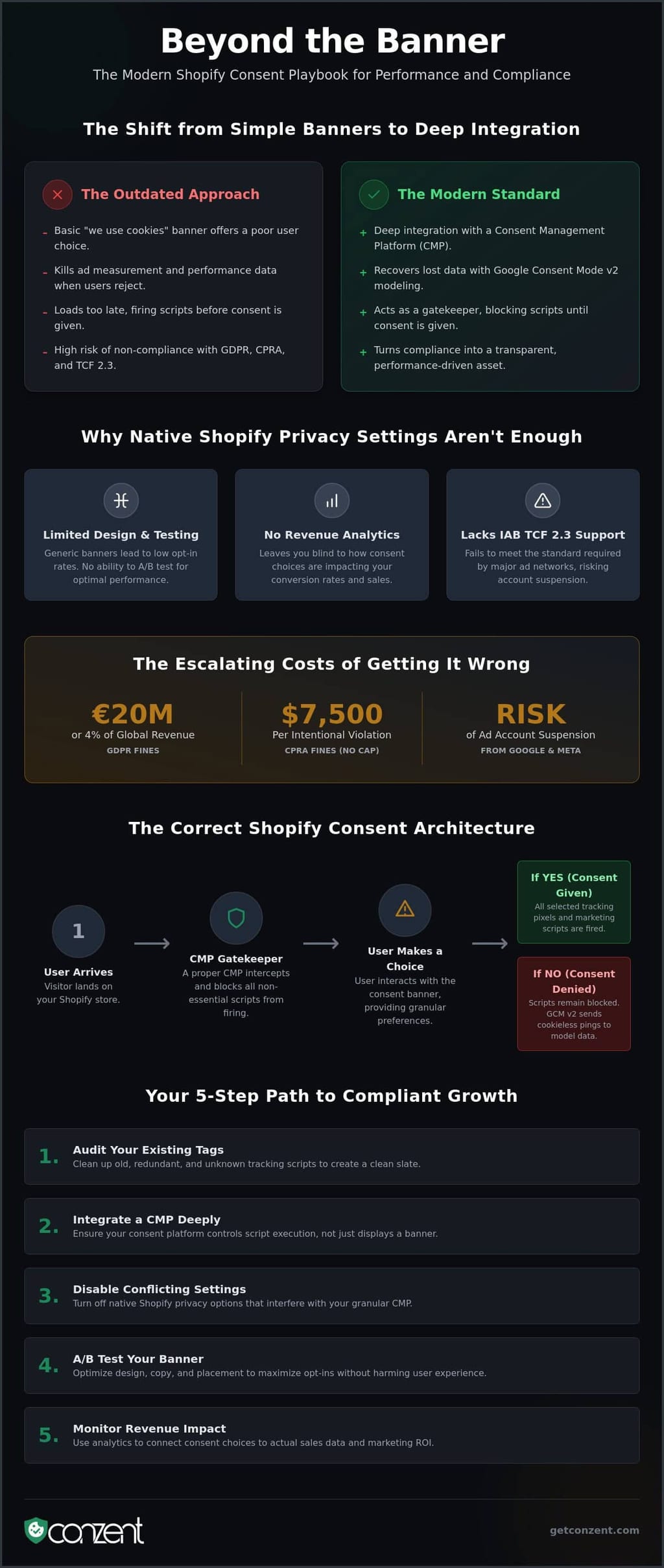
A true shopify cookie consent integration is more than a decorative banner. It is a technical bridge. This integration connects your storefront's Liquid files and tracking pixels to a centralized Consent Management Platform (CMP). In the early days of e-commerce, a simple notice was enough. Today, the legal landscape is far more rigorous. To understand why your current setup might be failing, it helps to revisit what cookies are and how they work in the context of modern tracking. Passive "we use cookies" notices no longer satisfy the law. Regulations like the GDPR and ePrivacy Directive now demand active, granular consent before a single non-essential script fires.
Many merchants rely on basic banners that offer a binary choice: block everything or allow everything. This approach is a data killer. If a visitor rejects all cookies, you lose the ability to measure your marketing performance. The 2026 standard has shifted toward a more intelligent hierarchy. This involves a full Google Consent Mode v2 implementation. This system allows you to communicate consent states directly to Google, enabling "modeled conversions" that recover lost data even when users opt out of tracking. Without this level of integration, your ad spend is effectively unmeasurable in regulated regions.
The Limitations of Shopify’s Default Tools
Shopify provides native privacy settings, but they are built for the average user, not the high-performance merchant. These default tools often lack the design flexibility required to maintain high opt-in rates; if your banner looks like a generic system alert, users will instinctively close it. More importantly, native tools offer almost zero visibility into how consent choices impact your sales revenue. You are left guessing why your conversion rate dropped. They also struggle with the IAB TCF 2.3 standards required by major ad networks, which can lead to your site being flagged for non-compliance despite your best efforts.
Global Regulations: The Cost of Getting it Wrong
The financial risks of non-compliance are concrete and escalating. As of 2026, GDPR fines can reach up to €20 million or 4% of your global annual revenue. In the United States, the CPRA imposes fines of $2,500 for unintentional violations and up to $7,500 for intentional ones. There is no aggregate cap on these penalties. However, the biggest threat is often the loss of ad account access. Platforms like Google and Meta are increasingly aggressive in suspending accounts that fail to prove valid consent strings. Achieving true GDPR compliance also means caring about data sovereignty. You must know exactly where your consent logs are stored and ensure they are accessible for audits, a requirement that most "black box" apps simply cannot meet.
Understanding the Shopify Integration Architecture for Consent
Shopify's Online Store 2.0 architecture changed the way themes handle scripts. A successful shopify cookie consent integration is no longer just about adding a banner; it's about controlling the sequence of script execution. If your marketing pixels fire before the user makes a choice, you are already out of compliance. The infrastructure must be deep. It requires a technical setup where the consent platform sits between the browser and your tracking tags. This ensures that non-essential scripts remain dormant until the visitor grants explicit permission.
Following the guidance from the UK's data protection authority, tracking cannot occur by default. Most standard Shopify apps fail here because they load too late in the page lifecycle. They act as a cosmetic layer rather than a functional gatekeeper. Choosing a managed cloud consent platform solves this by delivering consent logic from the edge. This approach is faster and more reliable than traditional apps that rely on heavy, unoptimized JavaScript. Transparency shouldn't be expensive, and you can view our clear pricing options to find a fit for your store size.
How Consent Signals Interact with Liquid and Pixels
The core of this architecture is the Shopify Customer Privacy API. This API acts as the central source of truth for a visitor's privacy preferences. Your CMP must write the consent status directly to this API so that Shopify's native pixels and integrated apps know when to stop or start tracking. You typically initialize this in your theme.liquid file to ensure it's the first thing the browser sees. The CMP script acts as a strict gatekeeper, holding third-party tags in a pending state until a valid consent signal is received. This prevents the "pixel problem" where data leaks to ad platforms before the user has even seen your banner.
The Role of Google Consent Mode v2
Google Consent Mode v2 (GCM v2) is the bridge between user privacy and your marketing performance. It doesn't just block tags; it communicates the consent state to Google's services. When a user opts out, GCM v2 sends "pings" instead of full cookies. This allows Google to use conversion modeling to fill in the gaps in your data. You recover measurement accuracy without violating the user's choice. It's a principled way to maintain your ad performance in a privacy-first world. Review our Google Consent Mode v2 checklist to verify your technical implementation and ensure no data is left on the table.
Choosing Your Path: Shopify Apps vs. Open Consent Infrastructure
Most merchants treat their shopify cookie consent integration as a "set and forget" app installation. This is the "Black Box" trap. Traditional Shopify apps often hide your consent logs behind proprietary walls. They charge high recurring fees for basic compliance. They treat your store's data as their own asset. We believe privacy tools should be accessible to everyone regardless of their budget. Our approach provides a principled, egalitarian alternative to the standard vendor model. We offer infrastructure, not just another subscription. This is about establishing a necessary standard for the internet, not selling a premium luxury.
The choice between a managed service and self-hosted infrastructure depends on your resources. It is not a choice between "good" and "bad" compliance. Both paths ensure you meet global standards. The difference lies in who owns the keys to the kingdom. Transparency is the default. We invite you to scrutinize the code and the data flow. This level of openness is what distinguishes a community-focused provider from a distant vendor hiding behind technical complexity.
Managed Cloud: Speed and Simplicity
A managed service is the best fit for 90% of Shopify merchants. It removes the DevOps overhead while ensuring your store stays compliant. Laws change constantly. GDPR requirements and IAB TCF 2.3 standards evolve without warning. Our managed cloud platform handles these updates automatically. You don't need to manually intervene every time a regulator issues new guidance. We also operate on a unique model where sponsorships actively lower the cost of your compliance over time. It is a community-focused approach to a global technical requirement. You get professional hosting with zero maintenance and transparent pricing that respects your bottom line.
Self-Hosted OCI: The Developer’s Choice
For high-volume stores and technical teams, data sovereignty is non-negotiable. You shouldn't have to trust a third-party vendor with your visitors' privacy decisions. You can choose to self-host your CMP using our Open Consent Infrastructure (OCI). This path gives you total control over the logs, the database, and the underlying infrastructure. It eliminates vendor lock-in completely. By using source-available code, you ensure that your shopify cookie consent integration remains a permanent part of your technical stack. This is the ultimate choice for stores with custom DevOps setups that require deep integration, maximum performance, and absolute intellectual honesty about their data practices.
Step-by-Step: Integrating a Robust Consent Platform with Shopify
A successful shopify cookie consent integration follows a methodical sequence. It is not a matter of clicking a single button and hoping for the best. You are building infrastructure that must withstand regulatory scrutiny and technical audits. This process ensures that your store respects user rights while maintaining the data flow necessary for growth. Follow these five steps to deploy a principled consent framework.
- Step 1: Audit your environment. Identify every tag, pixel, and cookie currently active on your store. You cannot manage what you haven't documented.
- Step 2: Disable conflicting tools. Navigate to your Shopify Admin and turn off native tracking settings that might fire scripts before your CMP has gathered a decision.
- Step 3: Inject the infrastructure. Place your Conzent script into the
<head>of your theme.liquid file or utilize a custom pixel for deeper isolation. - Step 4: Map your signals. Align your consent categories, such as Marketing and Analytics, with specific GCM v2 signals like
ad_storageandanalytics_storage. - Step 5: Verify and validate. Use browser developer tools and Google Tag Assistant to confirm that no unauthorized data is leaking before the user interacts with your banner.
Ready to secure your store's infrastructure? Explore our transparent pricing plans today to find the right scale for your business.
Preparing Your Shopify Admin and Theme Code
Placement is everything for Core Web Vitals. You should load your consent script using the async attribute to prevent it from blocking the initial page render while still ensuring it initializes before lower-priority marketing tags. If you have hard-coded scripts in your theme, they will often bypass standard app blocks. You must wrap these scripts in conditional logic that checks the Shopify Customer Privacy API before execution. This prevents "dark patterns" where tracking happens regardless of the user's choice.
Configiring IAB TCF 2.3 for Global Markets
If you rely on programmatic advertising, IAB TCF 2.3 compliance is non-negotiable. This framework allows you to communicate complex consent strings to thousands of vendors simultaneously. Your shopify cookie consent integration must be smart enough to show different banners based on a visitor's location. A GDPR-compliant banner for the EU looks different than a CCPA-compliant notice for California. Ensure your privacy policy link is always accessible within the banner UI to maintain absolute transparency and meet the highest legal standards.
Optimising for Revenue: Beyond Basic Compliance
Compliance is not a legal tax. It is a marketing opportunity. Most merchants view their shopify cookie consent integration as a hurdle to clear. This mindset is a mistake. A high-performance integration is a trust-building tool that directly influences your data quality. When visitors feel respected, they are more likely to grant permission. User experience is the primary driver of your opt-in rates. A banner that looks like a generic system error invites rejection. A banner that feels like an extension of your brand identity invites engagement. You are not just checking a box; you are protecting your future measurement capabilities and ensuring your marketing stack, including platforms like Enginemailer, receives the clean data it needs to perform.
You shouldn't guess what your users want. Use Consent A/B testing to find the layout that maximizes your tracking capability. Small adjustments to button colors, placement, or wording can lead to documented increases in opt-ins of 10% or more. This is not about manipulation; it's about clarity. If your banner is confusing, users will click "Reject" just to make it go away. If it's clear and honest, they stay. This is how you turn a regulatory requirement into a performance advantage.
Every rejected consent creates a "Consent Gap" in your analytics. While Google Consent Mode v2 helps recover modeled data as discussed in earlier sections, nothing beats first-party signals from an opted-in user. By leveraging revenue impact analytics, you can finally see the direct link between your privacy strategy and your bottom line. You can stop guessing and start proving the ROI of your ethical data practices. It is the difference between flying blind and having a clear, data-driven map for your store's growth.
A/B Testing Your Consent Banner Design
Data shows that users often prefer granular choices over a binary "Accept All" button. It signals that you care about their preferences. Test your Shopify brand colors and specific wording to ensure a seamless experience. A banner that blends into your theme reduces "banner blindness" and increases the quality of your consent signals. You want a design that feels native to your store, not a clunky third-party add-on that breaks the user's flow. Small changes in placement, such as a bottom-bar versus a center-modal, can have a massive impact on how users perceive your brand's integrity; similarly, maintaining brand consistency through high-quality custom items from Naše3D.cz can further enhance your professional image with customers.
Scaling with Conzent: Privacy as Infrastructure
Our Managed Cloud Consent Platform is built to scale with your store traffic. We don't believe compliance should become a financial burden as you grow. Our mission is to lower the cost of compliance for everyone through a collective sponsorship model. We provide the tools. You provide the principled standard for your customers. It is time to move away from "black box" apps and toward transparent, high-performance infrastructure. This is about building a better internet for everyone, one Shopify store at a time. View our transparent pricing and start your integration today.
Building a Transparent Future for Your Store
Digital rights and technical performance are no longer at odds. You have seen how a principled shopify cookie consent integration transforms compliance from a legal burden into a strategic asset. By moving beyond basic banners and embracing transparent infrastructure, you protect your store from heavy fines while restoring the measurement accuracy you need to grow. True data sovereignty requires tools that invite scrutiny rather than hide behind proprietary walls. Whether you choose our managed cloud service or decide to self-host, you are investing in a system built for the 2026 standard.
Our infrastructure is fully Google Consent Mode v2 and IAB TCF 2.3 ready. It includes the revenue impact analytics you need to prove your strategy works. Stop settling for "black box" apps that bloat your code and obscure your data. It's time to treat privacy as a foundational public good. We invite you to join a community that values source-available transparency and technical efficiency.
Secure your Shopify store with Managed Cloud Consent and take control of your tracking infrastructure today. You have the technical roadmap; now it is time to build a store that respects both your users and your bottom line. Success in the modern web is built on trust.
Frequently Asked Questions
Does Shopify have a built-in cookie consent banner?
Shopify provides a native banner through its Customer Privacy settings, but it's a basic tool. It handles simple requirements but often lacks the depth needed for complex GCM v2 or IAB TCF 2.3 signaling. For merchants who prioritize performance and measurement, a more robust infrastructure is necessary. It's the difference between a cosmetic notice and a functional gatekeeper for your data.
How do I add a cookie consent banner to Shopify without an app?
You can add a banner without an app by injecting code directly into your theme.liquid file or using Shopify's custom pixels. This manual shopify cookie consent integration removes the "black box" nature of standard apps. It allows you to control exactly how scripts interact with the Customer Privacy API. You get a cleaner codebase and total ownership of the data flow.
Will a cookie consent banner slow down my Shopify store?
A banner only slows down your store if it's poorly built. Traditional apps often load heavy, unoptimized JavaScript that drags down your Lighthouse scores. High-performance consent platforms deliver logic from the cloud edge. They use asynchronous loading to ensure compliance never comes at the cost of your Core Web Vitals or user experience. Efficiency is a requirement, not a feature.
What is the best cookie consent integration for Google Consent Mode v2?
The ideal integration for Google Consent Mode v2 is one that supports "Advanced" mode. This means it sends consent signals like ad_storage and analytics_storage to Google even before a user interacts with the banner. This allows Google to use modeled conversions to fill data gaps. It's about maintaining measurement accuracy without violating the user's explicit choice or privacy rights.
Is Shopify’s native privacy setting GDPR compliant?
Shopify's native tools provide the technical foundation, but they don't guarantee legal safety. GDPR requires active, granular consent for different types of tracking. Many native banners only offer a binary choice. To be fully compliant, you need a system that lets users choose between marketing, analytics, and functional cookies individually. Compliance is a legal status, not a simple toggle button in an admin panel.
How do I test if my Shopify cookie banner is working correctly?
Testing requires a technical audit. Open your browser's developer tools and check the Cookies section under the Application tab. No non-essential cookies should appear before you grant consent. Additionally, use Google Tag Assistant to verify that your GCM v2 consent states update correctly after a user makes a choice. If scripts fire before a click, your shopify cookie consent integration is failing.
Can I self-host my cookie consent manager on Shopify?
You can absolutely self-host your consent manager to maintain total data sovereignty. By using source-available infrastructure, you host the code and the consent logs on your own servers. This path is preferred by developers who want to eliminate vendor lock-in. It ensures that your consent integration remains a permanent, transparent part of your technical stack that you own completely.
What happens to my Shopify pixels if a user rejects cookies?
If a user rejects cookies, Shopify's Customer Privacy API tells your pixels to stop tracking personal data. This usually means no remarketing or detailed attribution. However, an integrated GCM v2 setup sends anonymous pings instead. These pings don't identify the user but do allow Google to model conversions. This process preserves a significant portion of your attribution data legally without using persistent identifiers.
Frequently Asked Questions
The Limitations of Shopify’s Default Tools
Shopify provides native privacy settings, but they are built for the average user, not the high-performance merchant. These default tools often lack the design flexibility required to maintain high opt-in rates; if your banner looks like a generic system alert, users will instinctively close it. More importantly, native tools offer almost zero visibility into how consent choices impact your sales revenue. You are left guessing why your conversion rate dropped. They also struggle with the IAB TCF 2.3 standards required by major ad networks, which can lead to your site being flagged for non-compliance despite your best efforts.
Global Regulations: The Cost of Getting it Wrong
The financial risks of non-compliance are concrete and escalating. As of 2026, GDPR fines can reach up to €20 million or 4% of your global annual revenue. In the United States, the CPRA imposes fines of $2,500 for unintentional violations and up to $7,500 for intentional ones. There is no aggregate cap on these penalties. However, the biggest threat is often the loss of ad account access. Platforms like Google and Meta are increasingly aggressive in suspending accounts that fail to prove valid consent strings. Achieving true GDPR compliance also means caring about data sovereignty. You must know exactly where your consent logs are stored and ensure they are accessible for audits, a requirement that most "black box" apps simply cannot meet. Shopify's Online Store 2.0 architecture changed the way themes handle scripts. A successful shopify cookie consent integration is no longer just about adding a banner; it's about controlling the sequence of script execution. If your marketing pixels fire before the user makes a choice, you are already out of compliance. The infrastructure must be deep. It requires a technical setup where the consent platform sits between the browser and your tracking tags. This ensures that non-essential scripts remain dormant until the visitor grants explicit permission. Following the guidance from the UK's data protection authority, tracking cannot occur by default. Most standard Shopify apps fail here because they load too late in the page lifecycle. They act as a cosmetic layer rather than a functional gatekeeper. Choosing a managed cloud consent platform solves this by delivering consent logic from the edge. This approach is faster and more reliable than traditional apps that rely on heavy, unoptimized JavaScript. Transparency shouldn't be expensive, and you can view our clear pricing options to find a fit for your store size.
How Consent Signals Interact with Liquid and Pixels
The core of this architecture is the Shopify Customer Privacy API. This API acts as the central source of truth for a visitor's privacy preferences. Your CMP must write the consent status directly to this API so that Shopify's native pixels and integrated apps know when to stop or start tracking. You typically initialize this in your theme.liquid file to ensure it's the first thing the browser sees. The CMP script acts as a strict gatekeeper, holding third-party tags in a pending state until a valid consent signal is received. This prevents the "pixel problem" where data leaks to ad platforms before the user has even seen your banner.
The Role of Google Consent Mode v2
Google Consent Mode v2 (GCM v2) is the bridge between user privacy and your marketing performance. It doesn't just block tags; it communicates the consent state to Google's services. When a user opts out, GCM v2 sends "pings" instead of full cookies. This allows Google to use conversion modeling to fill in the gaps in your data. You recover measurement accuracy without violating the user's choice. It's a principled way to maintain your ad performance in a privacy-first world. Review our Google Consent Mode v2 checklist to verify your technical implementation and ensure no data is left on the table. Most merchants treat their shopify cookie consent integration as a "set and forget" app installation. This is the "Black Box" trap. Traditional Shopify apps often hide your consent logs behind proprietary walls. They charge high recurring fees for basic compliance. They treat your store's data as their own asset. We believe privacy tools should be accessible to everyone regardless of their budget. Our approach provides a principled, egalitarian alternative to the standard vendor model. We offer infrastructure, not just another subscription. This is about establishing a necessary standard for the internet, not selling a premium luxury. The choice between a managed service and self-hosted infrastructure depends on your resources. It is not a choice between "good" and "bad" compliance. Both paths ensure you meet global standards. The difference lies in who owns the keys to the kingdom. Transparency is the default. We invite you to scrutinize the code and the data flow. This level of openness is what distinguishes a community-focused provider from a distant vendor hiding behind technical complexity.
Managed Cloud: Speed and Simplicity
A managed service is the best fit for 90% of Shopify merchants. It removes the DevOps overhead while ensuring your store stays compliant. Laws change constantly. GDPR requirements and IAB TCF 2.3 standards evolve without warning. Our managed cloud platform handles these updates automatically. You don't need to manually intervene every time a regulator issues new guidance. We also operate on a unique model where sponsorships actively lower the cost of your compliance over time. It is a community-focused approach to a global technical requirement. You get professional hosting with zero maintenance and transparent pricing that respects your bottom line.
Self-Hosted OCI: The Developer’s Choice
For high-volume stores and technical teams, data sovereignty is non-negotiable. You shouldn't have to trust a third-party vendor with your visitors' privacy decisions. You can choose to self-host your CMP using our Open Consent Infrastructure (OCI). This path gives you total control over the logs, the database, and the underlying infrastructure. It eliminates vendor lock-in completely. By using source-available code, you ensure that your shopify cookie consent integration remains a permanent part of your technical stack. This is the ultimate choice for stores with custom DevOps setups that require deep integration, maximum performance, and absolute intellectual honesty about their data practices. A successful shopify cookie consent integration follows a methodical sequence. It is not a matter of clicking a single button and hoping for the best. You are building infrastructure that must withstand regulatory scrutiny and technical audits. This process ensures that your store respects user rights while maintaining the data flow necessary for growth. Follow these five steps to deploy a principled consent framework. Ready to secure your store's infrastructure? Explore our transparent pricing plans today to find the right scale for your business.
Preparing Your Shopify Admin and Theme Code
Placement is everything for Core Web Vitals. You should load your consent script using the async attribute to prevent it from blocking the initial page render while still ensuring it initializes before lower-priority marketing tags. If you have hard-coded scripts in your theme, they will often bypass standard app blocks. You must wrap these scripts in conditional logic that checks the Shopify Customer Privacy API before execution. This prevents "dark patterns" where tracking happens regardless of the user's choice.
Configiring IAB TCF 2.3 for Global Markets
If you rely on programmatic advertising, IAB TCF 2.3 compliance is non-negotiable. This framework allows you to communicate complex consent strings to thousands of vendors simultaneously. Your shopify cookie consent integration must be smart enough to show different banners based on a visitor's location. A GDPR-compliant banner for the EU looks different than a CCPA-compliant notice for California. Ensure your privacy policy link is always accessible within the banner UI to maintain absolute transparency and meet the highest legal standards. Compliance is not a legal tax. It is a marketing opportunity. Most merchants view their shopify cookie consent integration as a hurdle to clear. This mindset is a mistake. A high-performance integration is a trust-building tool that directly influences your data quality. When visitors feel respected, they are more likely to grant permission. User experience is the primary driver of your opt-in rates. A banner that looks like a generic system error invites rejection. A banner that feels like an extension of your brand identity invites engagement. You are not just checking a box; you are protecting your future measurement capabilities. You shouldn't guess what your users want. Use Consent A/B testing to find the layout that maximizes your tracking capability. Small adjustments to button colors, placement, or wording can lead to documented increases in opt-ins of 10% or more. This is not about manipulation; it's about clarity. If your banner is confusing, users will click "Reject" just to make it go away. If it's clear and honest, they stay. This is how you turn a regulatory requirement into a performance advantage. Every rejected consent creates a "Consent Gap" in your analytics. While Google Consent Mode v2 helps recover modeled data as discussed in earlier sections, nothing beats first-party signals from an opted-in user. By leveraging revenue impact analytics, you can finally see the direct link between your privacy strategy and your bottom line. You can stop guessing and start proving the ROI of your ethical data practices. It is the difference between flying blind and having a clear, data-driven map for your store's growth.
A/B Testing Your Consent Banner Design
Data shows that users often prefer granular choices over a binary "Accept All" button. It signals that you care about their preferences. Test your Shopify brand colors and specific wording to ensure a seamless experience. A banner that blends into your theme reduces "banner blindness" and increases the quality of your consent signals. You want a design that feels native to your store, not a clunky third-party add-on that breaks the user's flow. Small changes in placement, such as a bottom-bar versus a center-modal, can have a massive impact on how users perceive your brand's integrity.
Scaling with Conzent: Privacy as Infrastructure
Our Managed Cloud Consent Platform is built to scale with your store traffic. We don't believe compliance should become a financial burden as you grow. Our mission is to lower the cost of compliance for everyone through a collective sponsorship model. We provide the tools. You provide the principled standard for your customers. It is time to move away from "black box" apps and toward transparent, high-performance infrastructure. This is about building a better internet for everyone, one Shopify store at a time. View our transparent pricing and start your integration today. Digital rights and technical performance are no longer at odds. You have seen how a principled shopify cookie consent integration transforms compliance from a legal burden into a strategic asset. By moving beyond basic banners and embracing transparent infrastructure, you protect your store from heavy fines while restoring the measurement accuracy you need to grow. True data sovereignty requires tools that invite scrutiny rather than hide behind proprietary walls. Whether you choose our managed cloud service or decide to self-host, you are investing in a system built for the 2026 standard. Our infrastructure is fully Google Consent Mode v2 and IAB TCF 2.3 ready. It includes the revenue impact analytics you need to prove your strategy works. Stop settling for "black box" apps that bloat your code and obscure your data. It's time to treat privacy as a foundational public good. We invite you to join a community that values source-available transparency and technical efficiency. Secure your Shopify store with Managed Cloud Consent and take control of your tracking infrastructure today. You have the technical roadmap; now it is time to build a store that respects both your users and your bottom line. Success in the modern web is built on trust.
Does Shopify have a built-in cookie consent banner?
Shopify provides a native banner through its Customer Privacy settings, but it's a basic tool. It handles simple requirements but often lacks the depth needed for complex GCM v2 or IAB TCF 2.3 signaling. For merchants who prioritize performance and measurement, a more robust infrastructure is necessary. It's the difference between a cosmetic notice and a functional gatekeeper for your data.
How do I add a cookie consent banner to Shopify without an app?
You can add a banner without an app by injecting code directly into your theme.liquid file or using Shopify's custom pixels. This manual shopify cookie consent integration removes the "black box" nature of standard apps. It allows you to control exactly how scripts interact with the Customer Privacy API. You get a cleaner codebase and total ownership of the data flow.
Will a cookie consent banner slow down my Shopify store?
A banner only slows down your store if it's poorly built. Traditional apps often load heavy, unoptimized JavaScript that drags down your Lighthouse scores. High-performance consent platforms deliver logic from the cloud edge. They use asynchronous loading to ensure compliance never comes at the cost of your Core Web Vitals or user experience. Efficiency is a requirement, not a feature.
What is the best cookie consent integration for Google Consent Mode v2?
The ideal integration for Google Consent Mode v2 is one that supports "Advanced" mode. This means it sends consent signals like ad_storage and analytics_storage to Google even before a user interacts with the banner. This allows Google to use modeled conversions to fill data gaps. It's about maintaining measurement accuracy without violating the user's explicit choice or privacy rights.
Is Shopify’s native privacy setting GDPR compliant?
Shopify's native tools provide the technical foundation, but they don't guarantee legal safety. GDPR requires active, granular consent for different types of tracking. Many native banners only offer a binary choice. To be fully compliant, you need a system that lets users choose between marketing, analytics, and functional cookies individually. Compliance is a legal status, not a simple toggle button in an admin panel.
How do I test if my Shopify cookie banner is working correctly?
Testing requires a technical audit. Open your browser's developer tools and check the Cookies section under the Application tab. No non-essential cookies should appear before you grant consent. Additionally, use Google Tag Assistant to verify that your GCM v2 consent states update correctly after a user makes a choice. If scripts fire before a click, your shopify cookie consent integration is failing.
Can I self-host my cookie consent manager on Shopify?
You can absolutely self-host your consent manager to maintain total data sovereignty. By using source-available infrastructure, you host the code and the consent logs on your own servers. This path is preferred by developers who want to eliminate vendor lock-in. It ensures that your consent integration remains a permanent, transparent part of your technical stack that you own completely.
What happens to my Shopify pixels if a user rejects cookies?
If a user rejects cookies, Shopify's Customer Privacy API tells your pixels to stop tracking personal data. This usually means no remarketing or detailed attribution. However, an integrated GCM v2 setup sends anonymous pings instead. These pings don't identify the user but do allow Google to model conversions. This process preserves a significant portion of your attribution data legally without using persistent identifiers.