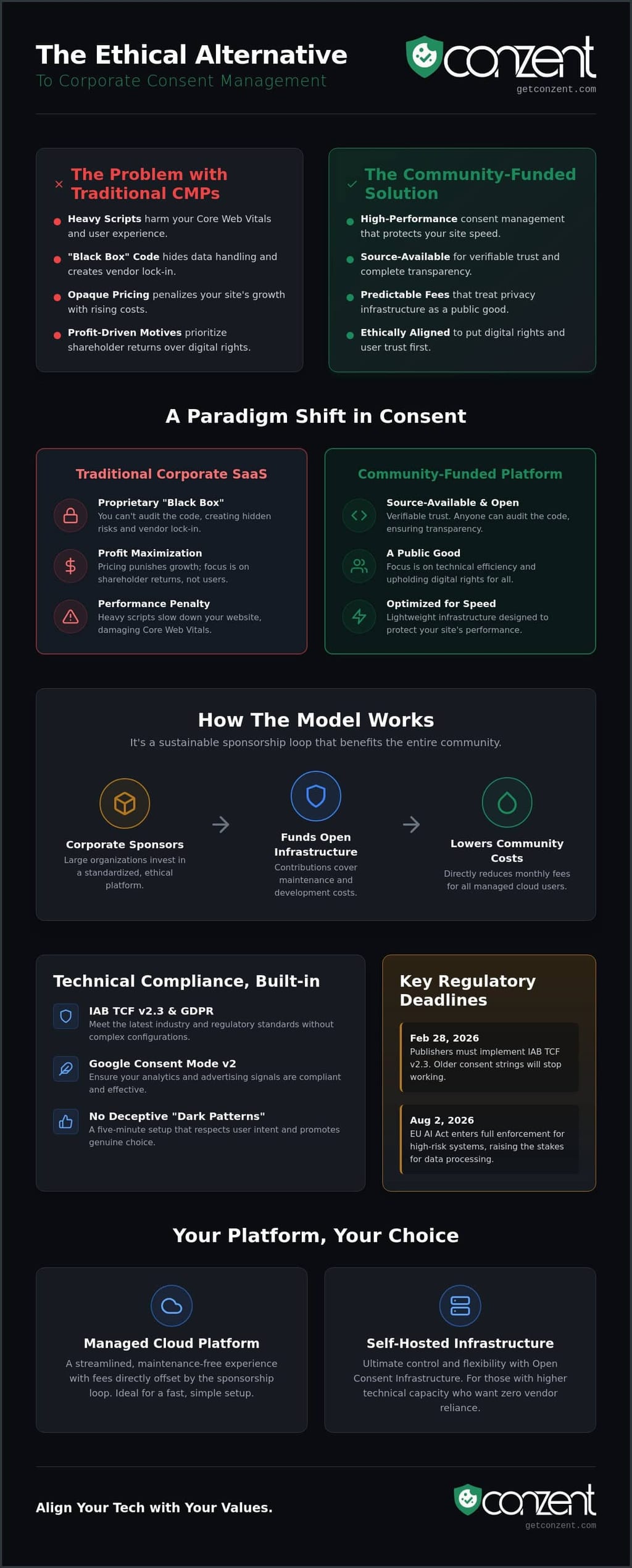
What is Community-Funded Consent Management? The Ethical Alternative to Corporate CMPs
Why are we handing over the keys to our digital ethics to venture-backed SaaS firms that prioritize their bottom line over your site's performance? Most website owners feel trapped by opaque pricing models and the lack of trust inherent in corporate tools. You shouldn't be penalized with heavy scripts just because you want to implement community-funded consent management. It's frustrating to see your Core Web Vitals suffer while paying for a "black box" solution that hides its own data handling practices.
There's a better way to handle compliance without compromising your principles or your budget. This article explores how a transparent, high-performance model serves as the ethical alternative to traditional corporate CMPs. You'll discover how a shared infrastructure model provides moral clarity in your tech stack while ensuring you meet the latest IAB TCF v2.3 and GDPR requirements. We'll break down how this Copenhagen-based approach eliminates the hidden costs of proprietary code and offers a fast, open-source path to true privacy autonomy. Performance matters. Ethics matter. It's time your tech stack reflected both.
Key Takeaways
- Define the model. It's a public good, not a high-margin subscription. Understand why community-funded consent management is the sustainable choice.
- Master the sponsorship loop. Learn how corporate contributions lower costs for the entire community while keeping your fees predictable.
- Ensure technical compliance. Support IAB TCF v2.3 and Google Consent Mode v2 without the heavy scripts that ruin Core Web Vitals.
- Eliminate vendor lock-in. Explore the flexibility of self-hosted Open Consent Infrastructure versus the convenience of the managed cloud.
- Align tech with values. Discover a five-minute setup that respects user intent and avoids deceptive dark patterns.
Defining Community-Funded Consent Management
Most website owners view Consent management as a legal tax. It's often treated as a necessary evil, a checkbox forced by regulators. But the infrastructure behind that checkbox matters. Community-funded consent management is a paradigm shift. It's a model where privacy infrastructure is supported by a community of users and sponsors rather than high-margin subscriptions. This approach replaces the traditional corporate drive for profit with a focus on technical efficiency and digital rights.
Let's be clear about what this is not. It's not a "free trial" designed to hook you into a cycle of rising costs. It's not a limited freemium tier that hides essential features behind an enterprise paywall. Instead, it's a commitment to Open Consent Infrastructure. The core philosophy is simple. Digital rights should be managed by tools that are as open and transparent as the laws they enforce. When code is source-available, trust isn't a marketing slogan. It's a verifiable technical reality that anyone can audit.
The Shift from Proprietary to Open Infrastructure
Traditional CMPs operate as a "Black Box." You install a script and hope it doesn't leak data or ruin your site's performance. This model is failing the transparency test. Corporate tools often prioritize shareholder returns, leading to heavy scripts and vendor lock-in. Community funding ensures the platform serves the people using it. We embrace Copenhagen-style egalitarian tech. This means building for the public good. It's about providing a standard that everyone can access, regardless of their budget. Open infrastructure prevents the data silos that corporate vendors use to keep you trapped.
Why 2026 is the Year of the Ethical CMP
Regulatory scrutiny is reaching a breaking point in 2026. With the EU AI Act entering full enforcement for high-risk systems on August 2, 2026, the stakes for data processing have never been higher. Publishers face a hard deadline of February 28, 2026, to implement IAB TCF v2.3. Older consent strings will simply stop working. You need a platform that moves as fast as the law. Community-funded consent management offers the agility to meet these standards without sacrificing site speed. It provides a path for businesses that want moral clarity in their tech stack. Community-funded consent is a movement toward shared digital responsibility.
How the Community-Funded Model Works
Traditional SaaS models often feel like a tax on your growth. If your traffic increases, your compliance costs skyrocket, even if the value you receive remains the same. Community-funded consent management breaks this cycle by treating privacy infrastructure as a shared public utility. Instead of extracting maximum profit from every user, the model focuses on covering the actual costs of maintenance and development through a collective effort. This approach ensures that high-performance compliance isn't a luxury reserved for enterprise budgets.
The model offers two primary paths: a Managed Cloud Consent Platform and a Self-Hosted Open Consent Infrastructure. Managed cloud users benefit from a streamlined experience while their fees are directly offset by the sponsorship loop. For those with higher technical capacity, self-hosting provides ultimate control. By sharing the burden of infrastructure maintenance, the community creates a more secure environment for everyone. When more eyes are on the code, vulnerabilities are identified and patched faster than any closed-source corporate team could manage. You can see how this reflects in our transparent pricing model which prioritizes sustainability over aggressive scaling.
The Role of Corporate Sponsorships
The engine of this model is the sponsorship loop. Large organizations and ethical tech advocates contribute to the Open Consent Infrastructure mission. These sponsorships aren't just donations; they are investments in a standardized, community-vetted platform that reduces compliance risk for everyone. There is a direct link between the growth of these sponsorships and the reduction of monthly fees for managed cloud users. Big players benefit from a robust, egalitarian standard that supports Ethical data practices across the entire web ecosystem. It's a system where the success of the platform directly translates into lower costs for its users.
Source-Available Code: The Ultimate Audit
True GDPR compliance is impossible without transparency. If you can't inspect the code running on your site, you can't truly know how it handles visitor data. Our source-available OCI model allows for the ultimate audit. Unlike traditional "black box" CMPs, every line of our infrastructure is open for inspection. This is distinct from generic "Open Source" software; it's a specific commitment to source-availability that protects the integrity of the tool while inviting public scrutiny. This transparency builds a level of trust that proprietary code simply cannot match. It ensures that the platform remains focused on user rights rather than hidden data collection or vendor lock-in. By moving away from proprietary silos, we ensure that community-funded consent management remains a reliable, long-term solution for the ethical web.
Traditional SaaS vs. Community-Funded Platforms
Choosing between a corporate vendor and a community-driven model is a choice between extraction and contribution. Proprietary platforms often penalize success. They use complex, traffic-heavy enterprise contracts that scale with your pageviews, not the value provided. In contrast, community-funded consent management relies on predictable cloud fees or self-hosting. This shift in economic logic ensures that your growth doesn't become a financial liability. When infrastructure is treated as a public good, innovation is driven by actual community needs rather than the latest marketing trends or shareholder demands.
Performance is another critical differentiator. Community-vetted code tends to be leaner and faster because it doesn't carry the "marketing bloat" often found in corporate scripts. Every extra kilobyte in a proprietary script is a potential drag on your site speed. By focusing on technical efficiency over feature stuffing, ethical platforms provide a streamlined solution that respects both the user's time and the site owner's Core Web Vitals.
The Hidden Costs of Proprietary CMPs
Many businesses fall into the "freemium trap." They start with a free tier only to discover that essential compliance features or white-labeling options are locked behind an expensive paywall. This isn't just a financial burden; it's a performance tax. Bloated scripts slow down your site, which directly impacts your SEO rankings and conversion rates. We've explored how to maintain compliance without sacrificing speed in our guide on lightweight cookie consent scripts. Beyond performance, the FTC guidance on privacy makes it clear that businesses are responsible for how they handle consumer data. Relying on an opaque third-party script makes fulfilling that responsibility much harder.
Data Sovereignty and Self-Hosting
The ultimate move for privacy-conscious organizations is self-hosting your consent manager. This approach grants you total data sovereignty. You control exactly where your consent logs live, preventing the data leakage risks inherent in multi-tenant SaaS environments. From an architect's perspective, self-hosting eliminates vendor lock-in. If the provider changes their terms or shuts down, your infrastructure remains intact. For companies that want the ethical benefits of community-funded consent management but lack the DevOps resources, our managed cloud serves as a convenient bridge. It provides the same transparent, source-available foundations without the overhead of maintaining your own servers.
Key Features of an Ethical Consent Platform
An ethical platform must do more than just display a banner. It needs to handle complex technical signals while maintaining peak site performance. Choosing a community-funded consent management platform means you get enterprise-grade tools without the corporate baggage. We provide full support for IAB TCF v2.3 and Google Consent Mode v2. These standards ensure your site communicates correctly with advertisers and analytics tools while respecting user choice. Compliance is not a premium luxury; it is a baseline requirement for the modern web.
User experience is where ethics meet design. An ethical UX is about respect. It is not a collection of dark patterns designed to force an opt-in through confusion or exhaustion. We prioritize a customizable UX that respects user intent. This means clear choices, accessible toggles, and no hidden "Accept All" buttons that ignore actual preferences. We've built seamless integrations for major platforms including WordPress, Drupal, and Wix. You can deploy a compliant, high-performance solution in minutes without writing a single line of code.
Balancing Compliance with Revenue
Privacy shouldn't kill your business. We use A/B testing to help you find the most effective, non-intrusive banner design. This process isn't about tricking users into consenting; it is about finding the clearest way to present their rights. Google Consent Mode v2 helps you recover data lost to non-consent through conversion modeling, keeping your marketing insights accurate. Our revenue impact analytics provide the data needed to justify ethical privacy choices. This transparency proves that doing the right thing is also the smart thing for your bottom line. You no longer have to guess how your privacy settings affect your earnings.
Technical Standards and Global Reach
Compliance is a global requirement that demands rigorous technical standards. Our platform meets the strict requirements of the GDPR and the ePrivacy Directive. IAB TCF v2.3 certification is critical for publishers and advertisers in 2026 to ensure consent strings remain valid after the February 28 deadline. Whether your visitors are in Berlin or California, your CMP works across different legal jurisdictions automatically. We ensure your infrastructure stays updated as regulations like the EU AI Act evolve. By providing a global standard, we make complex legal requirements attainable for everyone. Ready to switch to a model that respects your users and your budget? Explore our sponsorship-driven pricing.
Getting Started with the Open Consent Infrastructure
Adopting community-funded consent management is a strategic move toward technical autonomy. It is not a complex overhaul. It is a straightforward alignment with open-source values and high-performance standards. Most users find they can transition their entire compliance stack in a single afternoon. The process is designed to be inclusive, ensuring that technical teams and business owners alike can achieve moral clarity in their tech stack without the typical corporate friction.
The setup is direct. You integrate the Conzent script into your existing tech stack, and it begins managing signals immediately. There are no heavy, proprietary layers to peel back. There is no "black box" logic to decode. It is a streamlined solution built for the modern web. Whether you are running a single site or a massive network, the infrastructure scales to meet your needs without scaling your costs out of proportion.
Choosing Your Deployment Path
You have two clear paths for deployment. If you prioritize speed and simplicity, choose the Managed Cloud Consent Platform. This option allows you to scale your privacy efforts without managing the underlying servers. It is fast. It is reliable. It is the ideal choice for teams that want the benefits of a community-driven model with the convenience of SaaS.
For organizations demanding total data sovereignty, self-hosting is the superior route. This path grants you zero subscription fees and absolute control over where your consent logs live. It is the architect's choice for maximum security. If you are currently tied to a proprietary provider, migration is painless. We provide the tools to move your existing consent records so you don't lose your compliance history. You get the ethics of community-funded consent management with the control of an in-house build.
The Future of Shared Privacy Standards
The global "Privacy Patchwork" of laws is only getting more complex. Corporate vendors often struggle to keep pace with local regulations without passing those rising costs directly to you. Community funding is the only sustainable way to maintain global standards. It relies on shared responsibility and collective vigilance. We invite you to view the OCI source code and participate in the audit process. Scrutiny makes our shared infrastructure stronger. It ensures that the platform remains a public good rather than a private silo.
Our roadmap for the coming years includes automated risk assessments and deeper integrations with evolving AI regulations. These features will remain transparent. They will remain accessible. By joining the community, you move beyond the role of a passive customer. You become a sponsor of digital rights. Switch to a model that values your users as much as you do. Build on infrastructure that you actually own. It is time to demand more from your compliance tools.
Reclaiming Your Digital Autonomy
Privacy is a fundamental right, not a premium feature hidden behind a corporate black box. By adopting community-funded consent management, you move away from extractive SaaS models and toward a sustainable, shared infrastructure. This model proves that compliance can be transparent, low-cost, and high-performance. You gain full ownership of your data while benefiting from Copenhagen-based ethical engineering. It's about more than just avoiding fines; it's about building a web that respects its users through verifiable technical standards.
You now have a clear path to implement enterprise-grade compliance. With certified support for IAB TCF v2.3 and Google Consent Mode v2, you don't have to sacrifice data accuracy for ethics. Our source-available transparency ensures that your tech stack remains auditable, lean, and honest. It's time to align your technical requirements with your moral standards. Join the mission for open privacy infrastructure; start with Conzent today. We are building a standard that serves everyone, and your participation makes that infrastructure stronger. Let's build a more transparent web together.
Frequently Asked Questions
Is community-funded consent management as secure as enterprise SaaS?
It is often more secure because the code is source-available for public audit. Unlike closed-source enterprise SaaS, where vulnerabilities can hide behind proprietary walls, our infrastructure invites scrutiny from the global security community. This collective vigilance identifies and patches issues faster than a single corporate team. Security shouldn't be a "black box" you have to trust blindly. It is about verifiable protection and technical transparency.
How does sponsorship actually lower the price for my website?
Corporate sponsors and ethical tech advocates fund the core maintenance of the Open Consent Infrastructure. This sponsorship loop covers the fixed costs of development, allowing us to lower managed cloud fees for all users. Instead of extracting profit, we distribute the financial burden across the community. This ensures that high-performance compliance remains a public good rather than an expensive luxury. It is a more egalitarian way to fund the web.
Can I switch from the managed cloud to self-hosting later?
You can switch at any time because the infrastructure is designed for total portability. If your technical capacity grows or your data sovereignty needs change, you can move from our managed cloud to your own servers. We provide the tools to export your consent records so you don't lose compliance history. You are never trapped by vendor lock-in. It is your data and your infrastructure, always.
Does a community-funded CMP support Google Consent Mode v2?
Full support for Google Consent Mode v2 is a standard feature of our platform. We ensure your site communicates correctly with Google's tags while respecting user privacy choices. This allows you to recover measurement data through conversion modeling without violating GDPR. Community-funded consent management prioritizes these technical standards to keep your marketing insights accurate and legal. You don't have to choose between compliance and data quality.
What happens if a major sponsor leaves the community?
The model is built for resilience through a decentralized network of many sponsors rather than relying on a single entity. If a major sponsor leaves, the shared infrastructure remains intact because it is source-available and community-governed. Our pricing is designed for sustainability, not aggressive profit-taking. This ensures the platform continues to function as a public utility for all users regardless of individual sponsorship shifts. Stability is baked into the model.
Is Conzent’s OCI compliant with the IAB TCF v2.3 standards?
Our infrastructure is fully certified for IAB TCF v2.3 standards. This is critical for publishers and advertisers who must meet the February 2026 deadline to ensure their consent strings remain valid. We maintain active integration with the latest framework requirements. You get the same level of rigorous compliance as any corporate CMP without the predatory pricing. We prioritize these technical standards to keep your revenue streams safe and compliant.
How does self-hosting a CMP help with Core Web Vitals?
Self-hosting significantly improves Core Web Vitals by eliminating the latency of third-party server requests. You serve the consent script directly from your own infrastructure, reducing DNS lookups and execution time. Our code is built for speed, not for tracking your visitors. This lean approach ensures your site remains fast while meeting all legal requirements. Performance is a requirement, not an afterthought in community-funded consent management.
What is the difference between source-available and traditional open-source?
Source-available code allows anyone to inspect and audit the software while maintaining specific protections for the project's long-term sustainability. Traditional open-source often lacks the structured funding needed for complex compliance tools. Our source-available model ensures transparency and trust. It provides the right to audit without the risk of the project being fragmented or commercialized by bad actors. It is a commitment to openness and technical stability.
Frequently Asked Questions
The Shift from Proprietary to Open Infrastructure
Traditional CMPs operate as a "Black Box." You install a script and hope it doesn't leak data or ruin your site's performance. This model is failing the transparency test. Corporate tools often prioritize shareholder returns, leading to heavy scripts and vendor lock-in. Community funding ensures the platform serves the people using it. We embrace Copenhagen-style egalitarian tech. This means building for the public good. It's about providing a standard that everyone can access, regardless of their budget. Open infrastructure prevents the data silos that corporate vendors use to keep you trapped.
Why 2026 is the Year of the Ethical CMP
Regulatory scrutiny is reaching a breaking point in 2026. With the EU AI Act entering full enforcement for high-risk systems on August 2, 2026, the stakes for data processing have never been higher. Publishers face a hard deadline of February 28, 2026, to implement IAB TCF v2.3. Older consent strings will simply stop working. You need a platform that moves as fast as the law. Community-funded consent management offers the agility to meet these standards without sacrificing site speed. It provides a path for businesses that want moral clarity in their tech stack. Community-funded consent is a movement toward shared digital responsibility. Traditional SaaS models often feel like a tax on your growth. If your traffic increases, your compliance costs skyrocket, even if the value you receive remains the same. Community-funded consent management breaks this cycle by treating privacy infrastructure as a shared public utility. Instead of extracting maximum profit from every user, the model focuses on covering the actual costs of maintenance and development through a collective effort. This approach ensures that high-performance compliance isn't a luxury reserved for enterprise budgets. The model offers two primary paths: a Managed Cloud Consent Platform and a Self-Hosted Open Consent Infrastructure. Managed cloud users benefit from a streamlined experience while their fees are directly offset by the sponsorship loop. For those with higher technical capacity, self-hosting provides ultimate control. By sharing the burden of infrastructure maintenance, the community creates a more secure environment for everyone. When more eyes are on the code, vulnerabilities are identified and patched faster than any closed-source corporate team could manage. You can see how this reflects in our transparent pricing model which prioritizes sustainability over aggressive scaling.
The Role of Corporate Sponsorships
The engine of this model is the sponsorship loop. Large organizations and ethical tech advocates contribute to the Open Consent Infrastructure mission. These sponsorships aren't just donations; they are investments in a standardized, community-vetted platform that reduces compliance risk for everyone. There is a direct link between the growth of these sponsorships and the reduction of monthly fees for managed cloud users. Big players benefit from a robust, egalitarian standard that supports Ethical data practices across the entire web ecosystem. It's a system where the success of the platform directly translates into lower costs for its users.
Source-Available Code: The Ultimate Audit
True GDPR compliance is impossible without transparency. If you can't inspect the code running on your site, you can't truly know how it handles visitor data. Our source-available OCI model allows for the ultimate audit. Unlike traditional "black box" CMPs, every line of our infrastructure is open for inspection. This is distinct from generic "Open Source" software; it's a specific commitment to source-availability that protects the integrity of the tool while inviting public scrutiny. This transparency builds a level of trust that proprietary code simply cannot match. It ensures that the platform remains focused on user rights rather than hidden data collection or vendor lock-in. By moving away from proprietary silos, we ensure that community-funded consent management remains a reliable, long-term solution for the ethical web. Choosing between a corporate vendor and a community-driven model is a choice between extraction and contribution. Proprietary platforms often penalize success. They use complex, traffic-heavy enterprise contracts that scale with your pageviews, not the value provided. In contrast, community-funded consent management relies on predictable cloud fees or self-hosting. This shift in economic logic ensures that your growth doesn't become a financial liability. When infrastructure is treated as a public good, innovation is driven by actual community needs rather than the latest marketing trends or shareholder demands. Performance is another critical differentiator. Community-vetted code tends to be leaner and faster because it doesn't carry the "marketing bloat" often found in corporate scripts. Every extra kilobyte in a proprietary script is a potential drag on your site speed. By focusing on technical efficiency over feature stuffing, ethical platforms provide a streamlined solution that respects both the user's time and the site owner's Core Web Vitals.
The Hidden Costs of Proprietary CMPs
Many businesses fall into the "freemium trap." They start with a free tier only to discover that essential compliance features or white-labeling options are locked behind an expensive paywall. This isn't just a financial burden; it's a performance tax. Bloated scripts slow down your site, which directly impacts your SEO rankings and conversion rates. We've explored how to maintain compliance without sacrificing speed in our guide on lightweight cookie consent scripts. Beyond performance, the FTC guidance on privacy makes it clear that businesses are responsible for how they handle consumer data. Relying on an opaque third-party script makes fulfilling that responsibility much harder.
Data Sovereignty and Self-Hosting
The ultimate move for privacy-conscious organizations is self-hosting your consent manager. This approach grants you total data sovereignty. You control exactly where your consent logs live, preventing the data leakage risks inherent in multi-tenant SaaS environments. From an architect's perspective, self-hosting eliminates vendor lock-in. If the provider changes their terms or shuts down, your infrastructure remains intact. For companies that want the ethical benefits of community-funded consent management but lack the DevOps resources, our managed cloud serves as a convenient bridge. It provides the same transparent, source-available foundations without the overhead of maintaining your own servers. An ethical platform must do more than just display a banner. It needs to handle complex technical signals while maintaining peak site performance. Choosing a community-funded consent management platform means you get enterprise-grade tools without the corporate baggage. We provide full support for IAB TCF v2.3 and Google Consent Mode v2. These standards ensure your site communicates correctly with advertisers and analytics tools while respecting user choice. Compliance is not a premium luxury; it is a baseline requirement for the modern web. User experience is where ethics meet design. An ethical UX is about respect. It is not a collection of dark patterns designed to force an opt-in through confusion or exhaustion. We prioritize a customizable UX that respects user intent. This means clear choices, accessible toggles, and no hidden "Accept All" buttons that ignore actual preferences. We've built seamless integrations for major platforms including WordPress, Drupal, and Wix. You can deploy a compliant, high-performance solution in minutes without writing a single line of code.
Balancing Compliance with Revenue
Privacy shouldn't kill your business. We use A/B testing to help you find the most effective, non-intrusive banner design. This process isn't about tricking users into consenting; it is about finding the clearest way to present their rights. Google Consent Mode v2 helps you recover data lost to non-consent through conversion modeling, keeping your marketing insights accurate. Our revenue impact analytics provide the data needed to justify ethical privacy choices. This transparency proves that doing the right thing is also the smart thing for your bottom line. You no longer have to guess how your privacy settings affect your earnings.
Technical Standards and Global Reach
Compliance is a global requirement that demands rigorous technical standards. Our platform meets the strict requirements of the GDPR and the ePrivacy Directive. IAB TCF v2.3 certification is critical for publishers and advertisers in 2026 to ensure consent strings remain valid after the February 28 deadline. Whether your visitors are in Berlin or California, your CMP works across different legal jurisdictions automatically. We ensure your infrastructure stays updated as regulations like the EU AI Act evolve. By providing a global standard, we make complex legal requirements attainable for everyone. Ready to switch to a model that respects your users and your budget? Explore our sponsorship-driven pricing. Adopting community-funded consent management is a strategic move toward technical autonomy. It is not a complex overhaul. It is a straightforward alignment with open-source values and high-performance standards. Most users find they can transition their entire compliance stack in a single afternoon. The process is designed to be inclusive, ensuring that technical teams and business owners alike can achieve moral clarity in their tech stack without the typical corporate friction. The setup is direct. You integrate the Conzent script into your existing tech stack, and it begins managing signals immediately. There are no heavy, proprietary layers to peel back. There is no "black box" logic to decode. It is a streamlined solution built for the modern web. Whether you are running a single site or a massive network, the infrastructure scales to meet your needs without scaling your costs out of proportion.
Choosing Your Deployment Path
You have two clear paths for deployment. If you prioritize speed and simplicity, choose the Managed Cloud Consent Platform. This option allows you to scale your privacy efforts without managing the underlying servers. It is fast. It is reliable. It is the ideal choice for teams that want the benefits of a community-driven model with the convenience of SaaS. For organizations demanding total data sovereignty, self-hosting is the superior route. This path grants you zero subscription fees and absolute control over where your consent logs live. It is the architect's choice for maximum security. If you are currently tied to a proprietary provider, migration is painless. We provide the tools to move your existing consent records so you don't lose your compliance history. You get the ethics of community-funded consent management with the control of an in-house build.
The Future of Shared Privacy Standards
The global "Privacy Patchwork" of laws is only getting more complex. Corporate vendors often struggle to keep pace with local regulations without passing those rising costs directly to you. Community funding is the only sustainable way to maintain global standards. It relies on shared responsibility and collective vigilance. We invite you to view the OCI source code and participate in the audit process. Scrutiny makes our shared infrastructure stronger. It ensures that the platform remains a public good rather than a private silo. Our roadmap for the coming years includes automated risk assessments and deeper integrations with evolving AI regulations. These features will remain transparent. They will remain accessible. By joining the community, you move beyond the role of a passive customer. You become a sponsor of digital rights. Switch to a model that values your users as much as you do. Build on infrastructure that you actually own. It is time to demand more from your compliance tools. Privacy is a fundamental right, not a premium feature hidden behind a corporate black box. By adopting community-funded consent management, you move away from extractive SaaS models and toward a sustainable, shared infrastructure. This model proves that compliance can be transparent, low-cost, and high-performance. You gain full ownership of your data while benefiting from Copenhagen-based ethical engineering. It's about more than just avoiding fines; it's about building a web that respects its users through verifiable technical standards. You now have a clear path to implement enterprise-grade compliance. With certified support for IAB TCF v2.3 and Google Consent Mode v2, you don't have to sacrifice data accuracy for ethics. Our source-available transparency ensures that your tech stack remains auditable, lean, and honest. It's time to align your technical requirements with your moral standards. Join the mission for open privacy infrastructure; start with Conzent today. We are building a standard that serves everyone, and your participation makes that infrastructure stronger. Let's build a more transparent web together.
Is community-funded consent management as secure as enterprise SaaS?
It is often more secure because the code is source-available for public audit. Unlike closed-source enterprise SaaS, where vulnerabilities can hide behind proprietary walls, our infrastructure invites scrutiny from the global security community. This collective vigilance identifies and patches issues faster than a single corporate team. Security shouldn't be a "black box" you have to trust blindly. It is about verifiable protection and technical transparency.
How does sponsorship actually lower the price for my website?
Corporate sponsors and ethical tech advocates fund the core maintenance of the Open Consent Infrastructure. This sponsorship loop covers the fixed costs of development, allowing us to lower managed cloud fees for all users. Instead of extracting profit, we distribute the financial burden across the community. This ensures that high-performance compliance remains a public good rather than an expensive luxury. It is a more egalitarian way to fund the web.
Can I switch from the managed cloud to self-hosting later?
You can switch at any time because the infrastructure is designed for total portability. If your technical capacity grows or your data sovereignty needs change, you can move from our managed cloud to your own servers. We provide the tools to export your consent records so you don't lose compliance history. You are never trapped by vendor lock-in. It is your data and your infrastructure, always.
Does a community-funded CMP support Google Consent Mode v2?
Full support for Google Consent Mode v2 is a standard feature of our platform. We ensure your site communicates correctly with Google's tags while respecting user privacy choices. This allows you to recover measurement data through conversion modeling without violating GDPR. Community-funded consent management prioritizes these technical standards to keep your marketing insights accurate and legal. You don't have to choose between compliance and data quality.
What happens if a major sponsor leaves the community?
The model is built for resilience through a decentralized network of many sponsors rather than relying on a single entity. If a major sponsor leaves, the shared infrastructure remains intact because it is source-available and community-governed. Our pricing is designed for sustainability, not aggressive profit-taking. This ensures the platform continues to function as a public utility for all users regardless of individual sponsorship shifts. Stability is baked into the model.
Is Conzent’s OCI compliant with the IAB TCF v2.3 standards?
Our infrastructure is fully certified for IAB TCF v2.3 standards. This is critical for publishers and advertisers who must meet the February 2026 deadline to ensure their consent strings remain valid. We maintain active integration with the latest framework requirements. You get the same level of rigorous compliance as any corporate CMP without the predatory pricing. We prioritize these technical standards to keep your revenue streams safe and compliant.
How does self-hosting a CMP help with Core Web Vitals?
Self-hosting significantly improves Core Web Vitals by eliminating the latency of third-party server requests. You serve the consent script directly from your own infrastructure, reducing DNS lookups and execution time. Our code is built for speed, not for tracking your visitors. This lean approach ensures your site remains fast while meeting all legal requirements. Performance is a requirement, not an afterthought in community-funded consent management.
What is the difference between source-available and traditional open-source?
Source-available code allows anyone to inspect and audit the software while maintaining specific protections for the project's long-term sustainability. Traditional open-source often lacks the structured funding needed for complex compliance tools. Our source-available model ensures transparency and trust. It provides the right to audit without the risk of the project being fragmented or commercialized by bad actors. It is a commitment to openness and technical stability.