
Consent Management Platform Requirements: The 2026 Technical & Legal Checklist

Most legacy CMPs are proprietary black boxes that trade your site's speed for a false sense of security. You know that meeting modern consent management platform requirements shouldn't mean sacrificing core vitals or losing ad revenue to broken signals. It's frustrating to watch heavy scripts lag your site while you lose control over where your users' data lives. Compliance is a technical infrastructure challenge, not just a legal one. Transparency is the only way to scale without compromise.
This guide prepares you to master the technical, legal, and performance standards for 2026 to protect your revenue and user trust. We'll explore the shift toward open infrastructure, the specifics of IAB TCF 2.3, and how to maximize ad revenue through optimized Google Consent Mode v2 signals. You'll learn how to replace bloated scripts with a lightweight, verifiable data strategy. Speed matters. Sovereignty matters. Transparency is non-negotiable. We're moving past the era of "good enough" compliance and into a period where efficiency is the baseline for every ethical digital business.
Key Takeaways
- Modern consent management platform requirements demand a shift from proprietary black boxes to verifiable, open-source infrastructure.
- Protect your site speed by ensuring script weights remain under 50kb to prevent negative impacts on Core Web Vitals.
- Secure your 2026 ad revenue by integrating IAB TCF 2.3 and moving to the latest Google Consent Mode v2 standards.
- Use revenue impact analytics and A/B testing to find the balance between high opt-in rates and strict legal compliance.
- Choose between managed cloud or self-hosted models to regain control over your data sovereignty and user trust.
Defining Modern Consent Management Platform Requirements in 2026
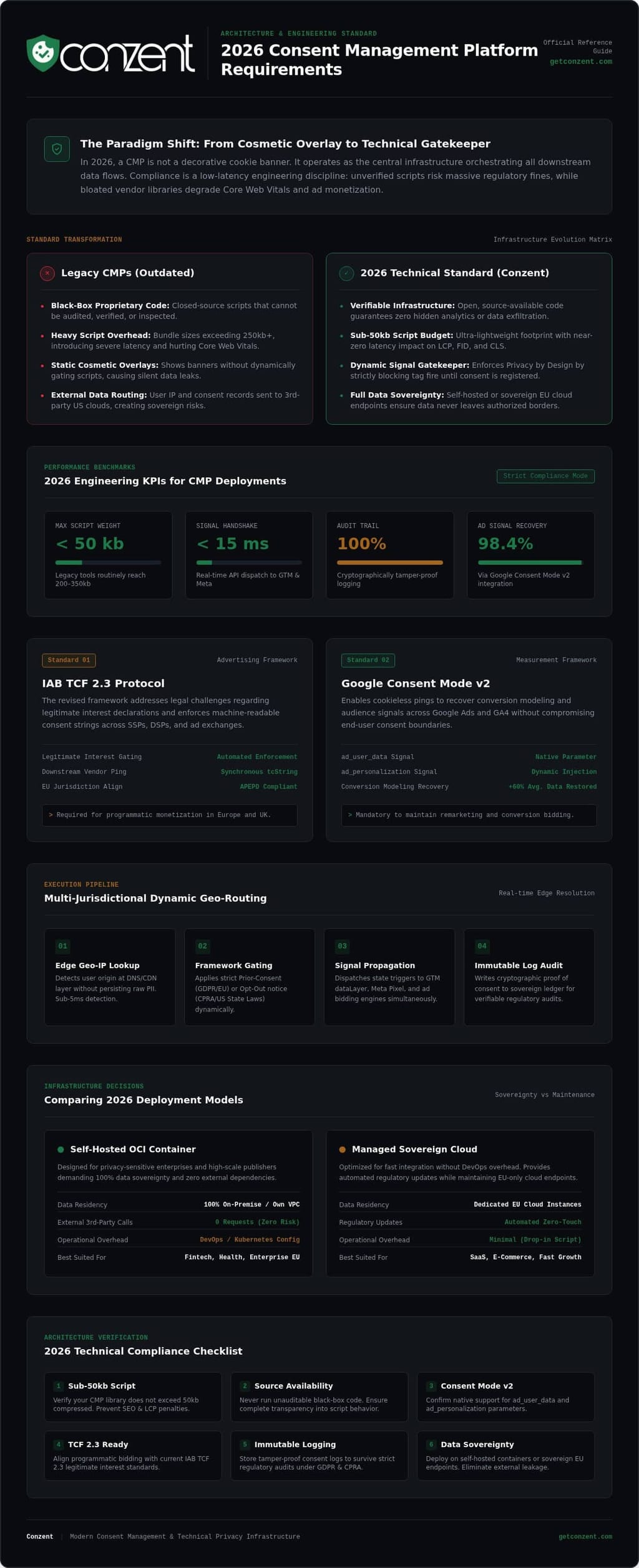
In 2026, a Consent Management Platform (CMP) is not a decorative banner. It's the technical infrastructure that orchestrates every data flow on your site. If your CMP only shows an overlay without controlling the scripts behind it, it isn't a compliance tool; it's a liability. Modern consent management platform requirements center on dynamic signal propagation. This means when a user clicks "Accept," that signal must travel instantly to downstream vendors like Google Tag Manager or Meta. Without this automated handoff, your marketing stack is either flying blind or operating illegally.
Security requires immutable logging. Under the General Data Protection Regulation, you must prove when and how consent was given. These logs must be tamper-proof and easily accessible for audits. We're seeing a fundamental shift from "opt-in overlays" that interrupt the user to "privacy-first user journeys" that integrate choice into the core experience. Transparency isn't an obstacle to growth; it's the foundation of it.
Legal Compliance vs. Technical Orchestration
Legal templates are the bare minimum. They don't solve the problem of data leakage. Real compliance lives in the technical APIs that manage multi-jurisdictional rules in real time. Your CMP should act as a gatekeeper, enforcing "Privacy by Design" by blocking scripts until the exact legal criteria are met. It's about orchestration, not just documentation. A principled approach ensures that technical limits match your legal promises.
Global Regulatory Coverage: GDPR, CPRA, and Beyond
Managing global traffic means handling conflicting laws simultaneously. Automated geo-detection is a baseline requirement for 2026. A visitor from Berlin needs a different experience than one from California. Your stack must identify the user's location and apply the correct framework without manual intervention. You can read more about specific GDPR Compliance requirements to see how these rules translate into technical settings. Handling the friction between EU GDPR and various US state laws requires a single, unified stack that can pivot its logic based on a user's IP. Meeting these consent management platform requirements isn't a luxury. It's the standard for any business operating on the open web.
Core Technical Requirements: Infrastructure and Data Sovereignty
Performance is often the first casualty of compliance. Many legacy tools ignore the impact of heavy scripts on your site's health. In 2026, meeting consent management platform requirements means keeping your script weight under 50kb. If your CMP adds significant latency, you aren't just checking a legal box; you're actively damaging your Core Web Vitals and SEO ranking. Speed is a prerequisite for a healthy user experience. A lightweight stack ensures that your privacy measures don't become a barrier to entry for your visitors.
Sovereignty is the second pillar of modern technical requirements. You shouldn't have to send sensitive user data to a third-party vendor's cloud just to ask for permission to track them. This creates unnecessary risk and complicates your data map. True sovereignty allows you to host consent data on your own servers, keeping you in complete control of the information lifecycle. It's about moving away from proprietary black boxes and toward infrastructure you can actually verify.
The Self-Hosted vs. Managed Cloud Debate
Choosing the right infrastructure model depends on your team's resources and control needs. You can Self-Host OCI if your priority is maximum data control and zero third-party dependencies. This approach eliminates external latency and ensures your implementation aligns perfectly with ICO guidance on cookies and similar technologies. Managed cloud options are better for organizations that want compliance without the DevOps overhead. These services handle automatic updates and global scaling, letting your team focus on core product development. If you're ready to see how these infrastructure models fit your budget, you can compare our managed and self-hosted options.
Source-Available: Why "Black Box" CMPs are a Risk
Running proprietary, closed-source scripts on your domain is a security gamble. You can't audit what you can't see, which makes it impossible to verify how data is processed or where it's sent. Source-available infrastructure provides the transparency of open-source code while maintaining the professional support and reliability of a managed service. This model prevents vendor lock-in and allows your security team to perform deep audits or create custom forks. It's a principled middle ground that respects your right to know exactly what's running on your infrastructure. When you evaluate consent management platform requirements, transparency should be at the top of your list. It's the only way to build a compliance stack that is truly defensible and future-proof.
Standardized Requirements: IAB TCF 2.3 and Google Consent Mode v2
Standardization is the only way to maintain a fair and open internet. In 2026, ad networks and publishers aren't just asking for compliance; they're enforcing it through rigid technical protocols. Meeting consent management platform requirements now means full alignment with IAB TCF 2.3 and Google Consent Mode v2. These aren't optional badges. They're the digital handshake that allows your site to communicate with the global ad ecosystem. Without them, your signals are ignored, your attribution breaks, and your revenue vanishes.
Signal integrity is paramount. Your CMP must do more than just record a choice; it must propagate that choice across every tag and pixel you use. If a user changes their mind, the system must refresh those signals automatically. Manual updates are a relic of the past that lead to data gaps and legal risks. Real compliance is automated, transparent, and immediate.
Technical Implementation of TCF 2.3
The transition to the latest IAB Europe TCF v2.3 specifications introduced stricter rules for vendor disclosures. Your stack must manage Global Vendor List (GVL) updates without manual intervention to stay current with hundreds of downstream partners. A core requirement is the clear distinction between "Legitimate Interest" and explicit "Consent." You can find more details in our IAB TCF Compliance guide. It's about giving users real control, not just the illusion of it through complex legal jargon.
Google Consent Mode v2: Beyond the Script
Google's shift toward "Basic" mode requirements in 2026 means that simply loading a script isn't enough. You must correctly configure specific signals like ad_user_data and ad_personalization to maintain functional tracking. Many teams fail here because they don't understand the difference between signal redaction and total script blocking. Redaction allows for anonymous pings that preserve modeling, while blocking cuts off all data. Debugging these errors is critical to prevent wasted ad spend and broken conversion funnels. For a deep dive into the technical setup, check our Google Consent Mode v2 Implementation Guide. When you evaluate consent management platform requirements, look for tools that prioritize signal accuracy over simple banner display.
Commercial Requirements: Revenue Impact and UX Optimization
Compliance is often viewed as a revenue killer. It shouldn't be. Modern consent management platform requirements include a mandate for commercial viability alongside legal strictness. You need to balance the law with a seamless user experience. A banner that drives users away is a failure. One that tricks them into consenting is a legal risk. In 2026, the goal is to create a privacy interface that feels like a natural part of the user journey, not a barrier to it.
Accessibility is no longer a secondary concern. Your privacy interfaces must meet WCAG 2.2 standards to ensure every user can manage their data settings. Principled design is inclusive design. It respects the person behind the screen regardless of their ability. When you prioritize accessibility, you don't just avoid fines; you expand your reach and demonstrate ethical responsibility.
Optimizing Opt-in Rates Without Dark Patterns
Dark patterns are a short-term gamble. They might spike opt-ins today, but they destroy brand trust and invite regulatory scrutiny. Real optimization happens through transparent, data-driven testing. You should use A/B testing features to experiment with banner placement, color schemes, and copy. Does a subtle bottom-bar perform better than a center modal? Don't guess; measure. Matching an "Accept All" button with an equally prominent "Reject All" option is a legal necessity in most jurisdictions. It's also an ethical one. Trust is the primary driver of long-term customer lifetime value, and transparency is the only way to build it.
Measuring Revenue Impact
You can't manage what you don't measure. Most legacy tools tell you how many people clicked a button, but they fail to connect that action to your bottom line. A commercial-grade stack must provide Revenue Impact Analytics features. This allows you to quantify exactly how "Reject All" choices affect your marketing ROI and ad spend efficiency. Having these insights helps you justify your CMP investment to the CFO by turning compliance from a vague cost center into a strategic optimization engine. If you're ready to align your compliance strategy with your revenue goals, you can view our flexible pricing models to find the right fit for your stack.
Selecting Your Consent Management Stack: A 2026 Strategy
Selecting a stack is a decision that defines your technical philosophy. You aren't just buying a tool; you're choosing how you respect your users and your data. The first step is to audit your current data flows and vendor dependencies. You can't manage what you haven't mapped. Once you know where the data goes, you must decide on your infrastructure model. Choose between Self-hosted Open Consent Infrastructure (OCI) for absolute control or a Managed Cloud for speed and automatic updates. Both paths meet modern consent management platform requirements, but they serve different operational needs.
Verification is next. Ensure your chosen solution carries active certification for IAB TCF 2.3 and Google Consent Mode v2. Without these, your ad signals are effectively useless. After deployment, run A/B tests to baseline your opt-in rates. Don't settle for the default configuration. Finally, monitor the revenue impact of your privacy choices. Use those insights to iterate on your banner design until you find the balance between law and profit. Compliance is a process, not a one-time event.
Why Conzent is the Logical Conclusion
Conzent exists to bridge the gap between open-source freedom and SaaS convenience. We believe you shouldn't have to choose between owning your data and having a platform that works out of the box. Whether you're managing a single site or an enterprise portfolio, our infrastructure scales with you. Our Managed Cloud options provide the growth you need without the DevOps overhead of managing your own servers. We offer a transparent, principled alternative to proprietary black boxes that hide their logic behind complex contracts. Transparency is our default state.
Final Implementation Checklist
Your implementation isn't finished until you verify the technical details. A single misconfiguration can lead to data leakage and legal liability. Follow this checklist to ensure your stack is secure:
- Verify script execution order to ensure zero data leakage before consent is granted.
- Set up automated compliance scans to detect new cookies or trackers added by your team.
- Integrate revenue impact analytics to track the real-world cost of your privacy settings.
- Review your A/B test results weekly to optimize user journeys without using dark patterns.
Building a future-proof compliance stack doesn't have to be a manual burden. You can get started with Conzent pricing and plans today to secure your infrastructure for 2026 and beyond. Ethical data management is the new standard. It's time to build a stack that reflects that reality.
Securing Your Infrastructure for a Privacy-First 2026
Compliance in 2026 isn't about hiding behind legal jargon. It's about building a transparent foundation that respects user rights while protecting your revenue. We've moved past the era of heavy, proprietary scripts that slow down your site and obscure data flows. Meeting modern consent management platform requirements now demands a balance of data sovereignty, high performance, and certified signal integrity.
You've seen how IAB TCF 2.3 and Google Consent Mode v2 act as the digital handshake for the modern web. You don't have to choose between a black-box vendor and a complex DIY build. Our Danish mission-driven infrastructure bridges that gap by offering source-available transparency and certified compliance out of the box. Whether you need the control of self-hosting or the ease of the cloud, the goal is the same: verifiable trust.
Take the next step toward an ethical, high-performance compliance stack. View Conzent Managed Cloud Pricing & Sponsorships to find the right fit for your organization. It's time to turn privacy into your competitive advantage.
Frequently Asked Questions
What is the primary difference between a cookie banner and a CMP?
A cookie banner is merely the visual interface users see, while a CMP is the underlying technical infrastructure. The banner collects the choice, but the platform orchestrates data flows, blocks unauthorized scripts, and maintains an immutable log of consent for legal audits. A banner without a platform is just a cosmetic overlay. A true platform ensures your entire technical stack respects the user's decision in real time.
Is Google Consent Mode v2 a mandatory requirement for all websites?
Google Consent Mode v2 is mandatory if you use Google Ads or Analytics and want to maintain functional conversion modeling in the EEA. Without it, Google cannot verify that consent was obtained, which leads to broken attribution and lost remarketing capabilities. It's a technical necessity for any business that relies on Google's advertising ecosystem to drive growth and measure marketing ROI under 2026 standards.
Can I self-host my consent management platform for better privacy?
You can self-host your platform using Open Consent Infrastructure to gain complete control over your data sovereignty. This model allows you to store consent logs on your own servers rather than a vendor's cloud. Self-hosting eliminates third-party dependencies and ensures that sensitive user preferences remain within your controlled environment. It's a principled choice for organizations that prioritize transparency and technical independence over proprietary black boxes.
How does a CMP impact website performance and Core Web Vitals?
Legacy tools often add heavy scripts that increase latency and hurt your SEO. To meet modern consent management platform requirements, your implementation must prioritize speed by keeping script weights under 50kb. A lightweight stack ensures that your compliance measures don't negatively impact your Core Web Vitals. Speed is a baseline requirement for maintaining both user trust and search engine visibility in a competitive and fast-paced digital landscape.
What happens if my CMP is not IAB TCF 2.3 certified?
If your platform lacks IAB TCF 2.3 certification, many major ad exchanges and publishers will refuse to serve your ads or accept your traffic. Certification validates that your consent strings are technically accurate and follow the latest industry standards. Operating without it puts your ad revenue at risk and can lead to your domain being flagged as non-compliant by the global advertising ecosystem in 2026.
How do I measure the revenue impact of user consent choices?
You can measure this impact by using revenue impact analytics that link consent status directly to your marketing metrics. This allows you to see the specific cost of "Reject All" choices on your overall ROI. By quantifying this loss, you can use A/B testing to refine your banner's design and messaging. This data-driven approach helps you find the sweet spot between strict legal compliance and measurable commercial success.
Does a CMP need to be localized for different languages and laws?
Localization is essential for any site with global visitors. Your stack must use automated geo-detection to show the correct legal framework based on the user's location, such as GDPR or various US state laws. It must also provide accurate translations for all interface elements. Informed consent is impossible if the user can't understand the options provided in their native language and specific jurisdictional context.
Is source-available code more secure than proprietary CMP software?
Source-available code provides a higher level of security because it allows for independent audits and total transparency. Proprietary software acts as a black box where you can't verify how data is handled or if vulnerabilities exist. By allowing your security team to inspect the source, you eliminate hidden risks and prevent vendor lock-in. consent management platform requirements in 2026 increasingly favor this open approach to build verifiable trust.