
Ethical Cookie Banner Design: Avoiding Dark Patterns in 2026

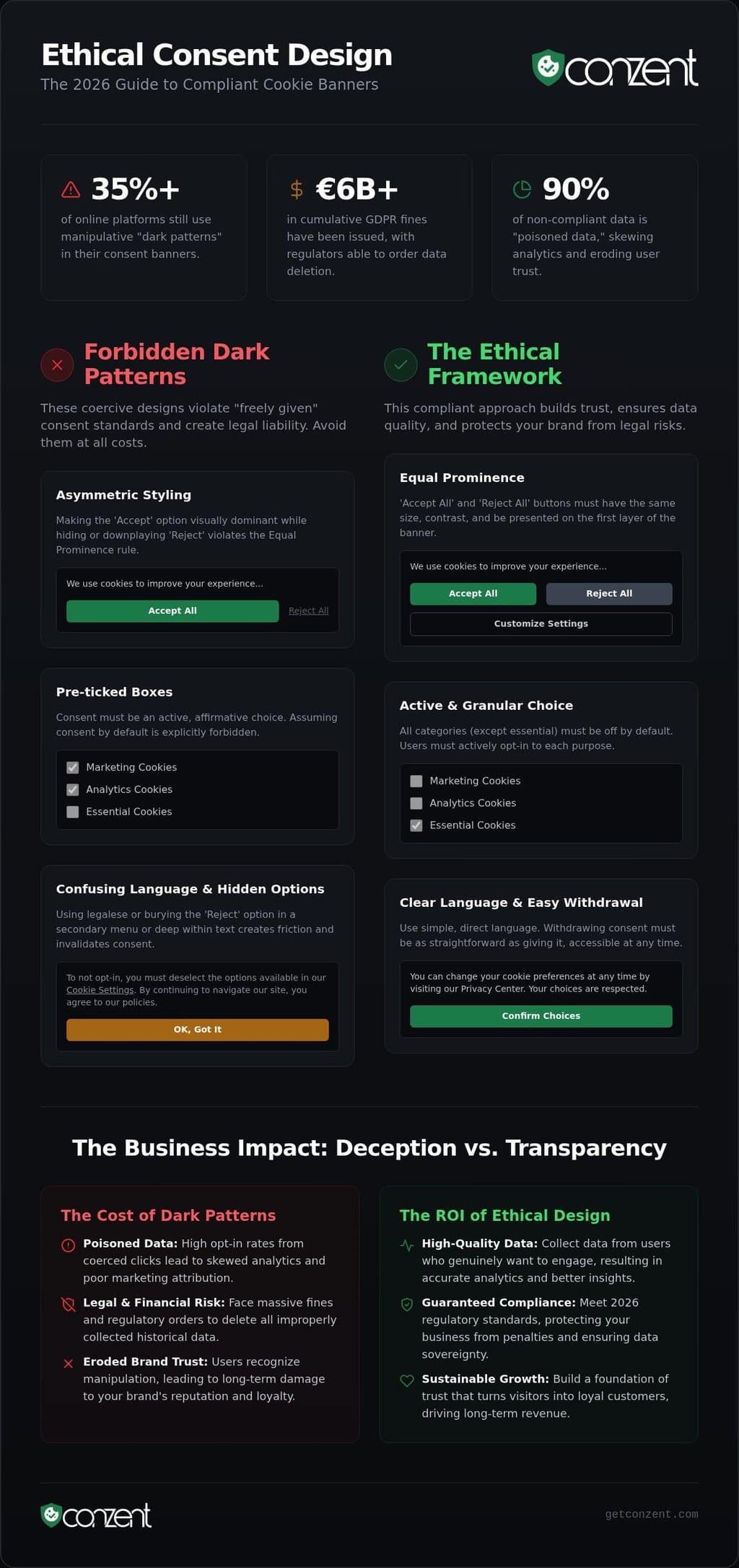
Over 35% of online platforms still rely on "dark patterns" to manipulate users into clicking "Accept." It's a high-risk gamble that's finally hitting a legal wall. As of 2026, regulators have issued over 2,560 penalties, with cumulative GDPR fines surpassing €6 billion. Deceptive design isn't just a legal liability; it's a data quality disaster. When you force consent, you end up with poisoned data that skews your analytics and erodes user trust.
You want to respect your visitors without sacrificing the insights you need to grow. It's a frustrating balance to strike, especially with strict "Equal Prominence" rules for Accept and Reject buttons. We're here to show you that ethical cookie banner design is actually a competitive advantage. Transparency doesn't have to lower your opt-in rates. Instead, it builds a higher-quality data set from users who actually want to engage with your brand.
This guide provides a clear taxonomy of forbidden dark patterns and a framework for ethical A/B testing. We'll prove that prioritizing digital rights is the most effective way to ensure 2026 compliance and drive sustainable revenue.
Key Takeaways
- Identify and eliminate deceptive design patterns that coerce users into giving consent they would otherwise withhold.
- Implement an ethical cookie banner design using the three-button triad to meet the 2026 regulatory standards for equal prominence.
- Stop collecting "poisoned data" by prioritizing transparent value exchanges that improve long-term marketing attribution and brand trust.
- Fix asymmetric button styling and pre-ticked categories to ensure your consent is truly freely given and unambiguous.
- Choose the right infrastructure, such as self-hosted open consent platforms, to maintain data sovereignty while scaling your ethical compliance.
Defining Dark Patterns in 2026 Privacy UX
A Dark pattern is a deliberate design choice that coerces or tricks users into giving consent they would otherwise withhold. It's a digital trap. By 2026, the regulatory focus has shifted away from simple opt-in metrics. Authorities now prioritize "freely given" and "unambiguous" consent. If your banner relies on trickery, your data is legally void. Consent obtained through deception isn't consent; it's a liability. You don't need tricks to build a loyal audience.
Consent fatigue is often blamed on strict privacy laws. This is a misconception. Fatigue is a symptom of poor UX, not the legislation itself. When banners are intrusive or confusing, users click "Accept" just to clear the screen. This creates "poisoned data." You get a high opt-in rate, but your analytics are filled with noise from users who didn't actually agree to be tracked. An ethical cookie banner design fixes this by treating the user as a peer, not a target. It ensures that every data point you collect is grounded in real intent.
The Evolution of Deceptive Design
We've seen a move from subtle "nudging" to blatant asymmetric choices. Early banners hid settings or used "implied consent" where scrolling counted as an agreement. Those days are over. The EDPB Taskforce has been clear: "Accept All" and "Reject All" buttons must have equal prominence. This means equal size, equal contrast, and equal accessibility. If your "Accept" button is a bright primary color and your "Reject" button is a faint gray link, you're using a dark pattern. Compliance requires an active choice standard. It's about clarity, not friction. Design should assist the user's intent, not override it.
Regulatory Consequences in 2026
Financial penalties are just the starting point. In 2026, regulators have the power to order the total deletion of deceptive data sets. If your "Privacy UX" is flagged as non-compliant, you lose your historical data. This destroys marketing attribution and long-term analytics. Beyond the legal risk, your brand reputation takes a hit. Users are more privacy-literate than ever. They recognize manipulation. Technical tools like Google Consent Mode v2 implementation are now designed to support these anti-dark-pattern rules. They ensure your signals are valid and your data remains sovereign. Compliance is a revenue driver, not a cost center. It protects your most valuable asset: clean, actionable data.
Identifying Deceptive Cookie Banner Design Patterns
Deception is rarely accidental. It's a calculated choice to prioritize short-term metrics over user agency. Identifying these patterns is the first step toward an ethical cookie banner design. Most violations fall into four categories: asymmetric styling, pre-ticked boxes, hidden withdrawal paths, and confusing language. These tactics don't just frustrate users; they create legal liabilities that can't be ignored in 2026.
Asymmetric styling is the most common offender. This involves making the "Accept" button visually dominant while the "Reject" button is muted or hidden. If your "Reject" option is a tiny link at the bottom of a block of text, you are likely in violation of the "Equal Prominence" rule. Similarly, pre-ticked categories assume consent by default. This is illegal. Consent must be an active, affirmative action. You can't assume a user wants to be tracked just because they didn't uncheck a box.
Language also plays a role in manipulation. Using double negatives or complex legalese is a classic trick to obscure the user's choice. So is making it harder to revoke consent than it was to give it. Digital rights groups like NOYB have targeted these deceptive cookie banners, leading to hundreds of formal complaints and significant fines. If your banner feels like a trap, it probably is.
Visual Hierarchy and the 'Equal Prominence' Rule
The standard for 2026 is clear: refusing consent must be as easy as giving it. This means the "Reject All" button must appear on the first layer of your banner. It must have the same font size and visual weight as the "Accept All" button. Regulators now look for specific contrast ratios. A common benchmark is the WCAG AA standard of 4.5:1 for text contrast. The Belgian DPA's September 2024 action against Mediahuis proved that hiding the "Reject" option in a secondary menu is a fast track to a violation. You can't bury the choice. If your design matches your brand but hides the opt-out, it's non-compliant.
The Trap of 'Legitimate Interest'
Many platforms try to bypass consent by claiming "Legitimate Interest" for tracking. This is a dangerous loophole that's closing fast. A robust IAB TCF 2.3 implementation strictly limits how these claims are used, especially for profiling and advertising. You must audit your vendor list to ensure third-party scripts aren't running under this label without justification. Transparency is your best defense against audits. If you're ready to move beyond black-box compliance, you can view our platform options to see how we automate these audits.
The ROI of Ethical Consent: Trust as a Capital Asset
Trust isn't a soft metric. It is a capital asset. For too long, businesses have treated consent as a hurdle to clear rather than a relationship to build. An ethical cookie banner design flips this script. It treats transparency as a competitive advantage. When you stop coercing users, you start building a data set that actually reflects your audience's intent. This is the foundation of high-quality marketing. You don't need a massive database of forced opt-ins; you need a precise database of engaged users.
Coerced consent leads to "poisoned data." This is a silent killer for marketing attribution. If a user only clicks "Accept" to remove a "consent wall" that blocks their access to content, they haven't given valid permission. They've just been annoyed into submission. This skews your analytics. You end up optimizing your marketing spend based on signals from users who don't actually want to engage. It's a waste of resources. True ROI comes from understanding users who choose to stay, not those who were forced to agree.
Revenue Impact vs. Deceptive Gains
Many fear that being honest will tank their opt-in rates. The reality is different. Deceptive gains are temporary. The real cost of an opt-out is far lower than the cost of a 2026 compliance failure. Regulators are no longer issuing warnings; they are issuing massive financial penalties. In September 2025, Google and SHEIN were fined a combined €475 million for cookie consent violations. That's a direct hit to the balance sheet that no opt-in rate can justify.
Transparency is a retention strategy. In the SaaS world, users value data sovereignty. We help brands use revenue impact analytics to see the truth. Clear consent flows don't just protect you from fines. They attract higher-quality, more loyal user segments. These users are more likely to convert and less likely to bounce. It's about building a sustainable audience, not a hollow database.
The Risk of 'Poisoned Data'
Data collected through dark patterns is a ticking time bomb. If a regulatory audit finds your design deceptive, that data is legally void. You may be ordered to delete entire databases. This happened in major enforcement actions where firms lost years of historical insights because their "Accept" buttons were too prominent. Re-collecting consent after a scandal is incredibly expensive. It's a reputational disaster that takes years to fix. Ethical UX ensures your marketing engine runs on clean, durable data. It's the only way to build a sustainable digital presence in a privacy-first economy.
Designing for Clarity: A Framework for Ethical Consent
Ethical design isn't a luxury. It's a baseline requirement for modern digital rights. To build an ethical cookie banner design, you must replace manipulation with a structured framework for clarity. This starts with the first layer of interaction. You must present the "Accept All," "Reject All," and "Manage Settings" triad with equal visual weight. If you hide the exit, you've already lost the user's trust. Don't bury the "Reject" option in a secondary menu; place it front and center.
Language is just as critical as layout. Avoid the trap of persuasive copy that masks the reality of data collection. Use neutral, descriptive language that explains the value exchange. Instead of "Help us make your experience better," try "We use cookies for analytics and targeted advertising." It's honest. It's direct. Your users deserve to know exactly what they're agreeing to without being coerced by flowery marketing fluff.
Performance is a part of ethics. A banner that causes layout shifts or slows down page load times creates a frustrating user experience. This frustration often leads to "click-to-clear" behavior, which results in low-quality consent signals. Optimize your banner for Core Web Vitals to ensure it doesn't interfere with the site’s technical efficiency. Consent is not a one-time transaction; it's an ongoing relationship. Ensure a persistent "Withdraw Consent" icon is always visible after the initial choice. Users must be able to change their minds as easily as they made their first selection.
Layered Information Architecture
A layered approach respects the reader's time while providing full transparency. Layer 1 should focus on the essential choice: accept, reject, or manage. Layer 2 is where you provide granular control. Users should be able to toggle specific categories like functional, analytics, or marketing cookies. Finally, Layer 3 must include the full vendor list and detailed legal disclosures. This hierarchy prevents information overload while ensuring that every detail is available for those who want to see it.
Ethical A/B Testing for Transparency
Data should drive your design, but not at the expense of ethics. You can A/B test your cookie banner to find which layouts improve clarity and understanding. Don't test to see which color tricks more people into clicking accept. Instead, test copy variations to see which one explains the value exchange most effectively. You might find that a bottom bar performs better than a center modal, or that being more specific about ad tracking actually increases long-term retention. If you're ready to implement a framework that respects your users, explore our managed consent options.
Scaling Ethical Compliance with Conzent’s Managed Infrastructure
Conzent exists to dismantle the "black box" approach to privacy. We believe that an ethical cookie banner design should be accessible to every business, regardless of their size or technical resources. Our mission is to make transparent, mission-driven compliance the standard for the open web. We provide the infrastructure needed to turn privacy from a legal burden into a core brand value. Whether you choose our managed cloud platform or our Self-Hosted CMP, you are choosing a system built on moral clarity and technical efficiency.
Selecting the right infrastructure is about more than just convenience. It is about data sovereignty and long-term control. Our self-hosted Open Consent Infrastructure (OCI) allows you to host your consent data on your own servers. This prevents "compliance drift," which happens when third-party vendors update their proprietary logic without your knowledge. For teams that need a streamlined, high-performance solution, our managed cloud platform offers native integration with Google Consent Mode v2. This ensures your revenue tracking remains compliant and accurate while respecting the user's choice at every step.
Built-in Anti-Dark-Pattern Defaults
We don't just tell you how to be ethical; we bake those standards into our code. Our cookie banner templates follow the latest 2026 EDPB guidelines by default. This means equal prominence for "Accept" and "Reject" buttons is the baseline, not a premium feature. We also include automatic script blocking. This ensures that no tracker or marketing pixel fires until a valid consent signal is recorded. To prevent translation errors that could accidentally obscure legal meaning, our platform provides multi-language support that is vetted for clarity across different global jurisdictions.
Transparency Through Source-Available OCI
Transparency in your banner is hollow if your CMP code remains a secret. We advocate for source-available infrastructure because you and your users should be able to verify how data is handled. This open model allows for community scrutiny and collaborative improvement. It also helps lower compliance costs for the entire digital ecosystem through corporate sponsorship. We aren't a distant vendor hiding behind layers of complexity. We are a knowledgeable peer helping you build a sustainable digital rights strategy. It is time to stop relying on deceptive design and start building a foundation of true trust. You can Start building ethical consent today.
Future-Proof Your Data Strategy with Transparency
Compliance isn't about checking a box; it's about building a foundation for sustainable growth. By eliminating deceptive dark patterns, you protect your business from the €6 billion in global fines and secure the data you need to thrive. Transparency is the only long-term strategy that works. It transforms consent from a technical hurdle into a capital asset that attracts loyal, high-quality users.
Implementing an ethical cookie banner design ensures you meet 2026 standards without sacrificing performance. You don't have to choose between legal safety and revenue. Our platform is IAB TCF 2.3 Certified and offers native Google Consent Mode v2 support to keep your tracking accurate and honest. We prioritize source-available transparency so you always know how your consent infrastructure handles user rights.
It's time to stop hiding behind complexity and start leading with clarity. You can switch to an ethical, high-performance cookie banner with Conzent and take control of your data sovereignty. Building a privacy-first brand is simpler than you think, and the rewards for your business are permanent.
Frequently Asked Questions
What is the most common dark pattern found in cookie banners?
Asymmetric button styling is the most prevalent dark pattern. It occurs when the "Accept" button is visually dominant while the "Reject" option is hidden or muted. Regulators now require both choices to have equal prominence on the first layer. Other common patterns include pre-ticked boxes and confusing language. These tactics trick users into giving consent. This creates legally void data sets that eventually skew your marketing analytics and erode trust.
Is it legal to make the 'Accept' button larger than the 'Reject' button?
No, it's not legal under current 2026 standards. The "Equal Prominence" rule mandates that refusing consent must be as easy as giving it. This applies to button size, font weight, and color contrast. If your "Accept" button is a large, colorful primary button and your "Reject" button is a small gray link, you're in violation. Regulators look for visual parity to ensure consent is truly freely given and unambiguous for every user.
How does Google Consent Mode v2 help avoid deceptive design?
Google Consent Mode v2 helps you respect user choices without losing all tracking capabilities. It communicates the user's consent state directly to Google tags. If a user rejects cookies through an ethical cookie banner design, the tags adjust their behavior to collect only aggregate, non-identifying data. This technical bridge ensures you stay compliant with EU traffic requirements while maintaining the integrity of your ad performance and revenue impact analytics without using deceptive tactics.
Can I use A/B testing on my cookie banner without violating the GDPR?
Yes, you can use A/B testing as long as your goal is clarity rather than coercion. Ethical A/B testing focuses on improving the user's understanding of the value exchange. You can test different copy variations or banner placements to see which one reduces bounce rates or improves engagement. However, testing to see which design tricks more people into clicking "Accept" is a violation. It leads to poisoned data and significant legal risks for your business.
What are the penalties for using dark patterns in 2026?
Penalties in 2026 are severe and go beyond simple fines. While cumulative GDPR fines have surpassed €6 billion, regulators now have the authority to order the deletion of deceptive data sets. This means you could lose years of historical analytics if your consent flow is found to be coercive. Major firms like Google and SHEIN have already faced combined fines of €475 million for cookie violations, signaling a shift toward stricter enforcement against deceptive design.
How do I make my cookie banner accessible for users with disabilities?
Accessibility is a core component of ethical design. You must follow WCAG standards, such as the 4.5:1 contrast ratio for text and buttons. Ensure your banner is fully navigable via keyboard and compatible with screen readers. Accessible design prevents "forced consent" for users who might otherwise struggle to find the "Reject" option. An ethical cookie banner design is inclusive by nature, ensuring all visitors can exercise their data rights regardless of their resources or physical abilities.
Why is a self-hosted consent manager considered more ethical?
Self-hosting is more ethical because it guarantees data sovereignty. When you use a self-hosted platform, you maintain full control over your consent logs on your own infrastructure. This prevents "black box" logic where a third-party vendor might update their processing rules without your oversight. It's a commitment to transparency that builds deeper trust with your users. You own the code and the data, ensuring that your compliance remains a standard rather than a luxury.
Does a 'Reject All' button really lead to a massive drop in ad revenue?
Not necessarily. While raw opt-in percentages might dip, the quality of your data improves significantly. Users who choose to opt in are more engaged and valuable than those who were tricked. Using tools like Google Consent Mode v2 allows you to recover aggregate insights even when users reject cookies. Transparency often leads to higher long-term ROI and brand affinity. This far outweighs the short-term gains of deceptive design, which eventually destroys the data sets you rely on.