
Google Consent Mode v2 Explained: The 2026 Guide to Privacy-First Tracking

In April 2026, a business lost 90% of its measured conversions overnight because their consent banner failed to communicate with Google's tags. It wasn't a penalty. It was a breakdown in digital infrastructure. You've likely felt this tension as you try to balance performance with the strict requirements of the Digital Markets Act. This guide has Google Consent Mode v2 explained so you can stop guessing and start measuring with clarity. Compliance is not a barrier to growth; it's the new standard for a transparent web.
You shouldn't have to choose between user privacy and actionable insights. We'll show you how to master the four required parameters and prepare for the June 15, 2026, retirement of Google Signals. You'll learn the mechanics of Advanced Mode to recover over 70% of lost user journeys through modeling. This isn't just about avoiding a "quietly broken" setup. It's about building a privacy-first tracking system that respects your audience and secures your data visibility for the long term. We will move from technical foundations to practical evidence, ensuring your 2026 strategy is both ethical and efficient.
Key Takeaways
- Understand how signaling replaces traditional tracking to meet 2026 compliance standards with Google Consent Mode v2 explained.
- Choose between Basic and Advanced modes to balance strict tag blocking with cookieless data pings.
- Use conversion modeling to recover attribution data and maintain the efficiency of your Google Ads bidding.
- Audit your Tag Manager and CMP setup to prevent "quietly broken" implementations that cause data loss.
- Evaluate source-available infrastructure to gain full control over your consent data and technical stack.
Table of Contents
Google Consent Mode v2 Explained: The New Privacy Standard
Google Consent Mode v2 is not a tracking tool. It is a signaling mechanism. Think of it as a technical translator that sits between your website's consent banner and Google's advertising platforms. In the past, tracking was binary; it was either on or off. If a user declined cookies, your data stream simply went dark. This "all or nothing" approach created massive blind spots in marketing performance. Having Google Consent Mode v2 explained means understanding that we have moved from a world of data collection to a world of data signaling.
The primary driver for this shift is the Digital Markets Act (DMA). Under this EU regulation, Google was designated as a "gatekeeper," making it legally responsible for ensuring that the data it uses for advertising is explicitly consented to by the user. By 2026, compliance isn't just about avoiding a fine. It's about maintaining the technical ability to run ads at all. Without these signals, Google Analytics and Google Ads lose their ability to attribute conversions or build remarketing lists for traffic from the EEA and UK. At Conzent, we treat GCM v2 native support as a foundational requirement for any modern tech stack, ensuring that your tracking remains both functional and ethical.
The Evolution from v1 to v2
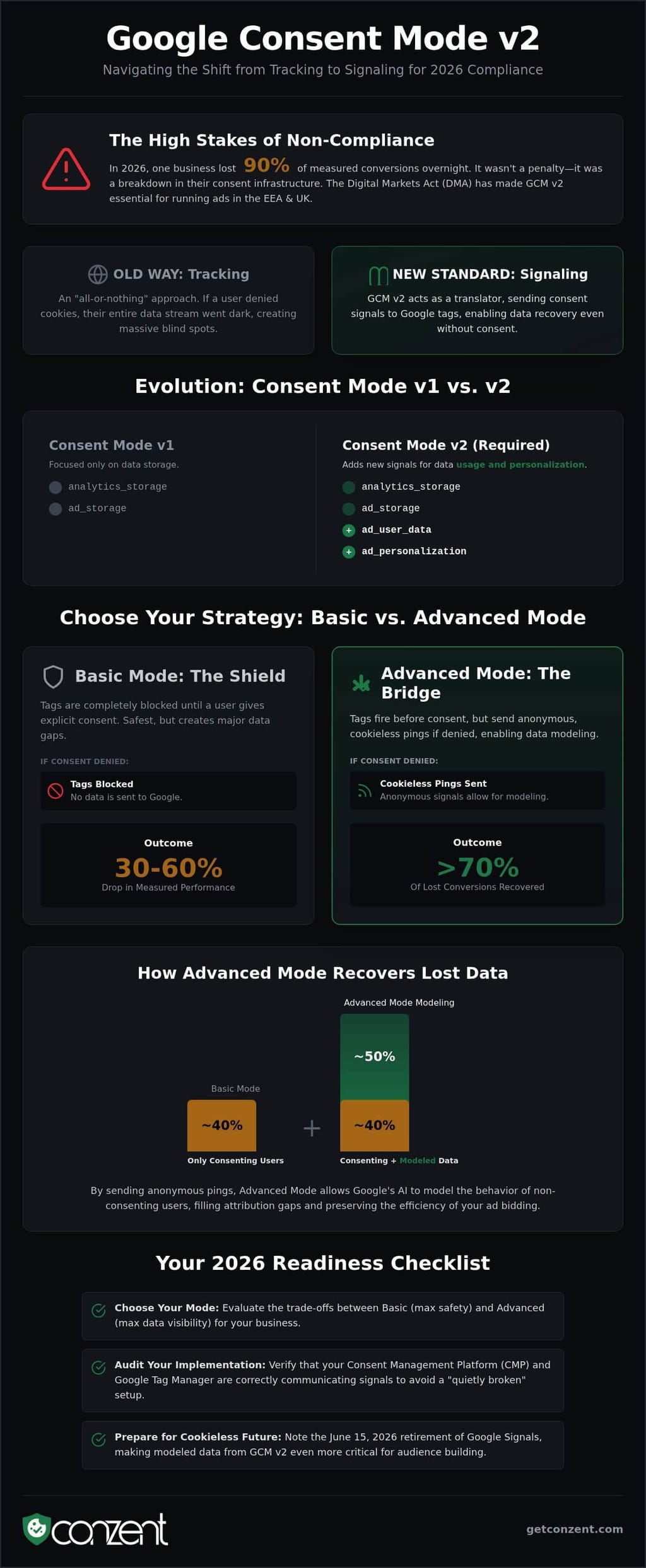
The original version of Consent Mode focused primarily on storage. It told Google whether it could use cookies for analytics or advertising. Version 2 expands this by adding two critical parameters: ad_user_data and ad_personalization. These parameters don't just ask if you can store data; they ask if Google can use that data for specific advertising purposes. This distinction is vital because v1 is no longer sufficient for modern ad platforms that require granular permission for audience building. GCM v2 is the communication layer between a CMP and Google tags. It ensures that every hit sent to Google servers carries a clear instruction on how that data can be processed. It's a more precise bridge that respects user choice without completely severing the connection to your marketing tools.
Why Consent Signals Matter More Than Cookies
We are entering a cookieless era. Traditional tracking relied on persistent identifiers stored in a user's browser, but privacy standards have made this method unreliable. Signals are the replacement. When a user denies consent, GCM v2 sends "pings" instead of cookies. These pings are anonymous and do not contain personal identifiers. They allow Google to use behavioral modeling to fill the gaps in your data. It's a way to recover lost user journeys without identifying the individual. This shift toward signal management is an ethical necessity. By using transparent, source-available infrastructure, you ensure that these signals are handled with integrity. You aren't bypassing the user's choice; you are using advanced mathematics to maintain visibility while keeping their identity private.
Basic vs. Advanced Mode: Choosing Your Privacy Strategy
Choosing an implementation mode is not just a technical task. It is a decision about your brand's relationship with its users. Basic Mode is a shield; Advanced Mode is a bridge. When we have Google Consent Mode v2 explained through the lens of business strategy, we see that the choice dictates how much you trust modeling over raw data. Basic Mode prioritizes the "no" from a user above all else. Advanced Mode prioritizes the "what happened" over the "who did it." Both are valid, but they serve different risk profiles and performance needs.
The technical differences are stark. In Basic Mode, tags are blocked until consent is explicitly granted. If a user ignores or declines your banner, no data is sent. In Advanced Mode, tags fire immediately but adapt their behavior based on the consent signal. If consent is denied, the tags send cookieless "pings." You can find the granular technical specifications for these triggers in Google's official Consent Mode documentation. This choice is the foundation of your 2026 data strategy.
Basic Mode: The Conservative Approach
Basic Mode offers a hard-gap in reporting. It is the safest route for businesses operating in highly litigious environments or those with a zero-tolerance policy for pre-consent network requests. The pros are clear: there is zero risk of data leakage before a user clicks "Accept." However, the cons are equally significant. You face a total loss of visibility for non-consenting users. There is no behavioral modeling to fill the gaps. Your conversion data will be strictly limited to the users who opt-in, which often results in a 30% to 60% drop in measured performance depending on your opt-in rates. It is a transparent approach, but one that requires a high tolerance for data "blackouts."
Advanced Mode: The Modeling Powerhouse
Advanced Mode uses cookieless pings to enable Google’s AI to model conversions. This is how Google claims to recover over 70% of lost user journeys. By sending non-identifying signals, such as device type and conversion type, the system can estimate the performance of your ads without tracking individuals. Many businesses prefer this because it maintains the efficiency of Smart Bidding. However, the legal landscape is nuanced. While Google considers pings to be privacy-safe, some European regulators argue that any network request requires consent. Managing these complex signals requires a Managed Cloud Consent Platform to ensure your implementation is transparent and verifiable. If you are ready to balance high-performance modeling with principled data management, you can explore our flexible implementation options to find the right fit for your infrastructure.
How Consent Mode v2 Restores Ad Revenue Visibility
Revenue visibility is the lifeblood of digital marketing. When you have Google Consent Mode v2 explained as a revenue protector, the stakes become clear. Modern advertising relies on machine learning. These algorithms need data to learn which users are likely to convert. If you stop sending signals, your Smart Bidding strategies lose their edge. You end up bidding on low-value traffic because the system can no longer distinguish between a browser and a buyer. This isn't just a technical glitch; it's a structural failure that leads to wasted ad spend and a lower ROAS.
This shift is mandated by the official Digital Markets Act overview. Google must prove consent before it can process data for ad personalization. Flying blind in this environment is a choice, not a necessity. By implementing the right signaling infrastructure, you maintain the "fuel" for your ad account. We recommend using Revenue Impact Analytics to see the real-world difference between your raw consent rates and your modeled conversion volume.
The Mechanics of Conversion Modeling
Conversion modeling uses the behavior of consented users to predict the behavior of those who opt out. It is a mathematical bridge. Google’s AI analyzes patterns in the ground truth data, meaning the users who said yes, and applies those patterns to the anonymous pings sent by those who said no. This process has specific requirements:
- Data Volume: Modeling requires a high volume of daily traffic to ensure statistical significance. Small sites may not see modeled results.
- Training Period: The AI needs time to learn your specific conversion paths before it can accurately "fill the gaps."
- Signal Accuracy: If your
ad_storagesignals are misconfigured, the model will be based on flawed assumptions.
In GA4, you will see these results as modeled conversions. These are distinct from recorded events. Modeling provides a more complete picture of your performance while keeping individual user identities protected. It is not a tracking bypass; it is a way to maintain statistical integrity in a privacy-first world.
Optimizing for the Privacy-First Future
The algorithms of 2026 are designed to work with signals, not just cookies. If you don't provide the required ad_user_data and ad_personalization signals, you aren't just losing visibility. You are risking account suspension. Google has made it clear that these signals are a hard requirement for businesses targeting users in the EEA and UK. Data visibility is now a byproduct of ethical consent management. You gain insights by respecting the user, not by bypassing their choice. This is the new standard for a sustainable, high-performance tech stack. It turns compliance from a burden into a competitive advantage.
Preparing Your Infrastructure for GCM v2 Integration
Infrastructure readiness is the difference between a compliant stack and one that is "quietly broken." You cannot rely on legacy triggers to handle modern privacy requirements. Start with a comprehensive audit of your Google Tag Manager (GTM) containers. Most setups fail because they don't explicitly account for the four required parameters. Having Google Consent Mode v2 explained as a technical requirement means recognizing that your tags must now wait for a specific signal before they execute. You need a Google-certified Consent Management Platform (CMP) that supports these v2 parameters natively. Without this foundation, your tags are essentially guessing, which leads to the 90% data loss scenarios we see in faulty implementations.
The transition to a privacy-first infrastructure is a shift in how we handle data ownership. It is not about finding a workaround; it is about building a transparent bridge. Your GTM setup must be configured to respond to the consent_updated event. This ensures that when a user makes a choice, your tags react instantly. If you're ready to secure your data stream with a principled approach, you can view our managed platform plans to deploy a verified solution.
Technical Prerequisites for 2026
Your CMP must be updated to the latest Google standards to remain functional in 2026. Using an outdated version is a liability that risks both compliance and data accuracy. It's helpful to consult our GCM v2 Technical Guide to align your developer workflows with current best practices. We see more organizations moving toward server-side tagging as the gold standard for GCM v2. Server-side processing allows you to strip personal identifiers before data ever reaches third-party servers. It provides a level of control and data sovereignty that client-side tracking simply cannot match. This is the core of a resilient technical stack.
Testing and Debugging Your Signals
Verification is where most implementations stall. Use Google Tag Assistant in debug mode to watch your signals change in real time. Open the "Consent" tab for every event. You must verify the sequence of "default" consent states versus "update" states. A common error occurs when the default state is set to "denied" but the update signal arrives too late for the conversion tag to fire. This timing issue is a primary cause of attribution gaps. You must also ensure that ad_personalization and ad_user_data are correctly mapped to user choices. If a user accepts analytics but declines marketing, your tags must reflect that specific nuance without fail. Testing is not a one-time task; it is a continuous part of maintaining your data integrity.
Why Managed Consent Infrastructure Beats Black-Box SaaS
Traditional SaaS is a black box. You send your signals into a proprietary system and hope they come out correctly on the other side. This approach is no longer sufficient for the 2026 data landscape. When we have Google Consent Mode v2 explained as a mission-critical part of your tech stack, the infrastructure behind it matters as much as the signals themselves. You need transparency, not just a dashboard. Conzent provides a source-available approach that contrasts sharply with the closed-source mentality of legacy vendors. We believe your consent data belongs to you, not your service provider. It is about sovereignty, not just a subscription.
Data sovereignty is the ultimate goal for any privacy-conscious enterprise. Choosing Self-Hosted Cookie Consent allows your organization to maintain absolute control over the code that handles user choices. It eliminates third-party dependencies that can become points of failure or privacy leaks. For teams that require the scale of SaaS without the opacity, our managed cloud hosting provides the perfect middle ground. It offers the efficiency of a managed platform with the transparency of open-source standards. Compliance is not a tax on your business; it is a public good that builds a more resilient web for everyone.
The Open Consent Infrastructure (OCI) Mission
Transparency in consent code is the only way to build genuine user trust. If users can't see how their choices are being processed, they have no reason to believe their privacy is being respected. Our OCI mission is built on egalitarian principles. We aim for a web where high-level privacy is a standard for everyone, not a premium feature for those with the largest budgets. Sponsorships allow us to lower the cost of compliance for the entire community. This is a mission-driven approach to technical efficiency. We are disruptors because we believe that the tools for digital rights should be accessible and open to scrutiny rather than hidden behind corporate walls.
Next Steps: Securing Your Ad Stack
Your current setup is likely a relic of an older era. Evaluate your CMP against the 2026 OCI standards to ensure you aren't leaving your ad revenue at risk. A simple implementation is only the first step toward a robust strategy. You must also optimize the user experience to maintain high opt-in rates. We recommend A/B testing your cookie banners to find the balance between clarity and conversion. The data visibility you've learned about today is only possible when your infrastructure is sound. If you're ready to move beyond black-box solutions, you can Explore Conzent’s Managed Cloud Platform to secure your future. Build a stack that respects your users and your data with total clarity.
Secure Your Data Sovereignty in 2026
The era of black-box tracking is over. Digital marketing in 2026 requires a fundamental shift from invasive collection to ethical signaling. Having Google Consent Mode v2 explained as a technical standard helps you move past the fear of data loss and into a strategy of clarity. You've seen how Advanced Mode modeling can recover over 70% of user journeys without compromising privacy. You've also learned why transparent infrastructure is the only way to verify that your signals are both accurate and compliant. It's not enough to just have a banner. You need a system that respects the user while fueling your ad account.
Don't let your data visibility become a casualty of changing regulations or the retirement of Google Signals. You can bridge the gap between user sovereignty and performance with tools built for the open web. Our source-available OCI ensures total transparency for your technical stack. We provide native support for GCM v2 and IAB TCF 2.3 out of the box. You can even prove your compliance ROI through our revenue impact analytics. It's time to treat consent as a foundation for growth; not a hurdle to bypass. Deploy Your Principled Consent Infrastructure with Conzent and lead the privacy-first future with confidence.
Frequently Asked Questions
What happens if I do not implement Google Consent Mode v2 by the 2026 deadline?
You lose the ability to measure conversions and build remarketing audiences for any traffic coming from the EEA or UK. By 2026, the March 2024 enforcement is long-standing, and failing to comply means your Google Ads accounts are essentially running blind. You risk a 90% drop in measured conversions and potential account suspension for violating the Digital Markets Act (DMA).
Is Google Consent Mode v2 required for websites outside of the EU/EEA?
It is mandatory for any website that serves users located within the EEA or UK, regardless of where your company is based. If you target global audiences, implementing it worldwide is the safest path. This future-proofs your infrastructure against local regulations like California's CCPA and ensures your tracking architecture remains consistent across all regions.
Does Google Consent Mode v2 replace the need for a cookie banner?
No, it acts as the communication layer between your banner and Google's tags. You still need a Consent Management Platform (CMP) to show the user interface and collect the initial choice. Consent Mode takes that choice and translates it into a signal that Google's servers can understand. Think of the banner as the listener and Consent Mode as the messenger.
What is the difference between ad_user_data and ad_personalization?
ad_user_data determines if user data can be sent to Google for advertising purposes at all. ad_personalization specifically controls whether that data can be used for remarketing and targeted ads. These two parameters were the core additions in v2. You must send both to maintain full functionality in your advertising accounts and stay compliant with gatekeeper requirements.
Can I use Google Consent Mode v2 with a self-hosted CMP?
Yes, you can implement the protocol using open-source or self-hosted infrastructure. Many enterprises choose this route to avoid "black-box" SaaS vendors and maintain total data sovereignty. While Google provides a list of certified partners, the technical API is open. You simply need to ensure your self-hosted setup correctly triggers the four required consent parameters in the right sequence.
How does GCM v2 affect my Google Analytics 4 (GA4) data accuracy?
It significantly improves accuracy through behavioral and conversion modeling. When you have Google Consent Mode v2 explained as a recovery tool, you see that it allows GA4 to use AI to fill data gaps left by non-consenting users. Without these signals, your reports only show users who clicked "Accept," which often misses over half of your actual traffic and revenue.
Is Advanced Mode compliant with the strict GDPR "prior consent" rule?
Compliance depends on your specific legal interpretation and jurisdiction. Advanced Mode sends cookieless pings before a user interacts with your banner. While Google considers these anonymous, some European regulators argue that any network request requires prior consent. Basic Mode is the more conservative choice, as it blocks all pings until the user provides explicit permission, ensuring zero data transmission before consent.
Can I implement Consent Mode v2 manually without a CMP?
You can, but it's a high-risk technical challenge. A manual setup requires you to write custom code that captures user intent and updates the gtag consent state before any tags fire. Most manual implementations are "quietly broken" because they fail to handle the complex timing of update signals. Using a managed platform ensures these signals are sent reliably without requiring constant developer maintenance.