
Impact of CMP on Core Web Vitals: Diagnosing and Fixing Performance Drag

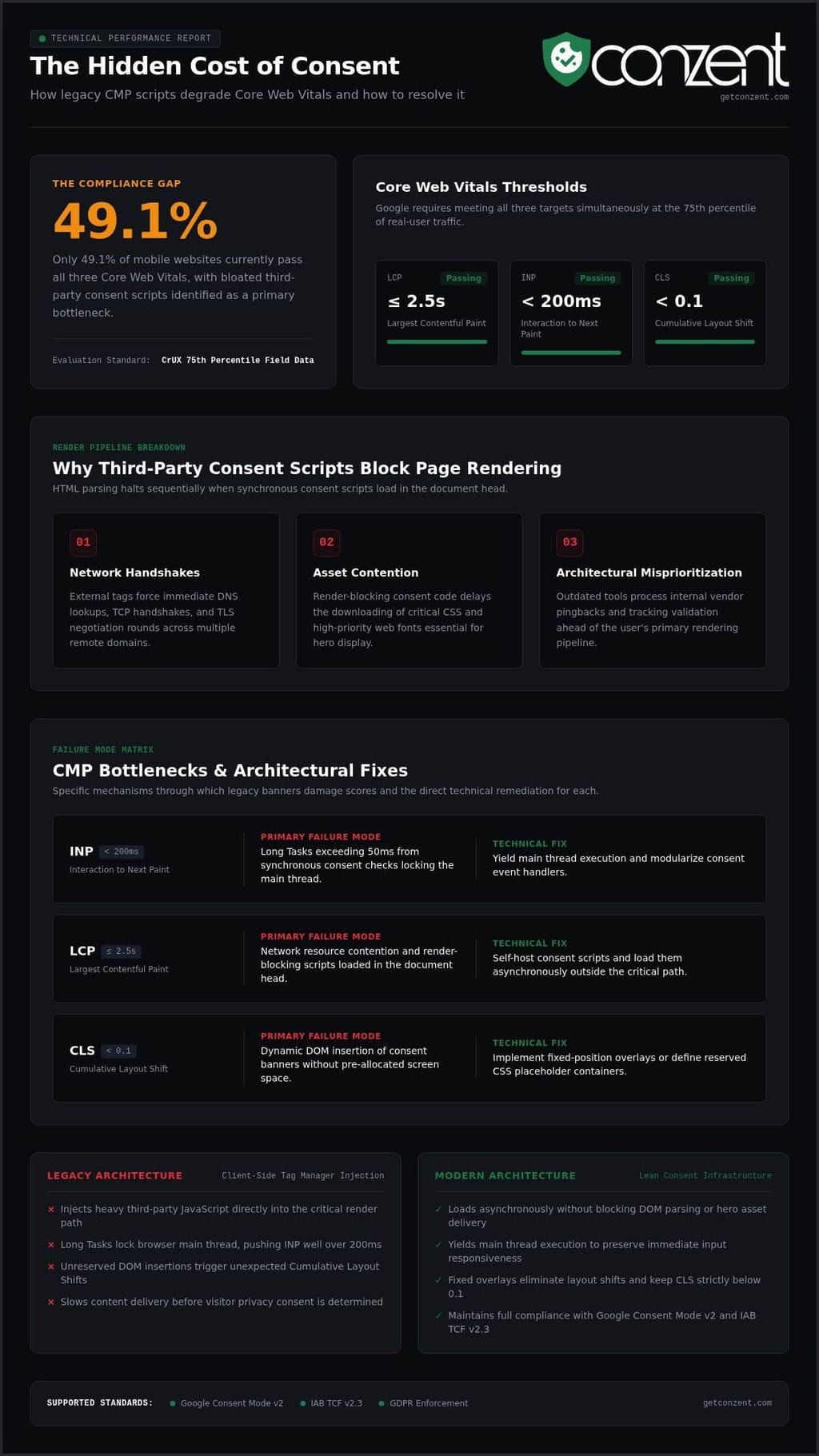
Only 49.1% of mobile websites currently pass all three Core Web Vitals, and bloated third-party consent scripts are often the primary reason. Privacy should protect users, not ruin their browsing experience. Yet the real-world impact of CMP on Core Web Vitals has turned basic regulatory compliance into a heavy performance tax, locking up the browser main thread and triggering unexpected layout shifts.
You shouldn't have to choose between strict GDPR enforcement and search visibility. When Google evaluates real-user field data at the 75th percentile, legacy vendor scripts quietly push metrics like Interaction to Next Paint well past the 200-millisecond threshold. You don't need to accept this trade-off. You can isolate the exact performance drag introduced by your consent setup and fix it without weakening your legal posture.
Here is how to diagnose consent-related bottlenecks, replace fragile client-side scripts with lean infrastructure, and protect your user experience while supporting Google Consent Mode v2 and IAB TCF standards.
Key Takeaways
- Understand the real impact of CMP on Core Web Vitals by identifying how third-party script bundles monopolize the main thread.
- Pinpoint the exact implementation flaws that trigger poor Interaction to Next Paint (INP) responsiveness and unexpected Cumulative Layout Shift (CLS).
- Learn a four-step diagnostic workflow to isolate consent script latency using synthetic lab tests and real-user field data.
- Evaluate the architectural trade-offs between fragile tag manager injection and modern, lightweight consent infrastructure.
- Maintain complete compliance with Google Consent Mode v2 and IAB TCF v2.3 without surrendering search visibility or user experience.
The Hidden Cost of Consent: How CMPs Degrade Core Web Vitals
A consent management platform governs script activation based on user privacy choices. It decides which tracking pixels, analytics tags, and ad scripts may run. But achieving legal compliance often introduces severe technical friction. Most legacy platforms inject bloated JavaScript bundles directly into the critical render path, forcing devices to process megabytes of third-party code before rendering primary content.
This reality creates a direct conflict with user experience. Google evaluates performance using real-world field metrics that quantify loading speed, interface responsiveness, and visual stability. The technical impact of CMP on Core Web Vitals is clear: it acts as a performance tax. This tax represents the cumulative latency, layout instability, and main-thread execution overhead imposed by third-party compliance scripts before a visitor can interact with a site. Understanding this drag is essential for sustainable Search engine optimization (SEO), where technical health directly shapes organic reach and engagement.
Why Third-Party Consent Scripts Block Critical Rendering Paths
Browsers parse HTML sequentially. When an HTML parser encounters an unoptimized synchronous script tag in the document head, it halts Document Object Model (DOM) construction entirely. The engine cannot resume parsing until the script downloads, parses, and executes.
Legacy architectures trigger multiple expensive bottlenecks:
- Network handshakes: External tags force immediate DNS lookups, TCP handshakes, and TLS negotiation rounds across remote domains.
- Asset contention: Render-blocking consent code prevents critical CSS and priority fonts from downloading early.
- Architectural misprioritization: Outdated tools prioritize internal vendor pingbacks and tracking validation ahead of the user's rendering pipeline.
This design flaw turns compliance into an obstacle. Rather than serving users, the browser freezes up while validating scripts that the visitor hasn't even agreed to run.
The Core Web Vitals Thresholds Every Site Must Meet
Google scores digital experience at the 75th percentile of real-user traffic through Chrome User Experience Report (CrUX) field data. Passing requires meeting three specific benchmarks simultaneously:
- Largest Contentful Paint (LCP): Must clock in at 2.5 seconds or less to verify prompt delivery of primary visible elements.
- Interaction to Next Paint (INP): Must stay under 200 milliseconds to guarantee immediate tactile feedback when users tap, click, or type.
- Cumulative Layout Shift (CLS): Must maintain a score below 0.1 to avoid disruptive interface jumps during asset loading.
Failing any of these three metrics damages organic discoverability. Beyond search visibility, slow experiences hurt conversions. Analyzing your data through revenue impact analytics reveals how poor field scores drive higher bounce rates. Tracking this measurable impact of CMP on Core Web Vitals shows that slow compliance scripts quickly erode customer retention.
Breaking Down the Metrics: How Cookie Banners Harm INP, LCP, and CLS
Every Core Web Vitals metric suffers from specific consent implementation mistakes. Chrome field data proves that cookie banners are among the worst contributors to main-thread congestion. When an unoptimized vendor script runs, it harms responsiveness, delays hero rendering, and shifts page elements. Diagnosing the exact technical impact of CMP on Core Web Vitals lets you apply precise fixes without compromising legal standards.
| Metric | Primary CMP Failure Mode | Technical Fix |
|---|---|---|
| INP | Long Tasks from synchronous consent checks | Yield main thread; modularize event handlers |
| LCP | Network resource contention in document head | Self-host script; load asynchronously |
| CLS | Dynamic DOM insertion without reserved space | Use fixed-position overlays or reserved CSS containers |
Interaction to Next Paint (INP): Main-Thread JavaScript Execution Bloat
INP is often the most fragile metric for sites running third-party scripts. Bulky vendor packages trigger prolonged Long Tasks that exceed 50 milliseconds. When a visitor taps an accept button or menu link, the browser queues the interaction behind heavy state-synchronization routines. Even search industry coverage reveals that Google collaborates on ways that improves INP for sites using consent platforms. Running rigorous cookie consent A/B testing ensures banner designs don't introduce lag during rapid mobile taps.
Largest Contentful Paint (LCP): Resource Contention and Lazy Loading
LCP fails when consent scripts compete directly with critical layout assets. Render-blocking tags consume bandwidth that your browser needs for hero images, system fonts, and primary CSS. On mid-tier mobile hardware, client-side script evaluation stalls execution queues. Pre-consent blocking mechanics often postpone media rendering until every privacy rule is evaluated, pushing your paint times well beyond Google's 2.5-second benchmark.
Cumulative Layout Shift (CLS): Unstable Banner Injections and DOM Mutations
Unexpected shifts destroy visual stability. When a script dynamically injects an unreserved banner at the top of the viewport, the entire DOM reflows downward. If a user is already reading or tapping a link, that sudden jump causes misclicks and inflates your layout shift score. You prevent this shift by avoiding top-bar pushes. Instead, rely on fixed-position overlays with isolated CSS containment or statically reserved container wrappers.
Tackling these bottlenecks directly is much easier with a streamlined setup. If you want to replace bulky legacy code with a lightweight footprint, explore our flexible consent platform pricing options to protect your scores from day one.
Architectural Trade-Offs: Client-Side Tag Managers vs. Lightweight CMPs
How you choose to load compliance scripts dictates your entire front-end performance profile. Tag management containers simplify deployment for marketing teams, but they often obscure massive cumulative payload sizes behind a single embed code. When nested layers of third-party tags compete for bandwidth, downstream rendering stalls. In fact, excessive script weight directly degrades ad viewability because delayed DOM parsing postpones ad slot hydration, cutting viewable impressions before visitors scroll down the page. Addressing the architectural impact of CMP on Core Web Vitals requires rethinking how code reaches the browser. Direct, lightweight consent integration stops this cascading network latency across user sessions. Explore our analysis on managing revenue impact without sacrificing speed.
Heavy Vendor Bundles vs. Minimal Script Footprints
Many legacy platforms deliver scripts exceeding several hundred kilobytes of uncompressed JavaScript. These monolithic bundles carry dead weight, including multi-framework wrappers, obsolete polyfills, and vendor telemetry. A modern lightweight cookie banner operates on a lean, purpose-built codebase. Cutting unnecessary execution weight instantly recovers dozens of precious milliseconds on device main threads, preventing client-side bottlenecks on mobile hardware.
Tag Management Latency: GTM vs. Direct Native Integration
Deploying a consent tool through Google Tag Manager creates an unavoidable sequential waterfall. The browser must fetch the tag manager container, compile its logic, request the external consent library, and only then evaluate consent states before releasing dependent tags. This daisy chain burns critical rendering time. Direct native integration initializes consent state immediately, freeing the browser to schedule tasks in parallel and streamlining your Google Consent Mode v2 setup.
Balancing Regulatory Compliance and Search Engine Rankings
Site performance and regulatory compliance are complementary disciplines, not opposing goals. Search algorithms penalize sluggish pages regardless of why scripts run, making the negative impact of CMP on Core Web Vitals a genuine commercial risk. You don't have to surrender organic discoverability to honor privacy rights. Deploying lean consent infrastructure allows you to respect user preferences while comfortably meeting Google's Core Web Vitals benchmarks.
Auditing and Diagnosing Your Cookie Banner Real Performance Impact
Diagnosing consent drag requires isolating compliance scripts from core application logic. Automated site audits often lump script latencies together, masking the true impact of CMP on Core Web Vitals under broader JavaScript execution warnings. An accurate assessment requires an actionable diagnostic workflow to reveal exactly how much processing time your consent tool takes from real visitors.
Use this four-step audit workflow to uncover the exact cost of your setup:
- Establish a clean baseline: Record performance metrics in staging with the consent script completely removed.
- Profile isolated execution: Re-inject the CMP and capture a performance trace using 4x CPU throttling in Chrome DevTools.
- Quantify main-thread monopolization: Measure total Long Task durations tied strictly to the consent vendor's domain.
- Reconcile lab traces with field telemetry: Compare synthetic Lighthouse metrics against 75th percentile CrUX field data to capture lower-end mobile experiences.
Profiling Long Tasks and Script Execution in Chrome DevTools
Open the DevTools Performance panel and capture a clean page initialization sequence. Look closely at the Main thread flame chart for tasks colored with red flags, which indicate execution times surpassing 50 milliseconds. Expand the Bottom-Up and Call Tree tabs, filtering by your CMP provider's domain. This exposes the CPU cycles burned by cryptographic operations, consent string serialization, and vendor state parsing before a user touches the screen.
Isolating CMP Overhead with Synthetic and Real User Monitoring (RUM)
Lab audits run under idealized conditions that frequently hide network latency. Real User Monitoring captures the varied conditions of your actual audience. Track Web Vitals separately across consented and unconsented sessions to spot clear divergences. If users in regions subject to strict consent experience sharp regressions in interaction responsiveness, your CMP delivery network is introducing regional latency bottlenecks.
Practical Remediation: Deferral, Facade Patterns, and Asynchronous Initialization
Remediation begins with execution timing. Load consent logic asynchronously, preventing external network fetches from pausing the primary DOM parser. Use explicit CSS containment on banner wrappers to prevent layout recalculations across parent elements. Where possible, load secondary consent features, like vendor preference sub-menus, on demand when requested rather than on the initial page load.
Taking control of these execution bottlenecks protects your search visibility and user retention. If your current audit reveals deep main-thread drag, view our transparent pricing plans to replace legacy vendor debt with lean, developer-first consent infrastructure.
Eliminating the CMP Performance Tax with Modern Consent Architecture
Privacy compliance does not require sluggish client-side code. The widespread belief that legal adherence demands sacrificing speed is simply false. The negative impact of CMP on Core Web Vitals stems from legacy architectures treating privacy as a bloated afterthought rather than core infrastructure. Monolithic tag bundles don't exist to protect users. They exist because legacy platforms stack years of technical debt into opaque, third-party black boxes.
Eliminating the impact of CMP on Core Web Vitals requires treating consent as an engineering discipline. Engineered by a specialized Danish privacy infrastructure team founded in 2024, Conzent replaces cumbersome scripts with lightweight, developer-first architecture. You can fulfill regulatory demands while keeping browser rendering pipelines clear and fast.
The Source-Available Advantage: Eliminating Third-Party Network Chokepoints
Traditional setups force visitors to connect to external servers before your site even renders. Deploying self-hosted open consent infrastructure removes this vulnerability entirely. Serving compliance code directly from your primary domain or edge CDN eliminates external DNS lookups, TLS negotiations, and third-party script delays.
Source-available code provides total transparency. Instead of loading unverified third-party libraries, your engineering team can audit every byte. You strip out unused runtime polyfills, retain complete control over your assets, and prevent remote network failures from blocking critical content.
High-Velocity Compliance: Preserving Both Conversion and CWV Pass Rates
Regulatory precision and fast render speeds can easily coexist. Modern infrastructure provides turnkey integration with Google Consent Mode v2 and the mandatory IAB TCF v2.3 framework without bogging down the browser. Consent states evaluate instantly, signaling downstream marketing tags without holding the main thread hostage.
This streamlined execution keeps Interaction to Next Paint well below the 200-millisecond threshold, even on low-powered mobile devices. Users get responsive feedback, clean layouts stay visually stable, and field metrics remain green across Google's 75th percentile audits. High performance is an ethical standard, not an optional luxury. Deploy high-performance consent infrastructure with Conzent to protect your Core Web Vitals and deliver frictionless compliance.
Reclaim Site Speed Without Sacrificing Compliance
Privacy compliance and front-end performance should never be opposing forces. Bloated legacy scripts have created a false dilemma, but the severe impact of CMP on Core Web Vitals is an engineering problem with an engineering solution. Profiling real-world main-thread tasks, eliminating synchronous render-blocking assets, and containing dialog reflows will restore your site's responsiveness and organic search visibility.
True compliance respects both user privacy and device resources. Adopting source-available Open Consent Infrastructure removes third-party black-box tags, returning complete runtime control to your development team. Engineered to protect Core Web Vitals without compliance compromises, the platform provides full integration with Google Consent Mode v2 and IAB TCF v2.3. Check out our transparent consent platform pricing to upgrade your compliance stack and deliver the fast, seamless experience your visitors deserve.
Frequently Asked Questions
How does a cookie consent banner directly affect Interaction to Next Paint (INP)?
Cookie consent banners harm INP by running expensive JavaScript tasks on the main browser thread. When a user clicks a button or interacts with the interface, the browser must wait for active consent serialization, cryptographic checks, or vendor state loops to finish. If these tasks take longer than 50 milliseconds, user inputs lag. Keeping event listeners lean and yielding execution back to the browser protects the 200-millisecond INP threshold.
Can an unoptimized CMP cause a website to fail Largest Contentful Paint (LCP)?
Yes, an unoptimized CMP can easily cause a site to fail LCP. When consent scripts load synchronously in the document head, they block the HTML parser and delay requests for hero images, main stylesheets, and fonts. This measurable impact of CMP on Core Web Vitals pushes paint times well beyond Google's 2.5-second limit, especially on mobile devices with constrained processor speeds and network connections.
What causes cookie banners to trigger high Cumulative Layout Shift (CLS) scores?
Cookie banners cause high CLS scores when injected dynamically into the top of the DOM without reserved space. As the banner renders late, it shoves visible page content downward while users are already reading or clicking. You can fix this by using fixed-position overlays, CSS transforms, or reserving explicit space in your page template so the underlying layout remains completely motionless during banner injection.
Does Google Consent Mode v2 add significant performance overhead to page loads?
Google Consent Mode v2 itself is just a standardized API for updating consent flags like ad_user_data and ad_personalization. The overhead comes from how your CMP communicates with that API. A lightweight, direct integration updates states in microseconds using native JavaScript calls. Heavy legacy platforms, however, add bloat by wrapping these signals in complex event listeners and oversized helper libraries that clog execution queues.
Can I load my consent management platform asynchronously without breaking GDPR rules?
Yes, you can load your consent platform asynchronously while staying fully GDPR compliant. The legal requirement states that non-essential tracking cookies and marketing tags cannot fire before a user grants consent. As long as your tracking scripts remain blocked until the consent script initializes and evaluates state, running your consent script asynchronously is completely valid and keeps your primary rendering path clear.
How do self-hosted consent managers perform compared to traditional cloud-hosted CMPs?
Self-hosted consent managers drastically outperform traditional third-party cloud scripts. Serving consent assets directly from your primary origin or edge CDN removes third-party DNS lookups, TLS negotiations, and external network latency. With source-available infrastructure, your team controls the codebase, eliminating unwanted polyfills and vendor pingbacks. This setup delivers immediate state evaluation while preventing external server outages from stalling your site.
Will improving my CMP performance directly impact my organic search rankings?
Improving your consent architecture can protect and strengthen your organic visibility. While Core Web Vitals serve as a tie-breaker signal in Google algorithms, failing them degrades user experience and increases bounce rates. Addressing the negative impact of CMP on Core Web Vitals ensures your 75th percentile CrUX field data stays green, keeping your pages competitive in search results while delivering smooth experiences that preserve conversions.