
OneTrust vs. Self-Hosted Cookie Consent: Choosing Your Compliance Infrastructure in 2026

The most expensive part of your tech stack shouldn't be a script that asks users for permission to exist. For many organizations, the debate over OneTrust vs self-hosted infrastructure has shifted from a legal checkbox to a fundamental question of digital sovereignty. You've probably noticed that enterprise platforms are becoming increasingly opaque; they're heavier, more expensive, and harder to leave. Compliance is a necessity, not a luxury. It shouldn't come with a performance penalty or a vendor lock-in that eats your margins.
You likely agree that checking a box for a regulator shouldn't mean sacrificing your site's speed or your team's autonomy. This guide compares the enterprise-grade complexity of OneTrust against the lean, transparent control of self-hosted solutions to find the right path for your organization. We'll examine how to lower your compliance overhead, reclaim your site performance, and ensure you actually own your consent logs. Whether you need the global reach of a managed platform or the absolute privacy of open infrastructure, we'll help you decide where your data belongs in 2026.
Key Takeaways
- Identify the hidden "compliance tax" and why shifting to owned infrastructure can reclaim your site's performance and budget.
- Compare OneTrust vs self-hosted architectures to determine which model provides the data sovereignty your legal team requires.
- Verify how to maintain support for IAB TCF 2.3 and Google Consent Mode v2 while moving away from proprietary black boxes.
- Evaluate your organization's DevOps maturity to decide if you're ready for the autonomy of self-hosting or if you need a managed middle ground.
- Learn how revenue impact analytics can transform consent management from a legal burden into a tool for business growth.
The Compliance Tax: OneTrust vs. The Self-Hosted Alternative
Compliance has become a tax on digital efficiency. This "compliance tax" represents the hidden friction, performance lag, and high costs that enterprise SaaS platforms impose on your infrastructure. In 2026, the debate over OneTrust vs self-hosted solutions isn't just about price. It's about who owns the plumbing of your website. OneTrust promises an all-in-one suite, but the reality for many is implementation bloat that slows down development cycles. Self-hosting has moved from a niche developer experiment to a viable enterprise strategy for those who value technical sovereignty.
The shift toward infrastructure ownership is a response to the "SaaS-ification" of everything. Companies are realizing that core functions like consent management are too critical to outsource to a distant vendor. By treating compliance as infrastructure, you integrate it into your existing systems. This makes compliance a standard part of your technical stack rather than a premium luxury you rent month-to-month. It is about building a foundation of trust, not just paying for a badge of compliance.
The True Cost of Enterprise SaaS
Subscription fees are only the surface of the expense. The real cost lies in the hundreds of billable hours required to configure a "black box" system. Beyond the invoice, there's a technical toll. Heavy proprietary scripts often tank your Core Web Vitals, creating a direct conflict between legal compliance and user experience. When evaluating OneTrust vs self-hosted options, you must look at the long-term maintenance of the code. The hidden costs include:
- Performance degradation: Bloated scripts increase time-to-interactive and frustrate users.
- Engineering overhead: Complex APIs require specialized knowledge to implement and maintain.
- Data friction: Proprietary formats make it difficult to audit consent logs independently.
Vendor lock-in further compounds this issue. When your consent logs are trapped in a proprietary database, migrating to a better solution becomes a multi-month engineering project. You shouldn't have to ask permission to move your own data. True compliance requires the ability to audit and move your records whenever necessary.
Why Self-Hosting is Gaining Ground
Data sovereignty is the primary driver for the shift toward self-hosted infrastructure. Managing an HTTP cookie and its associated consent logs within your own Virtual Private Cloud (VPC) ensures that sensitive user data never leaves your control. This isn't just about privacy; it's about security. Using a third-party vendor increases your attack surface. If their platform is breached, your users are exposed.
Self-hosting allows for total UI/UX customization without platform constraints. It ensures your banner looks like a part of your brand, not a tacked-on afterthought. You can tailor the experience to your specific audience without fighting against a rigid template. Organizations are choosing this path to gain full ownership of their compliance data while maintaining the speed their users expect. It is a commitment to technical efficiency and ethical responsibility.
When you use a proprietary Consent Management Platform (CMP), you're handing over user data to a black box. You don't see the logic. You don't own the logs. This lack of transparency creates a massive liability for any organization that values digital rights. In the debate of OneTrust vs self-hosted infrastructure, the question of where data lives is paramount. Under GDPR, data sovereignty isn't just a buzzword; it's a legal requirement. If your consent logs are stored on a vendor's server in a different jurisdiction, you've already lost control of your compliance chain. Proving compliance shouldn't require a third-party's permission. If a regulator audits your site, you need immediate, unfiltered access to your consent history. Proprietary cloud solutions often hide this data behind restrictive APIs or export tools. By contrast, an edge-deployed script allows for lightning-fast processing and local storage. Aligning your infrastructure with the NIST Privacy Framework requires a clear understanding of your data flows. You can't manage what you can't see.Proprietary vs. Source-Available Infrastructure
Closed-source compliance logic is a risk. You're trusting a vendor's code to interpret complex laws without being able to verify it yourself. This is where Open Consent Infrastructure changes the game. It provides the transparency of open source with the reliability of professional support. Source-available infrastructure serves as the essential bridge between total transparency and commercial support. It allows your security team to audit every line of code while maintaining a clear path for updates and maintenance.
Infrastructure Impact on Ad Revenue
Choosing OneTrust vs self-hosted scripts often comes down to millisecond differences in load time. Technical performance is a revenue driver. Every millisecond of script latency increases the chance that a user bounces before seeing your consent banner. If they don't see the banner, you can't track them. If you can't track them, your ad revenue drops. This is why deployment speed is a core component of revenue impact analytics. A self-hosted script running at the edge minimizes this friction. For those who want the benefits of a managed service without the opacity of a black box, our Managed Cloud Consent Platform: Scaling Privacy Without the Black Box provides a high-performance alternative. You can choose the deployment model that fits your risk profile by exploring our pricing options today.
OneTrust vs. Self-Hosted: Feature Parity in 2026
The assumption that choosing between OneTrust vs self-hosted infrastructure requires a sacrifice in features is outdated. By 2026, the technological gap has closed. Modern self-hosted solutions offer the same enterprise-grade capabilities as proprietary platforms, but without the restrictive licensing. You don't need a SaaS subscription to access advanced framework support or deep integration. You need a robust architecture that respects your technical autonomy.
Feature parity starts with customization. OneTrust offers pre-built templates that are easy to deploy but difficult to modify beyond basic branding. A self-hosted approach gives you full CSS control. Your consent banner becomes a native part of your site's design rather than a visual intruder. Integration follows the same logic. Whether you use a Tag Manager or a custom CMS, your consent manager should sit at the heart of your stack. It shouldn't be a satellite service that requires complex middleware to function.
Reporting is the final piece of the parity puzzle. While enterprise suites provide high-level executive dashboards, they often restrict access to the raw logs. Self-hosting reverses this. You get the clean visualizations you need for stakeholders, but you also maintain direct access to the underlying data. This transparency is vital for internal audits and deep technical troubleshooting. You aren't just looking at a summary; you're looking at the truth.
Meeting 2026 Standards: TCF 2.3 and GCM v2
Compliance is a moving target. Staying current with the EDPB Guidelines on consent means adopting the latest industry standards immediately. For publishers, IAB TCF 2.3 compliance is no longer optional. It's the price of entry for the programmatic ecosystem. Similarly, implementing Google Consent Mode v2 is essential for maintaining accurate measurement in a privacy-first world. Conzent supports both standards out of the box, ensuring your self-hosted environment is as capable as any enterprise suite. You get the same legal safety net without the proprietary overhead.
Scalability and Multi-Site Management
Managing a single domain is simple. Managing five hundred is where enterprise tools usually win. OneTrust provides a multi-tenant dashboard designed for centralized control. However, modern self-hosted orchestration has leveled the field. By using Kubernetes and containerized deployments, you can scale your consent infrastructure across thousands of subdomains with ease. This isn't just about matching SaaS; it's about exceeding it. You can deploy updates globally in seconds through your own CI/CD pipeline. For a deeper look at managing these complex environments, see The Ultimate Guide to Self-Hosted Cookie Consent Managers in 2026. Scalability is no longer a reason to accept vendor lock-in.
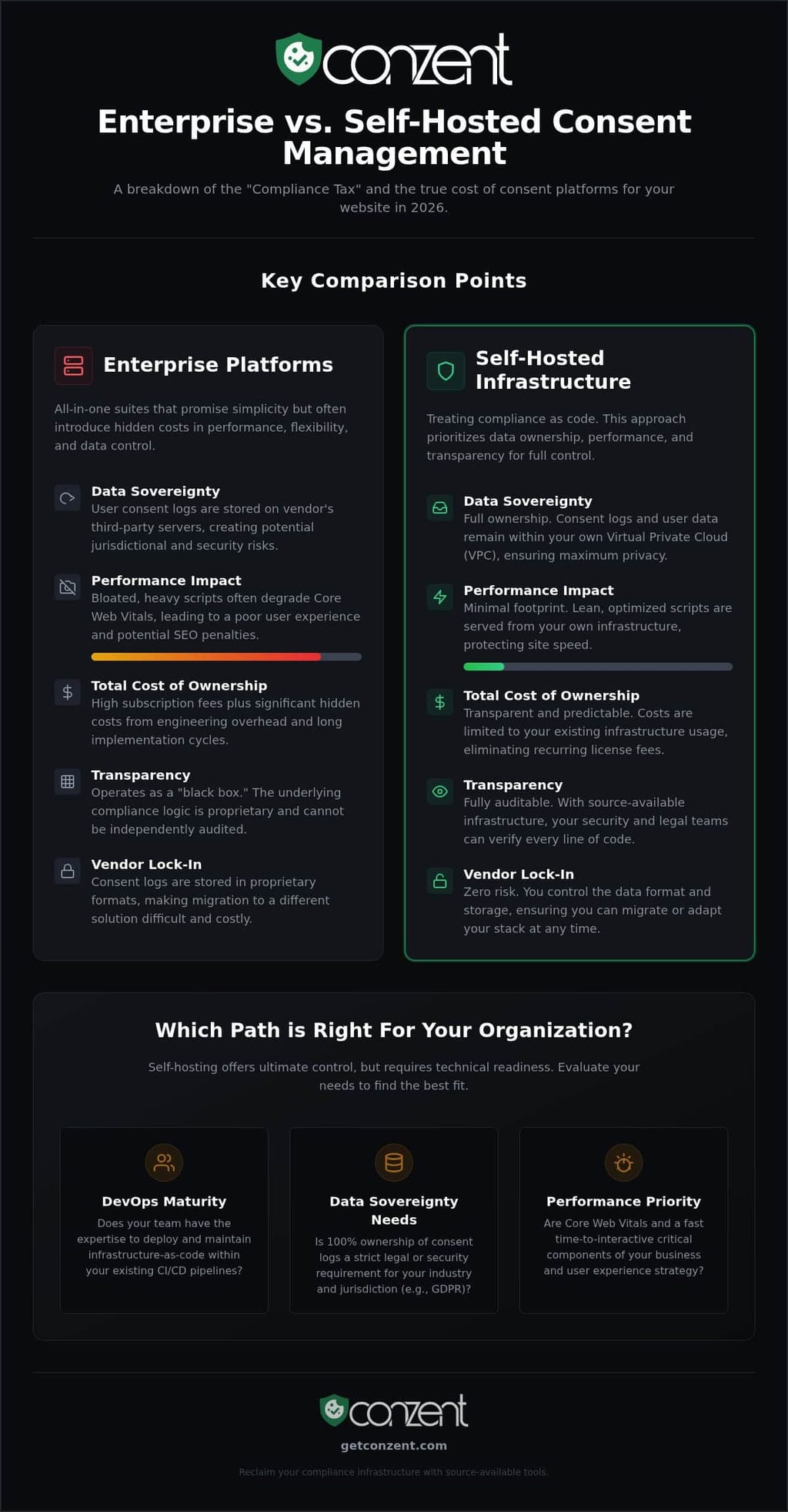
Evaluation Framework: When to Go Enterprise vs. Self-Hosted
Choosing the right path requires looking beyond the sales deck. The decision between OneTrust vs self-hosted infrastructure comes down to a trade-off between outsourced liability and technical sovereignty. For many, enterprise SaaS represents a predictable OPEX model. You pay a premium to make the problem go away. However, as organizations scale, that premium often becomes a tax on growth. Self-hosting shifts the focus to CAPEX. You invest in setup and ownership to eliminate recurring vendor fees and reclaim control over your data.
Budget analysis is rarely as simple as comparing two invoices. OneTrust requires a high annual commitment, often with significant price hikes at renewal. Self-hosting requires internal resources, but it offers a lower total cost of ownership over a three-year horizon. You aren't just buying software; you're building a capability. The "Hybrid" opportunity allows you to start with a managed cloud service and migrate to your own infrastructure as your DevOps maturity grows. This flexibility is something a closed-source vendor simply cannot offer.
The DevOps Maturity Checklist
Before you commit to self-hosted OCI, evaluate your team's capacity. Self-hosting is not a "set it and forget it" project. It requires a disciplined approach to maintenance. Ask your team if they have the bandwidth for manual pulls and security patches. You must also consider the monitoring and uptime requirements of a mission-critical script. If your banner fails, your tracking stops. If your team is lean, you can choose the managed cloud option or leverage OC Cubed - Your trusted MSP for expert infrastructure support. This ensures you maintain the transparency of open infrastructure with the reliability of a managed service.
Pitching a self-hosted solution to a legal team can be challenging. Many are accustomed to the "no one ever got fired for buying IBM" mentality. They see a large vendor like OneTrust as a shield against regulatory risk. To change this perspective, focus on auditability and GDPR compliance. Explain that the OneTrust vs self-hosted debate is actually about visibility. In a proprietary system, you trust the vendor's interpretation of the law. In a self-hosted environment, your legal team can verify exactly how consent is captured and stored. You're moving from blind trust to verified compliance. This level of transparency is often more persuasive to modern privacy officers than a generic enterprise certification.
Ready to evaluate the best deployment model for your organization? Explore our pricing and infrastructure options to find your path.
Conzent: The Middle Ground of Managed Open Infrastructure
The debate between OneTrust vs self-hosted infrastructure often presents a false dichotomy. You're told you must choose between a heavy enterprise suite or a complex DIY project. Conzent provides a middle ground. We offer a managed cloud service alongside our self-hosted Open Consent Infrastructure (OCI). This hybrid approach ensures that compliance is a standard, not a luxury. We believe in transparency. That's why our managed cloud is built on source-available code. You get the ease of a hosted platform without the "black box" risks of proprietary vendors.
Transparency shouldn't be a burden. In a proprietary system, you can't see how consent is derived or where it's truly stored. With Conzent, the logic is open to your scrutiny. This openness extends to our performance tools. Whether you host locally or use our cloud, you get access to revenue impact analytics and Consent A/B Testing. These aren't just features; they're tools to help you prove that privacy and profit can coexist. You can optimize your banner for better opt-in rates without ever sacrificing your technical integrity.
Managed Ease, Open Control
Our managed cloud platform provides the speed of SaaS with the ethics of open source. You can access advanced A/B testing to refine your user experience without managing your own server clusters. We've pioneered a sponsorship model that lowers costs for the entire ecosystem. This ensures that even small teams can access enterprise-grade framework support. Looking toward 2026 and beyond, our roadmap focuses on deepening the integration between OCI and edge computing. We move the logic as close to the user as possible to eliminate latency. Speed is a requirement, not a feature.
Getting Started with the Conzent Platform
Transitioning from a legacy provider like OneTrust doesn't have to be a multi-month ordeal. We've designed our platform to be an "un-locking" mechanism. You can set up your first cookie banner in minutes. Our integrations with platforms like WordPress, Drupal, and Wix make the technical setup seamless. You get to keep your data sovereignty while shedding the bloat of a proprietary suite. It's time to treat compliance as a core part of your infrastructure rather than an expensive external dependency.
View Conzent Pricing and Sponsorship Options to start your transition to transparent compliance infrastructure.
Reclaiming Your Compliance Infrastructure
The choice between OneTrust vs self-hosted infrastructure defines how your organization handles its most valuable asset: user trust. You've seen that enterprise suites often trade performance for perceived safety; meanwhile, self-hosting offers the technical sovereignty needed to truly own your data logs. Compliance shouldn't be a black box that slows down your site or inflates your budget. It's about building a transparent foundation that respects both digital rights and site speed.
By moving to a source-available model, you ensure your stack is IAB TCF 2.3 and Google Consent Mode v2 ready without the burden of vendor lock-in. Our Danish-engineered privacy standards provide the transparency your legal team needs and the efficiency your developers demand. It's time to treat consent as core infrastructure rather than a rented luxury. You have the tools to build a faster, more ethical web for your users.
Explore our Open Consent Infrastructure and sponsorship options today.
Frequently Asked Questions
Is self-hosting a cookie consent manager actually GDPR compliant?
Yes, self-hosting is fully GDPR compliant. In many cases, it provides superior compliance because your organization maintains total sovereignty over consent logs. Unlike proprietary cloud vendors that store data on third-party servers, self-hosting ensures personal information never leaves your controlled environment. This alignment with Danish-engineered privacy standards makes it an excellent choice for organizations that prioritize transparency and rigorous data protection over outsourced liability.
How does OneTrust pricing compare to self-hosted Conzent?
OneTrust typically requires a minimum annual contract of $10,000; many organizations pay significantly more for specific modules. In the OneTrust vs self-hosted debate, Conzent offers a more egalitarian model. Our Open Consent Infrastructure is free to self-host on your own servers. For those who prefer a managed cloud, we use a sponsorship model to lower costs for everyone, making enterprise-grade compliance attainable regardless of your budget.
Does a self-hosted CMP support Google Consent Mode v2?
Yes, a modern self-hosted CMP like Conzent fully supports Google Consent Mode v2. This integration is essential for maintaining accurate measurement and ad revenue in 2026. Because our infrastructure is source-available, you can verify exactly how the consent signals are processed. This transparency ensures your implementation meets Google's requirements while keeping your site's performance optimized and your data flows clear.
What are the maintenance requirements for a self-hosted consent platform?
Self-hosting requires a disciplined approach to DevOps. Your team must manage periodic updates, monitor uptime, and ensure security patches are applied to your VPC. While the software itself is designed for efficiency, the responsibility for the underlying infrastructure sits with your organization. If your team is lean, our managed cloud version handles these technical requirements while still providing the transparency and control of our source-available code.
Can I migrate my existing OneTrust settings to a self-hosted solution?
You can transition your configuration and banner logic from OneTrust to a self-hosted solution like Conzent. We've built our platform as an "un-locking" mechanism to help organizations escape vendor lock-in. While you'll need to map your existing cookie categories to our infrastructure, the process is straightforward for most technical teams. This migration allows you to reclaim ownership of your consent logs and eliminate high annual subscription fees.
How does self-hosting affect website performance compared to OneTrust?
Self-hosting generally offers superior performance because you eliminate the heavy, proprietary scripts that characterize many enterprise CMPs. By deploying your consent manager at the edge or within your own infrastructure, you reduce latency and improve Core Web Vitals. This speed directly correlates with higher opt-in rates and better ad revenue. When comparing OneTrust vs self-hosted setups, the millisecond differences in load time often justify the switch to owned infrastructure.
Is Conzent's managed cloud version proprietary like OneTrust?
No, Conzent's managed cloud version is not a proprietary "black box" like OneTrust. It's built on the same source-available Open Consent Infrastructure that we offer for self-hosting. This means you can audit the code and understand the logic even when we manage the hosting for you. We provide transparency without the maintenance burden, offering a middle ground that prioritizes ethical responsibility and technical clarity.
Do I need a developer to set up a self-hosted consent manager?
You will need a developer or DevOps engineer to set up and maintain a self-hosted consent manager. This involves configuring your server environment, managing deployments, and integrating the script with your CI/CD pipeline. However, if you don't have dedicated technical resources, our managed cloud platform offers a simpler setup. It integrates seamlessly with CMS like WordPress, Drupal, and Wix, allowing you to deploy a banner in minutes without deep infrastructure knowledge.
For those who want to simplify their entire digital footprint while maintaining a professional look, you can visit Erstelle deinen perfekten Online Auftritt mit Litefyr – schnell und einfach! to ensure your website is built on a high-performance foundation.