
Source-Available Cookie Consent: The 2026 Guide to Transparent Compliance

Most enterprise consent tools are proprietary black boxes. You pay a premium for a script you can't audit, essentially hoping it follows the law behind a closed curtain. It's a "trust me" model in an industry built on verification. Choosing source-available cookie consent changes this dynamic by putting the code in plain sight. This isn't just a technical preference. It's a stand for digital rights and infrastructure sovereignty. You shouldn't have to sacrifice site speed or settle for vendor lock-in to stay legal.
High costs and performance lag from heavy scripts are exhausting your team. We see the frustration of settling for a generic solution that hides its data processing methods. This guide explains how source-available platforms eliminate the compliance black box while delivering critical features like IAB TCF 2.3 and Google Consent Mode v2. You'll learn how to gain full control over your compliance stack, lower your long-term costs, and maintain peak performance. We'll explore how to move from self-hosted infrastructure to managed cloud services without losing your data or your dignity.
Key Takeaways
- Audit your compliance by moving away from "black box" proprietary vendors to inspectable, source-available cookie consent.
- Boost your Core Web Vitals and site security using lightweight, transparent scripts that minimize performance lag and supply-chain risks.
- Ensure full alignment with IAB TCF 2.3 and Google Consent Mode v2 to protect your ad revenue without compromising user privacy.
- Choose the best deployment path for your team by weighing the zero-cost licensing of self-hosting against the convenience of managed cloud infrastructure.
- Shift your perspective from viewing privacy as a third-party service to treating it as a core, transparent part of your own digital infrastructure.
What is Source-Available Cookie Consent?
Source-available cookie consent refers to software where the underlying source code is public and inspectable. Unlike closed software, anyone can read the logic that determines how user data is handled. It differs from purely open-source models because the license may restrict certain commercial redistributions. This model ensures the software remains sustainable for enterprise-grade development while providing the transparency required for high-stakes compliance. Source-available software provides a necessary middle ground. It offers the visibility of open source with the professional reliability of a commercial product.
Proprietary Consent Management Platforms (CMPs) are a liability for high-compliance industries. They operate as "black boxes." You install a script and trust that it executes the user’s choice correctly. You can't see how it processes the TC String or if it leaks data before consent is granted. In 2026, "trust" is a weak legal defense. If a regulator audits your stack, you need to prove exactly how your infrastructure works. Source-available tools make this proof possible. It's about moving from blind faith to technical certainty.
Source-Available vs. Proprietary CMPs
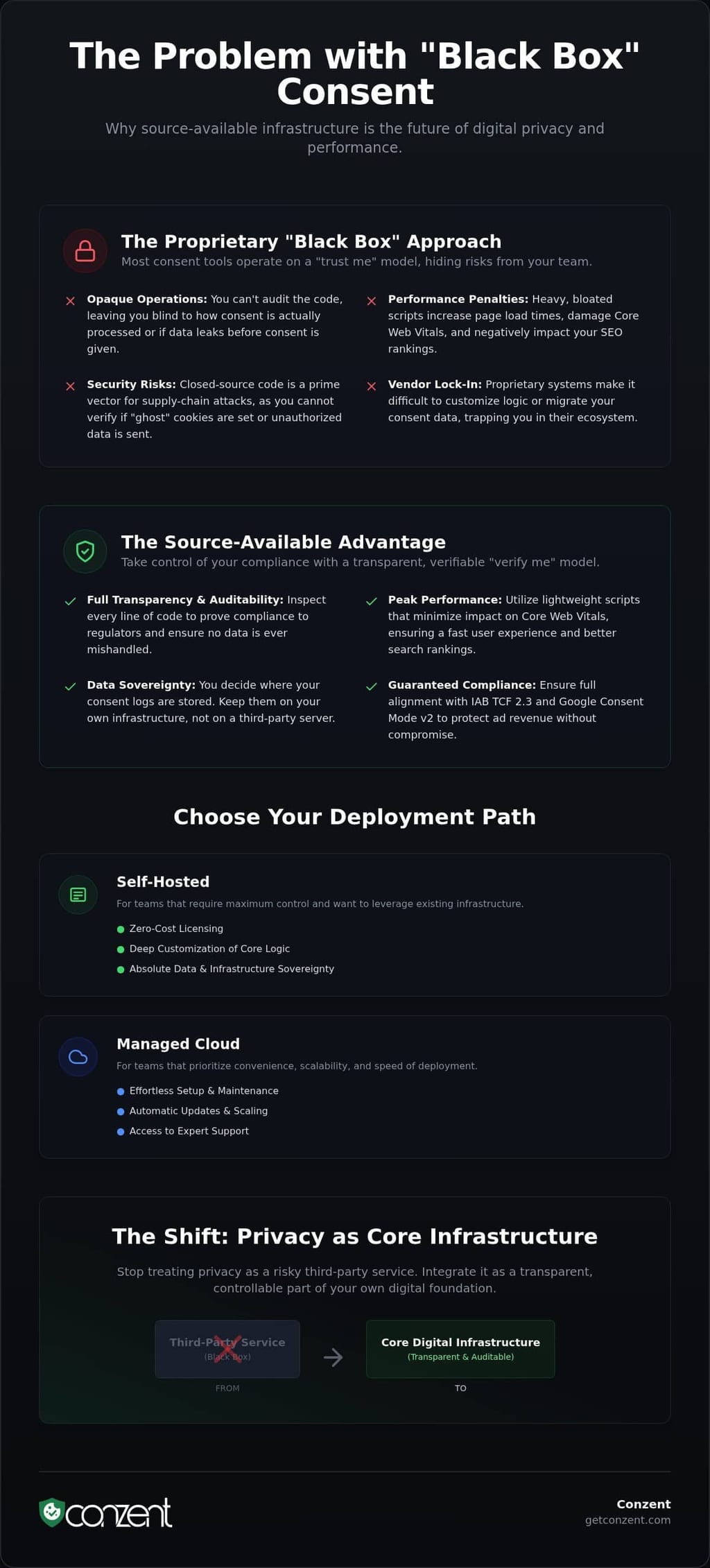
The difference is fundamental. With proprietary tools, you are a tenant on someone else's land. With source-available infrastructure, you own the deed. This shift provides several core advantages for technical teams:
- Trust vs. Verify: Proprietary vendors ask for blind faith. Source-available code allows your security team to audit every line to ensure no data is sent without a valid signal.
- Data Sovereignty: You aren't forced to send sensitive consent logs to a third-party server. You can store and process them entirely on your own infrastructure.
- Deep Customization: Most CMPs only let you change button colors or CSS. Source-available systems let you modify the core logic to fit complex internal data workflows.
The Transparency Mandate in Modern Privacy Law
Modern privacy law is moving toward a standard of "inspectability." GDPR Article 5 demands accountability and transparency in all data processing activities. It's no longer enough to say you're compliant. You must be able to demonstrate it. Regulators now look at the entire technical stack during audits. Using a transparent, inspectable code base simplifies this process. You can point to the specific logic in the Open Consent Infrastructure to show exactly how you respect user rights. You can read more about Conzent's GDPR compliance approach to see how this transparency works in practice. Transparency isn't a premium feature; it's a legal necessity.
Technical Advantages of Open Consent Infrastructure
Choosing source-available cookie consent isn't just an ethical decision; it's a technical optimization. Most proprietary platforms prioritize their own data collection over your site's speed. They bundle heavy tracking scripts and legacy code that bloat your page weight. Open consent infrastructure flips this dynamic. It treats compliance as a core utility, not a marketing vehicle. This results in a cleaner, faster, and more secure implementation for your users. You shouldn't have to choose between legal safety and a fast website.
Eliminating Performance Lag
Proprietary scripts are often "black boxes" that hide excessive tracking and redundant logic. These scripts increase Total Blocking Time (TBT) and hurt your Core Web Vitals. Conzent's lightweight banner minimizes this impact by shipping only the essential code needed to manage signals. In 2026, search engine algorithms directly penalize sites where heavy compliance scripts degrade Core Web Vitals like Interaction to Next Paint (INP). Performance is a silent driver of your SEO success. Every millisecond saved during the initial render directly correlates to higher search rankings and better user retention.
Security and Auditability
Closed-source CMPs present a significant security risk. You cannot verify if "ghost" cookies are being set or if unauthorized data pings are sent to third-party domains before a user clicks "Accept." This lack of visibility is a primary vector for supply-chain attacks. Source-available code allows your DevOps team to perform deep security audits. They can verify exactly where data goes and ensure no pings leave your server without explicit authorization. It turns your compliance stack from a vulnerability into a fortress. You gain the power to prove that your site respects user privacy at the protocol level.
Scalability is another hurdle in the traditional CMP market. Many vendors charge per-session fees that penalize you for growing your traffic. Open infrastructure handles millions of consent events without these artificial costs. By using an open API, you can integrate consent signals directly into your e-commerce or CMS backend. This allows for seamless synchronization with Google Consent Mode v2, ensuring your conversion tracking remains accurate while staying compliant. If you are ready to scale without the proprietary tax, consider exploring our flexible deployment options. This approach makes enterprise-grade privacy accessible to everyone, regardless of their traffic volume.
Achieving TCF 2.3 and Google Consent Mode v2 Compliance
Compliance in 2026 is no longer about checking a box. It's about maintaining your revenue stream while respecting user rights. Most proprietary vendors claim that only their expensive SaaS can handle complex frameworks like IAB TCF 2.3 or Google Consent Mode v2. This is a myth designed to keep you locked into a subscription. Choosing a source-available cookie consent solution provides the same enterprise features without the "black box" mystery. You gain the ability to inspect the logic that translates user choices into the technical signals that ad networks require. It is about verification, not just trust. For commercial firms that apply this same standard of verification to their business growth strategies, The GovCon Architect provides the expert consulting needed to successfully win U.S. federal contracts.
Implementing IAB TCF 2.3 with Conzent
The IAB Transparency and Consent Framework (TCF) v2.3 is the global standard for the digital advertising ecosystem. Since the enforcement deadline on February 28, 2026, publishers must use a certified CMP to ensure their ad revenue remains uninterrupted. New TC Strings now require the mandatory "disclosedVendor" segment to resolve ambiguity. Implementing IAB TCF 2.3 with Conzent ensures your consent signals are standardized across all vendors. You can follow Conzent's IAB TCF guide to see how we maintain certification while keeping our code inspectable. While tools like the Osano Cookie Consent Library provide a foundation for UI, enterprise publishers need the deeper infrastructure that supports full TC String generation for modern bidding environments.
GCM v2: Protecting Ad Revenue
Google Consent Mode v2 (GCM v2) is critical for balancing conversion tracking with privacy. It introduces granular control through parameters like ad_user_data and ad_personalization. Without these signals, Google Ads and GA4 cannot perform accurate data modeling for users who decline cookies. You can set up Google Consent Mode v2 using source-available infrastructure to avoid proprietary overhead. An incorrect implementation of GCM v2 creates a massive revenue risk; it leads to broken attribution and a complete loss of remarketing capabilities in the EEA. You lose data. You lose insight. Eventually, you lose revenue.
Optimizing your opt-in rates requires more than just compliance. It requires data. Revenue Impact Analytics allow you to see exactly how your consent banner affects your bottom line. You can test different layouts or wording to find the balance between user trust and data collection. This is where the mission-driven approach of source-available software shines. It gives you the tools to succeed without hiding the mechanics of your success. You don't just follow the rules. You master the infrastructure.
Self-Hosting vs. Managed Cloud: Choosing Your Path
Deciding how to deploy your consent infrastructure shouldn't feel like a trap. In the proprietary world, you are often forced into a high-cost subscription with no alternative. Source-available cookie consent breaks this cycle by offering a choice between total independence and managed convenience. You can host the code yourself for maximum control or use a managed service that respects your need for transparency. Both paths lead to compliance. The only difference is where you choose to invest your team's time and resources.
The Case for Self-Hosting (OCI)
Self-hosting the Open Consent Infrastructure (OCI) is the ultimate expression of data sovereignty. This path is ideal for high-security environments where sending consent logs to a third-party server is a non-starter. You get zero licensing fees and complete control over your database. Your DevOps team can audit the code, containerize it, and deploy it within your existing stack. It moves compliance from a "service" you buy to "infrastructure" you own.
The transition from repository to production is straightforward for technical teams. By following the Self-Hosting Documentation, you can ensure that your consent signals never leave your perimeter. This model eliminates vendor lock-in entirely. If you have the internal capacity to manage updates and server maintenance, self-hosting provides a principled, cost-effective way to achieve enterprise-grade compliance. You aren't just a user; you are the owner of your compliance stack.
The Managed Cloud Advantage
Not every organization has a dedicated DevOps team to manage a self-hosted instance. The Managed Cloud offers a zero-config setup that is perfect for marketing teams and small businesses. You get the same transparent, source-available code but without the maintenance burden. Updates for evolving standards like TCF 2.3 and GCM v2 happen automatically. It provides the convenience of a traditional SaaS while maintaining the ethical clarity of open infrastructure. You can see the code running your banner, even if we are the ones hosting it.
Our pricing model is built on community growth rather than corporate greed. As more organizations join the platform and sponsorships grow, the cost of the managed service actually decreases. This egalitarian approach ensures that high-quality privacy tools remain attainable for everyone, regardless of their budget. It's a community-driven model that challenges the traditional "per-session" tax of proprietary vendors. If you want the transparency of open code with the ease of a hosted platform, you can view our managed cloud plans here. This hybrid approach ensures you never have to sacrifice site performance or technical visibility for the sake of convenience.
The choice between self-hosting and the cloud depends on your long-term goals. Self-hosting offers the lowest financial cost but requires technical oversight. The Managed Cloud offers the fastest time-to-compliance with zero maintenance. Regardless of your path, the underlying source-available cookie consent remains the same. You are choosing a standard of transparency that proprietary "black box" vendors simply cannot match.
Why the Future of Privacy is Open Consent Infrastructure
The industry is evolving. We are moving away from "Consent-as-a-Service." In that old model, you rent compliance from a vendor who holds your data hostage. In the "Consent-as-Infrastructure" model, you own the system. This shift is necessary because privacy is a digital right, not a subscription-based luxury. Using source-available cookie consent ensures that the tools used to protect these rights are as transparent as the laws they satisfy. It is the difference between a temporary patch and a permanent foundation.
Optimizing for Trust and Revenue
Building this foundation often requires strategic oversight beyond just the technical setup. For organizations seeking to align their marketing and operational workflows with these new standards, CDABS – Content Development and Business Services offers the professional consulting expertise needed to manage complex business transitions effectively.
Compliance isn't just a legal hurdle. It's a conversion opportunity. Using A/B Testing allows you to find non-intrusive banner designs that actually respect the user. You don't have to trick people into consenting. By measuring the Revenue Impact of your strategy, you can prove that transparency pays off. Principled companies are switching to source-available solutions because they value long-term trust over short-term data grabs. It's about building a sustainable relationship with your audience. Trust is the most valuable currency in the 2026 digital economy.
Getting Started with Conzent
Joining the Open Consent Infrastructure movement is a commitment to a more transparent web. If you're currently locked into a proprietary vendor, the path out is simpler than you think. Start by auditing your current data flows. Then, prepare your migration checklist:
- Review your current TCF and GCM v2 requirements.
- Export existing consent logs for your internal records.
- Decide between self-hosting or our managed cloud service.
- Deploy the lightweight Conzent script to your production environment.
Conzent's mission is to make ethical compliance accessible to every website. We believe that privacy infrastructure should be a public good, not a gatekept secret. Corporate sponsorships allow us to democratize these tools, lowering costs for everyone as the community grows. This is more than just software; it's a new standard for source-available cookie consent that prioritizes the user over the vendor. Join us in building a web where compliance is clear, fast, and completely inspectable.
Take Control of Your Compliance Infrastructure
Proprietary black boxes are a legal and technical risk you no longer need to take. By adopting source-available cookie consent, you move from a model of blind trust to one of technical verification. This guide has shown how open infrastructure protects your Core Web Vitals and simplifies complex audits. It's about owning your data signals rather than renting them from a distant vendor. You've now got the roadmap to move beyond "Consent-as-a-Service" and toward a permanent, transparent foundation.
You can align with IAB TCF 2.3 and Google Consent Mode v2 without sacrificing site speed or data sovereignty. Whether you choose to self-host or use our managed cloud, you're joining a community that prioritizes digital rights and technical efficiency. Compliance shouldn't be a gatekept secret or a performance tax. It should be a standard that empowers both the user and the business. Transparency is no longer a premium feature; it's the necessary standard for the modern web.
The future of the digital world is open and inspectable. Take the next step toward infrastructure sovereignty and ethical data processing. Explore the Open Consent Infrastructure and start building a more transparent web today. You have the tools to stay compliant while keeping your site fast. Let's make privacy the new standard together.
Frequently Asked Questions
What is the difference between open-source and source-available cookie consent?
Source-available software allows you to view and audit the code, while open-source licenses allow for broader redistribution. Using source-available cookie consent ensures the project remains sustainable for enterprise development while providing the transparency required for compliance audits. This model avoids the risks associated with unmaintained community projects. You get the visibility of open code with the professional stability of a commercial product.
Is a source-available CMP compliant with GDPR and ePrivacy?
Yes, a source-available cookie consent platform is fully compliant with GDPR and ePrivacy requirements. In fact, it often exceeds the standards of proprietary tools by allowing for complete inspectability of data processing logic. Regulators value the ability to verify that consent signals are stored and transmitted correctly. Since Conzent is based in Copenhagen, our infrastructure is built specifically to meet the strict accountability standards defined by European data protection authorities.
Can I use Google Consent Mode v2 with a self-hosted CMP?
You can absolutely implement Google Consent Mode v2 using self-hosted infrastructure. The Open Consent Infrastructure is designed to communicate the required ad_user_data and ad_personalization signals directly to Google's services. This ensures your conversion tracking and data modeling in GA4 remain accurate. Self-hosting gives you the power to verify these signals at the code level, ensuring that no unauthorized pings leave your server before the user provides explicit consent.
How does a source-available platform support IAB TCF 2.3?
Source-available platforms like Conzent generate standardized TC Strings that meet the latest IAB specifications. TCF 2.3 requires mandatory disclosure of vendors, which our system handles through an inspectable logic layer. This transparency allows publishers to prove to ad networks that their consent signals are valid and legally obtained. By using a certified, source-available CMP, you maintain access to the global advertising ecosystem while keeping your compliance stack fully auditable by internal security teams.
Do I need technical skills to use a source-available consent manager?
It depends on your deployment choice. Self-hosting the Open Consent Infrastructure requires DevOps knowledge to manage servers and updates. However, our Managed Cloud Consent Platform offers a zero-config experience that is accessible to marketing teams and small business owners. You get the benefit of transparent, auditable code without needing to write a single line of it yourself. We handle the technical heavy lifting while you focus on your business.
What are the costs associated with self-hosting a cookie consent platform?
Self-hosting the OCI eliminates software licensing fees entirely. Your primary costs will be related to your own server infrastructure and the internal time required for maintenance and updates. While this path is financially efficient for teams with existing DevOps resources, it does require a commitment to monitoring regulatory changes. For organizations that prefer to offload this burden, our managed cloud service provides a cost-effective alternative that gets cheaper as more corporate sponsors join the mission.
Can I switch from self-hosted to managed cloud later?
Yes, you can migrate from a self-hosted instance to our managed cloud service at any time. The underlying logic and data structures are consistent across both deployment models, making the transition seamless. Many organizations start with self-hosting to test the infrastructure and later switch to the managed cloud to benefit from automatic updates and cloud-based analytics. This flexibility ensures your consent strategy can scale alongside your traffic and technical capacity without vendor lock-in.
How does source-available code improve website performance?
Source-available scripts are typically much lighter than proprietary alternatives. Closed-source vendors often bundle excessive tracking, telemetry, and legacy code that bloats your page weight. Because our code is public, it's optimized for speed and efficiency. This reduction in script weight directly improves your Core Web Vitals, specifically lowering Total Blocking Time. Better performance isn't just a technical win; it's a vital component of your SEO strategy for source-available cookie consent.