
Transparent Cookie Consent Solution: Building Trust Through Open Infrastructure

Most cookie banners are just digital wallpaper hiding a black box of opaque data processing. If you can't see how your Consent Management Platform (CMP) handles user data, you don't actually own your compliance; you're just renting a temporary shield. An ethical cookie consent platform should do more than check a legal box. It must provide total transparency into its underlying code and data flows. You deserve to know exactly how scripts affect your site speed and how consent signals reach your ad stack.
It's frustrating when privacy tools feel like a barrier to growth or a drain on your technical resources. You want a system that respects user rights without sacrificing your bottom line. This article shows you how to move beyond restrictive, closed-loop systems to implement a solution focused on data sovereignty and revenue stability. We'll examine the shift toward open infrastructure, the technical requirements of IAB TCF 2.3, and how to master Google Consent Mode v2 for the 2026 landscape.
Key Takeaways
- True transparency is about the auditability of your code. It moves your compliance from a "black box" to an open infrastructure.
- Adopting an ethical cookie consent platform helps you rebuild user trust while maintaining full control over your data processing.
- Proper integration of Google Consent Mode v2 and IAB TCF v2.3 is essential for capturing accurate conversion data in a post-cookie era.
- Use A/B testing and revenue analytics to prove that clear privacy choices don't have to hurt your bottom line.
- Evaluate the benefits of self-hosted versus managed cloud deployment to find the right balance of technical control and operational ease.
What is a Transparent Cookie Consent Solution in 2026?
Compliance used to be a surface-level game. You bought a banner, slapped it on your site, and hoped for the best. In 2026, that's no longer enough. Transparency isn't just about showing a list of trackers or explaining what an HTTP cookie does. It's about the auditability of the code itself. An ethical cookie consent platform allows you to verify how data is handled rather than forcing you to trust a vendor's marketing claims.
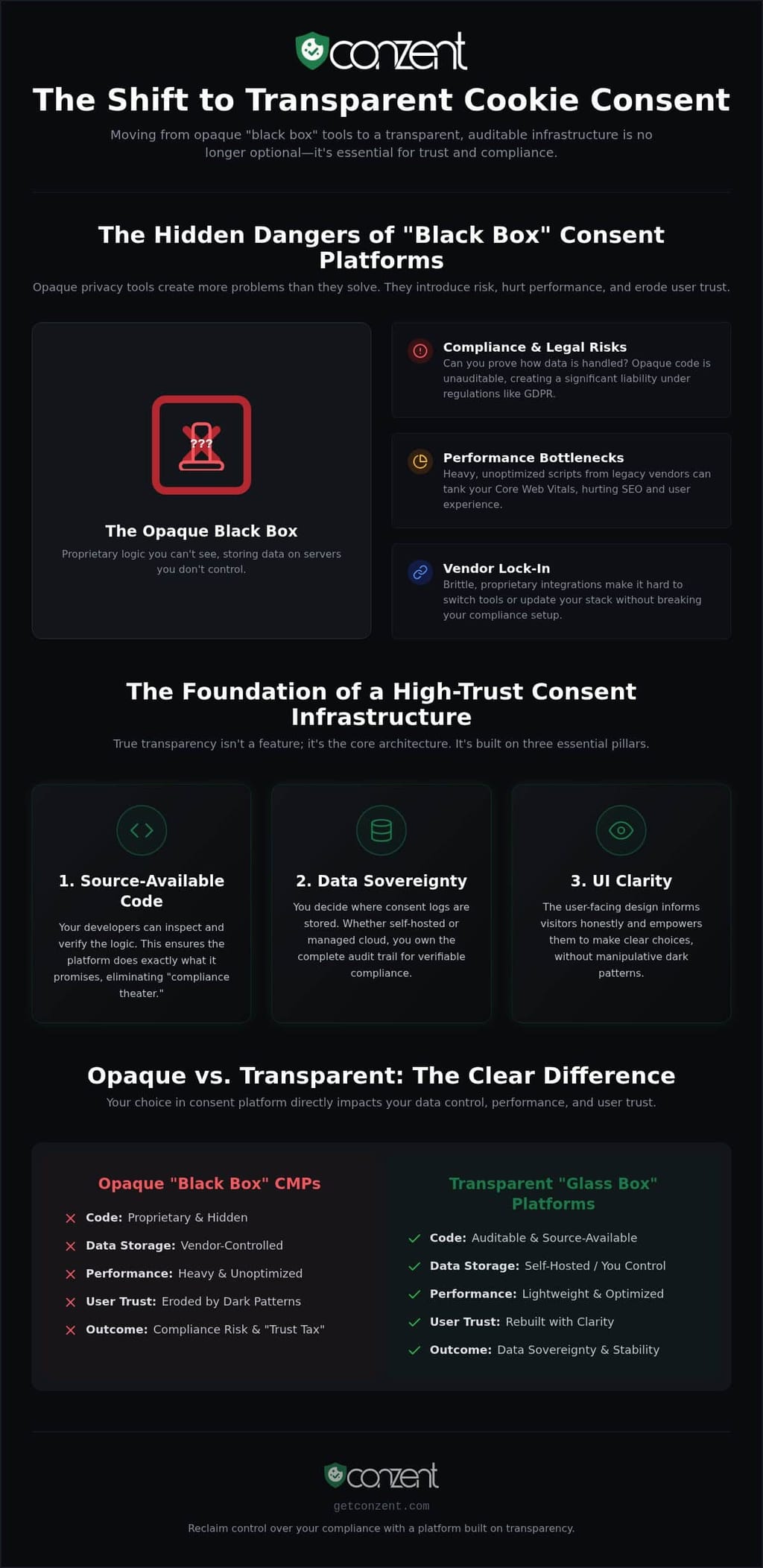
Most Consent Management Platforms (CMPs) operate as proprietary black boxes. You install a script, and it executes logic you can't see, storing data on servers you don't control. A transparent solution is the opposite. It provides visibility into every process. Transparency in 2026 means your consent platform is a glass box, not a locked vault. It prioritizes technical honesty over corporate secrecy.
The Three Pillars of Consent Transparency
To build a high-trust environment, your infrastructure must rest on three specific foundations:
- Source-available code: Your developers should be able to inspect the logic. This prevents "compliance theater" and ensures the platform does exactly what it says.
- Data sovereignty: You decide where consent logs live. Whether you choose self-hosted infrastructure or a managed cloud, you must own the audit trail.
- UI Clarity: Transparency extends to the user. Design should inform visitors without using manipulative dark patterns to force an "Accept" click.
Why "Black Box" CMPs are a Compliance Risk
Proprietary scripts often carry hidden baggage. Some vendors use their own consent banners to drop tracking cookies for their own analytics or cross-site profiling. This turns your compliance tool into a new privacy leak. Beyond legal risks, heavy, unoptimized scripts from opaque vendors can tank your Core Web Vitals. This directly hurts your SEO and user experience. Vendor lock-in is the enemy of digital rights because it forces you to choose between your data ethics and your technical stack.
Choosing an ethical cookie consent platform means reclaiming control. It's a shift from being a passive customer of a "black box" to being an active guardian of your users' data. This technical openness is the only way to meet the rising expectations of both regulators and privacy-conscious visitors.
The Hidden Cost of Opaque Privacy Tools
Many organizations choose a consent manager based solely on how fast they can get it running. This is a trap. You trade long-term infrastructure control for a temporary shortcut. This choice creates a "Trust Tax" that your business pays every day. When users encounter confusing or manipulative banners, they don't just decline cookies; they leave your site entirely. High bounce rates are often the direct result of a disconnect between your brand values and your privacy interface.
Proprietary "black box" tools also carry heavy technical debt. Their integrations are often brittle. When you update your CMS or adjust your tag manager, these closed scripts frequently break. Even worse, many "free" tools aren't actually free. They often monetize your visitor data in the background to subsidize their operational costs. Choosing an ethical cookie consent platform means avoiding these hidden compromises and protecting your relationship with your audience.
Data Sovereignty vs. Vendor Dependence
Storing consent logs on a vendor's server is a significant liability. If you don't control the storage environment, you don't truly own your compliance record. Achieving strict GDPR compliance requires you to verify the full path of every data point. Opaque tools make this level of oversight impossible. This lack of control is increasingly scrutinized under the Regulation of Dark Patterns in Cookie Consent, where regulators look past the banner to see how data is actually handled.
Performance Bottlenecks in Proprietary Scripts
Heavy compliance scripts are a silent killer for your SEO. Legacy tools often rely on bloated, "first-gen" code that significantly delays your Largest Contentful Paint (LCP). In 2026, search engines prioritize speed and technical stability above almost everything else. An unoptimized banner can drop your rankings before a user even has a chance to engage with your content. Conzent uses a streamlined, modern approach designed for high-performance environments. It provides the robust protection you need without the performance drag associated with legacy vendors.
You can build a faster, more transparent site by reviewing our flexible deployment options to see which infrastructure fits your needs.
Core Components of a High-Trust Consent Infrastructure
Trust is not a marketing slogan. It's a technical result. While a clear banner is the public face of your privacy stance, infrastructure is the silent partner in your privacy policy. An ethical cookie consent platform must provide the technical evidence to support its ethical claims. In 2026, this requires a stack that balances user rights with the practical needs of modern advertising and security.
Proprietary vendors often hide behind complexity. Transparent platforms invite scrutiny. To build a high-trust environment, you need a solution that integrates seamlessly with global standards while keeping your underlying code accessible for audit. This level of openness mirrors how tools like StatusPulse provide transparency for system uptime, turning technical reliability into a visible brand asset. It's the difference between a promise and a proof.
Google Consent Mode v2 and IAB TCF Integration
Modern ad tracking in the EEA is impossible without Google Consent Mode v2. It is a mandatory requirement for capturing data in Google Ads and GA4. A transparent solution doesn't just block scripts; it transmits precise consent signals to Google's servers. This allows for AI-driven conversion modeling that can recover up to 70% of lost ad-click-to-conversion processes. Advertisers who correctly apply this modeling see a median conversion lift of 17%.
For publishers, the technical benefit of using a TCF 2.3 certified CMP is equally critical. It ensures your site speaks the same language as the global advertising ecosystem. This certification maintains your revenue by allowing authorized vendors to process data based on verified user choices. For a detailed walkthrough of the setup, refer to our Google Consent Mode v2 Implementation guide.
Source-Available vs. Open Source: What You Need to Know
Security teams at the enterprise level are moving away from proprietary black boxes. They demand the ability to inspect the code running on their sites. This is where the Open Consent Infrastructure (OCI) model excels. We use a source-available approach rather than a purely open-source one. This choice balances developer freedom with the stability of enterprise-grade maintenance. You get the transparency of open code without the fragmentation risks of unmanaged community projects.
Source-available infrastructure is the new standard for high-security environments. It allows your internal teams to verify data flows and storage logic. It's an ethical advantage that turns your compliance setup into a community-supported asset. You aren't just buying a license. You're adopting a standard that respects technical efficiency and digital rights equally.
How to Implement Transparency Without Sacrificing Revenue
Many site owners fear that being too honest will tank their opt-in rates. They worry that a clear, ethical cookie consent platform will highlight "Reject" buttons too prominently and hurt their marketing data. This fear is misplaced. Transparency is not a liability; it is a competitive advantage. When you treat users with respect, they are more likely to engage with your brand. Implementing this approach requires a methodical, data-driven strategy.
Start by auditing your current friction points. If your bounce rate spikes the moment a banner appears, your design is likely too intrusive or confusing. Once you have a baseline, move to active experimentation. Use A/B testing to compare different layouts, wording, and color schemes. You might find that a centered modal performs better than a bottom bar, or that specific language around data usage increases trust. Don't rely on intuition when you can rely on evidence.
The next step is to monitor Revenue Impact Analytics. You need to see the direct line between consent choices and your bottom line. This data allows you to iterate on your design based on real user behavior rather than just legal guesswork. It transforms compliance from a static checklist into a dynamic part of your growth strategy.
The Myth of the Compliance-Revenue Trade-off
There is a persistent belief that you must choose between following the law and making money. This is a false choice. While "dark patterns" might offer a temporary boost in opt-in numbers, they destroy long-term brand equity. Honest design is a better investment. As detailed in our guide on the Revenue Impact of Cookie Consent, sites that prioritize clarity often see higher quality data and better conversion modeling results. Trust is the foundation of sustainable growth.
A/B Testing Your Way to Better UX
Privacy UX is the new frontier of digital design in 2026. It is the practice of making data choices easy to understand and act upon. For example, presenting "Accept" and "Reject" with equal visual weight isn't just a regulatory requirement; it's a signal of integrity. Use your testing data to justify these changes to stakeholders. Show them that a transparent interface reduces user frustration and improves the overall site experience. When privacy is seamless, revenue stays stable. You can start building a high-trust, high-performance site by choosing the right plan for your infrastructure.
Conzent: The Mission-Driven Choice for Modern Compliance
Conzent acts as a principled disruptor in a market crowded with distant vendors. We don't hide behind legal jargon or proprietary secrets. Instead, we function as a community advocate for digital rights and technical efficiency. While legacy providers lock you into closed ecosystems, we offer a choice that respects your technical autonomy. You should choose a partner that invites scrutiny over one that demands blind trust. Our goal is to make high-level compliance a standard for everyone, not a luxury for the few.
We provide a unique hybrid path that adapts to your specific needs. You can opt for our Managed Cloud for operational ease or choose Self-Hosted infrastructure for total data sovereignty. This flexibility is rare. Most vendors force you into a "take it or leave it" SaaS model that strips away your control over where consent logs live. We believe you should own your data stack from the ground up.
Scaling Privacy with Managed Cloud
Managing infrastructure isn't the right move for every team. Our managed cloud solution handles the technical heavy lifting for you. You get automatic updates for evolving standards like IAB TCF 2.3 and instant access to our revenue analytics dashboard. This is the logical step for SaaS and e-commerce brands that need to scale quickly without building a dedicated compliance team. We offer streamlined integrations for WordPress and other major CMS platforms. It ensures your ethical cookie consent platform remains fast, secure, and fully compliant without constant manual oversight.
Joining the Open Consent Infrastructure Movement
Compliance is a public good; your infrastructure should reflect that. This belief led us to develop the Open Consent Infrastructure (OCI). It is a source-available model designed to democratize access to high-end privacy tools. Our egalitarian mission is supported by corporate sponsorships. These partnerships help lower costs for the entire community, making ethical compliance attainable for all users regardless of their resources. Supporting the OCI means supporting a more transparent web.
By choosing Conzent, you are joining a movement that prioritizes technical honesty. You aren't just buying a license; you're adopting an open standard. We invite you to audit our code, scrutinize our data flows, and collaborate with us. Let's build a digital landscape where trust is earned through openness and infrastructure is built to last.
Reclaiming the Standard of Digital Trust
Compliance shouldn't be a hidden burden or a black box. It is a fundamental standard of how we treat people online. By choosing an ethical cookie consent platform, you move away from opaque vendor dependence and toward a model of technical honesty. You gain the ability to audit your own code and own your consent logs while maintaining peak site performance. This shift transforms privacy from a legal hurdle into a core brand advantage.
Building this infrastructure doesn't mean sacrificing growth. With IAB TCF v2.3 and Google Consent Mode v2 certification, you ensure your ad revenue remains stable through precise signaling and AI modeling. Use revenue-focused A/B testing to prove that a transparent user experience actually converts better than manipulative legacy banners. Trust is a measurable asset that pays dividends in user loyalty and data quality.
Take the next step toward a more open and efficient web. Explore the Managed Cloud Consent Platform to see how source-available transparency can secure your business and respect your users. You have the tools to lead with integrity; it's time to implement them.
Frequently Asked Questions
What makes a cookie consent solution "transparent" in 2026?
Transparency in 2026 is defined by the auditability of the underlying code rather than just the visual clarity of the banner. An ethical cookie consent platform must provide a "glass box" approach where developers can inspect data flows and verify storage logic. It means moving away from proprietary black boxes and ensuring you have full visibility into how user preferences are processed and stored on your infrastructure.
Can a transparent cookie banner actually improve my opt-in rates?
Yes, honest design often leads to higher quality engagement. While dark patterns might artificially inflate clicks, they increase bounce rates and destroy long-term trust. When users feel respected and informed, they're more likely to grant consent. By using A/B testing to find the right balance between clarity and conversion, you can build a sustainable relationship with your audience that prioritizes brand integrity over deceptive shortcuts.
Is Google Consent Mode v2 mandatory for a transparent solution?
Implementation is mandatory for websites using Google services and targeting users in the European Economic Area (EEA). Since March 2024, failure to use Google Consent Mode v2 results in the inability to capture data for Google Ads and GA4. A truly transparent solution integrates these signals seamlessly, ensuring your ad stack remains compliant while recovering up to 70% of lost conversion data through AI modeling.
What is the difference between open-source and source-available CMPs?
The primary difference lies in the balance between technical freedom and operational stability. While purely open-source projects can suffer from fragmentation, source-available infrastructure allows you to inspect the code while benefiting from enterprise-grade maintenance. It provides the transparency needed for security audits without the risks associated with unmanaged community code, making it the ideal standard for modern digital rights and technical efficiency.
How does Conzent’s managed cloud differ from its self-hosted version?
Managed cloud is a SaaS model where we handle infrastructure maintenance, automatic updates, and cloud-based analytics for you. It's the logical choice for teams that want compliance without technical overhead. In contrast, the self-hosted version of our Open Consent Infrastructure (OCI) gives you total data sovereignty. You host the code on your own servers, ensuring you have absolute control over where your consent logs are stored.
Will a transparent consent solution slow down my website?
A streamlined ethical cookie consent platform is designed to minimize performance lag. Legacy "first-gen" tools often rely on heavy, unoptimized scripts that delay your Largest Contentful Paint (LCP). Modern solutions like ours prioritize technical efficiency and speed. By using lightweight infrastructure, you can meet strict compliance standards without hurting your SEO rankings or forcing your visitors to wait for a bloated banner to load.
How do I measure the revenue impact of my cookie consent choices?
You can measure this through integrated Revenue Impact Analytics. This tool identifies the direct connection between user consent signals and your actual ad revenue. Instead of guessing how privacy choices affect your bottom line, you get concrete data to justify your setup. This allows you to iterate on your banner design and technical configuration based on real financial performance rather than relying on abstract assumptions.
Is Conzent compliant with IAB TCF v2.3 standards?
Yes, Conzent is fully certified for IAB TCF v2.3. This certification ensures that our platform speaks the standard language of the global advertising ecosystem. It allows you to transmit verified consent signals to authorized vendors, maintaining your ability to monetize content while respecting user choices. Staying current with these standards is essential for any publisher or advertiser looking to secure their revenue in a post-cookie landscape.