
7 Proven Strategies to Improve Your Cookie Consent Rate in 2026

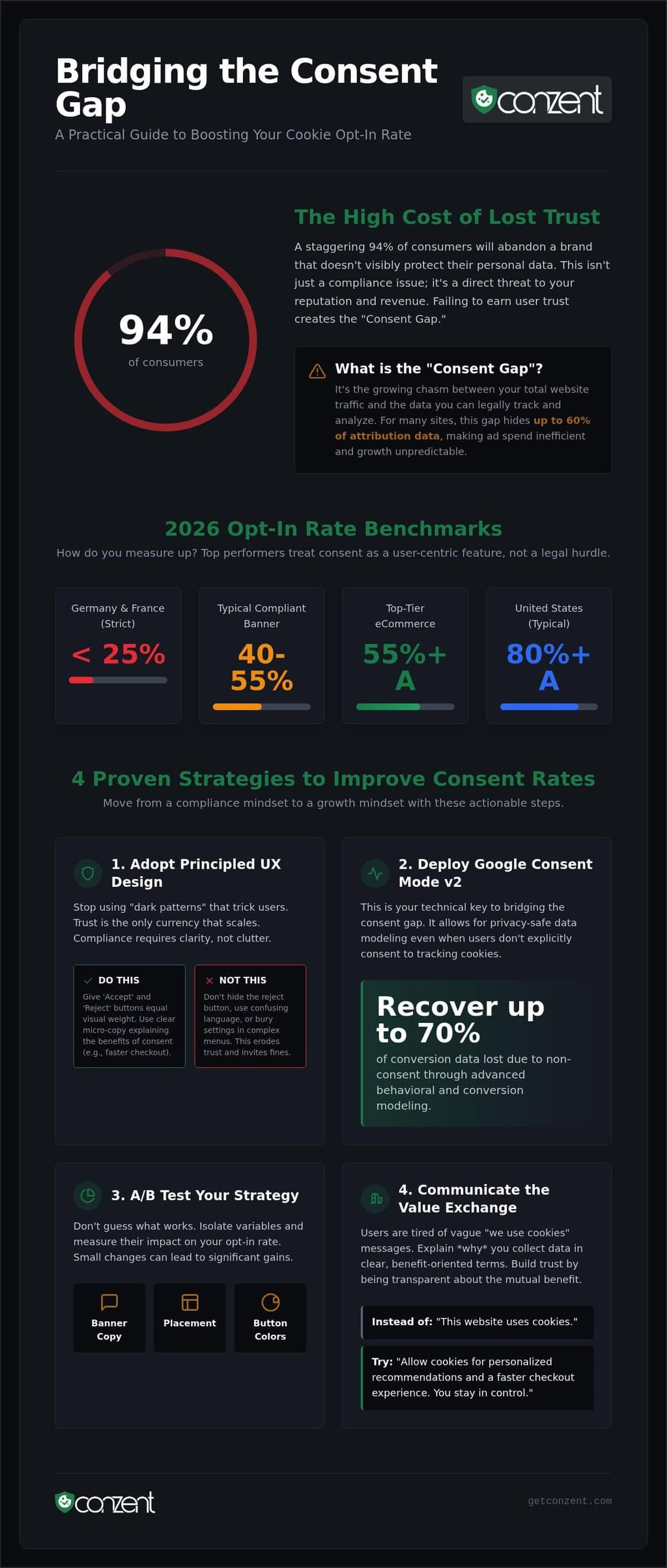
94% of consumers will stop buying from a brand that fails to visibly protect their personal data. It is a staggering figure that proves privacy is no longer a legal checkbox. It is a core pillar of your brand reputation. You likely feel the sting of the "consent gap" every day. Lost ad attribution, rising bounce rates from intrusive banners, and the constant shadow of GDPR fines make growth feel impossible. You need actionable data to scale, but you cannot sacrifice user trust to get it.
The good news is that transparency is your highest-converting feature. You can significantly improve cookie consent rate results without resorting to illegal dark patterns or deceptive design. This is about technical precision and ethical clarity. We will show you how to recover lost Google Ads attribution and boost opt-in rates using rigorous A/B testing and optimized signaling architecture. High performance is not a luxury; it is the result of respect for the user.
We are breaking down seven proven strategies to master Google Consent Mode v2 and IAB TCF v2.3 requirements while building a user experience that reflects your values. It is time to turn your consent banner from a barrier into a bridge.
Key Takeaways
- Identify the "Consent Gap" to understand how missing data directly degrades your Google Ads performance and SEO attribution.
- Replace deceptive "Dark Patterns" with principled UX design that builds long-term user trust while maintaining high visual weight for compliance.
- Deploy Google Consent Mode v2 to recover up to 70% of lost data through advanced behavioral modeling without compromising privacy standards.
- Implement a systematic A/B testing framework to improve cookie consent rate metrics by isolating variables like copy, button color, and banner placement.
- Leverage source-available infrastructure and Revenue Impact Analytics to gain full transparency over your data collection and its actual bottom-line effect.
Table of Contents
Understanding the "Consent Gap" and Why Your Opt-in Rate Matters
The "Consent Gap" is the silent killer of modern marketing budgets. It is the growing chasm between your actual site traffic and the data you can legally track. When a user rejects your HTTP cookie, they effectively disappear from your analytics. This isn't just a reporting annoyance; it is a fundamental break in your attribution chain. Without these signals, your conversion modeling collapses. You cannot optimize what you cannot see. To improve cookie consent rate metrics, you must first acknowledge that data loss is a choice made by your UX design, not an inevitable tax on privacy.
The Cost of Data Blindness
Lost signals lead directly to inefficient ad spend. When Google Ads loses sight of a user journey, it loses the ability to bid effectively. You end up paying for clicks that your system treats as "new" even if they are returning high-value customers. This creates a massive revenue impact of cookie consent that many teams fail to quantify. The Consent Gap is the delta between raw server logs and consented browser events, and it currently masks up to 60% of attribution data for non-optimized sites.
In 2026, the benchmarks for a healthy opt-in rate have shifted. While the typical compliant banner sees rates between 40% and 55%, top-tier eCommerce sites aim for 55% or higher. In the US, acceptance often exceeds 80%. However, in strict jurisdictions like Germany or France, clear choice banners often see fewer than 25% acceptance. If you are below these numbers, your technical implementation is likely working against your growth.
Why Traditional Banners are Failing
Users are exhausted. "Consent fatigue" is a real psychological barrier where visitors reflexively click "Reject All" just to clear their screen. This happens because most banners are intrusive, slow, and visually jarring. There is a persistent misconception that a banner must be "ugly" or "clunky" to be legally compliant. That is false. Compliance requires clarity, not clutter. Ethical transparency is a competitive advantage, while the "ignore it and hope" approach leads to high bounce rates and legal liability.
The industry is moving toward ethical cookie consent platforms that prioritize speed and principled design. A banner that loads 200ms faster can see a measurable lift in opt-ins. Dark patterns might offer a temporary boost, but they destroy brand trust. 94% of consumers will abandon a brand that doesn't visibly protect their data. Transparency is your most effective conversion tool. It's time to stop hiding behind complexity and start treating consent as a user-centric feature.
Privacy UX: How to Design Banners for High Conversion
Principled design is not a compromise; it is a conversion strategy. Many brands still rely on "Dark Patterns" to trick users into consenting. They use tiny "Reject" buttons or bury opt-out settings behind three layers of menus. This approach is a liability. In September 2025, France's CNIL fined Google €325 million and Shein €150 million specifically for cookie consent violations. To improve cookie consent rate metrics sustainably, you must move toward transparent, egalitarian design. Trust is the only currency that scales.
Button hierarchy and visual weight are your primary tools here. Regulators now require that "Accept" and "Reject" options have equal visual prominence. Attempting to hide the "Reject" button doesn't just invite fines; it alienates your audience. Instead, focus on micro-copy. Explain exactly *why* you are collecting data. When you tell a user that cookies enable "faster checkout" or "personalized recommendations," you provide a reason to opt in. Transparency demystifies the process.
The Psychology of the First Impression
Your banner's placement dictates the user's initial emotional response. A center modal demands immediate action but can feel like a roadblock. A bottom bar is less intrusive but might be ignored. The key is finding privacy ux design patterns that align with your brand's voice. We often see a "Value Exchange" model work best. This involves a clear statement: "We use data to make your experience better, and you stay in control." This level of honesty builds the confidence necessary for a high-quality opt-in. If you want to see how this looks in practice, you can explore our flexible pricing plans for managed implementations.
Mobile-First Consent Optimization
Mobile users have zero patience for clunky interfaces. On a small screen, a poorly designed cookie banner can easily trigger Google’s "intrusive interstitial" penalty. This actively harms your SEO rankings. Your mobile banner must be lightweight and touch-friendly. Follow this checklist for mobile optimization:
- Touch Targets: Ensure buttons are at least 44x44 pixels to prevent accidental clicks.
- Screen Real Estate: The banner should never cover more than 30% of the initial viewport.
- Contrast: Use high-contrast text to ensure legibility in various lighting conditions.
- Speed: Optimize the banner script to prevent Cumulative Layout Shift (CLS).
A mobile banner that respects the user's space is far more likely to be accepted than one that forces a confrontation. By prioritizing accessibility and clarity, you turn a legal requirement into a seamless part of your brand experience.
Technical Reliability: Google Consent Mode v2 and Performance
Technical reliability is the bedrock of digital trust. A banner that fails to load quickly or correctly is a banner that fails to convert. When your consent interface lags, users don't wait; they bounce or reflexively click "Reject All" to clear the obstruction. This technical friction is a primary reason why many sites struggle to improve cookie consent rate metrics. High performance is not a premium feature. It is a baseline requirement for maintaining your data integrity.
For publishers relying on programmatic advertising, the stakes are even higher. The IAB TCF v2.3 framework became mandatory on February 28, 2026. If your technical stack isn't certified to handle these signaling requirements, your ad revenue will drop as demand partners stop bidding on unverified traffic. Reliability means ensuring every preference is passed accurately and instantly to your entire marketing stack.
Restoring Attribution with GCM v2
Implementing Google Consent Mode v2 is the most effective way to bridge the data gap without violating privacy. The "Advanced" implementation mode allows your site to send cookieless pings to Google when a user declines consent. This enables behavioral modeling that can recover up to 70% of lost journey data. Unlike "Basic" mode, which simply blocks tags, Advanced mode provides the signals necessary for Google Ads to attribute conversions correctly.
Conzent optimizes this process by ensuring the consent script fires before any third-party tags. This precise sequencing prevents "data leakage" where tags fire before a user has made a choice. You can explore the full range of GCM v2 features to understand how this technical synergy protects your attribution while respecting the user's right to decline. Precision in execution is the only way to scale ethically.
Infrastructure Matters: Speed and Uptime
Your banner's load speed directly impacts your Core Web Vitals. A heavy, third-party cloud script can delay your Largest Contentful Paint (LCP) and frustrate visitors. This is why many high-traffic entities are moving toward self-hosted cookie consent managers. By hosting the infrastructure yourself, you eliminate third-party dependencies and reduce latency. Conzent’s lightweight, source-available architecture is designed for this exact purpose. It delivers maximum speed without the "black box" complexity of traditional vendors. When your banner loads via a global CDN alongside your primary site assets, the user experience remains seamless. Speed is conversion; lag is loss.
A/B Testing Your Consent Strategy: A Systematic Framework
A/B testing is often treated as a luxury for enterprise marketing. It isn't. It is a fundamental requirement for anyone serious about digital growth. Most competitors suggest that compliance is a static checkbox. They are wrong. Compliance is a baseline; optimization is where you recover your competitive edge. To improve cookie consent rate metrics, you must move from guesswork to a data-driven framework. This isn't about manipulation. It's about finding the clearest path to user agreement.
Follow this five-step cycle to refine your approach:
- Step 1: Establish a baseline. Use your current analytics to find your true opt-in rate. You cannot improve what you do not measure.
- Step 2: Isolate one variable. Change the button color. Change the micro-copy. Move the banner position. Never test two things at once.
- Step 3: Split your traffic. Use consent A/B testing tools to show different versions to live segments of your audience.
- Step 4: Analyze the metrics. Look at the "Accept" rate alongside your site-wide bounce rate. A high opt-in rate is a failure if it drives 20% of your visitors away.
- Step 5: Crown a winner. Implement the successful version and immediately identify the next variable to iterate on.
Variables That Actually Move the Needle
Small changes yield massive results. Research shows that a clear and honest banner can increase long-term conversion rates by 15%. Testing "Allow All" against "I Agree" or "Accept All" often reveals surprising user preferences. The presence of an "X" close button is another critical variable. In many jurisdictions, clicking "X" must be treated as a rejection of non-essential cookies. Testing this against an explicit "Reject" button helps you find the balance between regulatory safety and data retention. Brand-aligned colors also matter. A banner that looks like part of your site builds trust. A banner that looks like a system error invites a "Reject" click.
Measuring Success Beyond the Click
Don't fall into the trap of optimizing for clicks alone. High volume does not always mean high quality. You need to verify the "quality of consent." Are users accepting all categories or just the strictly necessary ones? Use a revenue impact dashboard to see how these choices affect your bottom line. If your "Accept" rate goes up but your Google Ads attribution stays flat, your signaling architecture is broken. You aren't just looking for a click; you're looking for valid, actionable data that fuels your growth.
Ready to stop guessing and start growing? View our managed cloud plans to begin testing your strategy today.
Conzent: The Principled Path to High Opt-In Rates
Conzent is not a black box. It is a standard. Most consent management platforms (CMPs) operate as distant vendors, hiding their logic behind proprietary code. We believe that transparency is the only way to build lasting digital trust. As a mission-driven alternative, Conzent provides the infrastructure you need to improve cookie consent rate results without compromising your integrity. Our "Source-Available" advantage means you can audit the code yourself. Transparency isn't a luxury; it's a requirement for ethical growth. It makes you a partner in the process rather than just a customer.
The Managed Cloud Consent Platform is built specifically for agencies and scaling SaaS teams who need performance without the overhead. We've removed the barriers to high-tier compliance. Through our sponsorship-driven pricing model, we make advanced tools accessible to everyone regardless of their budget. You get IAB TCF v2.3 certification and GCM v2 readiness right out of the box. We don't hide essential features behind enterprise paywalls. We provide public goods for a private web.
Managed Cloud vs. Self-Hosted Infrastructure
Every team has different technical requirements. DevOps-heavy organizations often prefer our self-hosting options through the Open Consent Infrastructure (OCI). This gives you total control over your data environment and eliminates third-party script dependencies that slow down your site. It is the ultimate choice for those who demand maximum speed and data sovereignty. You own the infrastructure; you own the trust.
For marketing teams, our managed service is the "set and forget" solution. It offers seamless integration with WordPress, Shopify, and other major CMS platforms. You get the same lightweight, fast-loading architecture without needing to manage the server yourself. Whether you choose cloud or OCI, the goal is the same: streamlined efficiency and total compliance. It is about choosing the path that fits your specific resources and brand values.
Ready to Recover Your Data?
Success in 2026 requires a three-part strategy: ethical UX, technical precision, and continuous A/B testing. You've seen how the "Consent Gap" drains your revenue and how Google Consent Mode v2 can restore your attribution. Now, it's time to act. Don't let your data disappear into a black box of non-compliance and poor design. You have the tools to turn your banner into a trust-building asset that drives measurable growth.
You can improve cookie consent rate metrics while respecting your users. It isn't a zero-sum game. Join the Open Consent Infrastructure mission and start building a more transparent web. Transparency is your highest-converting feature. Visit our pricing page to choose your plan and reclaim your data today.
Reclaim Your Data with Ethical Precision
Digital growth in 2026 requires more than just meeting legal minimums. It demands a shift from seeing privacy as a hurdle to seeing it as a standard. You've learned that closing the "Consent Gap" relies on a combination of ethical UX and technical excellence. High-performance banners aren't just faster; they're more trustworthy. When you combine rigorous A/B testing with a signaling architecture that actually works, you don't just follow the rules. You win back your attribution.
To improve cookie consent rate results across your properties, you need a partner that values transparency as much as you do. Conzent provides a source-available infrastructure that is fully IAB TCF v2.3 and GCM v2 certified. We've built in the A/B testing and revenue analytics you need to see the real impact of every design choice. Stop treating consent as a black box and start treating it as a competitive advantage.
View Conzent pricing and start optimizing your consent rates today. The path to privacy-first growth is clear. It's time to lead the way.
Frequently Asked Questions
How do I calculate my current cookie consent opt-in rate?
Divide the number of "Accept" events by the total number of banner impressions to find your raw opt-in percentage. To get a complete picture, you must also track the "Consent Gap" by comparing these events to your total server-side sessions. This identifies how much traffic disappears before the banner even interacts with the user. Accurate measurement is the first step toward optimization.
Is it legal to make the "Accept" button more prominent than "Reject"?
No, this is a "dark pattern" and is illegal under GDPR and ePrivacy regulations. Authorities like the French CNIL require that "Accept" and "Reject" buttons have equal visual prominence. Using different colors, sizes, or font weights to bias the user is a compliance risk. Ethical design focuses on clarity and egalitarian choice, not visual manipulation to force a click.
Can I use A/B testing on a cookie banner under GDPR?
Yes, you can use A/B testing to improve cookie consent rate results as long as every variant you test is fully compliant. You should experiment with elements like micro-copy, banner positioning, or the wording of your "Value Exchange." You must never test non-compliant designs, such as removing the "Reject" button. Compliance is the foundation of every experiment we run.
What is a good cookie consent rate for a B2B SaaS website?
A healthy opt-in rate for B2B SaaS typically ranges between 40% and 50%. This sector usually sees higher engagement than news media but lower rates than healthcare or finance. If your rate is below 40%, you likely have technical friction or a lack of trust in your micro-copy. Use Revenue Impact Analytics to see how this affects your customer acquisition costs.
Does Google Consent Mode v2 increase my opt-in rate?
No, it doesn't change how many users click "Accept." Instead, it uses behavioral modeling to recover data from users who decline consent. This technical implementation restores up to 70% of lost journey signals in Google Ads and GA4. It solves the data blindness problem without needing to change the user's mind. It's a technical solution for a data-driven world.
How does banner load speed affect my SEO and consent rate?
Slow banners increase bounce rates and lower your opt-in percentage. If a banner delays your Largest Contentful Paint (LCP), Google may penalize your SEO rankings for poor Core Web Vitals. Users who encounter a lagging interface often click "Reject" or leave the site entirely. A lightweight, self-hosted infrastructure ensures your banner loads instantly, protecting both your search visibility and your data.
What is the difference between a dark pattern and a high-conversion design?
Dark patterns use deception to trick users, while high-conversion design uses transparency to build trust. A dark pattern hides the "Reject" button or uses confusing double negatives. High-conversion design clearly explains the "Value Exchange" and provides a seamless, egalitarian choice. One is a legal liability; the other is a long-term brand asset that respects the digital rights of every visitor.
How can I measure the revenue impact of my cookie banner?
Use Revenue Impact Analytics to correlate consent events with conversion values in your CRM or eCommerce platform. This allows you to see the actual dollar value of a consented user versus an unconsented one. By quantifying the "Consent Gap" in financial terms, you can prioritize UX improvements that directly affect your bottom line. It turns a compliance task into a growth strategy.