
Cookie Consent Banner: The 2026 Guide to Compliance and Revenue

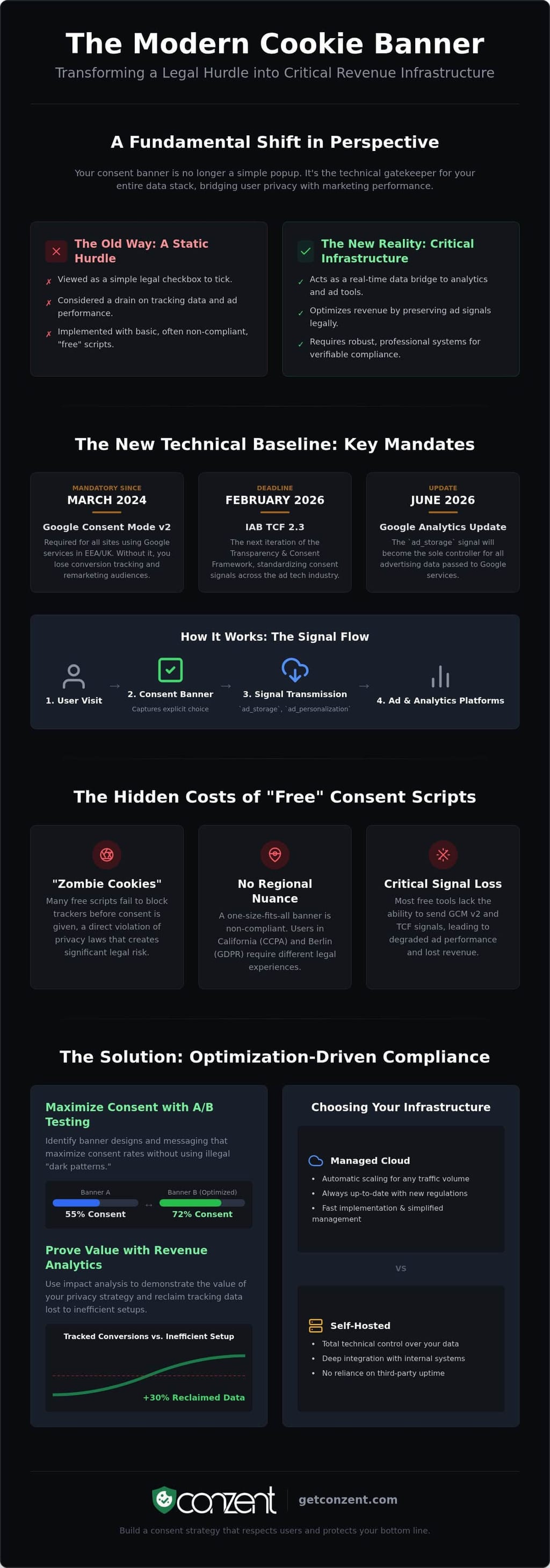
Your cookie consent banner isn't just a legal hurdle. It is a critical piece of revenue infrastructure. It is not a decorative popup. Most site owners see privacy compliance as a drain on tracking data and ad performance. They assume that being ethical means being invisible to their own analytics. It's a common frustration. The March 2024 Google Consent Mode v2 mandates and the February 2026 IAB TCF 2.3 deadline turned simple popups into complex technical puzzles. You aren't alone if you feel like the regulatory goalposts keep moving. Digital rights shouldn't be a barrier to business growth.
You don't have to choose between legal safety and your bottom line. This guide shows you how to implement a high-performance cookie consent banner that balances strict compliance with revenue optimization. We'll demystify the June 2026 Google Analytics updates, where ad_storage became the sole control for advertising data. You'll learn how to maintain 100% compliance across 20 US states while avoiding the "dark patterns" that regulators are now targeting. We are moving past "black box" solutions toward transparent, efficient systems that respect users and protect your data.
Key Takeaways
- Treat your cookie consent banner as critical data infrastructure that bridges the gap between user privacy and marketing performance.
- Implement Google Consent Mode v2 and IAB TCF 2.3 natively to prevent ad signal loss and ensure full compliance with 2026 standards.
- Leverage A/B testing to identify banner designs that maximize consent rates without resorting to illegal dark patterns.
- Compare the advantages of managed cloud scaling against the total technical control of self-hosted open consent infrastructure.
- Use revenue impact analytics to prove the value of your privacy strategy and reclaim tracking data lost to inefficient setups.
What is a Cookie Consent Banner and Why is it Infrastructure?
A cookie consent banner is the interface between user privacy and your data stack. It is not a cosmetic layer. It is the technical gatekeeper for every byte of data your website collects. In 2026, the era of the static "Close" button is over. Compliance now demands more than a simple notice. It requires verified signal transmission. Your banner must act as a bridge, communicating user preferences directly to your analytics and advertising tools in real time.
This shift represents a fundamental change in how we handle digital rights. We are moving away from the old "Notice and Choice" model. Modern standards require that your site doesn't just ask for permission; it must prove that permission was granted before any tracker fires. This is why we view consent as infrastructure, not a plugin. A poorly built plugin adds latency. It drags down your Core Web Vitals. It hurts your SEO. Robust infrastructure ensures that your privacy layers are as fast as your content. It turns a legal requirement into a technical advantage.
The Core Function of a Modern CMP
A modern Consent Management Platform (CMP) does more than show a popup. It captures explicit consent signals and translates them into machine-readable data. This process is rooted in the Directive on Privacy and Electronic Communications, which set the standard for how cookies are used across the EU. A professional cookie consent banner must categorize every tracker on your site into specific buckets: Essential, Functional, and Marketing. This categorization must be dynamic and accurate.
It must also maintain a legally defensible audit log. If a regulator asks for proof of consent, a screenshot of your banner is useless. You need a time-stamped, encrypted record of the user's choice. This is the difference between a visual gimmick and a compliant system. You can find more details on meeting these specific standards in our GDPR compliance guide. We believe transparency is a prerequisite for trust.
Why "Free" Scripts Often Fail Compliance
Free scripts are often a liability. They frequently fail to block cookies from firing before the user interacts with the banner. These "zombie cookies" are a direct violation of global privacy laws. Most free tools also lack the nuance to handle regional variations. A user in California requires a different experience than a user in Berlin. A one-size-fits-all approach is no longer viable and can lead to significant penalties.
Most free solutions also lack the complex signals required by Google Consent Mode v2 or the IAB TCF v2.3 framework. Without these signals, your ad performance will suffer as platforms lose the ability to model conversions. Choosing a cookie consent banner built on professional infrastructure is the only way to protect your revenue and your reputation simultaneously. It is about doing things right, not just doing them for free.
The Technical Baseline: Google Consent Mode v2 and IAB TCF 2.3
Your cookie consent banner is the primary translator for your marketing stack. It doesn't just show a message; it sends specific signals that tell Google and other ad platforms how to handle data. As of March 2024, Google Consent Mode (GCM) v2 became mandatory for all websites using Google services in the EEA, UK, and Switzerland. Without it, you lose the ability to track conversions and build remarketing audiences. The technical baseline has shifted from simple "on/off" switches to a complex array of parameters like ad_user_data and ad_personalization.
Effective signal mapping is what separates professional infrastructure from basic plugins. When a user interacts with your banner, the system must immediately update the consent state across your entire tag library. This ensures that your data remains clean and your ad spend remains efficient. Following the ICO guidance on cookies is essential for ensuring these signals are captured and transmitted legally. At Conzent, we treat GCM v2 as a native component, not an optional add-on. We ensure your marketing tags receive the right signals every time. You can view our managed and self-hosted options to see how we handle these integrations at scale.
GCM v2: Basic vs. Advanced Implementation
There are two ways to handle GCM v2. Basic mode is the most conservative approach. No tags fire until the user grants explicit consent. It's safe, but it leaves a massive hole in your data. Advanced mode is different. It sends cookieless pings to Google before consent is granted. These pings don't identify the user, but they allow Google to use AI to model the conversions you've missed. This can recover a significant portion of your lost attribution data. For a deeper dive into the setup, read our Google Consent Mode v2 Technical Guide.
IAB TCF 2.3 for Publishers and Agencies
If you rely on programmatic advertising, IAB TCF 2.3 is your standard. This framework allows you to communicate consent to hundreds of vendors simultaneously through the Global Vendor List (GVL). The enforcement deadline of February 28, 2026, made TCF 2.3 mandatory for anyone using Google AdSense or AdManager. It requires a "Disclosed Vendors" section in your consent string, giving users total transparency. Using a certified CMP is the only way to maintain your ad revenue in this ecosystem. Learn how to stay compliant with our IAB TCF 2.3 Certified CMP Guide.
Compliance Requirements: GDPR, CCPA, and Beyond
Compliance is a moving target. In 2026, a cookie consent banner that only offers an "Accept" button is a legal liability. Regulators in Europe and the US now demand equal prominence for choices. If you have a large "Accept All" button, your "Reject All" button must be just as visible. This isn't just a design choice; it's a core requirement of the GDPR. Consent must be freely given, specific, and informed. With the EU AI Act taking full effect on August 2, 2026, transparency now extends to how you use AI to process that data. Anything less than total clarity is a dark pattern that invites scrutiny.
The stakes are high. In February 2026, a settlement with The Walt Disney Company resulted in $2.75 million in penalties for failing to provide compliant CCPA opt-out rights. This shows that enforcement is getting aggressive. Your banner needs to adapt to regional nuances automatically. Whether it's Brazil's LGPD or Canada's PIPEDA, your infrastructure must detect the user's location and serve the correct legal framework. Following the ICO guidance on cookie compliance helps ensure your site meets the high standards expected by data protection authorities.
GDPR-Compliant Design Standards
Design is now a compliance issue. You can't use pre-ticked checkboxes for non-essential cookies. Users must take an active step to opt-in. Transparency is the only way forward. Your banner copy should use clear, non-technical language. It's also vital to provide an easy way to withdraw consent. Most regulators now expect a "floating" icon or a persistent link that allows users to change their minds at any time. We build these standards into our Conzent compliance features so you don't have to worry about the fine print.
US Privacy and Opt-Out Frameworks
The US landscape is fragmented but converging on stricter rules. As of March 2026, 20 US states have comprehensive privacy laws in effect. The CCPA and CPRA require a "Notice at Collection" and a clear way for users to opt-out of the sale or sharing of their data. You must also respect Global Privacy Control (GPC) signals. If a user's browser sends a GPC signal, your cookie consent banner must treat it as a valid opt-out request automatically. This is no longer optional. It's a baseline requirement for doing business in the US market.
Optimizing for Trust: UX and Revenue Impact
A cookie consent banner is often treated like a tax on your marketing budget. This is a mistake. When you view consent as a barrier, you ignore its role in your revenue engine. The "Consent Gap" refers to the data you lose when users opt-out or simply ignore your banner. Low opt-in rates don't just hide user behavior; they cripple your marketing ROI. If your ad platforms can't see who is converting, they can't optimize your spend. A 10% increase in consent isn't just a compliance metric. It is a direct boost to your attribution accuracy and your bottom line. You are essentially paying for data you aren't allowed to use.
Trust is the currency of the modern web. UX best practices are the tools you use to earn it. Intrusive, ugly banners don't just look bad; they drive users away. High-bounce pages are often the result of banners that block content or feel untrustworthy. Your placement, color schemes, and micro-copy must work together to create a seamless experience. We believe that privacy should be a standard, not a friction point. To find the right balance for your specific audience, you can view our platform options which include advanced testing and analytics tools. Professional infrastructure turns these choices into measurable advantages.
A/B Testing Your Consent Banner
Finding the highest-converting banner design requires data, not guesswork. You should test different positions to see what resonates with your users. A bottom bar is often less intrusive, while a center modal demands attention. Accessibility is also a legal requirement. You must test button colors and contrast to ensure everyone can interact with your cookie consent banner regardless of their visual needs. Small changes in micro-copy can lead to significant shifts in user behavior. For a deeper look at how these choices affect your growth, read our Revenue Impact of Cookie Consent Guide. We aim to demystify these variables for every user.
Revenue Analytics for Privacy Teams
Privacy teams and marketing teams often speak different languages. Revenue analytics bridge that gap. You need to visualize the correlation between consent rates and ad spend. If a specific page has a high bounce rate, check if your banner is the cause. Our Revenue Impact Features allow you to track these metrics in real time. This transparency allows you to prove the value of your privacy strategy to stakeholders. It turns compliance from a cost center into a performance driver. You aren't just following rules; you are building a more efficient and ethical business.
Choosing Your Infrastructure: Managed Cloud vs. Self-Hosted
Your choice of infrastructure defines your relationship with your users. A cookie consent banner is either a bridge to trust or a hidden leak in your data stack. Most Consent Management Platforms operate as "black boxes." They collect your users' data on their own servers and expect you to trust their proprietary logic. We believe that's the wrong approach. You should have the option to own your infrastructure entirely. Whether you need the convenience of the cloud or the security of a self-hosted environment, your privacy strategy should be transparent and verifiable.
Control is not a luxury. It is a standard. Source-available software allows you to inspect the code that handles your consent signals. Closed-source systems force you to rely on a vendor's word. In an era of aggressive regulatory enforcement, that's a significant risk. Our Open Consent Infrastructure (OCI) is built on the principle of openness. It gives you the technical efficiency of a professional platform with the moral clarity of open standards. You don't have to sacrifice performance for ethics. It's about providing a public good through technical excellence.
Scaling with Managed Cloud
Managed Cloud is built for teams that prioritize scale and zero maintenance. Privacy law is a moving target. On January 1, 2026, comprehensive privacy laws took effect in Indiana, Kentucky, and Rhode Island. Keeping up with these regional shifts is a full-time job. With a managed solution, these updates happen automatically. You get the benefit of a global CDN, ensuring your banner loads with minimal latency anywhere in the world. This speed is vital for maintaining your Core Web Vitals and user experience. You can explore our pricing tiers to find a managed plan that fits your traffic volume.
The Developer-First Approach to Self-Hosting
Self-hosting is the ultimate choice for data sovereignty. It allows you to deploy OCI directly on your own servers. This setup ensures that no third party ever sees your consent signals. It's the ideal path for organizations with strict security requirements or those who want to integrate consent management into existing CI/CD pipelines. You treat your cookie consent banner like any other part of your internal infrastructure. It becomes a seamless part of your development workflow. For a detailed roadmap on this approach, see our Ultimate Guide to Self-Hosted Cookie Consent Managers. We provide the tools; you maintain the control.
Future-Proof Your Data Strategy
Modern data privacy is a necessary standard; it is not a luxury. A high-performance cookie consent banner is the only way to bridge the gap between user rights and marketing revenue. You've seen how mandatory frameworks like Google Consent Mode v2 and IAB TCF v2.3 now dictate your ad performance. You also know that choosing between managed cloud and self-hosted infrastructure is a choice about data ownership. The era of the "black box" CMP is over.
Conzent provides the technical efficiency you need to scale without compromise. Our platform is IAB TCF v2.3 certified and features native Google Consent Mode v2 support. We believe in source-available transparency because you should control your own signals. Whether you're optimizing for CCPA or GDPR, you deserve tools that work for you, not against you. Start Building Your High-Performance Cookie Banner with Conzent. You can build a more ethical and profitable web today.
Frequently Asked Questions
Do I really need a cookie banner if I only use Google Analytics?
Yes, you need a banner because Google Analytics uses tracking identifiers that fall under GDPR and ePrivacy regulations. Even if you don't use advertising features, the storage of analytics cookies requires explicit user consent. In 2026, failing to capture this consent correctly means your data is legally non-compliant and technically incomplete. Google Consent Mode v2 now makes this signaling mandatory for all users in the EEA and UK.
What is the difference between Google Consent Mode v1 and v2?
The primary difference is the introduction of two new parameters: ad_user_data and ad_personalization. While v1 focused on storage permissions, v2 requires explicit signals for how data is used within the Google ecosystem. This version became mandatory in March 2024 for anyone using Google Ads or Analytics in the European Economic Area. It ensures that user preferences are transmitted directly to Google's modeling engines to maintain conversion accuracy.
Can a cookie banner affect my SEO rankings?
A cookie consent banner can impact SEO if it hurts your Core Web Vitals or blocks search engine crawlers. Heavy, poorly coded scripts increase page load times and trigger Cumulative Layout Shifts, which are negative ranking factors. However, using a lightweight infrastructure ensures your site remains fast and accessible. High-performance banners load asynchronously to prevent blocking the main thread, protecting your visibility in search results while maintaining strict legal compliance.
Is it legal to use a "Reject All" button that is less visible than "Accept All"?
No, it is no longer legal in most jurisdictions. Regulators now define this as a "dark pattern" that manipulates user choice. Under GDPR and many US state laws, the option to refuse consent must be as easy and prominent as the option to accept. If your "Accept All" button is bright green and your "Reject" link is hidden in small text, you risk significant fines and enforcement actions from data protection authorities.
How do I integrate a cookie banner with WordPress or Shopify?
Integration typically involves adding a small script to your site's header or using a dedicated plugin. For WordPress, you can use our native integration to deploy the cookie consent banner without manual coding. On Shopify, you insert the script into your theme files or use a tag manager. This ensures that your consent signals synchronize with your existing marketing tags and analytics tools automatically, providing a seamless experience for your visitors.
What happens if I don't use a cookie consent banner in 2026?
You face two major risks: legal penalties and data loss. Regulators are actively enforcing privacy laws, as seen in the $2.75 million Disney settlement in February 2026. Beyond fines, platforms like Google will stop processing your tracking data without valid consent signals. Your ad campaigns will lose their ability to target audiences or measure conversions accurately. Operating without a banner essentially blinds your marketing team and invites regulatory scrutiny.
How does Conzent handle IAB TCF 2.3 requirements?
Conzent is IAB TCF v2.3 certified, meaning our platform meets the strict standards for programmatic advertising. We provide the mandatory "Disclosed Vendors" section within the cookie consent banner, ensuring users see exactly who is processing their data. Our system generates the required Transparency and Consent strings automatically. This allows publishers and agencies to maintain their ad revenue while adhering to the February 28, 2026, enforcement deadline for the latest TCF version.
Can I host my own cookie consent manager for free?
Yes, you can use our Self-Hosted Open Consent Infrastructure (OCI) at no cost. This source-available option allows you to deploy the platform on your own servers, giving you total data sovereignty. It's an ideal solution for developers who want to integrate consent management into their own CI/CD pipelines without relying on third-party cloud vendors. You get the same high-performance features as our managed cloud version while maintaining full control over your technical stack.