
Cross-Domain Cookie Consent: Implementing Privacy Across Multiple Sites in 2026

Privacy is a standard, not a luxury. If your users have to click "Accept" on three different domains just to browse your brand portfolio, you aren't respecting their time or their rights. This friction destroys the user experience and breaks your attribution models. Effective cross-domain cookie consent is no longer a tracking trick; it's a first-party infrastructure requirement. In 2026, relying on outdated third-party methods is a liability. You need a system that works with modern browser storage partitioning, not against it.
You likely agree that managing a dozen different consent states across a global brand is a technical nightmare that hurts your bottom line. It's frustrating to watch revenue dip because of privacy walls that feel like digital roadblocks. This guide will show you how to maintain total compliance and a seamless user experience across multiple domains without relying on third-party tracking. We'll explore how to implement a single consent interaction for all your brand domains while ensuring full alignment with IAB TCF 2.3 and Google Consent Mode v2.
Key Takeaways
- Stop annoying your visitors with repetitive privacy prompts. Shared preferences across your brand sites create a frictionless experience that respects user time and intent.
- Understand why traditional third-party storage is dead and how to adapt. You'll learn how to implement cross-domain cookie consent using CHIPS and other 2026-ready technologies.
- Recover lost attribution data by maintaining consent states as users move between your domains. This persistence is critical for accurate revenue analytics and measuring true campaign performance.
- Take control of your privacy stack with source-available infrastructure. Whether you choose managed cloud or self-hosting, your CMP should offer transparency rather than a black-box approach.
What is Cross-Domain Cookie Consent?
Cross-domain cookie consent is the technical ability to share a user's privacy preferences across multiple websites owned by the same entity. It is the difference between a fragmented user experience and a cohesive brand journey. In a single-site model, a user's choice is trapped within one domain. If they move to a sister site, they are treated as a stranger and prompted again. Cross-domain persistence ensures that a single "yes" or "no" carries through your entire digital ecosystem.
Understanding HTTP cookie fundamentals is essential here. Traditionally, cookies were tied to specific domains or shared via third-party tracking. As we move through 2026, the industry has pivoted toward first-party identifiers. This shift is not just a technical preference; it's a legal necessity. GDPR and ePrivacy regulations require explicit, informed consent for data processing, even when the data stays within the same corporate family. You can't assume that consent on your blog automatically covers your e-commerce store.
The Problem of Fragmented Consent
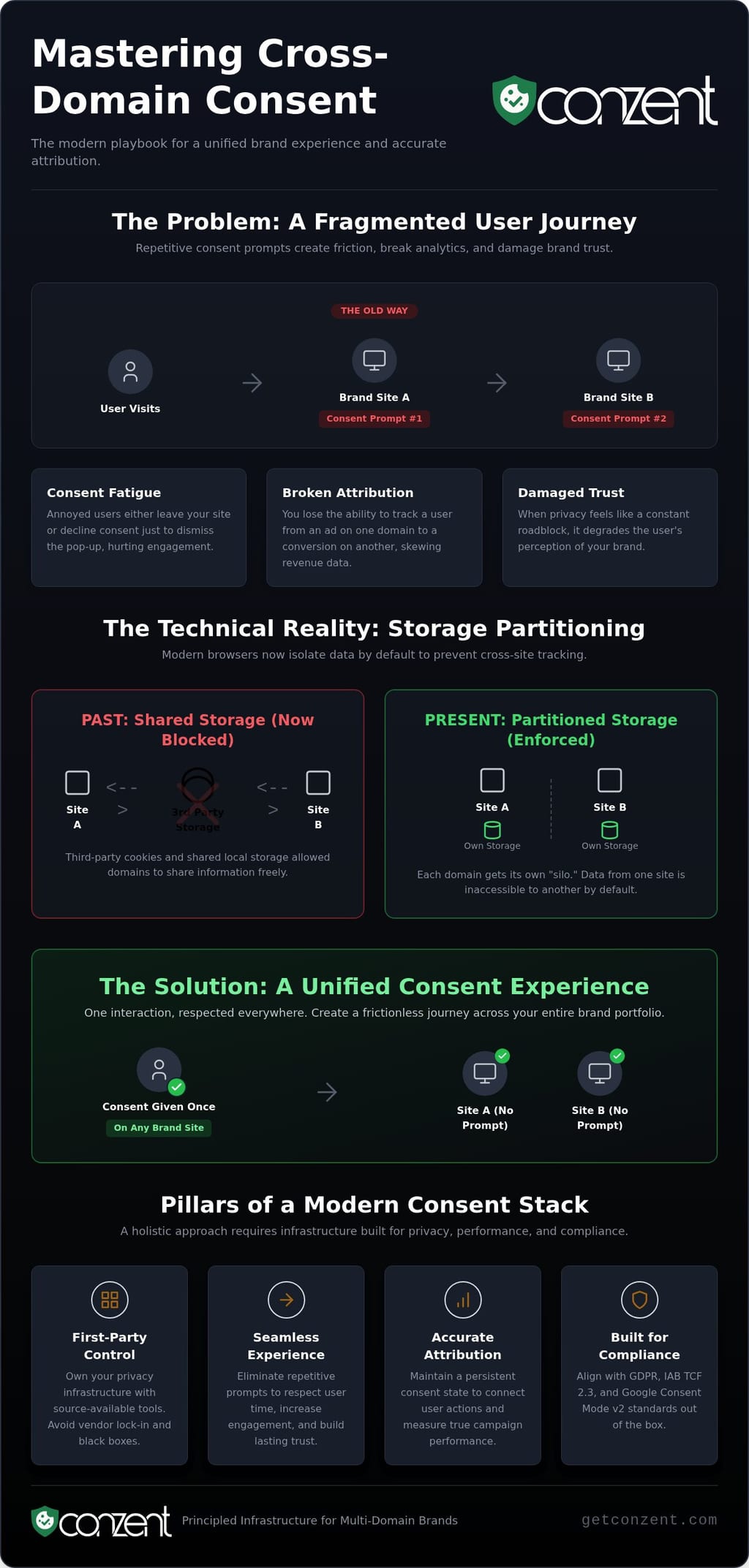
Consent fatigue is a real threat to conversion rates. When a user encounters a privacy banner on every site in a multi-site network, they stop engaging. They either bounce or click "decline" just to make the pop-up disappear. Browsers now treat every domain as a silo, which creates significant technical barriers. This fragmentation leads to "ghost" traffic. Your marketing attribution fails because you can't see that the user on Site B is the same person who converted from an ad on Site A. Without cross-domain cookie consent, your data becomes a collection of disconnected dots.
Regulatory Standards for Shared Consent
Compliance isn't a suggestion; it's the floor. Under GDPR, shared consent must be specific and informed. You must clearly state which domains are sharing the preference. The IAB TCF 2.3 framework has become the standard for signaling these choices to vendors and ad tech partners. It provides a structured way to pass consent strings across different environments. Additionally, implementing Google Consent Mode v2 is vital for brands that rely on Google's advertising ecosystem. It allows your sites to communicate consent status directly to Google tags, ensuring your measurement remains accurate while respecting the user's privacy boundaries. By using a unified cross-domain cookie consent strategy, you balance regulatory demands with the need for clean, actionable data.
The Technical Reality: Storage Partitioning in 2026
The digital landscape has shifted from open sharing to strict isolation. In the past, cross-domain cookie consent relied on third-party cookies or shared local storage to pass preferences between sites. Those days are over. Modern browsers now enforce storage partitioning, a security measure that ensures data collected on one domain stays on that domain. This change prevents "side-channel" tracking, where actors use shared storage to identify users across unrelated sites. To understand the depth of this shift, you should review Google's technical documentation on how Storage Partitioning works in contemporary environments.
Privacy Sandboxes and CHIPS (Cookies Having Independent Partitioned State) are the new standards. CHIPS allows developers to opt a cookie into "partitioned" storage, using a separate jar for every top-level site. While this improves security, it breaks the traditional flow for brand portfolios. You can't simply read a consent token from a sister domain anymore. The browser blocks it by default. Persistence now requires a more sophisticated, first-party approach to identity and consent signaling. Traditional tracking is dead. Modern infrastructure is the replacement.
Chrome 115 and Beyond: The Death of Shared Local Storage
The rollout of storage partitioning in Chrome 115 marked a definitive end for third-party local storage sharing. When a user visits your primary site and accepts cookies, that preference is stored in a silo. If they click through to your secondary domain, that domain sees an empty storage bucket. This isn't a bug; it is a privacy feature designed to eliminate cross-site tracking without user knowledge. Because browsers now prevent these side-channel leaks, client-side hacks are no longer viable. Effective cross-domain cookie consent now demands server-side management or standardized browser APIs to sync preferences legally and technically.
Implementing First-Party Sets for Consent
Related Website Sets, formerly known as First-Party Sets, provide the only sanctioned way to link domains. This framework allows you to declare a relationship between different hostnames, such as your .com and .co.uk sites. By defining a "set" in the browser's manifest, you signal that these domains belong to the same entity. This isn't a loophole for tracking; it's a transparent declaration of data processing intent. You must meet strict technical requirements, including a shared privacy policy and a clear primary domain, to qualify for a set. Conzent's infrastructure is built to leverage these first-party relationships, ensuring your consent signals move securely across your entire portfolio. You can explore our flexible deployment options to see how this fits your technical stack.
Compliance vs. Revenue: The Business Case for Persistence
Privacy is not just a legal hurdle. It is a performance metric. When your consent chain breaks between domains, your data dies. You lose the ability to track a user from an awareness-stage blog post on Domain A to a high-intent product page on Domain B. This creates "ghost" traffic. These are visitors who appear as new, anonymous users even though they already opted in elsewhere. This isn't just a technical gap; it's a financial leak that compromises your entire marketing funnel.
Every extra click on a banner is an opportunity for a user to leave. If a loyal customer sees a cookie banner every time they move between your brand sites, they feel harassed, not respected. Friction kills conversions. A unified cross-domain cookie consent strategy removes these digital roadblocks. It allows you to maintain a unified customer view while staying strictly within GDPR boundaries. You treat the user as a single person, not a series of disconnected sessions. This leads to cleaner data and higher confidence in your ad spend.
Optimizing Opt-in Rates Across Networks
High opt-in rates don't happen by accident. You need to verify what actually works for your specific audience. Using A/B testing allows you to compare different banner styles and placements to find the least intrusive cross-domain experience. The "Follow-Me" consent pattern is a proven best practice. It transparently carries the user's choice from the first domain to the next. By recognizing returning users from sister sites, you drastically reduce bounce rates and keep the user journey moving forward without unnecessary interruptions.
Measuring the Financial Impact
Privacy should be measurable. You can't fix what you don't track. Tools like Revenue Impact Analytics are essential for identifying the exact points where your consent chain fails. These analytics show the direct correlation between consent persistence and ad revenue performance. When you stop re-prompting loyal users, your opt-in rates stabilize and your marketing attribution becomes reliable again. Bridging the gap between privacy and profit is about building infrastructure that respects the user's initial choice across your entire network. This is how you maintain cross-domain cookie consent while protecting your bottom line.
How to Implement Cross-Domain Consent in 5 Steps
Setting up cross-domain cookie consent isn't about finding a loophole in browser security. It is about building a transparent bridge between your properties. The process begins with a comprehensive audit of your domain portfolio. You must identify every site that shares data processing purposes. This isn't just a technical exercise; it's a legal requirement. You need to document exactly why user data moves from your informational blog to your e-commerce shop. If the purpose for processing changes between sites, your shared consent might not be valid.
Once your audit is complete, you can follow these five core steps to ensure a 2026-ready deployment:
- Audit: Map your domains and identify shared vendors.
- Group: Organize your sites into logical Domain Groups within your CMP.
- Deploy: Install a unified consent script that utilizes first-party identifiers.
- Signal: Sync with IAB TCF 2.3 to broadcast consent to your ad-tech partners.
- Verify: Use browser developer tools to confirm the consent state persists across transitions.
Configuring Domain Groups
After your audit, move to your CMP admin dashboard to configure your Domain Groups. You should group related domains, such as your .com, .co.uk, and .de extensions, to enable unified signaling. This grouping tells the browser and the CMP that these sites belong to the same entity. You must designate a "Primary Domain" as the source of truth for the consent state. This domain acts as the anchor for the user's preferences.
Compliance isn't one-size-fits-all, so you'll need to manage regional exceptions within these groups. A user visiting from California might fall under CCPA requirements, while a user in Germany requires strict GDPR alignment. Your infrastructure must be smart enough to recognize these legal boundaries. It should apply the correct regional rules while still maintaining persistence where legally allowed. This balance ensures you don't over-collect data or under-serve your users.
Technical Integration for Developers
Developers can leverage the Conzent Cookie Banner API for custom implementations that go beyond standard templates. Timing is everything in a multi-site environment. You must handle race conditions by ensuring the consent state loads before any tracking or analytics scripts execute. If a tag fires before the consent signal is processed, you've failed your compliance check. A JSON Web Token (JWT) serves as a secure, signed credential that carries the user's consent preferences between your domains without exposing sensitive data.
Finally, verify your work using the browser console and network logs. Check that the IAB TCF 2.3 strings are correctly formatted and available to all authorized vendors on every domain in the group. Persistence should be seamless. If a user accepts cookies on your primary site, they shouldn't see another banner when they click through to a sister site. You can explore our deployment plans and pricing to see which setup fits your technical requirements.
Conzent: Principled Infrastructure for Multi-Domain Brands
Privacy is a standard, not a luxury. Conzent is not a black-box vendor. We are a transparent disruptor in a market filled with opaque tracking solutions. Source-available infrastructure is the only way to ensure long-term privacy for your users and your data. While other platforms hide behind proprietary tokens, we provide the code and the clarity you need to stay compliant. Our Danish-engineered standards ensure that your cross-domain cookie consent strategy is built on a foundation of ethical responsibility and technical efficiency.
Multi-site brands face unique hurdles. You need a system that respects the user's choice without creating a fragmented mess. Conzent provides built-in support for IAB TCF 2.3 and Google Consent Mode v2. This ensures your ad-tech partners receive the correct signals every time. We offer transparent pricing that scales with your business growth, not just your domain count. You shouldn't be penalized for expanding your digital footprint.
Managed Cloud vs. Self-Hosted OCI
Flexibility is at the heart of our platform. For brands that prioritize speed and ease of use, our Managed Cloud Consent Platform is the ideal choice. It allows you to scale privacy across your portfolio without managing the underlying infrastructure yourself. It's built for performance. It's built for 2026.
DevOps-heavy teams and security-conscious enterprises often prefer Self-Hosting our Open Consent Infrastructure (OCI). This option provides total control over your data environment. You decide where your consent logs live and how they are processed. By choosing self-hosting, you eliminate third-party data risks and lower your overall compliance overhead. You own the stack. You own the trust.
Future-Proofing Your Privacy Strategy
Browser updates wait for no one. Chrome, Safari, and Firefox continue to tighten their privacy controls, making traditional tracking even more difficult. Conzent stays ahead of these changes with automatic cloud updates. We treat privacy as a public good, not a corporate secret. Our mission is to demystify complex requirements and make them attainable for every brand, regardless of their technical resources.
Implementing cross-domain cookie consent shouldn't be a technical burden. It should be a seamless part of your user experience. By choosing a principled infrastructure, you protect your revenue and your reputation simultaneously. Don't wait for your attribution data to disappear. Start with a cross-domain audit today and build a privacy strategy that actually lasts.
Build a Privacy Infrastructure That Scales
The shift toward storage partitioning in 2026 means your old tracking methods are obsolete. You can't rely on browser loopholes to manage a multi-site brand anymore. Implementing a robust cross-domain cookie consent strategy is the only way to protect your attribution data and respect your users' digital rights simultaneously. By moving away from black-box vendors and adopting source-available infrastructure, you gain the transparency needed to navigate evolving global regulations without sacrificing technical efficiency.
Clean data and high opt-in rates aren't accidental; they are the result of principled engineering. Whether you choose a managed cloud solution for speed or a self-hosted deployment for total control, your goal remains the same: a seamless user journey that values privacy as a public good. You now have the technical roadmap to bridge the gap between compliance and profit across your entire domain portfolio.
Start scaling your privacy with Conzent’s Managed Cloud Platform to access IAB TCF 2.3 certified tools built with Danish privacy engineering and source-available infrastructure. It's time to turn privacy into your brand's strongest competitive advantage.
Frequently Asked Questions
Is cross-domain consent legal under the GDPR?
Yes, shared consent is legal under the GDPR if you provide clear information about the domains involved. You must explicitly list all sister sites that share the preference. Users must also have the ability to withdraw consent as easily as they gave it. It's not enough to assume consent; you must document the shared data processing purposes for every site in your portfolio.
Does Chrome’s storage partitioning break cross-domain consent?
Chrome's storage partitioning prevents domains from accessing each other's local storage or cookies by default. This change effectively breaks legacy tracking methods that relied on third-party access. To maintain persistence in 2026, you must use first-party identifiers or browser-sanctioned frameworks like Related Website Sets. These tools allow you to declare a relationship between your domains so the browser can sync consent states securely.
What is the difference between cross-domain and cross-device consent?
Cross-domain consent shares preferences between different URLs owned by the same brand, such as your blog and your shop. Cross-device consent attempts to sync those same preferences when a user moves from their phone to a laptop. While cross-domain cookie consent relies on browser-level identifiers and first-party sets, cross-device sync usually requires a persistent user login or a hashed identifier to recognize the individual across different hardware.
How do I implement cross-domain consent without third-party cookies?
You can implement shared consent by using first-party identifiers and secure tokens like JWTs. Instead of relying on a third-party cookie to bridge the gap, your CMP can pass a signed consent signal through a URL parameter or a server-side API call. This ensures the preference moves with the user as they navigate your brand network. Modern infrastructure handles this sync without triggering the privacy blocks associated with third-party tracking.
Do I need a separate cookie banner for every subdomain?
You don't need a separate banner for every subdomain if you configure your cookie settings to the root domain level. For example, a preference set on app.example.com can naturally extend to blog.example.com because they share the same base domain. However, you must ensure your privacy policy and CMP configuration explicitly cover all subdomains to remain compliant with transparency requirements. This approach reduces friction and prevents repetitive prompts for your visitors.
Can I share consent between a website and a mobile app?
Sharing consent between a website and a mobile app is possible through unified identifiers and SDKs. You can use a hashed email or a unique user ID to bridge the technical gap between a web browser and a native app environment. By integrating these platforms into a single consent management system, you ensure that a user's privacy settings remain consistent regardless of how they access your digital services.
Will cross-domain consent affect my SEO or Core Web Vitals?
Efficiently implemented cross-domain cookie consent should have no negative impact on your SEO or Core Web Vitals. The key is to use a lightweight, asynchronous script that doesn't block the main thread. If your CMP loads quickly and doesn't cause layout shifts, your Cumulative Layout Shift scores and Largest Contentful Paint metrics will remain healthy. Avoid heavy, synchronous scripts that delay page rendering or frustrate search engine crawlers.
How does IAB TCF 2.3 handle shared consent signals?
IAB TCF 2.3 uses a standardized Transparency and Consent string to broadcast user preferences to ad-tech vendors. When a user makes a choice on one domain, the CMP generates this string and passes it to the next domain in your network. This ensures that every authorized partner receives a consistent signal. Because the framework is standardized, it allows for seamless communication between your sites and the global advertising ecosystem.