
How to Make a Website Cookie Compliant: The 2026 Infrastructure Guide

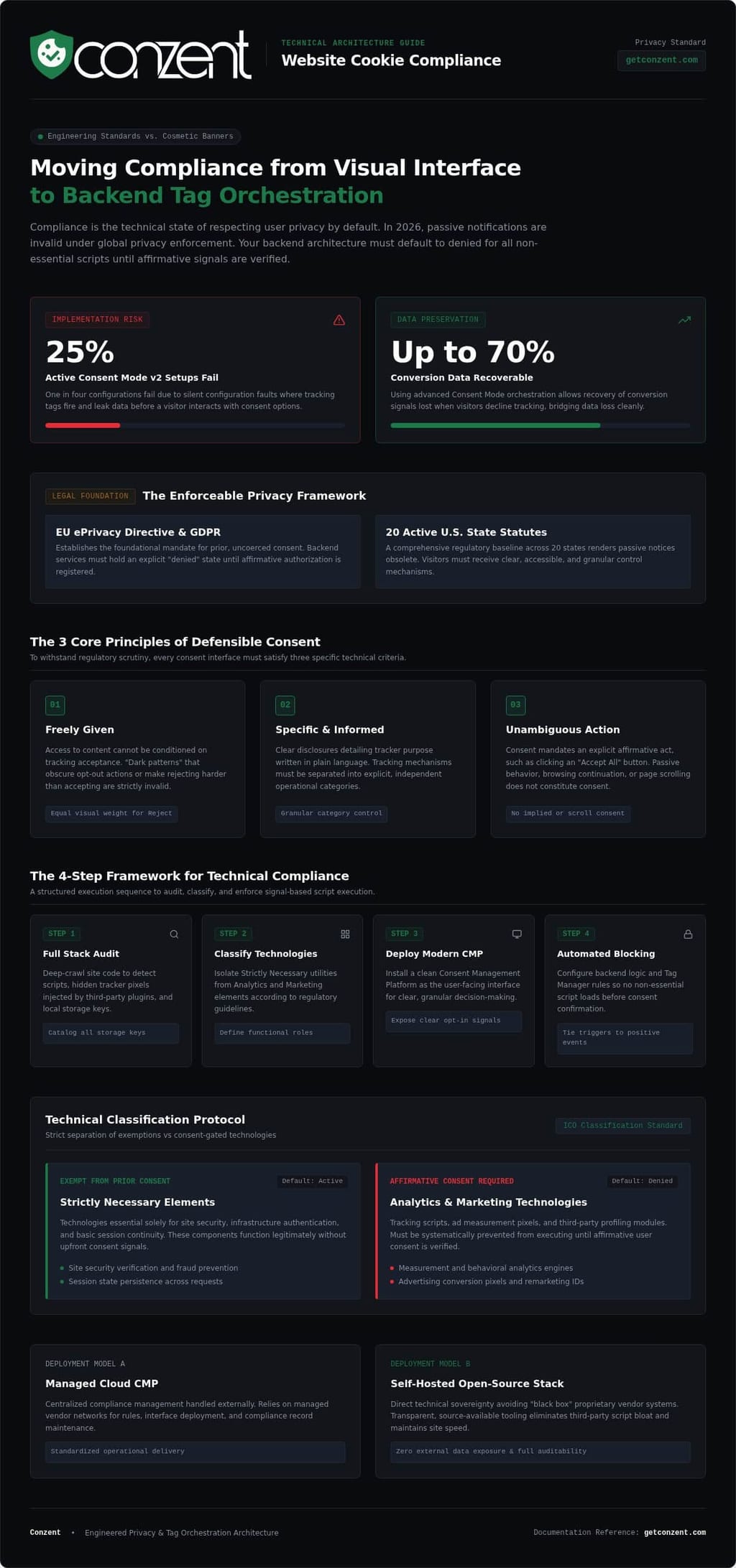
Did you know that 25% of active Consent Mode v2 setups currently fail due to silent configuration faults? It's a sobering reality for anyone trying to figure out how to make a website cookie compliant in 2026. Compliance is no longer a cosmetic banner. It's a technical orchestration problem. If your tags leak data before a user clicks "Accept," you risk more than just heavy GDPR fines; you risk losing the trust and data that fuel your growth.
We know that balancing Google's strict requirements with the fear of high opt-out rates feels like a losing game. This guide will help you master the technical and legal requirements of modern compliance to protect both your users and your revenue. We'll walk through an actionable 2026 checklist, explain the shift toward self-hosted infrastructure, and detail how to use Advanced Consent Mode to recover up to 70% of lost conversion data. It's time to move past the confusion and build a privacy stack that actually works.
Key Takeaways
- Stop treating compliance as a cosmetic banner. It is a technical orchestration of your backend tags and user signals.
- Discover how to make a website cookie compliant using a four-step framework that prioritizes both legal safety and technical efficiency.
- Implement Google Consent Mode v2 to recover up to 70% of conversion data lost when users decline tracking.
- Choose between managed cloud or self-hosted open-source infrastructure to match your specific technical and privacy requirements.
- Avoid "black box" proprietary software by switching to transparent, source-available tools that respect user rights without sacrificing site speed.
Understanding Website Cookie Compliance in 2026
Compliance is the technical state of respecting user privacy by default. It is not a legal suggestion or a marketing hurdle; it is a principled engineering standard. In 2026, simply slapping a "Close" button on a banner does not meet the legal bar. Regulators now look at whether your backend tags fire before a user provides an affirmative signal. Understanding how to make a website cookie compliant starts with acknowledging that your site's default state must be set to "denied" for everything but the strictly necessary components.
The legal landscape has matured into a complex global patchwork. You aren't just dealing with the GDPR anymore. The EU ePrivacy Directive established the foundational mandate for prior consent, and as of 2026, 20 U.S. states have active, enforceable comprehensive privacy statutes. This shift means passive notification is dead. Compliance today requires active, informed, and granular choices from your visitors. If your infrastructure doesn't support these signals, you're essentially operating in a state of technical debt that could lead to heavy fines or data loss.
The Core Principles of Valid Consent
For consent to be legally defensible in 2026, it must meet three non-negotiable criteria. First, it must be freely given. This means you can't coerce users into accepting cookies by blocking access to content or using deceptive "dark patterns" that make it harder to reject than to accept. Second, it must be specific and informed. You need to explain exactly what each cookie does in plain language, categorized by purpose. Finally, it must be unambiguous. A user must take a clear affirmative action, like clicking an "Accept All" button, rather than just scrolling past a notification. Our approach to GDPR compliance ensures these principles are baked into your site's architecture from the start.
Why Compliance is a Business Advantage
Ethical data practices aren't just about avoiding penalties; they're about building a sustainable brand. When you prioritize transparency, you build genuine user trust. Visitors are more likely to engage with a brand that respects their digital rights. Principled compliance improves your data quality. By ensuring that only consented users are tracked, you filter out low-intent noise and focus your marketing efforts on visitors who have explicitly expressed interest in your offerings. This shift reduces your legal liability while protecting your brand reputation in an increasingly privacy-conscious market. In 2026, privacy is no longer a premium luxury. It is the necessary standard for any business that values its users and its revenue.
The 4-Step Framework for a Compliant Website
Moving from regulatory theory to technical execution requires a methodical approach. It is a process of mapping data flows and enforcing boundaries. If you are refining how to make a website cookie compliant, you must look beyond the visual banner and focus on the logic that triggers your tags. This framework provides a repeatable roadmap to ensure your site respects user signals while maintaining operational integrity in 2026.
- Step 1: Audit your site to identify every script, pixel, and local storage key currently in use.
- Step 2: Classify these technologies into functional categories like Necessary, Analytics, and Marketing.
- Step 3: Deploy a Consent Management Platform (CMP) to serve as the user interface for these choices.
- Step 4: Configure automated blocking to ensure no non-essential script fires before a positive consent signal is received.
Auditing and Classifying Your Cookies
You cannot manage what you have not identified. Start by using a deep-crawl scanner to find trackers often hidden within third-party plugins. Many tools silently inject pixels that bypass basic audits. Once found, you must define which cookies are "Strictly Necessary" for site security or session state. These do not require consent, but everything else does. Refer to the ICO guidance on cookies and similar technologies to verify your classifications. Your Cookie Policy should be a living document that reflects your current technical stack in real-time.
Implementing Technical Blocking
A banner that allows scripts to fire in the background is a liability. You must implement active blocking to remain compliant. For most teams, integrating with Google Tag Manager is the most efficient way to tie tag firing to specific consent events. This ensures that a marketing pixel only loads after a user provides an affirmative signal. Your "Reject All" button must be as prominent and accessible as the "Accept All" option. Hiding the ability to opt out is a dark pattern that regulators are increasingly targeting. If you want to see how these technical requirements translate into a streamlined setup, you can explore our managed and self-hosted plans to find the right fit for your infrastructure.
Infrastructure vs. Interface: Choosing Your Compliance Path
Most guides focus on the visible banner. They treat compliance as a UI skin. This is a mistake. True compliance is an infrastructure problem. When you look at how to make a website cookie compliant, you must decide where your consent data lives and who controls it. Many proprietary SaaS Consent Management Platforms (CMPs) operate as "black boxes." You send user signals into their cloud, but you have zero visibility into their internal logic or data handling practices. This lack of transparency can become a legal liability if their systems fail or their data centers are located in non-compliant jurisdictions.
Choosing the right path depends on your technical resources and sovereignty requirements. Managed cloud solutions offer speed and ease of use. They handle the heavy lifting of legal updates and technical maintenance. Self-hosting, however, provides maximum data sovereignty and performance. By running compliance tools on your own servers, you eliminate third-party script bloat and keep user data within your own security perimeter. This is a critical distinction for engineering teams who value speed and privacy over convenience.
The Case for Open Consent Infrastructure
We believe compliance should be a public good, not a proprietary secret. This is why we advocate for Open Consent Infrastructure (OCI). Using source-available tools allows your developers to inspect the code, verify its security, and ensure it follows the latest IAB Tech Lab TCF specifications. Open standards prevent vendor lock-in. They ensure that your compliance stack remains transparent and auditable. When the community drives the standards, the cost of compliance drops for everyone, making digital rights accessible regardless of a company's budget.
Managed Cloud: Compliance Without the Overhead
For growing businesses, the managed cloud is often the most efficient way to maintain how to make a website cookie compliant status. Laws change fast. A managed platform provides automatic updates for evolving regulations like the GDPR without requiring manual code changes on your end. It allows you to scale privacy settings across hundreds of domains from a single dashboard. This approach reduces the burden on your internal DevOps team, letting them focus on your core product while the platform ensures your consent signals are always synchronized and legally sound.
Advanced Compliance: Google Consent Mode v2 and IAB TCF
In 2026, the technical definition of how to make a website cookie compliant includes active signaling to global ad ecosystems. It's no longer enough to just stop a script from loading. You must pass valid, machine-readable consent signals to platforms like Google and IAB vendors. This is where Google Consent Mode v2 becomes critical. Since the June 2026 update, the ad_storage signal acts as the primary control for data flowing into Google Ads. Without these signals, your marketing measurement effectively goes dark. Your ability to optimize campaigns vanishes.
For publishers, the IAB TCF 2.3 framework is the necessary standard for programmatic advertising. Failing to support these interoperability standards isn't just a legal risk. It's a financial one. Industry benchmarks from 2026 show that publishers who fail to pass a valid TCF string can see programmatic revenue drop by more than 50% as auctions fall back to limited ads. Compliance has evolved from a simple "yes or no" into a complex language of technical parameters. It requires a stack that speaks this language fluently.
Implementing Google Consent Mode v2
Deciding how to make a website cookie compliant at an advanced level requires choosing between Basic and Advanced implementation modes. Basic mode blocks all tags until consent is granted. It offers the cleanest regulatory profile but leaves a total gap in your analytics. Advanced mode fires tags immediately with a "denied" status, sending cookieless pings that power machine-learning models. Google reports that this advanced setup recovers an average of over 70% of ad-click-to-conversion journeys that would otherwise be lost. You must map user states to specific parameters like ad_user_data and ad_personalization. For a step-by-step technical walkthrough, read our Google Consent Mode v2 Implementation Guide.
Optimizing for Revenue Impact
Privacy shouldn't be a tax on your growth. You can maintain high compliance standards while protecting your bottom line through data-driven optimization. By using A/B testing, you can legally experiment with banner layouts and messaging to find the highest opt-in rates. This isn't about tricking users. It's about clarity. It's about trust. Our revenue impact analytics allow you to see exactly how your consent choices affect your conversion rates in real-time. If you want to bridge the gap between ethical data practices and business performance, view our plans to get started.
Conzent: The Principled Approach to Compliance
We built Conzent because the market failed to provide a transparent, ethical standard. Compliance shouldn't be a premium luxury hidden behind proprietary "black box" code. It's a fundamental digital right. Our Copenhagen-based team engineered this infrastructure with a focus on speed and moral clarity. We don't just help you understand how to make a website cookie compliant; we provide the open-source tools to ensure that compliance is verifiable by anyone. This transparency is the only way to build lasting trust in a digital economy that often prioritizes profit over privacy. We are here to demystify the process and make it accessible to everyone.
Why We Are Different
We aren't a distant vendor hiding behind corporate jargon. We are community advocates for an open web. While legacy platforms focus on the "banner interface," we focus on the underlying infrastructure. Our code is source-available. This means your developers can inspect exactly how we handle consent signals. We remove the artificial complexity that plagues many SaaS solutions. By prioritizing technical efficiency, we ensure your site stays fast and your user data stays secure. We believe that privacy tools should be public goods. This mission-driven approach separates us from competitors who treat compliance as a profit center rather than a necessary standard. Our European-engineered standards are built for those who value both performance and ethics.
Get Started with Conzent
Choosing how to make a website cookie compliant shouldn't be a financial burden. We offer a flexible deployment model to suit any technical stack. You can opt for our managed cloud service for a seamless, hands-off experience. Alternatively, you can self-host our infrastructure for free on your own servers. This is a powerful option for engineering teams that want total data sovereignty and zero third-party script bloat. Our unique pricing and sponsorship model ensures that as our community grows, the cost for everyone stays manageable. This egalitarian approach makes high-level compliance attainable for every business, regardless of their resources. Start your journey toward principled, European-engineered compliance today and join a community that values transparency as much as you do.
Future-Proof Your Digital Privacy Architecture
Compliance in 2026 is a test of technical integrity. It's the difference between a decorative banner and a principled infrastructure that respects user rights by default. Mastering how to make a website cookie compliant requires more than just a legal document. It demands a rigorous technical framework and a commitment to transparent data signaling. By choosing source-available, Open Consent Infrastructure, you move away from proprietary traps and toward a community-driven standard.
Our European-engineered platform is fully certified for IAB TCF 2.3 and Google Consent Mode v2. We built these tools to be accessible and efficient for everyone. You don't have to choose between revenue and digital rights. With the right infrastructure, you can have both. It's time to move past the "black box" and embrace a more transparent way of doing business.
View Conzent Pricing and Sponsorship Options to start building a privacy stack that actually serves your users. The transition to principled compliance is a journey worth taking. You've got the roadmap; now it's time to build.
Frequently Asked Questions
Is a cookie banner enough to make my website compliant?
A cookie banner alone is not enough to achieve compliance. It is merely the visual interface for user choice. True compliance requires a technical infrastructure that actively blocks non-essential scripts from firing until a user provides affirmative consent. If your analytics or marketing tags load before the user clicks "Accept," your site remains non-compliant. You must ensure that how to make a website cookie compliant involves backend script orchestration.
Can I use a free cookie consent manager for my business?
You can use free tools, but many proprietary SaaS versions impose hidden limits on domains or pageviews. We believe privacy is a digital right, not a premium feature. Conzent offers a source-available, self-hosted infrastructure that is completely free to use without traffic restrictions. This egalitarian model provides a principled alternative to "black box" vendors. It allows every business to implement high-level compliance without sacrificing their budget or user sovereignty.
What happens if my website is not cookie compliant?
Non-compliance results in heavy regulatory fines and immediate revenue loss. In 2026, data protection authorities actively penalize sites using dark patterns or "decorative" banners that don't block scripts. Furthermore, failing to meet standards like Google Consent Mode v2 will break your conversion tracking in the EEA and UK. This causes your ad bidding strategies to fail, often reducing programmatic yield by over 50% as auctions fall back to limited ads.
How does Google Consent Mode v2 affect my ad revenue?
Google Consent Mode v2 is mandatory for any business running ads in the EEA or UK. Without it, you lose the ability to process conversion data, which cripples your marketing optimization. However, implementing Advanced Consent Mode allows you to use conversion modeling. This technology recovers an average of 70% of ad-click-to-conversion journeys that are otherwise lost when users decline consent. It protects your bottom line while respecting user privacy choices.
What is the difference between GDPR and ePrivacy cookie requirements?
The GDPR regulates how you process personal data, while the ePrivacy Directive governs access to a user's terminal equipment. ePrivacy requires you to gain consent before storing or accessing any information on a device, such as cookies, regardless of whether that data is personal. Understanding how to make a website cookie compliant requires following both sets of rules. GDPR sets the high standard for valid consent, but ePrivacy dictates the initial requirement to ask.
How do I block cookies before a user gives consent?
You must configure your tag management system or CMP to hold all non-essential scripts in a "denied" state by default. This technical blocking ensures that analytics, functional, and marketing pixels only fire after a specific consent event is triggered by the user. You can use Google Tag Manager to orchestrate these signals. Active blocking prevents data leakage and ensures your site respects the user's digital rights from the moment they land.
Is Conzent really free to self-host?
Yes, our Open Consent Infrastructure is source-available and free to self-host on your own servers. We are mission-driven community advocates who believe in transparent, European-engineered privacy standards. Self-hosting eliminates third-party script bloat and keeps all user consent data within your own security perimeter. While we offer a managed cloud service for convenience, our self-hosted container remains a public good available to anyone who values data sovereignty and technical efficiency.
Do I need a cookie policy if I have a consent banner?
You must maintain a detailed cookie policy even if you use a consent banner. The banner is the mechanism for gathering permission, but the policy provides the legally required disclosure. It must contain a full, categorized inventory of every tracker on your site, explaining their purpose and duration in plain language. Without a clear policy, the consent you collect is not "informed." Regulators view the banner and policy as two essential, inseparable components.