
Zero latency consent management across platforms

Zero latency consent management aims to make consent changes available across platforms as quickly as systems allow. “Zero latency” isn’t literal: in practice, it means using near-real-time information so teams can coordinate decisions without relying on outdated records. The goal is fast, consistent consent updates, not a claim that networks have no delay.
Consent choices can span websites, advertising tools, analytics systems, and other connected services. When preferences are managed separately, updates can be difficult to coordinate. Centralized preference management, simpler integrations, and timely updates help bring these moving parts into a clearer governance process.
This article explains how consent governance works across platforms, what centralized management changes, and why integration design matters. You’ll also learn where fast updates can improve coordination, what “zero latency” can realistically mean, and how Conzent’s consent platform and integrations fit into this approach.
Key Takeaways
- Treat “zero latency” as a goal of near-real-time coordination, not a promise of instantaneous delivery.
- Map where consent choices are collected and used so updates can be governed consistently across platforms.
- Reduce integration complexity by clarifying how consent data moves between systems and which components depend on it.
- Assess consent platforms by how they handle current preferences, integrations, and the consent checks your workflows require.
- Explore centralized consent tools, testing, and analytics to support a more coordinated approach to preference management.
Consent governance across platforms
Consent governance defines how an organization records, applies, and reviews people’s choices across digital services. A zero latency consent management approach aims to make updated information available to teams quickly, so each platform can act on a current preference. “Zero latency” is an operational goal, not literal instant delivery. Network packets take time to travel, so the practical aim is near-real-time coordination.
Consider a visitor who declines advertising cookies on a company website. That choice may also affect the advertising tag, analytics setup, and customer data platform connected to the site. If each system holds a separate record, teams can face inconsistent signals. A shared governance model defines which preference record takes precedence, how systems receive it, and who handles exceptions when an integration behaves differently.
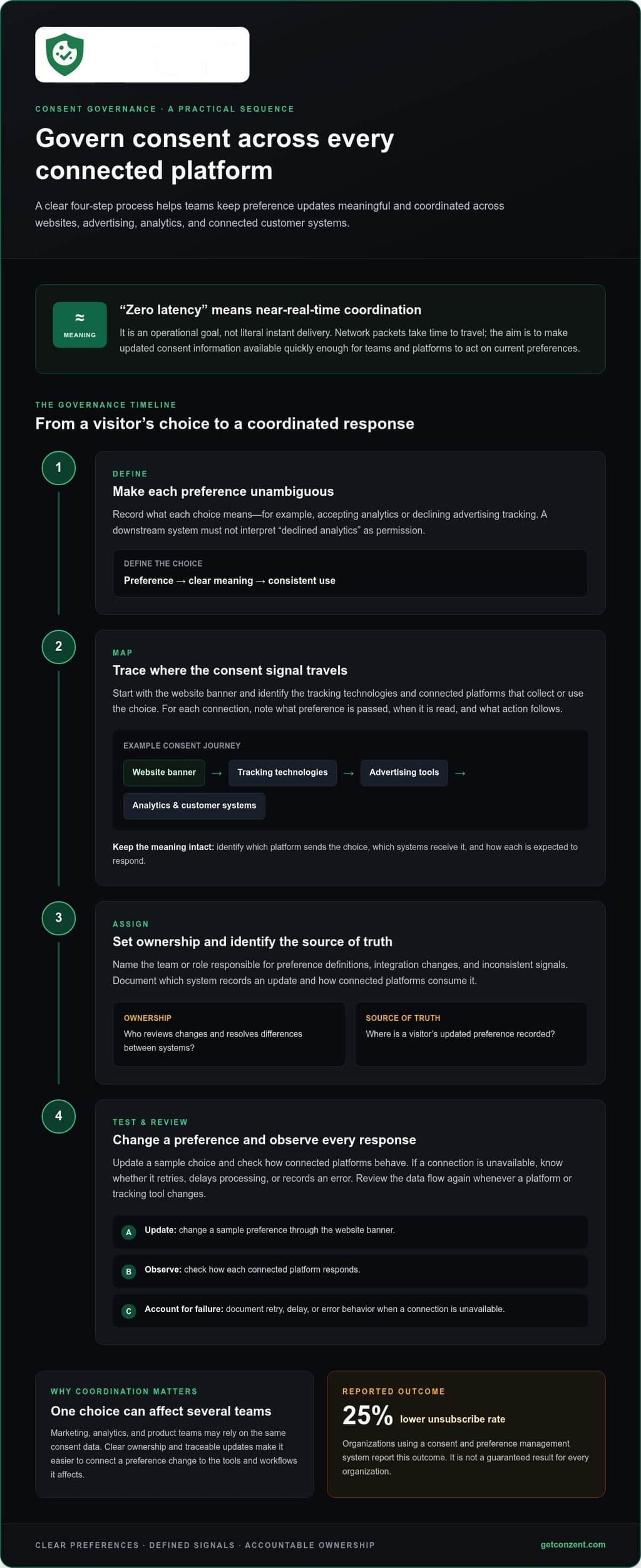
Start by mapping the consent journey across platforms. Include the website banner, tracking technologies, advertising tools, analytics services, and connected customer systems. For each connection, identify which preference is passed, when it is read, and what action follows. A consent signal needs a defined meaning: for example, “declined analytics” must not be interpreted as permission by a downstream tool.
Governance also needs clear ownership. Assign a team or role to maintain preference definitions, integration changes, and decision records. Then document the source of truth. If a visitor changes a choice through a website banner, teams need to know which system records the update and how connected platforms consume it. This makes troubleshooting more precise than comparing screenshots or relying on informal messages.
- Define the preference: Record what each choice means, such as accepting analytics or declining advertising tracking.
- Map the signal: Identify which platform sends the choice and which connected systems receive it.
- Set ownership: Name the role responsible for reviewing changes and resolving inconsistent signals.
- Test a change: Update a sample preference and observe how each connected platform responds.
These controls matter when marketing, analytics, and product teams rely on the same consent data. Organizations using a consent and preference management system report a 25% lower unsubscribe rate. That figure describes a reported outcome, not a guaranteed result for every organization. The operational value is clearer coordination: teams can connect a preference change to the tools and workflows it affects.
Governance should also account for timing and failures. If an analytics connection is unavailable, teams need to understand whether the platform retries, delays processing, or records an error. Documenting this behavior makes “fast updates” measurable in practice. Review the data flow whenever a platform or tracking tool changes, because a new connection can affect where preferences travel and how consistently they are applied.
Reducing consent data integration complexity
Consent data becomes harder to manage when connected tools expect different formats. An analytics platform may use category labels, while an advertising integration expects signals defined by a standard. A well-designed integration translates the visitor’s choice into a format each connected system can use. The aim is consistent meaning, not identical data structures.
Start with a small data contract. Define each consent category, its allowed values, and the system that owns the mapping. For example, “analytics: denied” should map to the relevant downstream signal, not disappear because another platform uses a different label. Include the update time and a version identifier where the integration supports them. These details help teams trace how a value changed.
Standards can reduce custom translation work. IAB TCF v2.3 provides a framework for communicating consent and vendor choices in its ecosystem. Google Consent Mode v2 uses signals that connected Google services can interpret. These standards serve different integration contexts. They don’t remove the need to decide which tools receive each signal or test the behavior after configuration.
Keep the flow understandable. A website banner can collect a choice, a consent layer can convert it, and a connected analytics tool can read the result. When each integration adds its own transformation, errors become harder to locate. Document the route in plain language, including the input, conversion, destination, and expected response.
- Normalize categories: Match internal preference names to each platform’s supported consent signals.
- Separate collection from delivery: Keep the visitor-facing choice distinct from integrations that consume it.
- Track changes: Record mapping updates so teams can identify when integration behavior changed.
- Test representative states: Check accepted, declined, and revised choices across connected tools.
Testing should go beyond the default setting. For example, change an analytics preference after the page loads, then check whether the connected tool responds as intended. Repeat the test after changing a mapping or adding a destination. A test record should note the preference, the signal sent, the receiving system, and the observed result.
Reduce unnecessary connections, too. If a tool doesn’t need a particular consent category, avoid sending it irrelevant data. Fewer dependencies can make investigations easier and limit the number of integration paths teams must maintain. For a practical next step, review consent platform options alongside the standards and systems your organization needs to connect.
Traditional analytics often relies on data-warehouse reports run on a periodic schedule, so the information used for decisions may already be hours old or older.
Zero-latency consent updates
Fast consent updates depend on how a platform reads, distributes, and applies a changed preference. The useful measure is whether connected systems act on the current choice, not whether an update is described as instantaneous.
Platform Support for Immediate Consent Checks
A platform supports immediate consent checks when connected tools can read a current preference before acting. This matters because an outdated signal can cause a tool to respond to an earlier choice. Compare platforms by checking where they store consent state, how integrations access it, and whether a change can reach relevant tools without waiting for a separate scheduled process.
For example, test a preference change on a page with analytics and advertising tags. Record which signal each tag reads and what it does next. Platforms that support standards such as IAB TCF v2.3 or Google Consent Mode v2 can communicate consent through defined signals, but the integration still needs correct configuration.
Feature and Performance Comparisons
Feature and performance comparisons should examine how quickly and consistently platforms apply preferences across connected tools. This matters more than a “zero latency” label, which says nothing about test conditions or the systems measured. Compare consent storage, integration methods, signal handling, error visibility, and whether changes can be tested across the tools your organization uses.
Use the same scenario for each platform: change an analytics choice, then observe the signal at the receiving tag. Note when the change is recorded, when the tag reads it, and whether its behavior matches the choice. This reveals integration delays and configuration gaps without relying on broad performance claims.
Risks of Cached or Asynchronous Signals
Cached signals reuse a previously stored preference, while asynchronous signals may arrive after another process has started. Both approaches can expose tools to stale consent state. For example, a tag might read cached permission just before a visitor withdraws it, or an asynchronous update might reach an advertising tool after its request begins.
Reduce that risk by defining how each integration refreshes consent and handles a pending update. Test a changed choice during page activity, not only before loading. Also examine what happens when a signal cannot be retrieved. A clear fallback and visible error help teams detect mismatches instead of mistaking old data for a current choice.
Measuring Latency and Compliance
Measure latency by recording when a preference changes and when each connected system reads or applies that change. This gives teams a comparable view of update paths. To assess consent governance, keep the preference, transmitted signal, destination, and observed response together in a test record.
Repeat the same test for accepted, declined, and revised choices across representative tools. Compare results after an integration change, and investigate any tool that acts on an older state. A useful review shows which systems received each signal and whether their behavior matched the recorded preference. It measures the process, but does not by itself establish legal compliance.
Centralized consent and preference management
In the United States, CCPA and other state privacy laws can affect how organizations manage consent and preferences. Which requirements apply depends on the organization’s activities and the people whose information it handles. A central system should support review of applicable rules without treating every state identically.
Centralized management gives teams one place to maintain preference categories and their meaning. It doesn’t mean every platform stores identical records. Instead, a shared preference model helps a website, analytics tool, and advertising system interpret a person’s choices consistently. For example, a visitor may allow essential site functions while declining analytics and advertising.
Keep consent separate from broader communication preferences. A person might accept analytics but opt out of promotional email. Combining those choices into one “approved” value can obscure what the person selected. Keep categories distinct, define each one in plain language, and record which interface collected the choice. This makes later changes easier to interpret, particularly when syncing preferences with enterprise customer experience platforms like cote.com.au.
Centralization also needs a clear identity approach. A signed-in visitor may have a profile, while an anonymous visitor has only a browser-level record. Teams should define how those records relate and avoid assuming they represent the same person. If someone changes a choice on one device, the system needs a defined process for applying that update to other relevant records.
Reported figures offer context, not a guaranteed result: organizations using consent and preference management systems report a 39% increase in opt-in rates. Organizations without such a system report a 20% opt-in rate, compared with organizations using one. The figures point to a potential relationship, but they don’t explain every organization’s outcome or prove that centralization alone caused the difference.
- Define categories: Separate analytics, advertising, and communication preferences instead of combining them.
- Record context: Keep the choice, collection interface, and applicable preference category together.
- Set conflict rules: Decide how the system handles a newer choice that differs from an earlier record.
- Review access: Limit preference changes to authorized roles and retain a record of updates.
For instance, if a visitor changes an advertising choice on a website, the system should identify the newer preference and make it available to connected tools. A review should then compare the stored choice with the signal those tools receive. This helps teams spot stale records, conflicting categories, or access problems before they spread across workflows.
Centralized records also make measurement more useful. Compare opt-in and unsubscribe outcomes across preference categories, while keeping the collection method and user choice clear. Organizations without a consent and preference management system report a 12% unsubscribe rate, compared with organizations using one. Treat that reported comparison as context for evaluating your own data, not as a promised outcome.
CCPA and other state privacy laws may apply, depending on an organization’s activities and whose information it handles. Consent management should support reviewing applicable requirements without assuming the same rules apply in every state.
Which consent management platforms support zero-latency consent checks?
Platforms support fast consent checks when a website can read a visitor’s current choice before activating a tag. Look for browser-side consent state, clear tag controls, and integrations that pass preference signals directly to connected tools. A platform’s label alone doesn’t show whether those checks happen in the right order.
For example, a consent layer can hold a visitor’s choice while the page loads, then let each tag check that state before running. This avoids waiting for a separate reporting process to decide whether analytics can start. Review the platform’s documentation and test the actual page sequence, including what happens after someone changes a preference.
IAB TCF v2.3 and Google Consent Mode v2 provide named frameworks for communicating consent signals. A platform can support an applicable framework and still require careful setup for each connected tool. Check which signals it sends, how integrations read them, and whether the resulting tag behavior matches the preference selected on the site.
Compare architecture, not labels
Compare platforms by how they store consent, gate scripts, and expose preference changes to integrations. A browser-based check can serve a page without waiting for a remote lookup, while a server-side workflow may suit systems that need centralized processing. The key is to trace the full route from banner choice to tag response.
- Check tag timing: Confirm that tags read consent before collecting or transmitting data.
- Inspect updates: Change a choice after page load and observe whether connected tools respond.
- Review failures: Test what happens if a consent signal or integration is unavailable.
- Compare deployment: Assess managed and self-hosted approaches against your infrastructure and operational needs.
Repeatable testing makes platform comparisons more useful. Use the same page, tags, and preference changes for each evaluation. Record the choice, the signal received by each tool, and the observed behavior. For instance, decline analytics, then confirm that the analytics tag follows that choice. Repeat after revising the preference.
Also examine how the platform handles updates across different page types. A tag manager, embedded video, and analytics script may each read consent differently. A practical evaluation checks those integrations individually instead of treating one successful banner test as proof that every connected tool behaves correctly.
Choose based on the systems you need to govern, the signals they support, and how clearly you can test their behavior. To explore platform options for your setup, review consent platform options.
Conzent: Managed Cloud Consent Platform
Conzent’s Managed Cloud Consent Platform helps organizations manage consent across connected platforms without building a separate system from scratch. It suits teams seeking centralized preference management and simpler integration workflows. Organizations that want to run the infrastructure themselves can use Conzent’s Self-Hosted Open Consent Infrastructure.
Consent A/B Testing helps teams compare banner approaches, while Revenue Impact Analytics helps them examine how consent choices relate to revenue. These tools support evaluation and governance, but they don’t make network delivery instantaneous. The practical goal remains clear: coordinate preference handling and make updates available to connected systems promptly.
If you’re assessing a managed or self-hosted approach, consider which systems need consent signals and how your team will evaluate the results. Explore Conzent’s platform options to find the approach that fits your consent management needs.
Build consent governance that can adapt
As your platforms and data flows change, treat consent governance as an operating practice, not a one-time configuration. Give teams a clear way to review new integrations, test preference changes, and keep consent signals aligned with the tools that use them. That’s how zero latency consent management becomes a practical goal: updates move promptly, and teams can see how systems respond.
Choose an approach that fits how your organization manages infrastructure and ongoing work. Conzent offers a Managed Cloud Consent Platform and Self-Hosted Open Consent Infrastructure, alongside Consent A/B Testing. These options help teams build a consent process they can evaluate and refine as their needs evolve.
Ready to consider the next step for your setup? Explore Conzent’s consent management options and find an approach that supports clearer, more coordinated governance.
Frequently Asked Questions
What is zero-latency consent management?
Zero-latency consent management is an approach that makes consent choices available to relevant systems with minimal delay. Literal zero latency isn’t possible because information takes time to travel between devices and services. In practice, teams aim to reduce waiting and outdated signals. For example, after a visitor changes an analytics preference, the website should make the updated choice available to the tools that rely on it.
How does zero-latency consent management work technically?
Technically, a consent interface records a visitor’s choice, then makes the resulting state accessible to site components and connected services. A tag manager, for example, can read that state before deciding whether to run an analytics tag. Implementation depends on how the site stores preferences, how scripts check them, and how integrations receive changes. Testing those connections reveals where delays or mismatched signals arise.
What is the latency impact of consent management platforms?
A consent platform can add work during page loading, but the effect depends on its code, hosting, and integration pattern. A remote request before page scripts proceed can create a different delay than a local check against an available preference. Compare page behavior with consent checks enabled and disabled, while observing script execution and network activity. This helps distinguish platform overhead from delays caused by other page components.
How can a business implement zero-latency consent management?
A business can work toward near-real-time consent handling by reviewing its page architecture, integrations, and preference workflows together. Start with a representative page, identify which scripts depend on consent, and confirm each checks the current choice before running. Then test a preference change during an active visit and inspect connected tools. Record the results, fix outdated assumptions, and repeat the test after configuration changes.