
Best Open Source Cookie Consent Tools: 2026 Comparison Guide

Your "free" cookie banner is likely a Trojan horse for vendor lock-in and performance bloat. Most proprietary SaaS tiers hide the real costs of compliance behind heavy scripts that tank your Core Web Vitals. Finding the best open source cookie consent tool isn't just about saving money; it's about reclaiming data sovereignty. You shouldn't have to choose between legal compliance and a fast, transparent user experience.
You want full ownership of your consent logs without the lag of third-party trackers. We believe transparency is a necessity, not a premium luxury. This 2026 comparison guide breaks down the most reliable and compliant open-source solutions available. We'll show you how to secure your data and maintain verified compliance with GDPR, the EU AI Act enforcement starting August 2, 2026, and Google Consent Mode v2.
We've analyzed the latest updates, including Silktide 2.0.1 and the new WebToffee 3.x.x releases. You'll discover which tools offer zero performance impact and how to implement infrastructure that you truly own. It's time to move beyond generic banners and build a privacy-first foundation that respects both your users and your technical standards.
Key Takeaways
- Reclaim your data sovereignty by moving from proprietary black boxes to transparent, auditable codebases. Learn why open source is now the standard for ethical data handling.
- Discover the best open source cookie consent solutions that natively support IAB TCF v2.3 and Google Consent Mode v2. These integrations are essential for maintaining your ad revenue and analytics accuracy.
- Protect your Core Web Vitals by eliminating heavy third-party scripts. We compare how different libraries impact site speed and user experience.
- Evaluate the trade-offs between managing your own Self-Hosted Open Consent Infrastructure and choosing a Managed Cloud Consent Platform.
- Leverage Revenue Impact Analytics to see exactly how your consent strategy affects your bottom line. Stop guessing and start using data to optimize your compliance flow.
Why Open Source Cookie Consent is the Standard in 2026
In 2026, the era of the simple "cookie banner" has ended. It's been replaced by a demand for robust Consent Infrastructure. Open source consent managers provide full access to their source code, allowing for deep technical auditing and self-hosting. This transparency is the only way to verify how a script interacts with an HTTP cookie and where that data actually goes. Proprietary SaaS vendors often hide their data handling logic behind proprietary "black boxes." They treat your compliance as a trade secret. We treat it as a public good.
Choosing the best open source cookie consent solution means moving away from vendor-controlled environments. When you rely on a closed-source provider, you're vulnerable to sudden pricing hikes or shifts in data terms. Open source removes this risk. It empowers your team to inspect every line of code, ensuring that your compliance strategy is built on a foundation of technical honesty rather than marketing promises.
Data Sovereignty and Compliance
Data residency is no longer optional. For many organizations, keeping consent logs on their own servers is the only way to satisfy strict GDPR and ePrivacy requirements. Self-hosting your GDPR compliance infrastructure ensures you maintain full ownership of user data. You don't have to worry about a third-party vendor's security posture or where they store their databases. Data Protection Officers (DPOs) now prefer source-available code for technical due diligence because it makes "Privacy by Design" documentation a factual reality rather than a legal theory.
Performance and Core Web Vitals
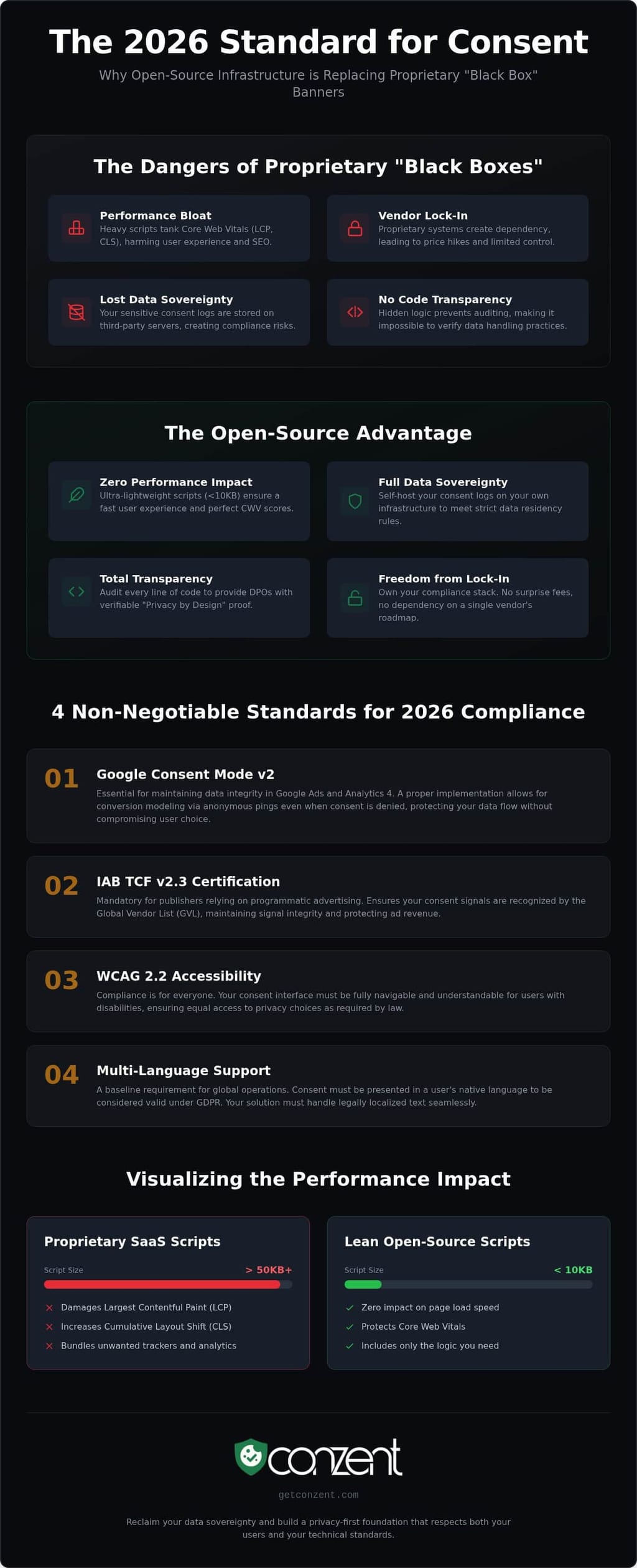
Speed is a compliance issue. Proprietary scripts often bundle trackers and analytics that you didn't ask for; these add unnecessary weight to your site. Open source allows for lean, custom builds that prioritize your user experience, much like how specialized firms like Wine Rack Concepts, LLC create custom storage solutions that optimize both form and function for their clients. Heavy scripts directly damage your Largest Contentful Paint (LCP) and Cumulative Layout Shift (CLS) scores. A lightweight consent script is a package under 10KB that executes after the main thread to ensure zero impact on page load speed. By stripping away the bloat of traditional SaaS tiers, you ensure that your best open source cookie consent implementation supports your SEO and performance goals simultaneously.
Selecting the best open source cookie consent tool requires looking beyond the code repository. In 2026, compliance isn't just about a visible banner; it's about meeting specific technical benchmarks that protect your revenue and your users. You need a solution that stands up to four non-negotiable standards. First, IAB TCF v2.3 certification is essential for any publisher relying on programmatic advertising. Second, support for Google Consent Mode v2 (GCM v2) is mandatory to maintain data integrity in Google Ads and Analytics 4. Third, your tools must meet WCAG 2.2 accessibility standards to ensure every user can navigate your privacy choices. Finally, multi-language support is a baseline requirement for handling global traffic with legally localized text.
The European Data Protection Board guidelines on consent make it clear that valid consent must be specific and freely given. This means your open-source implementation cannot rely on "implied" consent or complex UI hurdles. Transparency is your greatest asset. High-quality tools provide a clear path for users to exercise their rights while providing you with the technical signals needed to stay compliant without sacrificing performance.
Google Consent Mode v2 Integration
Open source tools must handle "denied" states without breaking your site's tracking logic. Advanced implementation allows Google tags to send anonymous pings for data modeling, whereas basic implementation blocks tags entirely until a user opts in. Your choice depends on your specific risk tolerance and data needs. A properly configured Google Consent Mode v2 implementation ensures you continue to receive conversion data even when users decline cookies. This technical balance is what separates a simple script from a professional consent platform.
IAB TCF 2.3 for Publishers
Signal integrity is the lifeblood of digital publishing. IAB TCF v2.3 certification ensures that your consent signals are recognized by the Global Vendor List (GVL). Maintaining this compliance in a forkable codebase is a significant technical challenge; many generic plugins fail here. You need a solution that consistently passes the IAB's rigorous validation checks to protect your ad revenue. You can find more about these requirements in our IAB TCF certification details. If you're ready to see how these standards fit your budget, you can explore our pricing options for managed or self-hosted infrastructure.
Top Open Source Cookie Consent Tools Compared
Choosing the best open source cookie consent tool depends on whether you prioritize simplicity or technical sovereignty. In 2026, the market is split between lightweight scripts and full-stack infrastructure. We've compared the most prominent players based on their ability to handle modern requirements like Google Consent Mode v2 and IAB TCF 2.3.
- Silktide Consent Manager: Version 2.0.1 (released July 2, 2026) remains a popular choice for those who believe mandatory compliance should be free. It's simple but lacks deep infrastructure control.
- Osano Cookie Consent: Their open-source JavaScript library (v4.0.0) is seen over 2 billion times every month. It's a reliable baseline but often requires manual work to meet 2026 GCM v2 standards.
- Klaro: Known for its clean JSON configuration, it's the "Developer's Choice" for small-to-medium projects that don't require heavy advertising signals.
- Conzent OCI: This is the "Publisher's Choice." It's a source-available Open Consent Infrastructure that provides the database-backed logging and TCF 2.3 support that pure GPL libraries often miss.
Lightweight JavaScript Libraries
Simple JavaScript libraries like Klaro and Silktide are best for sites with minimal tracking needs. They're fast, free, and easy to theme with basic CSS. However, they come with significant trade-offs. You won't get backend logs out of the box, which makes defending your compliance in an audit much harder. You're also responsible for manual updates every time a legal requirement changes. They're excellent for performance but require constant developer oversight to remain compliant.
Full-Stack Consent Infrastructure
For SaaS platforms, enterprises, and high-traffic publishers, a lightweight script isn't enough. You need Self-Hosted Open Consent Infrastructure. This approach provides database-backed logs, Consent A/B Testing, and cross-domain consent management. While it requires server management, it eliminates vendor lock-in and gives you full ownership of your data. This is how you secure data sovereignty. By using a source-available model, you get a commercial-friendly license that supports advanced features like Revenue Impact Analytics. It's a mission-driven approach that treats compliance as a scalable technical asset rather than a design afterthought.
Self-Hosted vs. Managed Cloud: Choosing Your Path
Choosing the best open source cookie consent setup is a strategic decision about where your data lives and who manages it. Most people think of open source as a free snippet of code. The reality is more complex. You have to decide between the total control of a self-hosted environment and the streamlined efficiency of a managed cloud. Both paths use the same transparent code, but they demand very different levels of operational maturity. You aren't just choosing a tool; you're choosing a maintenance philosophy.
Self-hosting requires you to handle security patching, database backups, and uptime. It's not a "set and forget" solution. If your consent server goes down, your tracking stops and your compliance vanishes. Self-hosting is a commitment to infrastructure, not just a one-time script install. You're trading developer hours and server overhead for absolute data sovereignty. This is the price of total independence from third-party ecosystems.
When to Self-Host Your CMP
Some industries can't afford to share data with a third-party vendor. If you're in FinTech or HealthTech, total data isolation is often a regulatory necessity. This path is ideal if your DevOps team already manages Kubernetes or Docker environments. It allows you to bake consent logic directly into your existing CI/CD pipelines. For teams ready to take on the technical lift, you can find our technical docs to guide your deployment. It's the ultimate way to ensure no consent data ever leaves your perimeter.
The Managed Cloud Advantage
Our best open source cookie consent offering includes a Managed Cloud Consent Platform. This provides the convenience of SaaS without the "black box" secrecy of proprietary vendors. You get automatic updates for IAB TCF 2.3 and Google Consent Mode v2. A global CDN ensures your banner loads with zero latency, protecting your Core Web Vitals. It's the best way to scale privacy without the DevOps burden. You can read more about this approach in our Managed Cloud Consent Platform Pillar.
Subscription fees are often lower than the hidden costs of developer maintenance. Managing your own server isn't free; it costs time and attention. We offer both paths so you can choose the one that fits your resource availability. You can compare our self-hosted and cloud pricing to see which model aligns with your team's current infrastructure.
Conzent: Reimagining Open Consent Infrastructure
Conzent exists to dismantle the idea that high-level compliance is a luxury. Our mission is to make robust, ethical data handling accessible through Open Consent Infrastructure (OCI). We don't believe in locking your data behind proprietary gates. Instead, we provide a source-available platform that gives you the transparency of open source with the power of an enterprise tool. This approach ensures you remain the sole owner of your consent logs while benefiting from a community-driven codebase.
Most tools stop at showing a banner. We go further by offering Revenue Impact Analytics. This feature allows you to see exactly how consent choices affect your bottom line. You can stop guessing and start measuring the real-world relationship between privacy and profit. Our sponsorship model supports this vision. By partnering with corporate entities, we lower costs for the entire community. It's a principled way to build the best open source cookie consent ecosystem where everyone wins. You can also fully redesign your banner to match your brand identity, ensuring that compliance feels like a natural part of your user journey.
Beyond Compliance: A/B Testing and Optimization
Opt-in rates are a critical metric for your marketing data. If your banner is intrusive, users leave. If it's too vague, you risk non-compliance. We solve this by enabling A/B tests on your banner design. You can experiment with different layouts and copy to find the perfect balance between user trust and legal requirements. This isn't about tricking users; it's about finding the most transparent way to ask for permission. Better trust leads to better data quality, which ultimately strengthens your entire digital strategy.
Getting Started with Conzent
You have two clear paths to get started. Our Managed Cloud Consent Platform offers the fastest route to compliance with zero server maintenance. If you need total data isolation, our Self-Hosted Open Consent Infrastructure provides the technical sovereignty required by high-security environments. Both options include seamless integration support for WordPress, Shopify, and other major CMS platforms. We provide the tools, and you choose the infrastructure that fits your team's resources. You can view Conzent pricing and sponsorship options to find the right tier for your organization. It's time to build a privacy-first future on your own terms.
Reclaim Your Data Sovereignty Today
The transition from simple banners to robust Consent Infrastructure is a necessary shift for any principled organization. The best open source cookie consent tools don't just block scripts; they provide a transparent, auditable foundation for your entire digital stack. You've seen the trade-offs between the total isolation of a self-hosted setup and the streamlined convenience of a managed platform. Both paths offer a way out of proprietary vendor lock-in and hidden SaaS costs.
Your compliance strategy must meet the technical demands of 2026. This means utilizing infrastructure that is IAB TCF 2.3 Certified and Google Consent Mode v2 Ready. By choosing source-available infrastructure, you ensure that your consent logs remain your property, not a third-party asset. It's time to stop hiding behind corporate black boxes that prioritize their own data over your performance. You can scale your privacy without the black box by trying Conzent's Managed Cloud. Compliance is a technical standard that is finally within your reach. Start building a faster, more ethical web that respects your users and your data today.
Frequently Asked Questions
Is open source cookie consent really compliant with GDPR?
Open source tools are fully compliant with GDPR if they meet the core technical requirements for valid consent. This includes offering granular choices for different tracker categories and providing a clear way for users to withdraw consent at any time. Because the code is public, you can audit the logic to ensure it doesn't drop cookies before a user opts in. This transparency makes it easier to document your compliance for regulatory authorities.
What is the difference between open source and source-available consent managers?
The primary difference lies in the licensing and commercial usage rights. Pure open-source tools typically use licenses like GPL or MIT, allowing anyone to modify and redistribute the code freely. Source-available models, like Conzent’s Open Consent Infrastructure, allow you to view, audit, and self-host the code but may include restrictions on commercial redistribution. Both models provide the transparency needed for security audits while protecting the long-term sustainability of the project.
Does open source cookie consent support Google Consent Mode v2?
Yes, the best open source cookie consent solutions now offer native support for Google Consent Mode v2. This integration is essential for websites using Google Ads and Analytics 4 to maintain data modeling when users deny consent. Tools like Conzent handle the "granted" and "denied" states automatically, ensuring your tags behave according to user preferences without breaking your tracking logic. Always verify that your chosen library specifically supports the latest 2026 requirements.
Can I self-host my cookie consent banner for free?
You can self-host Conzent’s Open Consent Infrastructure on your own servers at no cost for the software itself. This approach gives you total data isolation and removes the need for monthly SaaS fees. However, you remain responsible for your own server costs, security patching, and uptime management. For teams with existing DevOps resources, this is a highly cost-effective way to maintain full data sovereignty without sacrificing advanced compliance features.
Why do I need IAB TCF 2.3 for my website?
You need IAB TCF 2.3 if you are a publisher who relies on programmatic advertising to generate revenue. This framework ensures that your consent signals are standardized and recognized by the Global Vendor List. Without a TCF-certified banner, many ad networks will stop serving personalized ads on your site, which can lead to a significant drop in revenue. It provides a necessary legal and technical bridge between your users and the advertising ecosystem.
How do open source cookie banners affect website performance?
Open source banners generally improve performance because they lack the tracking bloat found in many proprietary SaaS scripts. Most open-source libraries are designed to be lightweight, often weighing under 10KB. By self-hosting the script or using a global CDN, you reduce the impact on your Core Web Vitals. This ensures that your compliance measures don't slow down your Largest Contentful Paint or disrupt the user experience with unnecessary layout shifts.
What happens if privacy laws change and I am using an open source tool?
When privacy laws change, the community or the primary maintainer updates the codebase to reflect new requirements. If you are self-hosting, you must manually pull these updates to stay compliant. Managed cloud versions handle these updates automatically, ensuring you meet new deadlines like the EU AI Act enforcement on August 2, 2026. The advantage of open source is that legal updates are often peer-reviewed for accuracy and technical efficiency.
Is Conzent's managed cloud version still open source?
Conzent’s Managed Cloud Consent Platform uses the same source-available code as our self-hosted version. It isn't a separate, closed-source product. Instead, it provides the convenience of a SaaS model with the transparency of open infrastructure. You get the same auditable code but we handle the hosting, security, and global delivery for you. This model allows you to scale your privacy efforts without the technical burden of managing your own infrastructure.