
Cookie Consent Security Features: Protecting Data Integrity in 2026

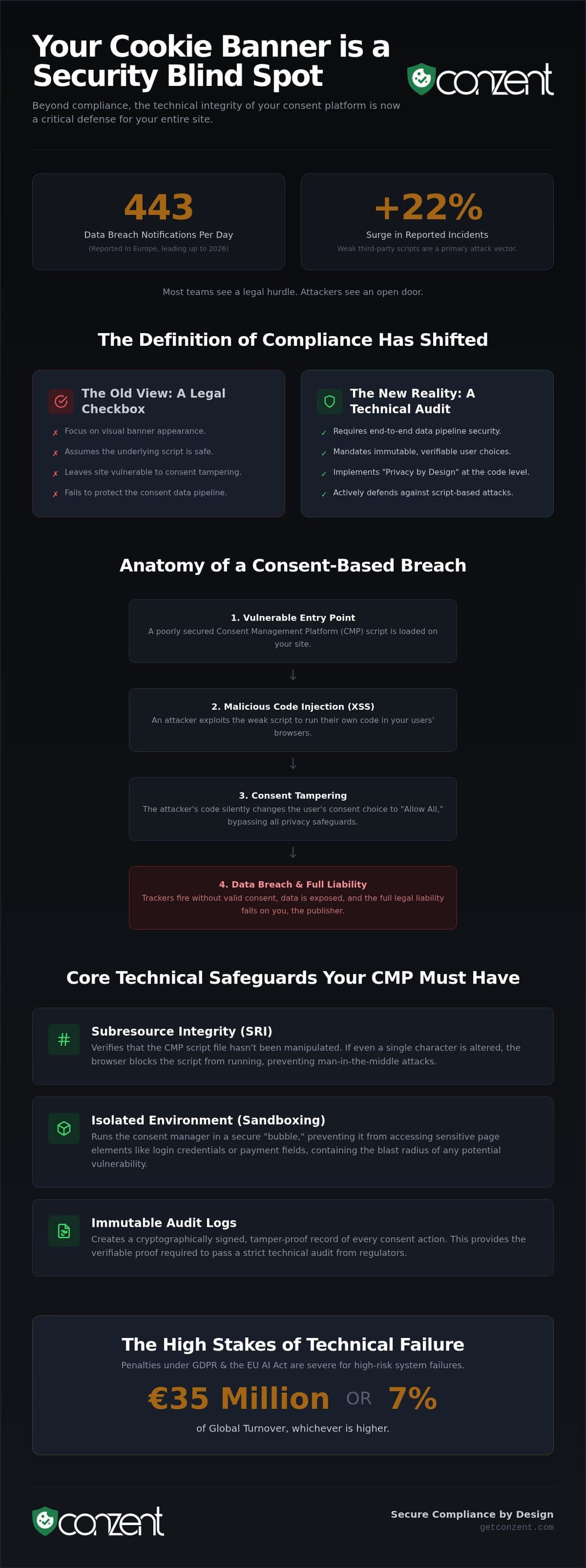
In the year leading up to January 2026, reported data breach notifications in Europe surged by 22 percent, averaging 443 incidents every single day. Most teams view a cookie banner as a legal hurdle, but it's actually a critical piece of your security infrastructure. If your consent management platform is weak, it becomes an entry point for XSS attacks through third-party scripts. High-level compliance isn't just about showing a banner. It's about implementing robust cookie consent security features that protect your data integrity from the moment a user lands on your site.
You've likely felt the pressure of managing complex integrations like IAB TCF v2.3 and Google Consent Mode v2 while worrying about where that consent data actually lives. Cloud leaks and data sovereignty concerns are real risks. You need a setup that survives a technical audit, not just a lawyer's review. This article explains how to move beyond basic banners to a secure, tamper-proof mechanism. You'll learn how to take full control of your consent data storage and ensure your technical implementation remains ironclad against evolving threats.
Key Takeaways
- Identify the technical risks of poorly secured CMPs and how they can lead to Cross-Site Scripting (XSS) breaches.
- Learn how to use Subresource Integrity (SRI) and sandboxing to ensure your consent manager doesn't compromise your site's data.
- Compare managed cloud and self-hosted models to decide which cookie consent security features best protect your data sovereignty.
- Follow a practical checklist to audit your platform's source code and verify its support for modern Content Security Policy (CSP) headers.
- Shift from "check-the-box" compliance to a transparent, source-available infrastructure that invites security vetting.
Why Cookie Consent Security Features are Non-Negotiable in 2026
In 2026, the definition of compliance has shifted. It's no longer enough to display a visually compliant banner; you must ensure the technical integrity of the choice-gathering mechanism itself. We define consent security as the end-to-end protection of the data pipeline that captures, stores, and transmits user privacy preferences. If this pipeline is compromised, your legal compliance becomes a liability. A legal banner is not necessarily a safe banner. Without robust cookie consent security features, your consent management platform (CMP) can become a backdoor for malicious actors.
Regulators have moved past checking for "Accept" or "Reject" buttons. They're now auditing technical implementation. They want to see that trackers don't fire before consent and that user choices are immutable once recorded. This shift reflects a reality where approximately 443 data breach notifications were reported daily in Europe leading up to 2026. Many of these breaches stem from vulnerabilities in third-party scripts. To prevent this, developers must implement Secure cookie attributes to ensure that consent-related data remains encrypted and inaccessible to unauthorized scripts. Ensuring your cookie consent security features are functional is now a prerequisite for digital operations.
The Anatomy of a Consent-Based Security Breach
Attackers frequently target third-party scripts because they often run with high privileges in the user's browser. A poorly secured CMP script is a prime vector for Cross-Site Scripting (XSS). If an attacker injects code into your CMP, they can manipulate the consent signal to "allow all," effectively bypassing your site's security and legal safeguards. This leads to "Consent Tampering," which places the full weight of legal liability on the publisher, not the vendor.
Consent Integrity is the protection of user choices from unauthorized modification. To maintain this integrity, your technical stack must include verification that the CMP script hasn't been altered. It requires the isolation of the consent manager from sensitive site data and the encryption of the consent string at the browser level. Without these technical safeguards, the user's choice is merely an illusion that can be rewritten by any malicious script on the page.
Regulatory Pressure on Technical Standards
The GDPR mandates "Privacy by Design" and "Privacy by Default." This means security isn't an optional add-on; it's a core requirement. In 2026, the updated IAB TCF Compliance framework, specifically version 2.3, introduces stricter technical guardrails. These guardrails ensure that the consent signal is transmitted securely across the advertising ecosystem. Failure to meet these technical standards can lead to fines under the EU AI Act, where penalties reach as high as €35 million or 7% of global turnover for high-risk system failures. Compliance is now a technical audit, not just a policy review.
Core Technical Safeguards: Beyond the Consent Banner
Visual compliance is a facade if the underlying code is vulnerable. To achieve true data integrity, you must look past the user interface and audit the infrastructure. Robust cookie consent security features start with Subresource Integrity (SRI). By using SRI hashes, your browser verifies that the CMP script fetched from a CDN hasn't been manipulated by a third party. If even a single character in the code changes, the browser blocks the script. This prevents the "man-in-the-middle" attacks that often plague high-traffic sites.
Sandboxing is the next layer of defense. A secure consent manager should operate in an isolated environment, preventing it from accessing sensitive DOM elements like login credentials or payment fields. This technical isolation ensures that even if a CMP vulnerability is discovered, the blast radius is contained. You should also maintain immutable audit logs. These are not simple spreadsheets; they are cryptographically signed records of when and how consent was granted. These logs are essential for proving compliance with the ICO's rules on cookies during a technical audit. Choosing a platform with these built-in protections is the only way to ensure audit-ready compliance. You can explore our infrastructure options to see how we prioritize these safeguards.
Google Consent Mode v2 and Security
As of June 15, 2026, Google consolidated its data controls, making a correctly configured CMP essential for advertisers. Google Consent Mode v2 securely communicates consent signals to Google tags without exposing personal data. To secure this process, you must ensure your data layer is protected against unauthorized tag firing. A secure implementation prevents malicious scripts from spoofing the ad_storage signal. For a deep dive into implementation, consult our Google Consent Mode v2 Guide.
API Security for Developers
Developers must treat consent state updates with the same rigor as financial transactions. This requires securing the endpoints that handle consent data with robust authentication and rate limiting. Rate limiting prevents automated consent "stuffing," where bots attempt to overwhelm your system with fake consent records. When building custom integrations, follow our best practices for implementing a cookie consent API. This includes using short-lived tokens and ensuring all state changes are validated on the server side, not just the client side. These cookie consent security features turn a legal requirement into a technical asset.
Data Sovereignty: Managed Cloud vs. Self-Hosted Security
Where your consent data lives is a security decision, not just a logistical one. Most proprietary cloud CMPs operate as a "black box." You integrate their script, collect user preferences, and trust their internal protocols without any real visibility into their infrastructure. For many organizations, this represents a significant security blind spot. If a central cloud provider suffers a leak, your users' privacy choices are exposed alongside thousands of other companies. True data sovereignty requires a conscious choice between professional infrastructure maintenance and total local control.
In 2026, the global average cost of a data breach is reported to be between $4.44 million and $4.88 million. Proprietary systems often hide vulnerabilities until they're exploited. By contrast, source-available cookie consent security features allow for independent vetting. Whether you choose a managed service or a self-hosted one, you should never have to guess how your data is being handled. The goal is to move away from blind trust toward verified technical integrity.
The Case for Self-Hosted Infrastructure
Self-hosted Open Consent Infrastructure (OCI) offers the highest level of protection for data-sensitive industries. By keeping consent data within your own Virtual Private Cloud (VPC) or behind your firewall, you eliminate fourth-party risks in your supply chain. You aren't just trusting a vendor's promise; you are owning the entire stack. This is vital for sectors like healthcare, finance, or government where data residency is a legal mandate. When you host the infrastructure, you have total control over data processing and storage locations. For a deeper look at this setup, read The Ultimate Guide to Self-Hosted Cookie Consent Managers in 2026.
Managed Cloud Security Features
Managed cloud options prioritize security through professional maintenance and scale. A dedicated platform provides automatic security patching, vulnerability scanning, and DDoS protection that many internal IT teams might not have the resources to manage 24/7. It's an efficient way to ensure your cookie consent security features are always up to date without the overhead of manual server management. Our Danish-based service ensures that even in a managed environment, you benefit from transparency rather than a closed system. Learn more about how to achieve this in our article on the Managed Cloud Consent Platform: Scaling Privacy Without the Black Box.
Choosing between these models depends on your specific risk profile. A high-growth SaaS company might value the speed and automatic patching of a managed cloud. Conversely, a public sector entity or a hospital might find that self-hosting is the only way to satisfy a rigorous technical audit. Both paths lead to the same destination: a secure, tamper-proof environment where user choices are respected and data integrity is preserved.
The 2026 Security Checklist for Evaluating a CMP
Evaluating a CMP is no longer a job for just the legal team. In 2026, it's a rigorous security audit. You need to verify that your cookie consent security features are actually functional and not just decorative. Use this five-step checklist to ensure your implementation survives a technical review and protects your data integrity.
- Step 1: Audit source code availability. Transparency is the enemy of vulnerabilities. If you can't see the code, you can't vet it for backdoors or insecure dependencies.
- Step 2: Verify support for Content Security Policy (CSP) headers. A secure CMP must be compatible with your site's CSP to prevent unauthorized script execution and data exfiltration.
- Step 3: Check certifications. Ensure the platform is certified for IAB TCF 2.3 and Google Consent Mode v2. These standards prove the platform follows secure, industry-recognized communication protocols.
- Step 4: Evaluate A/B testing security. Verify that the testing engine doesn't bypass consent logic or manipulate the UI in ways that create security loopholes.
- Step 5: Review encryption policies. Confirm that all consent data is encrypted at rest. With data breach costs reaching new highs in 2026, unencrypted records are an unacceptable liability.
Auditing for Consent Tampering
Consent tampering occurs when a signal is altered between the user's browser and your database. You must verify that the consent string is protected in transit and cannot be spoofed by malicious scripts. Use browser developer tools or automated scanners to simulate script injection and see if your CMP blocks the attempt. When running A/B testing, ensure the different variants don't accidentally disable security headers or create logic flaws that attackers could exploit.
Integration Security
Your security is only as strong as your weakest integration. Whether you use WordPress, Drupal, or Wix, your cookie consent security features must remain consistent across the entire stack. Lightweight scripts are inherently more secure; they offer a smaller attack surface than bloated, library-heavy alternatives. When you perform revenue impact analysis, ensure the platform uses anonymized data aggregates. This keeps your marketing insights separate from your security vulnerabilities, ensuring that performance tracking doesn't compromise user privacy.
Ready to deploy infrastructure that prioritizes these technical standards? View our transparent pricing and hosting options.
Conzent: Transparent Infrastructure for Secure Compliance
Conzent is not just another vendor. We are a community advocate for digital rights. Our mission centers on Open Consent Infrastructure (OCI). We believe that cookie consent security features should be transparent by design, not hidden behind proprietary walls. Closed-source models rely on "security through obscurity," which is a fundamental flaw. If you cannot audit the code, you cannot verify the security. We invite scrutiny because transparency is the only way to build a safer web. Obscurity is a liability. Transparency is a standard.
Our platform delivers the technical tools you need for ironclad compliance. We support IAB TCF v2.3 and Google Consent Mode v2 natively. We provide granular audit trails that prove compliance during any technical audit. You can choose the deployment model that fits your risk profile. Use our managed cloud version for reduced overhead. Alternatively, deploy a self-hosted OCI instance to keep every byte of consent data within your own infrastructure. This flexibility ensures that your security strategy scales with your technical requirements.
The Security Benefits of OCI
Proprietary systems are technical silos. When a vulnerability exists in a closed system, you are at the mercy of the vendor's internal timeline. Open infrastructure changes this dynamic. A community-driven approach catches vulnerabilities faster through collective vetting and peer review. It effectively eliminates the "black box" risk that plagues traditional CMPs. This transparency also reduces vendor lock-in. You own your configuration. You own your data. Learn more about our Open Consent Infrastructure and how it redefines technical standards for the modern web.
Ready to Secure Your Consent Strategy?
Migrating to a secure CMP shouldn't break your site or your workflow. We designed our scripts to be lightweight and compatible with modern CMS platforms like WordPress, Drupal, and Wix. You can scale from a single site to enterprise-wide cloud consent without losing data integrity. Our Danish-based team provides the global scope and technical expertise needed for 2026 compliance. We don't hide behind complexity. We provide the tools for you to take control. Check out our pricing for managed cloud services to find the right tier for your organization. Secure compliance is a necessity, not a luxury. We make it attainable for everyone, regardless of their resources.
Securing the Future of Digital Consent
Compliance in 2026 isn't a legal checkbox; it's a technical fortress. We've moved past the era of "check-the-box" banners toward a reality where your consent management platform is a core piece of your security infrastructure. By prioritizing cookie consent security features like Subresource Integrity and source-available code, you protect your site from XSS attacks and ensure that user choices remain tamper-proof. Whether you choose the total control of self-hosting or the professional efficiency of a managed cloud, the goal remains the same: verified transparency.
Conzent provides the infrastructure to make this attainable for everyone. Our platform is IAB TCF v2.3 and Google Consent Mode v2 certified, built on Danish data protection standards that respect global privacy rights. We invite you to audit our source-available code and see how we've eliminated the "black box" of traditional CMPs. It's time to stop relying on obscurity and start building on a foundation of technical integrity.
Secure your website with Conzent’s Managed Cloud Consent Platform and take full control of your data residency today. Building a safer, more transparent web is a mission we can achieve together.
Frequently Asked Questions
Can a cookie consent banner be a security risk to my website?
Yes, a cookie banner can be a significant security risk if the script is vulnerable to Cross-Site Scripting (XSS). Attackers often target third-party scripts because they run with high privileges to manage other tags. If your CMP is compromised, it can exfiltrate sensitive data or inject malicious code. You must implement cookie consent security features like Subresource Integrity (SRI) to ensure the script hasn't been altered.
What is the difference between a secure CMP and a compliant one?
A compliant CMP follows legal rules like GDPR, but a secure CMP protects the technical integrity of the data pipeline. Compliance focuses on the user interface and legal text. Security focuses on encryption, script sandboxing, and protecting the administrative dashboard from unauthorized access. You can have a banner that looks legally perfect but remains technically vulnerable to data leaks if it lacks robust technical safeguards.
How does self-hosting a consent manager improve security?
Self-hosting keeps your consent data within your own Virtual Private Cloud (VPC) or behind your firewall. This eliminates fourth-party risks where you rely on a vendor's external cloud security. It gives you total control over data residency and residency audits. For data-sensitive industries like healthcare or government, self-hosting is the ultimate security feature. It ensures that user privacy choices are never stored in a shared, proprietary black box.
Does Google Consent Mode v2 include security features?
Google Consent Mode v2 secures the communication of consent signals between your site and Google's services. It ensures that advertising and analytics tags only fire when the correct signals are present. While it isn't a standalone security tool, it prevents unauthorized data collection. Using a certified CMP ensures these signals are transmitted via secure, encrypted protocols that meet the technical requirements for 2026 data integrity standards.
What technical features prevent users from bypassing the consent banner?
Server-side validation and script blocking are the primary technical features that prevent bypasses. A secure implementation ensures that trackers are physically blocked from loading until a positive consent signal is received. Some advanced cookie consent security features include cryptographically signed consent strings. These strings prevent users or bots from manually altering their consent state in the browser's local storage to access restricted site features without giving valid permission.
How do I audit the security of my current cookie consent provider?
Start by requesting their source code availability and latest security audit reports. Check if they support Content Security Policy (CSP) headers and Subresource Integrity (SRI). You should also verify their data retention policies and encryption-at-rest standards. If a provider cannot explain how they protect their script from injection attacks, they aren't prioritizing security. A transparent provider will invite scrutiny and offer clear technical documentation for your team.
Is open-source cookie consent software more or less secure than proprietary software?
Open-source or source-available software is generally more secure because it allows for independent vetting. Proprietary software relies on security through obscurity, which often hides vulnerabilities until they're exploited by attackers. With source-available infrastructure, the community and your own security team can inspect the code for backdoors. This transparency leads to faster patching and a more resilient platform. It turns security into a collaborative effort rather than a vendor's secret.