
Self-Hosted Cookie Management: The 2026 Guide to Data Sovereignty

Your cookie banner shouldn't be a tax on your compliance or a back door for third-party data harvesters. For too long, the industry has accepted a model where you pay a monthly fee to rent a solution for a legal requirement you're forced to meet. It's an extraction of value that often comes at the cost of your site's performance and your users' privacy. Transitioning to self-hosted cookie management is no longer a niche developer project. It's a strategic infrastructure choice for any organization that values data sovereignty.
You're right to be frustrated by rigid designs that hurt your user experience and the constant fear of data leakage to CMP vendors. Compliance is a standard, not a luxury. This guide shows you how to master the transition from vendor-locked banners to a self-hosted infrastructure. You'll gain full ownership of your consent database and achieve zero monthly fees for basic compliance. We'll walk through the technical control needed to implement lightweight scripts that meet the June 2026 Google Consent Mode v2 requirements. It's time to stop renting your compliance and start owning your data.
Key Takeaways
- Reclaim your data sovereignty and eliminate "compliance taxes" by keeping all user consent logs on your own internal servers.
- Master the technical architecture of self-hosted cookie management, including the deployment of APIs and databases using source-available infrastructure.
- Calculate the true total cost of ownership by comparing initial developer hours to the unpredictable price escalations of SaaS vendors.
- Implement a clear framework for auditing tracking scripts and deploying compliant banners via Docker or binary files.
- Discover how a Self-Hosted Open Consent Infrastructure provides a sustainable, enterprise-grade alternative to vendor-locked compliance platforms.
Why Organizations are Moving to Self-Hosted Cookie Management
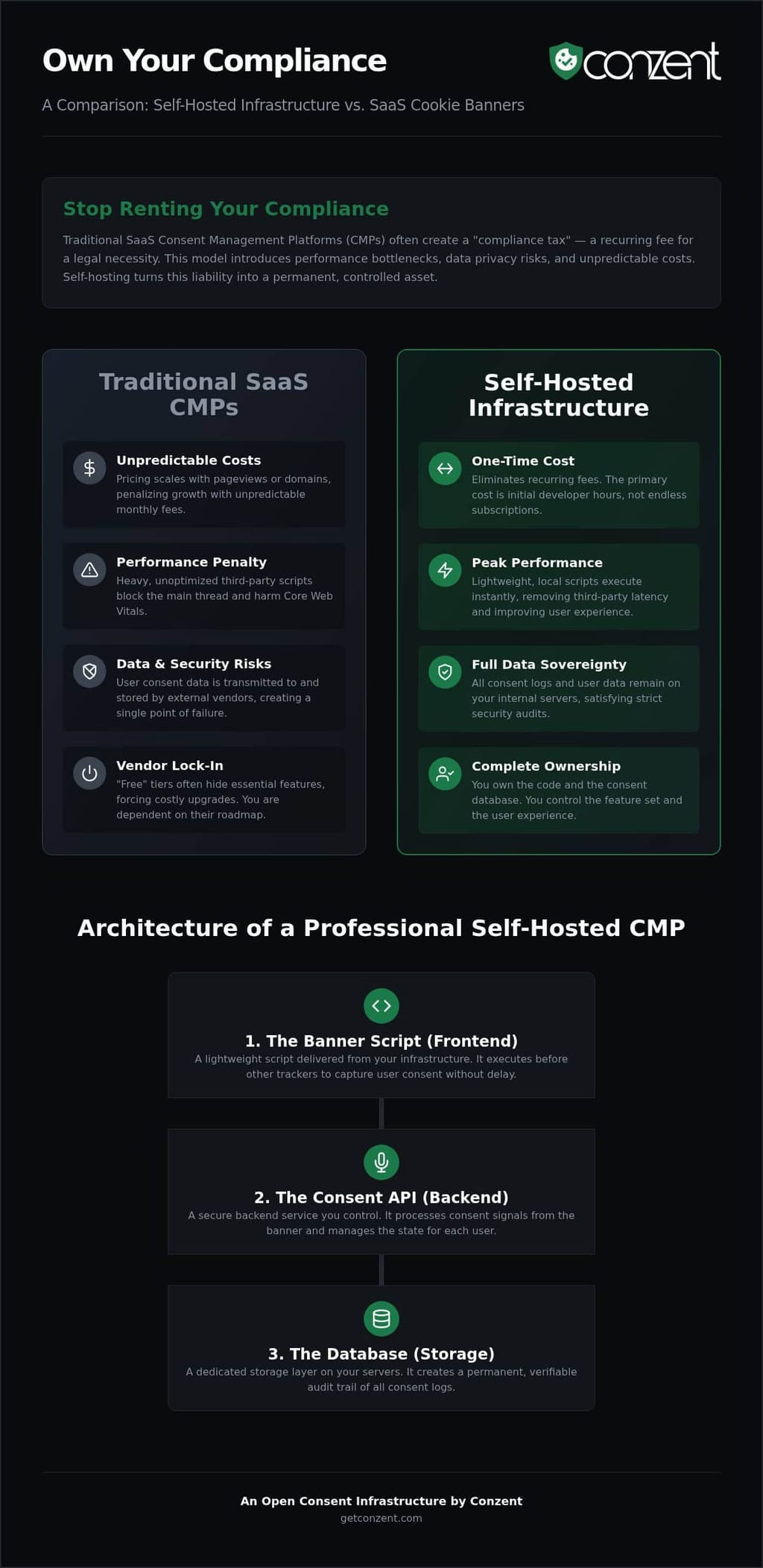
Organizations are tired of renting their compliance. For years, the industry standard was to outsource consent management to third-party vendors. This created a technical dependency that many now find unacceptable. Transitioning to self-hosted cookie management allows teams to reclaim their infrastructure. It turns a recurring liability into a permanent asset that you control.
There are four primary drivers behind this movement:
- Cost Control: SaaS pricing often scales with pageviews or domains. This penalizes growth. Self-hosting removes these unpredictable monthly escalations.
- Technical Performance: Third-party scripts are often heavy and unoptimized. They delay the main thread and hurt Core Web Vitals. Local scripts are lightweight and execute faster.
- Security Audits: Many enterprise security teams now forbid the transmission of user consent data to external processors. Local hosting satisfies these strict internal requirements.
- Data Ownership: You don't just collect consent; you store the proof. Keeping these logs on internal servers ensures you never lose access to your own records if a vendor changes their terms.
The Problem with Black-Box SaaS CMPs
Most Consent Management Platforms function as a single point of failure. If their API goes down, your site's tracking breaks. If they suffer a breach, your users' privacy is compromised. This is the hidden cost of the black-box model. You're effectively paying a vendor to manage data that should never have left your perimeter in the first place.
Many "free" tiers also act as a trap. They often omit critical features required for modern standards, such as Google Consent Mode v2. This forces businesses into expensive upgrades just to maintain basic functionality. By choosing self-hosted cookie management, you bypass these artificial limitations. You control the feature set because you own the code.
Data Sovereignty as a Competitive Advantage
Privacy is not a checkbox; it's a relationship with your user. When you manage consent locally, you demonstrate a commitment to transparency. This alignment with the ePrivacy Directive and GDPR isn't just about avoiding fines. It's about building a privacy stack that users can trust without wondering which third-party is harvesting their clicks.
Hosting your own infrastructure ensures that sensitive consent signals remain within your jurisdiction. This is particularly vital for companies operating in regions with strict data residency requirements. If you need a middle ground between total DIY and a black-box vendor, a Managed Cloud Consent Platform offers a way to scale privacy without sacrificing technical control. This approach provides the benefits of the cloud while maintaining the principles of source-available infrastructure.
The Architecture of a Professional Self-Hosted CMP
Professional self-hosted cookie management is not just a JavaScript file sitting on a server. It is a three-tiered system designed for resilience, speed, and legal accountability. While many developers mistake a consent banner for a simple UI component, a robust architecture requires a frontend script, a secure API, and a scalable database. This structure ensures that every user choice is not only respected in the browser but also documented in a verifiable audit trail.
The core components of this architecture include:
- The Banner Script: A lightweight delivery mechanism that executes before other trackers.
- The Consent API: A backend service that processes signals and manages state.
- The Database: A dedicated storage layer for consent logs, separate from your primary application data.
Unlike traditional open source, source-available infrastructure provides a necessary balance, offering the transparency of open code with the sustainable engineering required for enterprise-grade privacy. This distinction is vital for long-term maintenance. You need the ability to inspect the code for security while relying on a framework that evolves alongside changing standards like IAB TCF v2.3 and Google Consent Mode v2.
The Frontend: Lightweight Consent Banners
Performance is a privacy feature. A heavy banner script delays your site's interactivity and damages your mobile user experience. By hosting the script yourself, you eliminate the latency of third-party DNS lookups and SSL handshakes. This allows for deep UI/UX customization without relying on a rigid vendor dashboard. You can match the banner to your brand's design language perfectly while maintaining high performance. To see what a performance-first banner looks like, explore our cookie banner features.
The Backend: Consent Storage and APIs
The real work happens behind the scenes. Your API must be secured against unauthorized consent tampering to prevent malicious actors from spoofing user choices. When choosing between SQL and NoSQL for your consent logs, consider your scale. SQL is often preferred for its strict schema and ease of auditing, while NoSQL offers the horizontal scalability required for high-traffic environments. This backend layer is where you integrate Google Consent Mode v2 signals, ensuring that your marketing stack receives the correct data without leaking user info to third parties. If you want to compare deployment models for your infrastructure, review the Self-Hosted Open Consent Infrastructure options.
Self-Hosted vs. SaaS: Evaluating the Total Cost of Ownership
Self-hosting is often marketed as a free alternative to expensive SaaS subscriptions. This is a half-truth that ignores the reality of engineering resources. While self-hosted cookie management eliminates recurring vendor fees, it introduces a different set of costs: developer hours. You must account for the initial setup, server maintenance, and the ongoing labor of monitoring regulatory shifts. Compliance is not a set and forget task. It's a continuous process of technical refinement.
Maintaining your own infrastructure means you're responsible for security patches and regulatory updates. Because you are managing your own internet-facing endpoints and APIs, running regular vulnerability scans with platforms like ReadySECURE helps keep self-hosted services protected against emerging threats. When the industry shifts to standards like IAB TCF v2.3, your team must implement those changes manually. If you don't have a dedicated DevOps presence, the "free" version of compliance can quickly become more expensive than a managed solution. We believe in a sponsorship model that lowers these barriers. By offering a Self-Hosted Open Consent Infrastructure that is source-available, we provide the community with enterprise-grade tools without the typical enterprise price tag.
When to Choose Self-Hosted Infrastructure
Self-hosting is the ideal choice for high-traffic sites that already maintain internal DevOps teams. If you're managing millions of monthly visitors, the per-pageview cost of a SaaS CMP becomes a significant drain on your budget. Hosting locally allows you to bake consent into your existing CI/CD pipelines. It also gives you the freedom to customize A/B testing and revenue analytics without being limited by a vendor's pre-built reports. You can view our pricing model to see how these options compare to managed alternatives.
The Managed Cloud Alternative
For many, a Managed Cloud Consent Platform is the more efficient path. It reduces the compliance tax by leveraging shared infrastructure. You get the same technical control and data sovereignty of a self-hosted setup, but without the burden of manual updates. When laws change or new Google Consent Mode requirements emerge, the platform handles the heavy lifting. This allows your developers to focus on your core product rather than chasing the latest cookie law amendments. It's a balance of technical openness and operational sustainability.
Implementing Self-Hosted Consent: A Step-by-Step Framework
Theory must eventually meet production. Transitioning to self-hosted cookie management requires a methodical approach that prioritizes both technical stability and legal compliance. This isn't about slapping a script on a page; it's about building a resilient data pipeline. By following a structured framework, you ensure that your consent signals are accurate, your site remains fast, and your data stays under your control.
- Step 1: Audit Your Inventory. Catalog every cookie and tracking script currently firing on your site. You cannot manage consent for trackers you haven't identified.
- Step 2: Infrastructure Deployment. Deploy your Consent API and database using Docker containers or standalone binaries. This ensures environmental consistency across your staging and production servers.
- Step 3: Signal Configuration. Map your user choices to Google Consent Mode v2 and IAB TCF v2.3 signals. This is critical for meeting the June 15, 2026, Google Ads deadline for compliant data signaling.
- Step 4: Analytics Integration. Connect your consent data to Revenue Impact Analytics to understand how opt-in rates affect your bottom line.
Technical Deployment for DevOps
Your deployment strategy should treat consent infrastructure like any other mission-critical service. Start by configuring your environment variables to handle database credentials and API secrets securely. If you use a CMS, leverage native integrations for WordPress or Drupal to streamline the frontend delivery. Once deployed, use Google Consent Mode v2 debugging tools to verify that your tags only fire when valid consent is present. This prevents accidental data leaks and ensures your setup survives a technical audit.
Optimizing for Performance and Revenue
Compliance shouldn't kill your conversion rate. Use A/B testing to experiment with different banner placements and copy to find the least intrusive experience for your users. By measuring the revenue impact of these choices, you can balance legal requirements with business goals. A privacy-first user experience reduces bounce rates and fosters the trust necessary for users to grant consent, directly sustaining your advertising revenue. If you're ready to deploy your own infrastructure, explore our Self-Hosted Open Consent Infrastructure plans to get started.
Conzent’s Open Consent Infrastructure: Compliance Without Compromise
Conzent OCI represents a fundamental shift in how we approach compliance tools. It's not a closed-loop SaaS trap designed to extract monthly fees for a mandatory legal requirement. Instead, it's a Self-Hosted Open Consent Infrastructure that bridges the gap between community-driven transparency and enterprise-grade reliability. We believe privacy infrastructure should be a public good. That's why the core engine is source-available and free to host on your own servers. You can audit every line of code, verify every data flow, and ensure your self-hosted cookie management strategy remains technically honest.
Scaling shouldn't mean starting over. As your traffic increases or your infrastructure needs grow, you don't have to migrate to a different vendor or relearn a proprietary API. You can transition from the free self-hosted version to our Managed Cloud Consent Platform without losing your configuration. This unified path provides a level of flexibility that traditional vendors can't match. Most providers force a binary choice: a limited open-source script or a locked-down cloud service. We offer a single, performance-first standard that evolves alongside your business.
Built for 2026 Regulations
Compliance is a moving target. Our infrastructure includes native support for the latest IAB TCF standards, ensuring your site remains compliant with the complex requirements of the ad-tech ecosystem. We've also engineered the platform to handle the technical shifts of cookie deprecation and the new enforcement realities of 2026. Every update is backed by Danish engineering and a community-driven development model. We prioritize technical clarity over marketing fluff to ensure your site stays ahead of regulatory changes without the typical overhead.
Take Control of Your Privacy Stack
Mission-driven infrastructure is the future of the web. It's about moving away from opaque vendors and toward a web where transparency is the default. You can get started with OCI self-hosting today by accessing the repository on GitHub. This gives you the technical control discussed in previous sections without the financial burden of a mandatory subscription. You own the code. You own the data. You own the relationship with your users.
Whether you're a developer looking for a free, high-performance solution or an enterprise needing a managed environment, the path forward is clear. You shouldn't have to compromise on your values to meet your legal duties. View pricing and sponsorship options to find the right fit for your organization's growth.
Reclaim Your Technical Sovereignty
Data sovereignty isn't a premium luxury for the few. It's the necessary standard for a transparent and ethical web. We've explored how moving to self-hosted cookie management eliminates the compliance tax while giving you absolute control over your consent logs. You now have a practical framework to audit your tracking scripts, deploy resilient infrastructure via Docker, and optimize your opt-in rates through revenue-focused A/B testing. This transition moves your privacy stack from a recurring liability to a permanent technical asset.
Our infrastructure is built on the principle of source-available transparency. It's IAB TCF v2.3 certified and natively integrated with Google Consent Mode v2 to meet the strictest 2026 requirements. You don't have to choose between technical openness and regulatory safety. Whether you host it yourself for free or utilize our managed services, you're investing in a system that respects your users and your bottom line. Ready to own your privacy stack? Explore Self-Hosted and Managed Pricing to find the right path for your organization. Taking control of your data infrastructure is a bold step toward a more sustainable digital future.
Frequently Asked Questions
Is self-hosted cookie management really free?
Yes, the source-available infrastructure is free to host on your own servers without recurring license fees. However, you must account for your own internal server costs and the developer time required for initial setup and ongoing maintenance. While there is no "compliance tax" paid to a vendor, it is an investment in your own technical resources. This model prioritizes your budget by removing unpredictable SaaS pricing escalations that scale with your traffic.
Does self-hosting a CMP satisfy GDPR requirements?
Self-hosting provides the technical foundation for GDPR compliance by ensuring data sovereignty and verifiable consent logs. It allows you to keep sensitive user choices on your own infrastructure rather than leaking them to third-party processors. Compliance also depends on your specific configuration. You must ensure that trackers only fire after valid consent is obtained and that you respect signals like "Reject All". This transparency makes passing strict internal security audits much easier.
Can I use Google Consent Mode v2 with a self-hosted solution?
Yes, professional self-hosted cookie management solutions like Conzent OCI are fully integrated with Google Consent Mode v2. This is essential for meeting the June 15, 2026, deadline for Google Ads data signaling. Your self-hosted setup can communicate the necessary consent states directly to Google tags. This ensures your marketing analytics remain accurate without relying on a black-box SaaS provider that might compromise your data sovereignty or site performance.
What technical skills are required to self-host a cookie manager?
You generally need a developer or DevOps engineer familiar with Docker or binary deployments to set up the infrastructure. Familiarity with managing environment variables, database connections, and API security is necessary. While the frontend banner implementation is straightforward, the backend storage layer requires a solid understanding of server-side management. This ensures high availability and data integrity for your consent logs. It is a task for a knowledgeable peer, not a generic automation tool.
How do I handle IAB TCF 2.3 updates on a self-hosted platform?
You handle these updates by pulling the latest versions of the source-available code from the repository. When industry standards like IAB TCF v2.3 evolve, the community and core maintainers release updates to keep the infrastructure compliant. Unlike a SaaS platform that updates automatically, a self-hosted setup requires your team to manually trigger these updates. This ensures your banner remains certified and compatible with the latest ad-tech requirements while you maintain full control over the deployment timing.
What happens to my consent logs if my server goes down?
If your consent storage server is unavailable, your banner may fail to load or record new choices. This could lead to tracking being blocked to maintain compliance. This is why we recommend a resilient architecture with database backups and load balancing. Professional self-hosted cookie management requires the same uptime considerations as any other mission-critical API. You must ensure you always have a valid audit trail available for regulatory scrutiny, even during high traffic periods.
Is Conzent OCI open source or source-available?
Conzent OCI is source-available infrastructure. This model provides the transparency and inspectability of open source while ensuring a sustainable development path for enterprise-grade compliance tools. You can access and audit the code for free to host it on your own servers. This approach balances the public good of open code with the principled Danish engineering required to keep the platform updated. It is a middle ground between total DIY and a black-box vendor.
How does self-hosting affect my websites loading speed?
Self-hosting typically improves loading speed by reducing third-party script dependencies. You eliminate the latency caused by external DNS lookups and SSL handshakes with a vendor's server. Because the scripts are hosted on your own CDN or origin server, they benefit from your existing performance optimizations. This focus on low latency is similar to the requirements for game server hosting australia, where server proximity and optimization are key to performance. The result is a more lightweight execution that helps you maintain better Core Web Vitals and user experience while meeting mandatory legal requirements.