
GDPR Cookie Consent for Small Business: The 2026 Compliance Checklist

As of February 2026, the era of "light" penalties for UK cookie violations is officially over. Managing GDPR cookie consent for small business used to feel like a choice between legal safety and marketing growth. Now, with the UK Data Act matching EU fines of up to 4% of global turnover, the stakes are higher than ever. Compliance is not a tax on your success; it's a standard of digital respect that protects your reputation. It is a necessary foundation for a sustainable business, not a premium luxury.
You probably worry that strict banners will destroy your conversion rates or that technical terms like Google Consent Mode v2 are too complex to implement. We promise to demystify these requirements with a practical, revenue-first checklist that eliminates legal risk without breaking your site. This guide previews the essential 2026 standards, showing you how to maintain equal-choice UX while using advanced modeling to recover over 70% of lost conversion paths. You'll move from confusion to a clear, actionable plan for data-driven growth and total peace of mind.
Key Takeaways
- Audit your tracking. Identify what you track versus what you actually need. Stop firing scripts before the user says yes.
- Implement GDPR cookie consent for small business using equal-prominence buttons. Regulators now scan your network layer, not just your banner's look.
- Use Google Consent Mode v2 to bridge the gap between privacy and profit. Recover conversion data that would otherwise be lost to opt-outs.
- Eliminate dark patterns. Your "Reject All" option must be as visible as "Accept All." Compliance shouldn't be a hidden maze for your users.
- Decide between a Managed Cloud for speed or Self-Hosted Infrastructure for data sovereignty. Find the path that fits your resources.
Why Small Businesses Can’t Ignore GDPR in 2026
The days of small businesses flying under the radar are gone. By 2026, data protection authorities have moved from manual investigations to automated scanning tools. These bots don't care about your company's size; they only care about your network waterfall. If your site drops tracking pixels before a user clicks "Accept," you're flagged. Proper GDPR cookie consent for small business is no longer a luxury for corporations. It's a baseline requirement for anyone who wants to stay online. It's about technical efficiency and moral clarity, not just ticking a box for a lawyer.
Compliance isn't a legal burden; it's a standard of digital respect. In a market where privacy is a top priority, transparency becomes your competitive edge. Consumers in 2026 avoid brands that feel "creepy." They trust businesses that give them clear, honest choices about their data. We see this shift as a necessary evolution of the web. It's a move away from the "wild west" of data brokerage toward a more egalitarian digital ecosystem where the user is in control.
The Real Cost of Non-Compliance
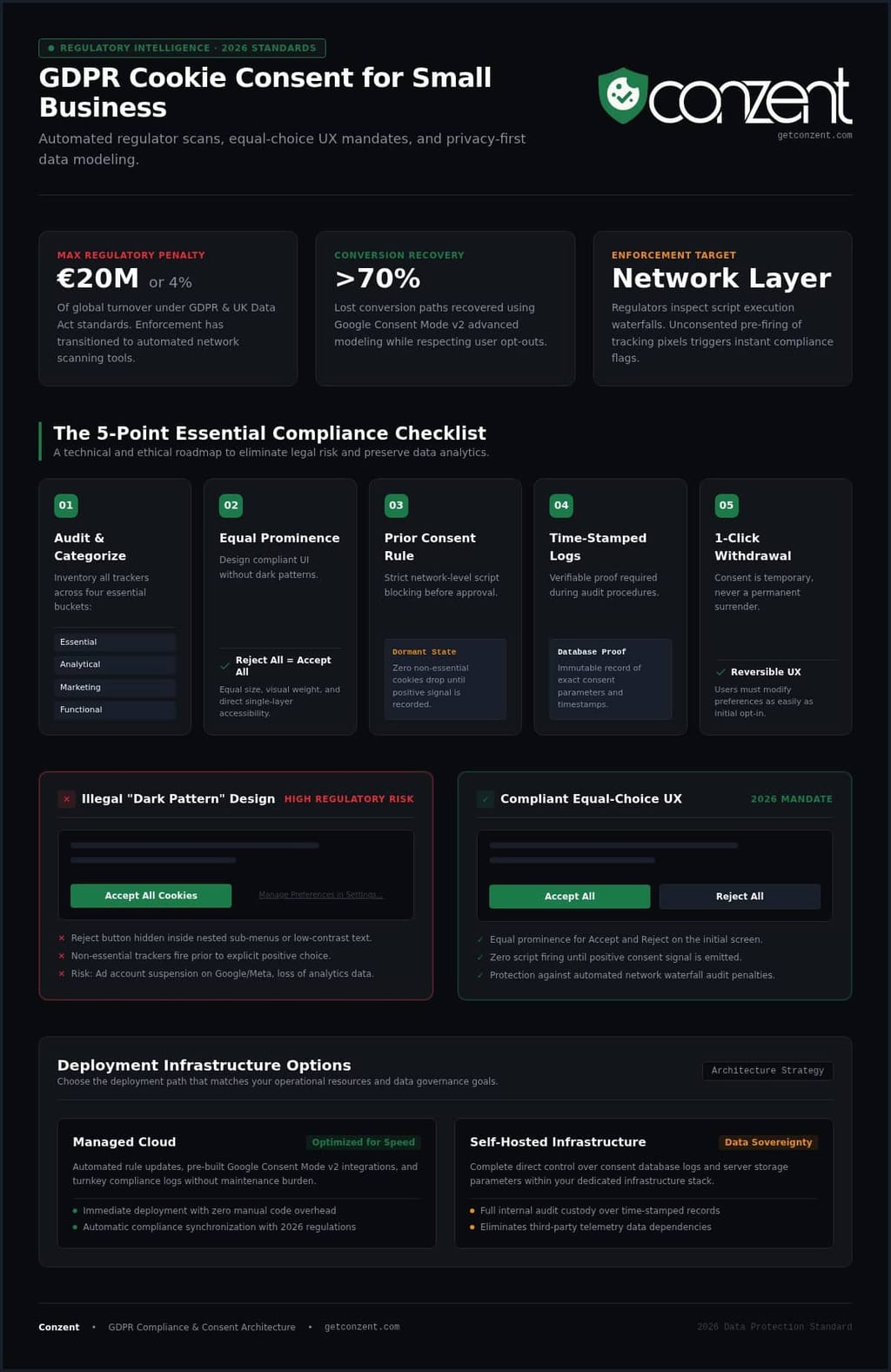
Fines are the headline, and they're massive. Under the General Data Protection Regulation (GDPR), serious infractions can cost up to €20 million or 4% of global turnover. For a small business, however, the hidden costs hurt more. An ad account suspension on Google or Meta can kill your lead flow overnight. Losing access to your historical analytics because of a "forced consent" violation is an operational disaster. You can't claim you didn't know the rules. Regulators now view "ignorance" as negligence, especially with the wide availability of compliant tools.
The 2026 Regulatory Landscape
The standards have evolved significantly since 2018. We've moved past simple "we use cookies" banners to a strict focus on user intent. Regulators are now aggressively targeting "dark patterns." These are design choices that trick users into consenting. If your "Accept" button is bright green and your "Reject" button is hidden in a sub-menu, you're non-compliant. To understand the full scope of these rules, explore our guide on GDPR Compliance.
Maintaining marketing performance in this environment requires modern tools like Google Consent Mode v2. This isn't just about blocking tags; it's about communicating consent states so you can still use privacy-preserving modeling. Without it, you lose visibility on over half your traffic. Implementing GDPR cookie consent for small business with these technical signals ensures your data-driven growth doesn't come at the expense of your users' rights.
The 5-Point Essential Cookie Consent Checklist
Compliance begins at the network level. It isn't enough to just slap a banner on your homepage. Effective GDPR cookie consent for small business requires a systematic audit of your entire digital footprint. You need to know exactly what's running under the hood before you can ask for permission to use it. This checklist provides the technical and ethical roadmap for 2026 compliance.
Step 1 & 2: Auditing and Banner Design
Your first task is a comprehensive cookie audit. Identify every script, pixel, and tracker. You must categorize these into four buckets: Essential, Analytical, Marketing, and Functional. Most owners are surprised by the number of third-party trackers they find during this phase. Once you have your list, your banner design must follow the "Equal Prominence" rule. This means your "Reject All" button must be as visually significant as "Accept All." Different colors, sizes, or hidden links are now considered illegal dark patterns. Using Conzent Cookie Banners ensures your UI meets these principled standards without manual coding.
Step 3 & 4: Technical Execution and Logging
Technical blocking is the most common point of failure. The "Prior Consent" rule dictates that no non-essential cookies may fire before the user grants permission. If your Google Analytics loads the moment the page opens, you're in breach. The ICO guidance on cookies and similar technologies is clear: trackers must stay dormant until the "Accept" signal is received. Beyond blocking, you need a verifiable, time-stamped consent log. This is your insurance policy. If a regulator audits your site, you must produce a database record of when and how consent was captured.
Step 5: Accessibility and Withdrawal
Consent is a temporary grant, not a permanent surrender. Users must be able to withdraw or change their preferences at any time. The 2026 standard requires a "one-click withdrawal" mechanism that is as easy to find as the original banner. A persistent floating icon or a clear footer link is the best way to handle this. It's about digital rights and transparency. If you respect your users' choices, you build long-term trust. To get started with a setup that handles these technical hurdles for you, view our platform options to find your best fit.
Avoiding the "Dark Pattern" Trap: Compliant UX Design
Design is never neutral. It either empowers a user or manipulates them. A dark pattern is a deceptive design choice that negates free will. For GDPR cookie consent for small business, the shift in 2026 is toward visual equity. Regulators now issue citations for "unequal button prominence," meaning the visual weight of your choices must be identical. If your "Accept All" button glows while your "Reject" button is a hidden text link, you aren't asking for consent. You're engineering it.
Transparency is your strongest currency. Clear language beats legalese every time. When you hide behind complex jargon, you signal that you have something to hide. A principled approach to UX design treats the visitor as an equal partner in the data exchange. This isn't just about avoiding fines; it's about building a brand that people actually trust with their information.
What Makes a Banner Non-Compliant?
Non-compliance often hides in the details of the interface. Regulators in 2026 are particularly focused on three areas:
- Asymmetric Click-Depth: Requiring three clicks to reject cookies while allowing acceptance in one is an illegal dark pattern. The path to "No" must be as short as the path to "Yes."
- Pre-ticked Boxes: Silence or inactivity does not constitute consent. Every non-essential toggle must start in the "off" position by default.
- Vague Purpose Statements: Phrases like "to improve your experience" are functionally useless. You must state exactly what the data is for, such as "tracking ad performance" or "personalizing marketing content."
Designing for Trust and Conversion
Many owners fear that compliance will destroy their opt-in rates. The reality is often the opposite. Minimalist design that respects the user's time can actually improve your "Accept" rates by reducing friction and building immediate credibility. You don't have to guess which layout works best. By using A/B Testing, you can iterate on button placement, color contrast, and micro-copy to find a compliant design that still supports your growth goals.
The goal is a website that functions as a public good. It should be fast, open, and honest. When you remove the deceptive traps, you create a cleaner browsing experience. This efficiency benefits your site's performance and your reputation simultaneously. Compliance should be the foundation of your design system, not an afterthought that you try to hide. High impact design doesn't need to trick the user; it just needs to be useful.
Google Consent Mode v2 and Revenue Protection
Compliance often feels like a trade-off. You either protect user privacy or you protect your marketing data. Google Consent Mode v2 (GCM v2) exists to bridge this gap. It is a technical protocol that communicates a user's choice to Google tags without harvesting personal data. For GDPR cookie consent for small business, this is the difference between data-driven growth and flying blind. It's not a luxury feature; it's an infrastructure requirement for any business using Google Ads or GA4 in 2026.
When a user rejects cookies, GCM v2 sends cookieless pings to Google. These pings contain no personally identifiable information (PII). They simply tell the server that an event happened. This allows Google to use privacy-preserving conversion modeling to fill the gaps. Without these signals, your ad platform loses the ability to attribute sales to specific clicks. Your bidding algorithms starve. Your return on ad spend (ROAS) plummets because the system can't see what's working.
Maintaining Ad Performance
Modern advertising relies on high-quality signals. If you block tags entirely without GCM v2, you lose over 40% of your visitor data on average. This data loss breaks your automated bidding strategies. GCM v2 preserves the signal quality needed for these algorithms to function. It ensures your budget isn't wasted on underperforming keywords. To understand the technical requirements for this setup, explore our guide on GCM v2 Compliance. Proper integration is a necessary standard for technical efficiency.
Measuring Revenue Impact
You cannot manage what you do not measure. Using Revenue Impact Analytics allows you to see the tangible cost of consent choices on your bottom line. You can identify which specific pages or banner designs cause the highest bounce rates. This transparency helps you optimize for both rights and revenue. GCM v2 allows for legal data modeling when users opt out of tracking. Google's internal benchmarking indicates that this modeling can recover more than 70% of ad-click-to-conversion paths that would otherwise be lost. Stop guessing about your marketing performance and start using a compliant, data-first infrastructure.
Secure your measurement and your compliance in one step. Select your Managed Cloud or Self-Hosted plan today.
Choosing Your Path: Managed Cloud vs. Self-Hosted Infrastructure
By 2026, the market for GDPR cookie consent for small business has bifurcated. You are no longer forced into a single, restrictive subscription model. You have a choice between convenience and control. This decision depends on your internal resources and your philosophy on data ownership. It's a choice between compliance as a service or compliance as infrastructure. We provide both because we believe digital rights should be attainable for every organization, regardless of their size or technical budget.
This isn't about premium luxury. It's about technical fit. Some businesses need the speed of the cloud; others need the sovereignty of their own hardware. Both paths lead to the same goal: a website that respects its users while protecting its revenue. We've built our platform to be a public good. This ensures that small entities have access to the same defensive tools as global corporations without the burden of enterprise-level complexity.
Managed Cloud: Compliance on Autopilot
The Managed Cloud Consent Platform is our "set-it-and-forget-it" solution. It's built for busy owners who don't have a dedicated IT or DevOps team. We handle the heavy lifting. This includes automated cookie scanning, infrastructure maintenance, and cloud-based analytics. You don't have to worry about server uptime or manual script updates. Everything is synchronized in real-time to meet 2026 standards. It is the fastest route to a compliant site. You can check our pricing for managed options that scale with your traffic and subpage count.
Self-Hosted OCI: Total Data Ownership
For those seeking transparency and zero vendor lock-in, there is the Open Consent Infrastructure (OCI). This is our self-hosted approach. It's free to host on your own servers. This means you don't rely on third-party data handlers. You own the infrastructure. You own the logs. You own the performance metrics. This path is ideal for developers and privacy-first SaaS startups who want absolute control over their network waterfall. It eliminates recurring software costs while maximizing data sovereignty. It's a bold choice for those who view privacy as a core technical advantage rather than a checkbox.
Our mission is to democratize these tools. We don't hide behind complexity or corporate coldness. We provide open standards because we believe a transparent web is a better web. Whether you choose our cloud or our code, you are adopting a principled standard of digital respect. We invite you to scrutinize our methods and join a community focused on ethical responsibility and technical efficiency. Compliance should be open, honest, and accessible to everyone.
Future-Proof Your Digital Foundation
Digital respect is the new baseline for growth. By 2026, the technical requirements for GDPR cookie consent for small business have become rigorous, but they aren't impossible. You now have the checklist to audit your trackers, eliminate deceptive dark patterns, and implement Google Consent Mode v2 to protect your revenue. Compliance is no longer a hidden burden. It is a visible commitment to your users' rights and your own operational integrity.
We exist to make these standards attainable for everyone. Our platform is IAB TCF v2.3 and Google Consent Mode v2 Certified, ensuring you stay ahead of regulatory shifts without manual engineering. Whether you choose our Managed Cloud for speed or our source-available, self-hosted infrastructure for total transparency, you are choosing a principled approach to data. You don't have to sacrifice your marketing performance to meet legal standards. You just need the right foundation.
Take the final step toward a more ethical and efficient website. Start Your Compliance Journey with Conzent and gain the peace of mind that comes with a future-proof setup. Your users deserve clarity, and your business deserves to grow without risk. It's time to build a web that works for everyone.
Frequently Asked Questions
Does a small business really need a cookie banner?
Yes, any small business targeting visitors in the EU or UK must have a banner if they use non-essential trackers. The law applies regardless of your company's turnover or employee count. Automated scanning tools in 2026 make it easy for regulators to identify non-compliant sites. Skipping a banner is a gamble with your brand's reputation and financial stability. It's a necessary standard of digital respect and a baseline for doing business online.
What is the penalty for not having a GDPR compliant cookie banner?
Penalties are severe and scale with your global turnover. Under Article 83 of the GDPR, serious infractions carry fines up to €20 million or 4% of annual worldwide turnover. In the UK, the Data (Use and Access) Act 2025 aligned penalties with these standards as of February 2026. Beyond the headline fines, you risk losing your Google Ads account or access to your marketing data. Compliance is your insurance against these operational disasters.
Can I just use a free WordPress plugin for GDPR?
You can, but most free plugins fail the technical standards of 2026. Many basic tools don't support Google Consent Mode v2 or maintain a verifiable consent log. They often look like a banner but don't actually block cookies from firing before the user clicks "Accept." For reliable GDPR cookie consent for small business, you need a solution that handles the network layer, not just the visual interface. Don't let a free tool compromise your security.
How do I make my cookie banner compliant with Google Consent Mode v2?
Compliance requires your banner to communicate four specific signals to Google tags: ad_storage, analytics_storage, ad_user_data, and ad_personalization. You must ensure these signals are sent based on the user's explicit choice. Using a certified platform simplifies this by automating the API communication. This technical bridge allows you to recover conversion data through modeling without violating user privacy or harvesting personal identifiers. It's a bridge between your measurement needs and your users' right to privacy.
What is the difference between essential and non-essential cookies?
Essential cookies are strictly necessary for the website to function. This includes security features, load balancing, and remembering items in a shopping cart. You don't need prior consent for these. Non-essential cookies include trackers for marketing, behavioral analytics, and social media pixels. These require an explicit opt-in before they can load. Distinguishing between the two is the foundation of a transparent privacy policy. It shows you know exactly what is running on your own infrastructure.
Do I need a cookie banner if I only use Google Analytics?
Yes, Google Analytics uses cookies that track user behavior across sessions. While the UK Data Act 2025 introduced some exemptions for first-party analytics, the EU GDPR remains strict. If you have even one visitor from the EEA, you must obtain prior opt-in consent. Implementing GDPR cookie consent for small business ensures you stay compliant across all jurisdictions while still collecting the data you need for growth. It's about being a responsible digital citizen and respecting visitor choices.
How often should I audit my website for new cookies?
You should conduct a thorough audit at least once a month. Marketing teams frequently add new tracking pixels, social widgets, or third-party integrations that drop cookies without your knowledge. A regular scan ensures your banner categorization stays accurate and your consent logs remain truthful. In 2026, regulators expect you to have an updated inventory of every tracker running on your site. It's a matter of technical hygiene and maintaining a truthful relationship with your visitors.
What should I do if a user asks to see their consent history?
You must provide a clear, time-stamped record of their consent choice. Under the GDPR right of access, users can request proof of how their data is processed. Your consent management platform should store these logs in a verifiable database. If you use our self-hosted or managed solution, you can export this data quickly to satisfy the request. Transparency is not just a legal duty. It is an opportunity to prove your commitment to digital rights and technical efficiency.