
Demonstrating Cookie Consent Compliance: The 2026 Audit-Ready Guide

If a regulator knocked on your door today, could you prove that every marketing tag on your site respected every user's choice? Most businesses can't. They rely on black box vendors where data is hidden and control is an illusion. The era of the check-the-box banner is over. Demonstrating cookie consent compliance in 2026 requires more than a pretty interface. It demands a technical audit trail that stands up to scrutiny.
We know the struggle of managing shifting CCPA mandates and GPC signals while trying to keep your marketing engine running. It's a complex landscape where the fear of heavy fines is real. This article will teach you how to build a verifiable, regulator-proof audit trail that protects both your users and your revenue. We'll provide a clear checklist for 2026 audit readiness and explain the critical difference between a simple banner and a functional proof trail. You'll walk away with a strategy that balances ethical privacy with technical efficiency, ensuring your infrastructure remains as transparent as your mission.
Key Takeaways
- Shift your perspective from seeing compliance as a static banner to treating it as an active technical state you must prove at any moment.
- Build an immutable audit trail for demonstrating cookie consent compliance that includes critical metadata like masked IPs, user agents, and timestamps.
- Avoid the "black box" risk by choosing transparent infrastructure that gives you full ownership and visibility of your consent records.
- Ensure your technical setup fully supports IAB TCF 2.3 and Google Consent Mode v2 to protect both your legal standing and your ad revenue.
- Follow a systematic five-step process to audit every tracker on your site and eliminate hidden data leaks before an inspector finds them.
Beyond the Banner: What Demonstrating Compliance Means in 2026
A cookie banner is not a compliance strategy. It's a user interface choice. In 2026, regulators don't just look at what your users see; they look at what your servers do. Demonstrating cookie consent compliance has evolved from a "set and forget" task into an active, ongoing infrastructure requirement. If you can't prove that your tracking pixels remained dormant until a specific user clicked "Accept," you don't have consent. You have a liability.
The burden of proof lies entirely with you. Under the GDPR, the data controller is responsible for showing that valid consent was obtained. This isn't a suggestion; it's a legal mandate. This principle was established early by the ePrivacy Directive (the 'Cookie Law'), but today's enforcement is far more technical. A simple database entry that says "User 123 accepted" won't satisfy a Data Protection Authority (DPA). They want to see the version of the banner the user saw, the specific language used, and the timestamped proof of the interaction.
The Legal Pillars of Verifiable Consent
To stay audit-ready, your records must reflect three core pillars. First, unambiguous action. You must prove the user took a clear, affirmative step. Pre-ticked boxes or "scrolling equals consent" are relics of the past. Second, informed choice. Your logs should show exactly what information was presented to the user at the moment they decided. Third, easy withdrawal. Regulators now check if opting out is as simple as opting in. If your "Reject All" button is buried three clicks deep, your audit trail will only document your non-compliance. You can find more details on these specific requirements in our GDPR compliance guide.
Front-End UI vs. Back-End Proof
There is a dangerous gap between a "compliant-looking" banner and a compliant data pipeline. In 2026, DPAs use automated "secret shoppers" to crawl websites. These bots don't just look for a banner. They monitor network requests to see if tracking scripts fire before consent is given. A pretty UI is worthless if your back-end ignores the user's choice. Real compliance happens in the audit log, an immutable record of every consent event. When demonstrating cookie consent compliance to an auditor, your technical infrastructure is your primary witness. It's the difference between a guess and a guarantee.
The Anatomy of a Verifiable Consent Audit Log
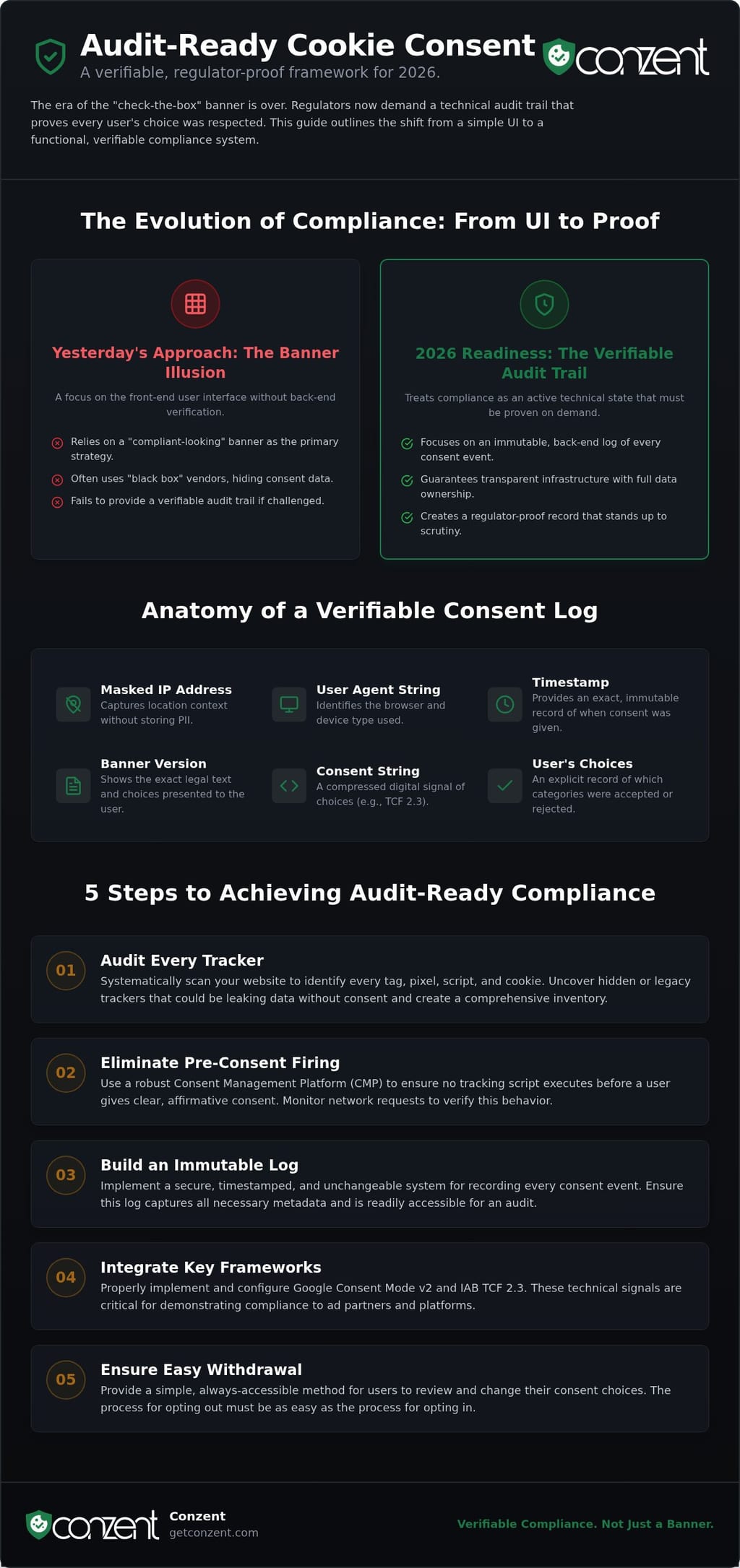
We believe that privacy is a right, not a feature. A verifiable consent audit log is the technical manifestation of that belief. It's a timestamped, immutable record that captures exactly when, where, and how a user interacted with your privacy settings. This isn't just a background process; it's the core of demonstrating cookie consent compliance. Without this granular evidence, your defense against a DPA inquiry will fail. To be truly audit-ready, your logs must be accessible but strictly privacy-preserving. This means storing zero Personally Identifiable Information (PII) within the log itself. We recommend IP masking as a standard practice to keep your records useful but anonymized.
The EDPB Guidelines on consent emphasize that the controller must be able to prove consent was validly obtained. Your technical evidence should include specific metadata: masked IP addresses, user agent strings, the exact timestamp, and the version of the consent banner shown. This data creates a unique fingerprint of the event without exposing the user's identity. Modern ad tech also relies on the "Consent String" to pass these choices across the ecosystem. It's a compressed digital signal that tells every vendor on your site exactly what they're allowed to do. If you're looking for a solution that prioritizes this level of transparency, explore our transparent pricing options for managed and self-hosted infrastructure.
Google Consent Mode v2 as a Proof Point
GCM v2 acts as a bridge between user choice and data collection. It communicates consent states to Google tags through signals like "ad_user_data" and "ad_personalization". This allows you to respect privacy while maintaining measurement accuracy. For a deep dive on the technical setup, read our Google Consent Mode v2 guide. It's an essential component for any business operating in the EEA or UK that wants to maintain revenue without compromising on ethics.
IAB TCF 2.3 and the Transparency Framework
The Transparency and Consent Framework (TCF) is the industry standard for signaling intent to advertising vendors. By using TCF 2.3, you ensure that user preferences are respected throughout the advertising supply chain. Your audit log should document that you only share data with verified vendors listed on the Global Vendor List (GVL). Versioning is key here. You need to prove which GVL version was active during the consent event. This level of detail is what makes a consent trail truly verifiable and regulator-proof. It turns demonstrating cookie consent compliance from a burden into a clear technical advantage.
Infrastructure Matters: Cloud vs. Self-Hosted Compliance Chains
Infrastructure is the silent witness in your compliance strategy. While the front-end banner captures the user's attention, the back-end architecture carries the weight of demonstrating cookie consent compliance. Many organizations fall into the "Black Box" trap. They hand over their legal records to a third-party vendor and hope for the best. If that vendor suffers a breach or an outage, your audit trail vanishes. This creates a dangerous dependency. True compliance isn't just about having data; it's about owning it.
Data Sovereignty and the GDPR
Where you store your logs matters. Under the GDPR, cross-border data transfers add a layer of legal complexity. If your CMP stores consent records in a jurisdiction without an adequacy decision, you're at risk. By using Self-Hosted Open Consent Infrastructure, you keep everything on your own servers. This ensures total data sovereignty. It provides the ultimate proof trail because you control the infrastructure from start to finish. Even the U.S. legal definition of a cookie emphasizes the storage of information on a user's device, which mirrors why your server-side logs must be beyond reproach. Proving compliance by keeping logs on your own hardware eliminates the risk of third-party failure.
Managed Cloud: Simplifying the Evidence Chain
Not every team has the resources for self-hosting. For those who need speed without sacrificing transparency, our Managed Cloud Consent Platform offers a streamlined alternative. It automates the versioning of your privacy policies and centralizes reporting. This reduces DevOps overhead while maintaining "Audit-Ready" status. You get the benefit of a professional dashboard for global reporting without the "Black Box" mystery. Managed platforms bridge the gap between technical efficiency and legal duty, ensuring that demonstrating cookie consent compliance remains simple regardless of your resource level.
We believe "Source-Available" infrastructure is the only ethical choice for privacy tech. It invites scrutiny. It allows you to see exactly how your data is handled. This transparency is a necessary standard for the 2026 landscape. Whether you choose cloud or self-hosted, your infrastructure should be an open book, not a secret.
5 Steps to Achieving Audit-Ready Compliance
Compliance isn't a one-time event. It's a constant posture. To move from a "compliant-looking" site to one that actually survives a DPA inspection, you need a systematic approach. The 2026 regulatory landscape is unforgiving. With the inflation-adjusted CCPA threshold reaching $26.625 million and fines like the €150 million penalty against SHEIN in late 2025, the stakes are higher than ever. Here is how you build a defense that holds up under pressure.
- Audit your current cookie landscape: Identify every tracker. A 2025 study found that 83% of US sites set tracking cookies before receiving user consent. You can't be audit-ready if you don't know what scripts are firing.
- Implement a certified CMP: Use a platform that natively supports IAB TCF 2.3 and Google Consent Mode v2. These are the technical languages of modern compliance. They ensure your choices are communicated correctly across the entire ad tech ecosystem.
- Configure immutable logging: Set up a system that records every consent event. Ensure these logs are timestamped and tamper-proof. Proving your intent is half the battle when demonstrating cookie consent compliance to an auditor.
- Run A/B tests for transparency: Use testing to ensure your users actually understand their choices. Regulators now look for evidence that you've prioritized user comprehension over simple "Accept" rates.
- Monitor revenue impact: Use analytics to track how consent choices affect your bottom line. Trust is a currency. Compliance should support your growth by building a loyal, privacy-conscious audience.
The Role of A/B Testing in Compliance
Regulators are now technically proficient at spotting "Dark Patterns." These are deceptive interfaces designed to nudge or trick users into giving consent. By using Consent A/B Testing, you can prove your UX is honest. Document your design iterations as part of your Privacy Impact Assessment. This shows you've optimized for clarity rather than just trying to bypass user intent. It's a critical step in demonstrating cookie consent compliance through ethical design.
Revenue Impact: The CFO’s Compliance Metric
We often hear that privacy kills revenue. The data says otherwise. In 2026, the average EU marketing cookie opt-in rate is 46%. Businesses that build trust through transparency often see higher engagement from those who do opt-in. You can use our guide on the revenue impact of cookie consent to see how privacy-first growth works. To start building a compliant infrastructure that respects both your users and your budget, view our pricing models today and choose the path that fits your mission.
Conzent: Verifiable Compliance Without the Complexity
We don't just build banners. We build infrastructure. Conzent is an Open Consent Infrastructure (OCI) designed to meet the technical demands of 2026. Traditional consent management platforms often act as "black boxes." They store your data on their servers and hide their logic behind proprietary code. This makes demonstrating cookie consent compliance difficult during an audit. You're forced to trust a vendor's word because you can't see the gears turning. We believe in evidence over trust. Our source-available model invites regulatory scrutiny rather than hiding from it. It's an approach rooted in moral clarity and technical efficiency. We prioritize transparency because it's the only way to ensure your audit trail is truly immutable and verifiable.
Open Source vs. Managed Cloud
You shouldn't have to choose between security and scale. If you require total data sovereignty, our Self-Hosted Open Consent Infrastructure allows you to keep every log on your own hardware. This gives you the ultimate proof trail for regulators. For teams that want high-performance compliance without the DevOps headache, our Managed Cloud Consent Platform offers immediate implementation with global scale. This isn't a premium luxury; it's a necessary standard. We use a unique sponsorship model to lower the cost of ethical privacy. This makes verifiable compliance accessible to all users, regardless of their resources. We're a community advocate for digital rights, not just another distant vendor hiding behind complex legal jargon.
Getting Started with Verifiable Proof
Efficiency matters. You can deploy the Conzent banner in under 10 minutes on WordPress, Shopify, or custom tech stacks. This speed doesn't come at the expense of depth. Once live, you gain access to a centralized compliance dashboard. This isn't just a reporting tool. It's your real-time audit log. You can see every consent event as it happens, creating the verifiable trail regulators now demand. It's the simplest way to move from a "compliant-looking" site to one that is actually audit-ready. You can finally stop worrying about CMP "black boxes" where data is stored by a third party. Don't let your privacy strategy be a liability. Experience the future of consent infrastructure and start demonstrating cookie consent compliance with absolute confidence today.
Future-Proof Your Infrastructure for an Era of Enforcement
The era of "check-the-box" privacy is over. Regulators in 2026 demand technical evidence, not just visual cues. You've learned that true audit readiness requires moving beyond the front-end banner to a robust, back-end infrastructure. Whether you choose the flexibility of self-hosting or the speed of a managed platform, your compliance chain must be immutable and transparent. There is no room for ambiguity when your reputation and revenue are on the line.
The burden of proof rests on your shoulders. Demonstrating cookie consent compliance is only possible when you replace "black box" vendor promises with a verifiable audit trail. By integrating certified standards like IAB TCF 2.3 and Google Consent Mode v2, you protect your revenue while honoring user rights. Our Danish-engineered privacy standards ensure that your technical output matches your ethical mission. It's time to stop guessing and start proving.
Start Building Your Verifiable Compliance Trail with Conzent today. Our transparent, source-available infrastructure provides the clarity you need to survive any audit. You have the tools to build a more ethical web. We're here to help you deploy them.
Frequently Asked Questions
How do I prove a user gave consent if I mask their IP address?
You use a combination of non-PII metadata like timestamps, browser user agents, and a unique, anonymous consent ID. Masking the IP address is actually a best practice because it protects user privacy while still allowing you to link a specific consent event to a session. This creates a verifiable audit trail without storing sensitive personal data that could become a liability in a breach or a regulatory check.
Is a database record of consent enough for a GDPR audit?
No, a simple database row isn't sufficient for demonstrating cookie consent compliance. Regulators want to see the "how" and the "what." You must be able to reproduce the exact version of the banner, the specific text shown, and the UI layout at the moment of consent. An immutable log containing versioned metadata proves that the consent was informed and unambiguous, rather than just a silent flag in a table.
What is the difference between Google Consent Mode v2 and a cookie banner?
The banner is the user interface; Google Consent Mode v2 is the communication layer. While the banner collects the user's choice, GCM v2 translates that choice into technical signals like "ad_user_data" for Google's tags. It ensures that your tracking behavior automatically adjusts based on the user's decision. Using both allows you to maintain measurement accuracy in the EEA and UK while respecting strict privacy boundaries and mandates.
Can I demonstrate compliance while still using A/B testing on my banner?
Yes, provided your A/B tests focus on clarity rather than deception. Regulators allow testing to improve user understanding, but they ban "dark patterns" that nudge users toward "Accept." To stay compliant, you should document your testing process in a Privacy Impact Assessment. This shows you're actively optimizing for informed consent, which is a core part of demonstrating cookie consent compliance through ethical, transparent design choices.
How long should I store cookie consent audit logs?
You should store logs for as long as the data collected under that consent is being processed, plus the duration of local statutes of limitations for privacy claims. In many EU jurisdictions, this means keeping records for three to six years. You must ensure these logs don't contain PII. Storing masked, anonymized records protects your legal interests without creating new data storage risks that could complicate your infrastructure or security posture.
Does self-hosting my CMP make it easier to demonstrate compliance?
It provides total data sovereignty, which is the ultimate proof of compliance. When you self-host your infrastructure, you own the entire evidence chain. You don't have to rely on a third-party vendor to provide logs during a surprise audit. This eliminates the "black box" problem and ensures that your consent records are stored on your own secure servers, directly under your control and subject to your own scrutiny.
What happens if I cannot provide proof of consent during a regulatory check?
Failure to provide proof is treated as a lack of consent, which can lead to significant fines. Under GDPR, the burden of proof is on you, the data controller. If you can't produce a verifiable audit trail, regulators assume every cookie placed was illegal. This can result in penalties up to €20 million or 4% of global turnover, as seen in recent high-profile enforcement actions against major tech firms.
How does IAB TCF 2.3 help in demonstrating compliance to advertisers?
TCF 2.3 creates a standardized digital signal that tells advertisers exactly what the user allowed. It proves you're only sharing data with verified vendors on the Global Vendor List. By logging these TCF strings, you provide a technical guarantee to your ad partners that your traffic is compliant. This protects your ad revenue while ensuring every participant in the supply chain respects the user's choice through an open, transparent framework.