
GDPR Consent Language Requirements: The 2026 Compliance Guide

GDPR compliance isn't a translation task; it's a semantic integrity challenge where the choice of a single verb can invalidate your entire consent database. You've likely felt the friction of managing dozens of languages while trying to meet strict GDPR consent language requirements without spiking your bounce rates. It's a difficult balance to strike when vague "unambiguous" copy creates legal risk and corporate coldness alienates your users. Most teams treat their banners as a nuisance, but we see them as a fundamental standard for technical efficiency and digital rights.
You deserve a framework that turns compliance into a clear, attainable standard for user trust. This guide will help you master the exact linguistic and structural demands needed to protect your revenue in 2026. We'll move past the generic summaries to examine the practical application of the EDPB's latest 1/2026 guidelines on dynamic consent. You'll gain a clear framework for writing copy that remains legally valid across every language you support. We're moving from legal ambiguity to a precise, ethical infrastructure for your data.
Key Takeaways
- Identify the specific linguistic thresholds that turn vague "unambiguous" requests into legally binding consent.
- Navigate the risks of machine translation to ensure your GDPR consent language requirements maintain semantic integrity across every region you serve.
- Align your UI design with your copy to meet the "clearly distinguishable" standard and eliminate illegal dark patterns like pre-ticked boxes.
- Use our 2026 audit checklist to confirm that your data controllers and processing purposes are described in plain, non-legalese English.
- Streamline your compliance workflow by using managed infrastructure that isolates legal language from your technical deployment.
The Four Pillars of Compliant GDPR Consent Language
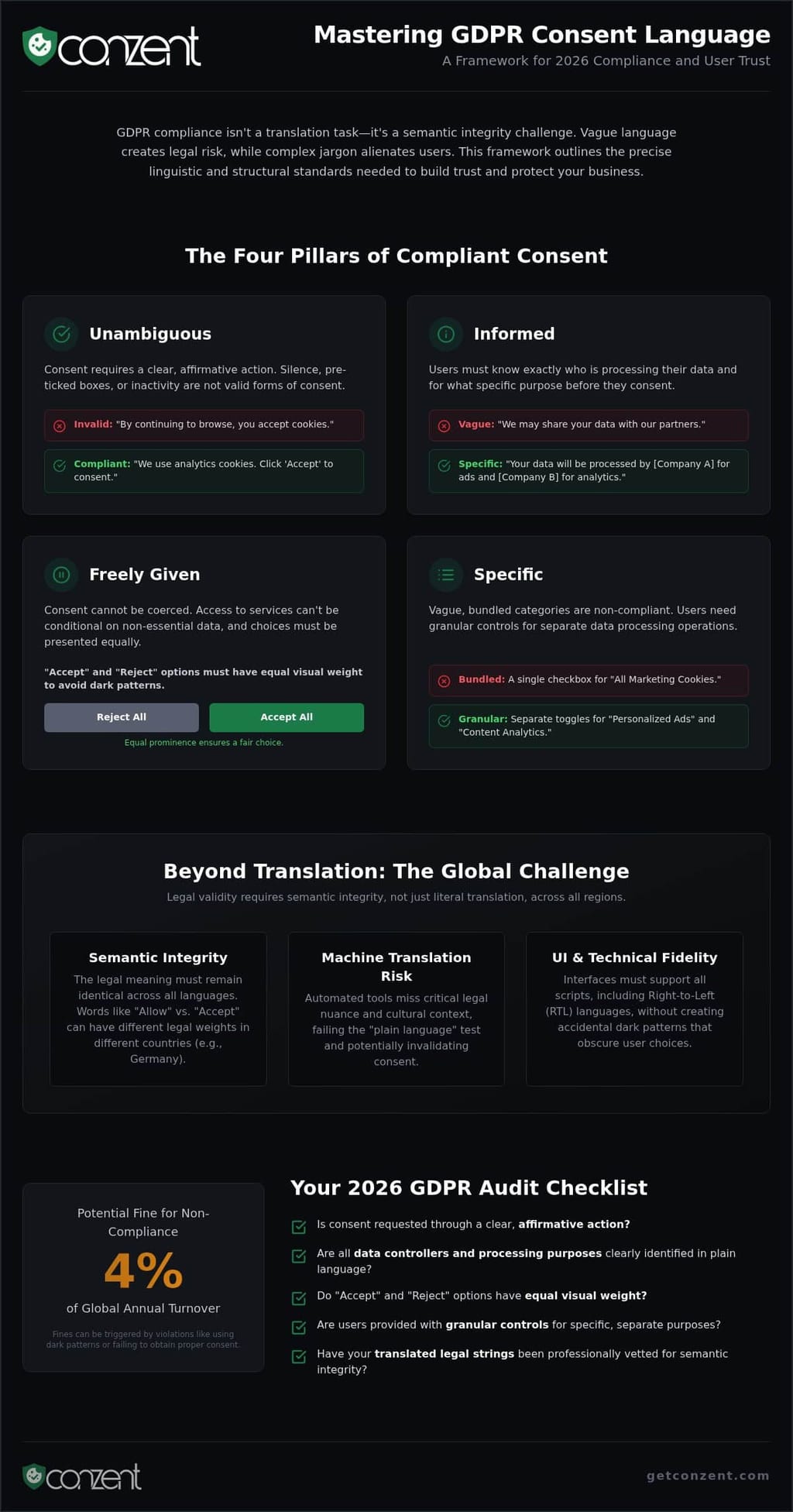
Compliance is not a checkbox. It's a commitment to transparency. Article 7 of the GDPR defines the effectiveness of consent through specific linguistic thresholds that many businesses still fail to reach. Valid GDPR consent language requirements demand more than a simple "I agree" button. They require an affirmative action that is freely given, specific, informed, and unambiguous. This isn't just about avoiding penalties; it's about building an ethical infrastructure for your users.
Unambiguous does not mean simple; it means clear. In 2026, the era of implied consent is over. Consider the contrast: "By continuing to browse, you accept cookies" is no longer a legal defense. It's a liability. Regulators now view silence or inactivity as a lack of consent. You must describe the affirmative action in plain language that leaves no room for doubt. If the user doesn't explicitly choose to opt in, your data processing remains unauthorized. Informed consent also necessitates naming every data controller. Vague references to "our partners" don't meet the standard. You must be specific about who is processing the data and for what exact purpose.
Defining "Freely Given" in Your Copy
Consent isn't free if it's coerced. Avoid "coupling" language that makes access to your service conditional on the user providing non-essential data. You must define the specific choice the user is making without forcing their hand. A compliant banner provides a neutral environment for decision-making. "Accept all" and "Reject all" options must have equal visual and linguistic weight. If your "Reject" option is buried in a sub-menu or styled to be less prominent, you're using a dark pattern. This design choice alone can trigger fines of up to 4% of global annual turnover, as seen in recent enforcement actions against major tech platforms.
The Specificity Requirement: Purpose-Driven Language
Grouping all cookies under a vague "marketing" label is a legal failure. The European Data Protection Board (EDPB) 2026 guidelines emphasize the need for granular control. Your language must allow for separate consent for separate processing operations. Instead of abstract categories, use purpose-driven phrasing. For example, you can describe "cross-contextual behavioral advertising" as "tracking your activity on other websites to show you personalized ads." This level of clarity respects the user's digital rights and ensures your GDPR compliance remains robust. Using a self-hosted consent infrastructure can help your team maintain total control over these critical language strings.
Multi-Language Consent: Beyond Simple Translation
Meeting GDPR consent language requirements isn't as simple as running your English banner through a translator. That's a shortcut to a regulatory audit. Legal validity depends on semantic identity. If your Danish translation softens the intent of your primary English string, your consent is no longer "informed." We believe transparency should be a global standard, not a regional privilege. Every user deserves the same level of clarity, regardless of their native tongue.
Google Translate isn't a legal partner. Automated tools often miss the nuance of local data protection laws and cultural expectations. Regulators expect "plain language" that a layperson in that specific culture can understand. If a translation is clunky or uses incorrect legal terminology in the target language, it fails the test of being easily accessible. This is why you must maintain a centralized "Source of Truth" for all consent strings across 20+ locales. Ad-hoc translations lead to fragmented compliance and increased legal risk.
Semantic Integrity in Legal Translations
Words like "Allow" or "Accept" carry different weights across Europe. In German, legal phrasing often requires a specific level of formality to be considered "plain" and legally binding. Using native-speaking legal experts to vet core banner strings is a necessity. They ensure the meaning remains identical even when the syntax changes. Technical accessibility also plays a role. Consent UI must handle Right-to-Left (RTL) languages like Arabic without breaking the layout. If the text flips but the "Reject" button becomes obscured or less prominent, you've accidentally created a dark pattern.
Scaling Global Compliance with a Managed CMP
Managing dozens of languages manually is a recipe for error and technical debt. Conzent automates the delivery of pre-vetted, multi-language consent strings so your team can focus on growth. By using Managed Cloud Consent Platforms, you ensure that an update to your privacy policy propagates correctly across every localized version of your banner. This infrastructure allows you to handle regional variations, such as mixing GDPR and CCPA/CPRA requirements, within a single, coherent interface. To see how we can streamline your global deployment, you can view our transparent pricing and choose the plan that fits your scale.
UI/UX Requirements: How Language Meets Design
Design isn't just aesthetics; it's a legal requirement. The way you present your text is as vital as the text itself. Under GDPR consent language requirements, your copy must be "clearly distinguishable" from other terms and conditions. It can't be buried in a footer or hidden behind a wall of legalese. If a user can't read it, they haven't consented to it. Clarity is a mission, not a luxury.
Language alone cannot carry the burden of consent. Even the most perfect sentence is invalidated by a pre-checked box. Consent is a proactive choice, not a passive assumption. This means your UI must default to "off" for all non-essential processing. Readability standards also apply to your technical choices. Font size, color contrast, and text placement are all compliance factors. Light grey text on a white background is a liability. Your legal text must be legible on all devices to ensure every user has the resources to make an informed choice.
Button labels are the final point of friction. Avoid ambiguous labels like "Okay" or "Got it." These terms don't confirm what the user is agreeing to. Use "I agree" or "Accept all" to confirm a specific choice. Consent is an action, not an accident. When your language matches your design intent, you reduce legal risk and build genuine trust with your community.
The "Clear Affirmative Action" Threshold
Your language must describe the specific action being taken. "I consent to data processing" is a choice. "Settings saved" is a status update; it doesn't prove intent. Closing a banner with an "X" is neither acceptance nor rejection. It's a design failure that leaves your data collection in a legal grey area. You must also ensure the "Right to Withdraw" is linguistically accessible. The text to opt-out should be just as easy to find and understand as the initial opt-in. If withdrawing consent is harder than giving it, your banner is non-compliant.
Linguistic Transparency in the Second Layer
The second layer is where the technical details live. Your "Show Details" or "Preferences" link shouldn't be a trap. It must clearly communicate that more granular choices are available. When listing vendors through IAB TCF, don't overwhelm the user with jargon. Use plain language to describe what these vendors actually do with personal data. You can integrate Revenue Impact Analytics to test how different phrasing in this second layer affects your opt-in rates. This allows you to optimize for performance while maintaining the highest standards of transparency and GDPR consent language requirements.
The 2026 GDPR Consent Language Audit Checklist
A compliant banner is more than a legal shield; it's a transparency tool. Auditing your GDPR consent language requirements ensures that your technical infrastructure aligns with ethical standards. This checklist moves beyond theory into practical application. It's time to scrutinize your strings. If your language is vague, your consent is invalid.
- Identity check: Is the data controller clearly named in the first layer? Users must know exactly who is asking for their data without clicking through three menus.
- Purpose check: Are all processing purposes listed in plain, non-legalese English? Avoid jargon that obscures intent. Clarity is the goal.
- Withdrawal check: Is the right to revoke consent mentioned explicitly? Withdrawal must be as simple and accessible as the initial opt-in.
- Data types check: Does the user know exactly what is being collected? List specific identifiers like IP addresses, unique device IDs, or email hashes.
Step 1: Scrutinizing the First Layer
The first layer is your front line. Eliminate the phrase "we use cookies to improve your experience." It's too vague. It doesn't inform; it deflects. Instead, state clearly what the data actually does. Ensure the "Reject" option has equal visual weight to the "Accept" button. If your design pushes users toward a specific choice through color or size, you've failed the neutrality test. Finally, verify that your language doesn't imply consent is mandatory. Access to your site shouldn't be held hostage by a tracking pixel. Consent is a gift, not a toll.
Step 2: Technical Integration Verification
Linguistic compliance must reach your code. Check if your language strings match the strict requirements of Google Consent Mode v2. This isn't just about the words; it's about the technical signals they trigger. You must also verify that IAB TCF 2.3 purposes appear in the user’s detected browser language. If a user in Madrid sees English legal strings, your consent is not "informed." It's a failure of accessibility.
If you use a Self-Hosted CMP, audit it for hard-coded strings. Manual overrides often bypass your translation logic and create legal gaps that regulators will find. Every string must be dynamic and vetted for the specific locale it serves. To secure your infrastructure and ensure every localized string meets the 2026 standard, explore our managed platform options and find the right fit for your team.
Automating Compliance with Conzent’s Managed Infrastructure
Compliance is not a static goal. It is a continuous process of technical and linguistic refinement. Managing GDPR consent language requirements by hard-coding strings into your site code is a recipe for technical debt and legal exposure. Conzent simplifies this by decoupling your legal copy from your deployment. This separation of concerns allows your legal team to update language without involving a developer or risking a site outage. It's about speed. It's about accuracy.
We provide source-available transparency because we believe in ethical infrastructure. You can audit exactly how your consent is recorded and stored. There is no black box here. Our platform provides real-time updates for IAB TCF v2.3 and Google Consent Mode v2 language requirements. When the standards change, your banners update automatically. You can also use our tools to A/B test compliant language. This helps you find the precise balance between legal necessity and Revenue Optimization without compromising user rights.
Managing Multi-Language Strings in the Cloud
The Conzent dashboard serves as your central command for custom legal text. You can manage 20+ languages from a single interface. Our system uses automatic language detection to serve the correct banner based on user headers. This ensures your GDPR consent language requirements are met for every visitor instantly. We also provide full version control. You can see exactly what version of the consent text a user agreed to and when. This audit trail is essential for defending your data processing practices during a regulatory inquiry.
Getting Started with Open Consent Infrastructure
You have choices. You can choose Self-Hosting for total control over your data and language strings. If you prefer a hands-off approach, our Managed Cloud platform offers maximum ease of use and scale. Integration is seamless. We provide dedicated tools for platforms like WordPress and Drupal to get you running in minutes. Don't let technical debt slow down your compliance. Secure your infrastructure today and build a foundation of trust with your community.
Securing the Future of Digital Trust
Compliance is a baseline for any ethical business, not a premium luxury. Mastering GDPR consent language requirements means moving beyond vague phrases and embracing granular, purpose-driven clarity. You've seen how semantic identity across languages is non-negotiable for legal safety. You also know that design and language must work together to ensure every user can take a clear affirmative action without coercion.
Building a foundation of trust requires technical efficiency and moral clarity. Our platform is IAB TCF v2.3 Certified and Google Consent Mode v2 Ready to ensure your infrastructure stays ahead of shifting standards. With source-available transparency, you can audit exactly how your users' rights are protected. Don't let technical debt or legal ambiguity slow your growth. You have the tools to turn compliance into a competitive advantage for user trust.
Start your journey to ethical compliance with Conzent and build a more transparent digital future today. You're ready to lead with confidence.
Frequently Asked Questions
Does the GDPR require a cookie banner in every language?
Yes, if you target users in those regions. Article 12 mandates that information must be intelligible. This means your banner must appear in a language the user understands. If you sell to a Spanish audience, an English banner is a compliance failure. We help you automate this by detecting browser headers and serving pre-vetted strings that meet GDPR consent language requirements across 20+ locales.
What is the "plain language" requirement under GDPR Article 12?
Plain language means your copy is readable for a layperson. You must avoid complex legal jargon and dense sentence structures that obscure the truth. The goal is transparency. If a user needs a law degree to understand your banner, you've failed the test. It's about providing moral clarity so users can make an informed choice without being overwhelmed by technical or legal complexity.
Can I use "I agree" as the only button on my consent banner?
No. This is a common dark pattern that regulators are actively penalizing. You must provide a "Reject all" or "Refuse" option that has equal visual and linguistic weight to the "Accept" button. Consent isn't freely given if you make it harder to say no than to say yes. Ensuring both options are equally accessible is a fundamental standard for ethical digital rights.
How often do I need to re-verify my consent language?
You should audit your strings whenever your data processing changes or new regulatory guidance is released. For example, the EDPB draft Guidelines 1/2026 introduced new nuances for dynamic consent. Staying compliant is a continuous process. We recommend a quarterly review of your GDPR consent language requirements to ensure your copy still reflects your current vendor list and the latest legal interpretations from the European Data Protection Board.
Is it compliant to use machine translation for my privacy policy?
Using machine translation without human review is a significant legal risk. GDPR requires semantic identity between translations. If an automated tool mistranslates a legal term, your consent may be invalidated. You must ensure that your Danish or German strings carry the exact same legal weight as your primary language. Expert vetting is necessary to maintain the integrity of your consent database and avoid systemic compliance failures.
What happens if my consent language is found to be ambiguous?
Ambiguous language makes your consent legally void. If a regulator finds your copy unclear, they treat it as if you never received permission to process the data. This can lead to administrative fines of up to €20 million or 4% of your total worldwide annual turnover. You'll also likely be forced to delete the affected data and re-collect consent using compliant, clear, and specific language.
Do I need to name every third-party vendor in the first layer of consent?
You must name the data controller in the first layer, but you don't need to list every third-party vendor immediately. However, you must provide a clear link to a second layer where every vendor is identified. This keeps the initial banner concise while still being informed. Transparency is about accessibility; users shouldn't have to hunt for information about who is actually processing their personal data.
Can I make consent a requirement for downloading a whitepaper?
Generally, no. This is known as "coupling" and it violates the requirement that consent must be freely given. You cannot make access to a service or content conditional on consent for data processing that isn't strictly necessary for that service. If you want to collect marketing data, you must offer a choice that doesn't prevent the user from accessing the whitepaper if they decide to opt out.