
Open Consent Infrastructure: Beyond the Cookie Banner in 2026

Your website's cookie banner is likely a performance tax you never agreed to pay. For years, the industry has treated privacy as a decorative legal checkbox. It isn't a popup. It's a fundamental architecture. By implementing an open consent infrastructure, you stop trading away your Core Web Vitals for a simple "Accept" button. It's time to stop paying high monthly fees for third-party tools that slow down your site and keep your own data out of reach.
We understand the frustration of watching your performance metrics tank because of a compliance script. You deserve control, not just a workaround. This shift allows you to treat user permission as a core technical standard rather than a legal afterthought. It ensures you meet the strict 2026 CCPA requirements and IAB TCF v2.4 standards without sacrificing speed. We'll show you how moving consent into your own stack restores transparency, eliminates lag, and puts you back in charge of your digital assets.
Key Takeaways
- Move beyond superficial cookie banners to an open consent infrastructure that treats user privacy as a core technical standard.
- Stop sacrificing site speed for compliance. Shift from heavy, third-party scripts to efficient, server-side consent management to protect your Core Web Vitals.
- Reclaim data sovereignty. Choose between self-hosting or managed cloud options to ensure you remain in control of where your consent data lives.
- Secure your advertising revenue and maintain transparency with seamless integrations for Google Consent Mode v2 and IAB TCF v2.3.
- Transition to a machine-readable framework. This allows you to audit and enforce user permissions across your entire data stack rather than just your website's surface.
The Failure of the 'Checkbox' Model: Why Banners Aren't Enough
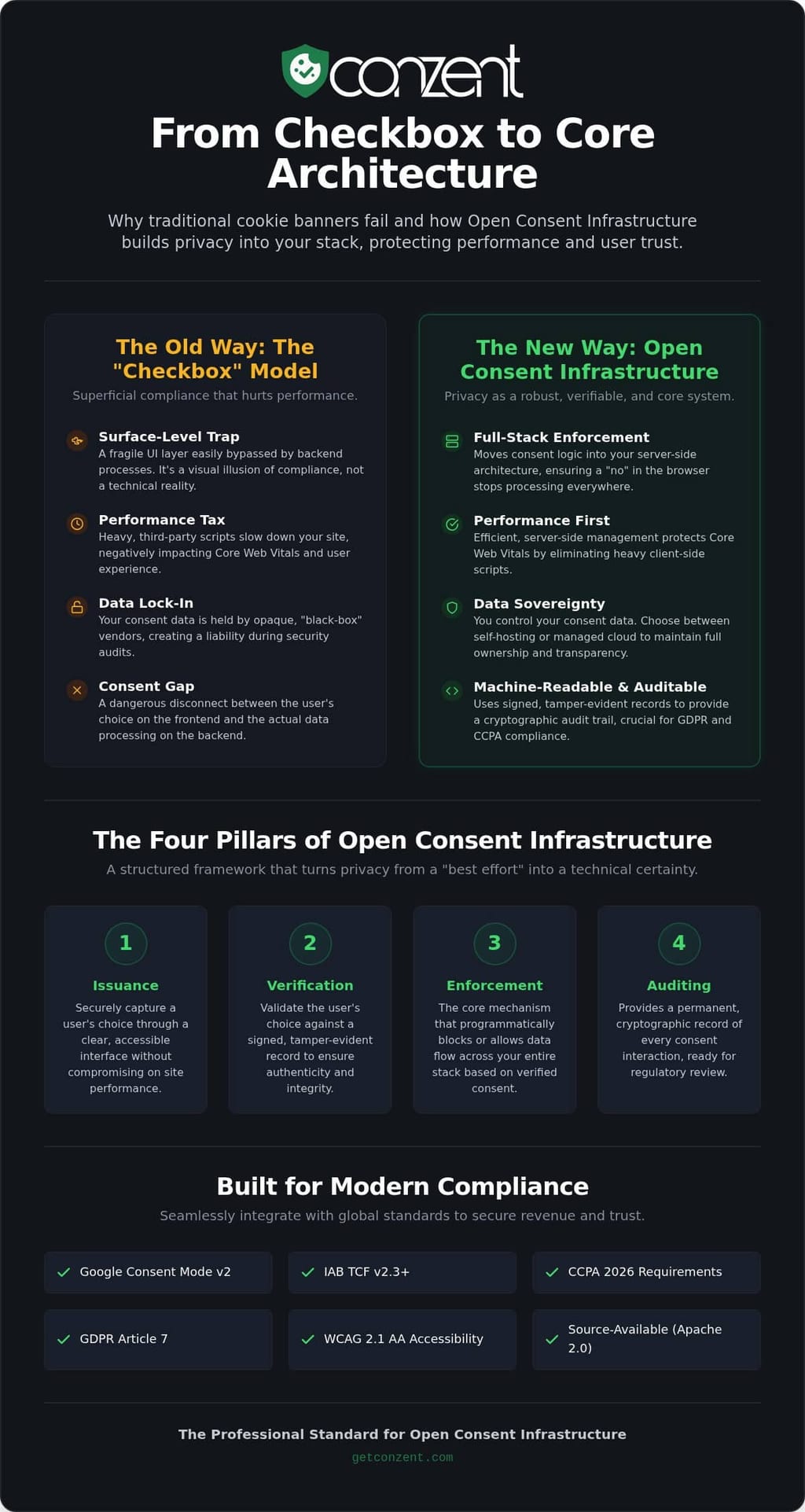
The standard cookie banner is a facade. Most traditional Consent Management Platforms (CMPs) operate as a thin UI layer. They exist to satisfy a legal checklist, not to secure data. This approach is easily bypassed. A script might fire before a user clicks "Reject," or a backend process might continue tracking regardless of the frontend choice. This is the "Surface-Level Trap." Your banner says no, but your database says nothing. It's a visual illusion of compliance that fails under technical scrutiny.
Real privacy requires more than a popup. It demands foundational principles of information privacy built directly into your technical stack. Regulators and users are tired of "dark patterns" and opaque processes. They want structural transparency. When you rely on closed-source vendors, you face data lock-in. You don't own your consent records; they do. Their pricing is often opaque, scaling with your traffic rather than the value they provide. This is why a shift toward open consent infrastructure is no longer optional.
The Decoupling of Consent and Data
Browser-side permission often fails to reach the backend. This creates a dangerous "consent gap," which is the disconnect between the user's expressed preference in the UI and the actual data processing occurring in the server-side environment. Without a robust open consent infrastructure, you risk "Zombie Cookies." These are tracking identifiers that reappear even after a user attempts to delete them. If your frontend doesn't talk to your backend in a machine-readable way, your compliance is an illusion. You aren't managing consent; you're just managing a widget.
The Transparency Crisis in Privacy Tech
Black-box vendors are a liability. During an enterprise security audit, "trust us" isn't a valid answer. Many traditional tools hide their logic behind proprietary code. This makes it impossible to verify how data is handled or stored. We're seeing a massive shift toward source-available code. It's a trust requirement for 2026. You need to know exactly what is running on your servers. Transparency isn't just a moral choice; it's a security necessity. For a deeper look at how this fits into legal frameworks, see the Conzent Compliance Overview. By treating consent as infrastructure, you ensure that every part of your stack respects the user's choice.
What is Open Consent Infrastructure (OCI)?
OCI is a machine-readable framework for issuing, verifying, and auditing consent. It isn't a visual add-on. It's a structural property of your data stack. While traditional banners live solely in the browser, open consent infrastructure lives deep within your server-side architecture. It moves the logic of permission away from fragile JavaScript popups and into a robust, verifiable system. This ensures that a "no" in the browser actually stops data processing on the server. The stability and transparency of this framework are guaranteed by the Apache 2.0 License. This open-source standard prevents vendor lock-in. It ensures the community can maintain and audit the infrastructure long-term without relying on a single, opaque entity.
The system relies on four distinct pillars to function effectively. First is Issuance, the process of capturing the user's choice through a clear interface. Second is Verification, where the system validates that choice against a signed record. Third is Enforcement, which is the actual mechanism that blocks or allows data flow based on the verified status. Finally, Auditing provides a permanent, tamper-evident record of the interaction. This structure turns privacy from a "best effort" into a technical certainty. You can inspect the core logic and contribute to the standard in the Conzent Open Consent Infrastructure (OCI) repository.
Machine-Readability and the Audit Trail
A simple "true" or "false" flag in a database isn't enough for modern compliance. OCI uses signed consent records. These are tamper-evident logs that prove exactly what a user agreed to and when. This is critical for GDPR Article 7 compliance. If a regulator asks for proof, you don't just show them a database entry; you show them a cryptographic record. Beyond legal safety, open consent infrastructure supports automated accessibility tests like WCAG 2.1 AA. It ensures that the interface is usable by everyone, regardless of their resources or abilities.
The Developer Experience (DX) of Privacy
Privacy shouldn't be a burden for engineers. Modern OCI prioritizes developer experience through one-line installers for Linux and Docker. Instead of spending weeks on complex integrations, teams can deploy a full compliance stack with one command. The interface for this system uses TypeScript SDKs and REST APIs. This allows developers to build privacy into their apps using the tools they already know. You can Explore OCI Features to see how these tools work in practice. If you're ready to scale your implementation, view our flexible pricing plans to find a model that fits your mission.
Infrastructure vs. Traditional CMPs: A Comparison
Traditional CMPs are guests on your website. They rely on script injection; a fragile method of managing permissions. If the third-party server lags, your site lags. If the script is blocked by a browser extension, your compliance breaks. An open consent infrastructure is different. It is a permanent part of your technical stack. It uses server-side management to ensure consent is a constant, verifiable state rather than a temporary browser event. This architectural shift moves privacy from the "edge" of your site to the "core" of your data processing.
Performance and Core Web Vitals
Legacy tools are often bloated. They load heavy JavaScript wrappers that delay First Contentful Paint. This is the "Banner Lag" problem. Users wait for a compliance script to load before they can see your content. This kills your Core Web Vitals and frustrates your visitors. OCI scripts are lightweight. Because the primary logic happens on the server, the frontend remains fast and responsive. Server-side consent is the future of web performance because it offloads the heavy lifting of compliance from the user's browser to your optimized infrastructure.
Data Sovereignty and Ownership
Who owns your consent logs? With a traditional vendor, they do. You're sending sensitive user preference data to a third-party server you don't control. This creates a "Data Brokerage" risk. Your vendor might use that data to build profiles or train models. Self-hosting removes this middleman entirely. When you follow the Self-Hosting Guide for DevOps, you keep every log on your own hardware. You own the audit trail. You own the security. This isn't just about privacy; it's about technical independence.
Traditional pricing models also tax your success. They charge per view or per domain. If your traffic spikes, your bill spikes. This is a rent-seeking model that treats compliance as a luxury. Infrastructure-led consent breaks this cycle. It focuses on the mission of digital rights. Whether you use the managed cloud or a self-hosted instance, you're investing in a standard, not just a service. You stop paying for the right to be compliant and start building a foundation of trust that scales with your business.
Building Your Privacy Stack: Integration and Implementation
Your privacy stack shouldn't be an island. It must communicate with every tool you use to drive revenue. Implementing an open consent infrastructure allows you to bridge the gap between compliance and performance. This isn't just about blocking scripts. It's about orchestrating how data flows across your entire ecosystem while maintaining absolute transparency. For enterprises, this often involves unifying complex data into a structured format through tools like Syntes AI. When consent is integrated into your core architecture, you stop reacting to regulations and start building a resilient data strategy.
Google Consent Mode v2 is a non-negotiable requirement for 2026 marketers. Without it, you lose the ability to model data for users who decline cookies. This leads to massive gaps in your conversion data. An open consent infrastructure provides the technical engine to signal these preferences to your ad tech stack accurately. This ensures you maintain tracking accuracy while respecting user choice. For a detailed walkthrough on setting this up, see our Google Consent Mode v2 Implementation Guide.
For publishers, IAB TCF 2.3 integration is essential for programmatic transparency. It allows you to pass consent strings to vendors with cryptographic certainty. But compliance shouldn't come at the cost of your bottom line. Use Consent A/B Testing to find the layouts that resonate best with your audience. You can optimize for higher opt-in rates without resorting to manipulative dark patterns. Pair this with Revenue Impact Analytics to quantify exactly how privacy-first choices influence your long-term growth.
Scaling with Managed Cloud
Self-hosting offers the ultimate form of data control. It's the right choice for teams that want full sovereignty over their infrastructure. However, as your traffic grows, the overhead of manual maintenance increases. This is when many teams transition from self-hosted OCI to a Managed Cloud Consent Platform. You get the same mission-driven infrastructure with the benefit of automated updates and zero-maintenance scaling. It removes the technical burden from your engineering team, allowing them to focus on your core product. If you're ready to scale your compliance without the operational headache, view our flexible pricing plans to find a model that fits your mission.
Conzent: The Professional Standard for OCI
Conzent is the bridge between open-source flexibility and enterprise reliability. We don't believe privacy should be a premium luxury. It's a technical standard that every business deserves. By taking the Apache 2.0 core and wrapping it in a professional management layer, we've created the ultimate open consent infrastructure. It's a system built for transparency and speed. We don't hide our logic behind proprietary walls. We invite you to inspect it, host it, and own it. This is how we move the industry away from opaque, closed-source vendors toward a future of digital rights.
Our model is built on egalitarian principles. We use a unique sponsorship system where managed cloud pricing actually drops as the community grows. This makes high-grade compliance accessible to everyone, regardless of their resources. We provide the tools you need to succeed, including automated cookie scanning, multi-language support, and fully customisable layouts. You aren't just buying a service; you're joining a mission to make the web more honest. We provide the infrastructure, but you retain the data sovereignty. You decide where your logs are stored and how they are used.
Ecosystem and CMS Integrations
Integration shouldn't be a barrier to entry. We provide native support for the platforms that power the web, including WordPress, Joomla, Drupal, and Shopify. If you're building something more bespoke, our TypeScript SDK and REST APIs allow for seamless custom implementations. You can deploy our Conzent Features and Banners in minutes, ensuring your site meets the highest standards of transparency without a heavy technical lift. We've simplified the complex requirements of IAB TCF v2.3 and Google Consent Mode v2 so you can focus on your business.
The Future of Open Consent
The roadmap for 2026 is bold. We are moving beyond simple browser cookies to address the challenges of agentic AI consent. As AI agents begin to navigate the web on behalf of users, they will need a machine-readable way to verify permissions. Our open consent infrastructure is being built to handle these automated interactions with the same cryptographic certainty we use for human visitors. This is the next frontier of privacy. You can contribute to this mission as a developer or a sponsor, helping us build a public good that protects everyone. If you're ready to lead the way in ethical data management, Choose Your Conzent Plan and secure your infrastructure today.
Take Control of Your Technical Sovereignty
Privacy in 2026 isn't about hiding behind legal jargon. It's about building a foundation of trust that lives directly in your code. By implementing an open consent infrastructure, you move beyond the limitations of fragile cookie banners. You reclaim your site's performance and ensure that user permissions are enforced across your entire stack. This isn't a luxury for the few; it's a necessary standard for everyone who values transparency and speed.
You can deploy our IAB TCF 2.3 certified platform in minutes using our one-line Docker installer. Because our core is Apache 2.0 licensed, you never have to worry about vendor lock-in or opaque data practices. Whether you choose to self-host or use our managed cloud, you're investing in a mission-driven architecture that respects both your users and your bottom line. It's time to stop treating consent as a legal checkbox and start treating it as a core technical asset. Start building your open consent infrastructure today and join a community dedicated to a more open, honest web. Your users deserve clarity, and your business deserves a stack that doesn't compromise.
Frequently Asked Questions
What is the difference between a cookie banner and consent infrastructure?
A cookie banner is merely a visual interface element, while open consent infrastructure is a comprehensive technical data layer. A banner shows a popup to the user, but infrastructure manages how those permissions are issued, verified, and enforced across your entire backend. It ensures that a user's choice actually stops data processing on the server rather than just hiding a visual element in the browser.
Is Open Consent Infrastructure really free to self-host?
Yes, the core of our open consent infrastructure is free and source-available under the Apache License 2.0. You can download the code, install it on your own servers, and manage your compliance without paying a subscription fee. This model ensures that high-quality privacy tools remain accessible to everyone regardless of their budget. It's a principled approach to making digital rights a global standard.
Does Conzent support Google Consent Mode v2?
Yes, Conzent includes full support for Google Consent Mode v2. This integration allows your website to signal user consent states directly to Google's advertising and analytics tags. It's a critical feature for maintaining tracking accuracy and ad revenue in 2026. It enables conversion modeling for users who decline cookies while staying fully compliant with modern privacy regulations and platform requirements.
Can I use OCI with my existing WordPress or Shopify site?
Absolutely. Conzent provides native support and integrations for major platforms like WordPress, Shopify, Joomla, and Drupal. You don't need to rebuild your site to implement a professional open consent infrastructure. For custom-built sites, our TypeScript SDK and REST APIs provide the flexibility to integrate consent management into any modern web framework or application architecture without adding unnecessary technical debt.
What are the technical requirements for self-hosting OCI?
Self-hosting is designed to be streamlined for DevOps teams. We provide a one-line installer for Linux and Docker environments, which simplifies the deployment process significantly. You'll need a standard server environment capable of running containerized applications. This setup gives you absolute data sovereignty, as all consent logs and user records remain on your own hardware under your direct and exclusive control.
How does open consent infrastructure improve website performance?
OCI improves speed by moving the heavy lifting of consent logic from the user's browser to the server. Traditional CMPs often load heavy JavaScript wrappers that delay your First Contentful Paint and hurt Core Web Vitals. Because our scripts are lightweight and much of the processing happens server-side, your website remains fast and responsive. You stop taxing your visitors' browsers for the sake of compliance.
Is OCI compliant with IAB TCF 2.3?
Yes, Conzent is fully certified for IAB TCF v2.3. This ensures that publishers can pass consent strings to ad tech vendors with cryptographic certainty and full transparency. Supporting this standard is vital for any website that relies on programmatic advertising. It provides a verified way to communicate user preferences across the global digital advertising ecosystem, ensuring you remain a trusted partner for premium advertisers.
What happens to my data if I move from self-hosted to the managed cloud?
Transitioning is a straightforward process designed to preserve your compliance history. When you move to the managed cloud, your existing consent records and audit trails can be migrated to our secure infrastructure. You gain the benefit of automated updates and zero-maintenance scaling while maintaining the same mission-driven standards. Your data remains yours; we simply handle the operational overhead of keeping the system running efficiently.