
GDPR Compliant Analytics Setup: The 2026 Guide to Data Integrity

Compliance is not a tracking blocker. It is the essential infrastructure for data accuracy in a world that finally values digital rights. As of early 2026, regulators have issued over €7.1 billion in total fines; the time for vague policies and "best guesses" has passed. You likely feel the daily frustration of data gaps and the technical maze of Google Consent Mode v2 while trying to maintain a GDPR compliant analytics setup. It’s exhausting to watch your revenue attribution crumble because legal requirements don't seem to translate into functional code.
We believe privacy is a standard, not a luxury. We promise to help you architect a privacy-first analytics stack that preserves data accuracy without sacrificing compliance. This guide moves past the typical corporate fluff to deliver a stable, future-proof architecture. We will explore how to bridge the gap between technical efficiency and legal necessity, ensuring your data remains both honest and actionable.
Key Takeaways
- Reclaim the 40% of traffic data currently lost to poor consent UX and learn how to build visibility in a post-cookie landscape.
- Master the technical orchestration of a GDPR compliant analytics setup by correctly implementing Google Consent Mode v2 and IAB TCF v2.3.
- Decide whether your organization needs the total control of a self-hosted Open Consent Infrastructure or the automated efficiency of a Managed Cloud Consent Platform.
- Follow a five-step blueprint to audit personal data and secure accurate revenue attribution before 2026 regulatory deadlines take effect.
- Transition your data strategy from a legal liability to a mission-driven asset that prioritizes transparency and ethical technical standards.
The 2026 Analytics Crisis: Why Standard Setups are Failing
The era of tracking by default is over. In 2026, the death of third-party cookies is the baseline reality for every digital business. Many teams still rely on outdated configurations that ignore the strict requirements of the General Data Protection Regulation (GDPR). This negligence creates a massive visibility gap. A true GDPR compliant analytics setup is not a single tool. It is the deliberate orchestration of consent signals and secure storage. It is the difference between guessing and knowing.
Compliance is not a checkbox. It is a technical architecture. Implementing a GDPR compliant analytics setup ensures that every data point has a clear, verifiable permission path from the browser to the database. This isn't just about avoiding fines. It's about building a foundation of trust with your users. Anonymous tracking might hide the user's identity, but it often fails to meet the legal standard for informed consent in complex environments.
The Cost of Invisible Data
Standard consent banners are often technical hurdles that alienate users. Poorly designed consent UX leads to massive opt-out rates. When between 30% and 40% of your traffic becomes invisible, your marketing budget suffers immediately. Attribution breaks. You end up over-investing in channels that seem to perform but actually drive "dark traffic" you can't verify. Intrusive banners don't just block data; they drive up bounce rates by frustrating your audience. High-growth businesses cannot survive on fragmented insights or broken attribution models.
When 'No-Cookie' Isn't Enough
Some advocates suggest removing cookie banners entirely by using simple, anonymous analytics. This approach works for personal blogs, but it fails high-growth SaaS and E-commerce brands. Complex marketing stacks require deep attribution and revenue tracking. You cannot optimize a multi-million dollar ad spend with "no-cookie" counts alone. You need a formal Consent Management Platform to handle the technical complexity of modern ad-tech and signal orchestration. Our Managed Cloud Consent Platform bridges this gap. It provides the technical infrastructure to collect high-quality data while respecting the user's right to privacy. It turns compliance from a barrier into a competitive advantage by stabilizing your data flow.
The Three Pillars of a Compliant Analytics Architecture
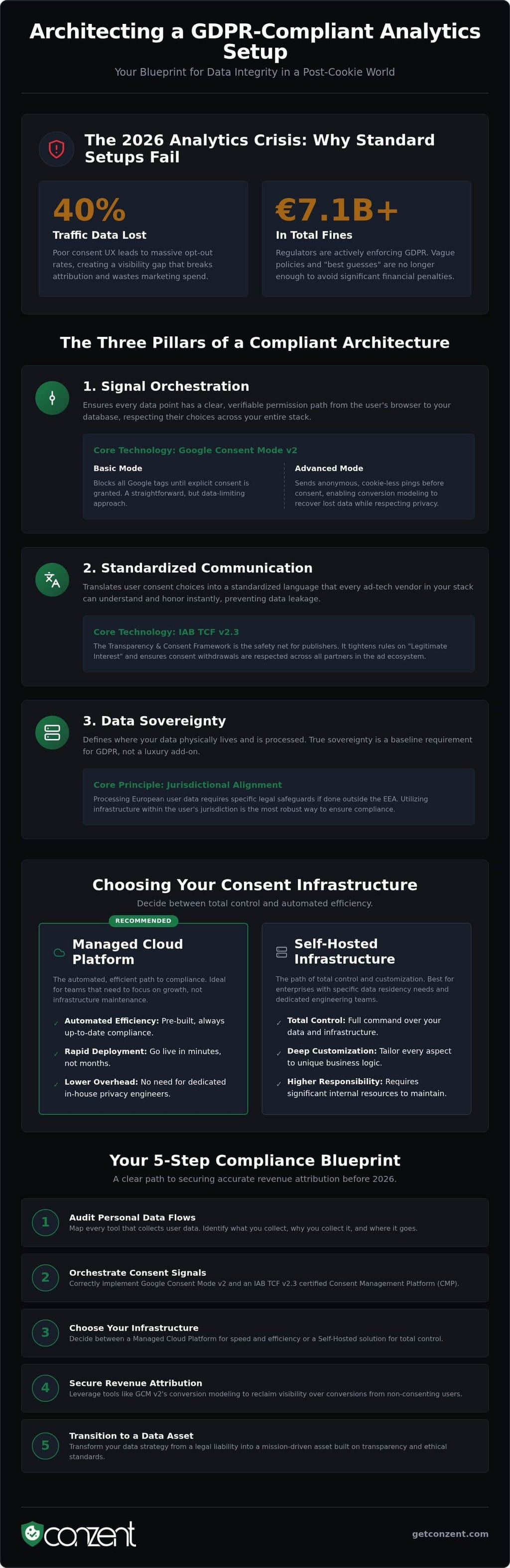
A GDPR compliant analytics setup is not a single tool. It is a layered defense. Most competitors focus on the dashboard. We focus on the engine. To achieve data integrity in 2026, your architecture must stand on three specific pillars: Signal Orchestration, Standardized Communication, and Data Sovereignty. These layers interact to prevent data leakage and ensure that user choices are respected across your entire marketing stack. When these pillars fail, your data becomes a liability rather than an asset.
Data sovereignty is the final, often ignored, pillar. It defines where your data actually lives. If you process European user data on servers outside the EEA without the specific safeguards mandated by the Official Text of the GDPR, your setup is legally fragile. True sovereignty means utilizing infrastructure, like our Danish-based systems, that keeps data within the jurisdiction of the user. This isn't a premium luxury. It is a baseline requirement for digital rights and technical efficiency.
Google Consent Mode v2: Mandatory for 2026
Google Consent Mode v2 is no longer optional for businesses targeting the European Economic Area. It acts as the signal orchestrator between your website and Google’s services. You must choose between Basic and Advanced implementation modes. Basic mode blocks all tags until consent is granted. Advanced mode sends anonymous pings without cookies, allowing Google to use conversion modeling to recover the 30% to 40% of data typically lost to opt-outs. This modeling provides accurate revenue attribution without compromising privacy. You can find more in our Google Consent Mode v2 implementation guide.
IAB TCF 2.3: The Publisher's Safety Net
The Transparency and Consent Framework (TCF) v2.3 is the communication standard for the ad-tech ecosystem. It translates user choices into a standardized string that every vendor in your stack can understand. This is critical for ad-supported sites. TCF 2.3 specifically tightens how "Legitimate Interest" is handled, ensuring that user withdrawals are honored instantly across all partners. Using a CMP that is IAB TCF certified is the only way to ensure your ads remain compliant and your revenue stays stable. Standardizing this infrastructure doesn't have to be a resource drain. You can view our managed platform options to see how we automate these pillars.
Managed vs. Self-Hosted Consent: Choosing Your Infrastructure
Infrastructure is the bedrock of any GDPR compliant analytics setup. You have a choice: build your own or use a managed service. This is not just a technical decision. It is a strategic one that determines your long-term maintenance burden. Some organizations need total control. Others need the speed of the cloud. Understanding the trade-offs between these two paths is essential for maintaining data integrity in 2026. Control is valuable, but it is never free.
Self-hosting offers zero external dependencies. You own the stack and the data flow. However, this control comes with significant DevOps overhead. You are responsible for uptime, security patches, and regulatory updates. In contrast, a managed service handles the heavy lifting. It provides a "Mission Control" for your data, allowing you to focus on analysis rather than server maintenance. We believe in providing both options. Transparency should not be a barrier to entry.
The Case for Self-Hosted OCI
High-security sectors like FinTech and HealthTech often require absolute isolation of their data. For these teams, a Self-Hosted Open Consent Infrastructure is the standard. It allows you to keep consent records within your own virtual private cloud. This setup eliminates third-party data transfers entirely. But be honest about the cost. Following the ICO's Guide to the GDPR requires constant vigilance. Technical debt accumulates quickly when you have to manually update your CMP for every new browser privacy feature or legal shift. If you have the engineering resources, self-hosting is powerful. If you don't, it's a liability.
The Efficiency of Managed Cloud
Most agencies and high-growth brands prefer a Managed Cloud Consent Platform. It is the friction-free way to scale. When you manage hundreds of domains, manual updates are impossible. A managed platform automates regulatory changes like ePrivacy updates or new TCF versions. This ensures your GDPR compliant analytics setup remains valid without constant developer intervention. Our platform uses Danish-based infrastructure to guarantee data residency within the EU. You get the security of open-source standards with the reliability of a global SaaS. It turns a complex legal requirement into a streamlined technical utility.
A 5-Step Blueprint for a Compliant Analytics Setup
Transitioning from a legacy tracking system to a GDPR compliant analytics setup requires more than a new script. It demands a methodical re-engineering of how data flows from the user to your servers. You don't need a complex 50-page manual; you need a clear, actionable blueprint. This process ensures that your data remains accurate while respecting the digital rights of every visitor. Follow these five steps to stabilize your infrastructure.
- Step 1: Audit your data points. Identify every piece of Personal Identifiable Information (PII) you currently collect. This includes IP addresses, User IDs, and even specific device fingerprints.
- Step 2: Configure your signals. Set up your Consent Management Platform (CMP) to broadcast IAB TCF and Google Consent Mode v2 signals. This tells your marketing stack exactly what it is allowed to do.
- Step 3: Move to the server. Implement server-side tagging to gain control over what data is sent to third parties.
- Step 4: Optimize the experience. Test different banner designs to find the most effective way to ask for consent without being intrusive.
- Step 5: Validate and audit. Use debugging tools to ensure tags only fire when consent is present. Regular privacy audits prevent technical drift over time.
Optimizing for Opt-In Rates
UX design is a compliance tool. If your banner is confusing or intrusive, users will opt out or bounce entirely. This creates the data gaps we discussed earlier. We recommend using Consent A/B Testing to find the balance between legal clarity and user engagement. By testing placements and messaging, you can significantly improve your opt-in rates. Use revenue impact analytics to see exactly how these UX changes translate into better attribution and higher marketing ROI.
Server-Side Tagging: The Future of Privacy
Client-side tracking is increasingly fragile. Ad-blockers and browser privacy features often break standard analytics scripts. Server-side tagging solves this by moving the logic from the user's browser to your own server. Your server acts as a "Privacy Proxy." It receives the data, strips away unnecessary PII, and then forwards only the essential, compliant signals to third-party vendors. This setup protects user privacy and ensures your analytics remain functional even when ad-blockers are active. It is the most robust way to maintain a GDPR compliant analytics setup in 2026. If you're ready to modernize your stack, view our pricing to find the right infrastructure for your needs.
Future-Proofing Your Analytics with Conzent
We don't view consent as a premium add-on. We view it as a public good. Our mission is to standardize digital rights by making a GDPR compliant analytics setup accessible to everyone. The technical requirements of 2026 are complex, but they don't have to be a burden. Our Managed Cloud Consent Platform automates the heavy lifting of signal orchestration and legal alignment. We provide the Mission Control for your data flows, ensuring your stack remains stable as regulations evolve. This is about moral clarity and technical efficiency, not just avoiding fines.
Integration shouldn't be a bottleneck for growth. We support everything from standard WordPress installations to complex, custom headless frameworks. Our infrastructure is built for high-level technical performance and ethical responsibility. Unlike the "black box" solutions that dominate the market, our source-available code invites scrutiny and collaboration. We are the voice of a knowledgeable peer, not a distant vendor. This transparency ensures that your GDPR compliant analytics setup is never a matter of guesswork or hidden vulnerabilities.
Scaling Privacy Simplified
Scaling a business often leads to accidental data leakage. Our Danish-hosted infrastructure is GDPR-native from the ground up. It handles massive global traffic spikes without adding latency to your site or compromising user experience. By keeping data residency within the EEA, we eliminate the legal risks associated with international transfers. We help you transition from viewing compliance as a hurdle to seeing privacy as a core product feature. This shift in mindset transforms your analytics from a potential liability into a high-performance, trustworthy asset.
Join the Open Consent Movement
We are challenging the traditional commercial mentality that hides privacy behind high paywalls. Our sponsorship models are designed to lower the barrier to entry, making professional-grade tools available to users of all sizes. This is a community-focused effort to democratize data integrity. You can start your journey by conducting a thorough compliance audit to see where your current setup falls short. Once you understand your specific needs, check our pricing and sponsorship tiers to see how we can help you scale. The future of data is open, transparent, and principled. Join us in setting the new standard for the digital ecosystem.
Secure Your Data Integrity for the Post-Cookie Era
The 2026 analytics landscape doesn't tolerate technical shortcuts. Achieving a GDPR compliant analytics setup is no longer just about avoiding fines; it's about reclaiming the data integrity required to run a high-growth business. You've seen how standard setups fail and why a layered architecture of signal orchestration and data residency is the only way forward. By following a structured blueprint and choosing the right infrastructure, you turn privacy from a legal hurdle into a competitive advantage.
We believe transparency is a public good. Our infrastructure is IAB TCF v2.3 Certified and Google Consent Mode v2 Ready, providing the "Mission Control" you need without the "black box" secrecy of traditional vendors. With source-available transparency, you can trust that your technical efficiency aligns with your ethical responsibilities. Don't let invisible traffic or broken attribution stall your growth.
Start building your compliant analytics stack with Conzent today. It's time to build a data strategy that respects your users and secures your future.
Frequently Asked Questions
What is the difference between GDPR compliant analytics and anonymous tracking?
Compliant analytics tracks identified or identifiable users based on explicit, informed consent. It allows for deep attribution and personalized marketing while respecting legal boundaries. Anonymous tracking strips away all personal identifiers so the data is no longer personal under the law. A full GDPR compliant analytics setup often requires more than simple anonymity; it needs signal orchestration to manage complex marketing tags and revenue attribution.
Do I really need a cookie banner if I use Google Analytics 4?
Yes, you do. GA4 is not compliant by default in the European Union because it uses identifiers like Client IDs and transfers data to servers in the United States. To use it legally, you must implement a consent banner that captures an explicit opt-in before any tags fire. Relying on GA4’s internal privacy settings without a robust consent infrastructure leaves your organization exposed to significant regulatory scrutiny.
How does Google Consent Mode v2 fix data loss in my analytics setup?
GCM v2 uses conversion modeling to bridge the visibility gap when users decline cookies. Instead of losing 100% of that visitor data, the system sends anonymous pings to Google. These pings don't contain personal data but allow machine learning to estimate behavior and conversions. This technical process recovers approximately 30% to 40% of the data typically lost to opt-outs, ensuring your attribution remains accurate.
Can I host my own consent management platform for free?
You can host our Open Consent Infrastructure (OCI) on your own servers at no cost. This gives you total control over your data residency and eliminates dependencies on third-party vendors. While the software itself is free, your team will handle the DevOps overhead. This includes managing server uptime, security patches, and manual updates whenever browser privacy standards or legal requirements shift across the European Economic Area.
What are the penalties for a non-compliant analytics setup in 2026?
Penalties remain severe under the two-tier enforcement system. Serious violations can result in fines up to €20 million or 4% of global annual turnover, whichever is higher. In 2025 alone, regulators issued approximately €1.2 billion in total fines. Beyond these legal costs, non-compliance creates "dark traffic" and broken attribution, which forces you to waste marketing budgets on unverified channels and inaccurate data points.
Is IAB TCF 2.3 mandatory for all websites?
It isn't legally mandatory for every personal blog, but it is a technical necessity for any site using ad-tech or complex marketing stacks. TCF v2.3 is the industry standard for communicating consent signals to advertising vendors. If you show ads or use partners within the IAB ecosystem, this framework is the only way to ensure your revenue stays stable. Without it, many platforms will stop serving ads to your users.
How do I test if my analytics tags are respecting user consent?
You should use browser developer tools or privacy auditors to monitor active network requests. No cookies should be set and no tracking pings should fire to third-party domains before a user clicks "Accept." You can also use the debug mode in Google Tag Manager to verify that your GDPR compliant analytics setup is correctly blocking or allowing tags based on the real-time consent status of the visitor.
Does a GDPR compliant setup slow down my website's performance?
A professional architecture won't hurt your speed. Using our Managed Cloud Consent Platform with Danish-hosted infrastructure ensures low latency for European visitors. By implementing server-side tagging, you move heavy processing logic away from the user's browser and onto your own server. This approach actually improves page load speeds and overall performance while maintaining the highest standards of data integrity and legal compliance.