
What Constitutes Valid GDPR Consent? The 2026 Compliance Standard

A checkbox is not a legal safeguard. It is a technical liability if you cannot prove exactly how, when, and why it was clicked. Many operators treat consent as a passive hurdle to clear, but in 2026, regulators view it as a verifiable data event that requires rigorous documentation. If your current setup relies on "good enough" logic, you are likely sitting on a compliance time bomb. Valid consent is not a state of agreement. It is a managed technical process. Much like how Cornerstone Real Estate Investment Services provides a structured framework for real estate investors navigating 1031 exchanges, digital operators must adopt a rigorous system to manage their compliance obligations.
We understand the anxiety of balancing strict privacy laws with the need to maintain your advertising revenue. It is easy to get lost in the technical jargon of the EU AI Act or the nuances of the UK Data (Use and Access) Act 2025. This GDPR consent implementation guide cuts through the noise. You will learn to master the precise legal and technical requirements that turn a simple click into a legally defensible consent event.
We are moving beyond abstract theories to provide a practical checklist for validity. We will cover how to configure your CMP for IAB TCF v2.3, manage Google Consent Mode v2, and ensure your data minimization efforts meet the latest standards. This guide provides the clarity needed to achieve regulatory peace of mind and the confidence that your infrastructure is built on ethical, transparent standards.
Key Takeaways
- Move beyond subjective assumptions by treating consent as an objective technical event that must satisfy Article 4(11) standards.
- Eliminate invalid "consent or leave" ultimatums by mastering the four pillars of freely given, specific, informed, and unambiguous agreement.
- Turn simple clicks into immutable, timestamped records that document exactly what a user saw at the moment they provided consent.
- Follow this GDPR consent implementation guide to integrate IAB TCF v2.3 and Google Consent Mode v2 without sacrificing your programmatic revenue.
- Shift your perspective from viewing compliance as a legal hurdle to treating it as a high-performance technical prerequisite for the 2026 data landscape.
Defining Valid GDPR Consent: The Article 4(11) Framework
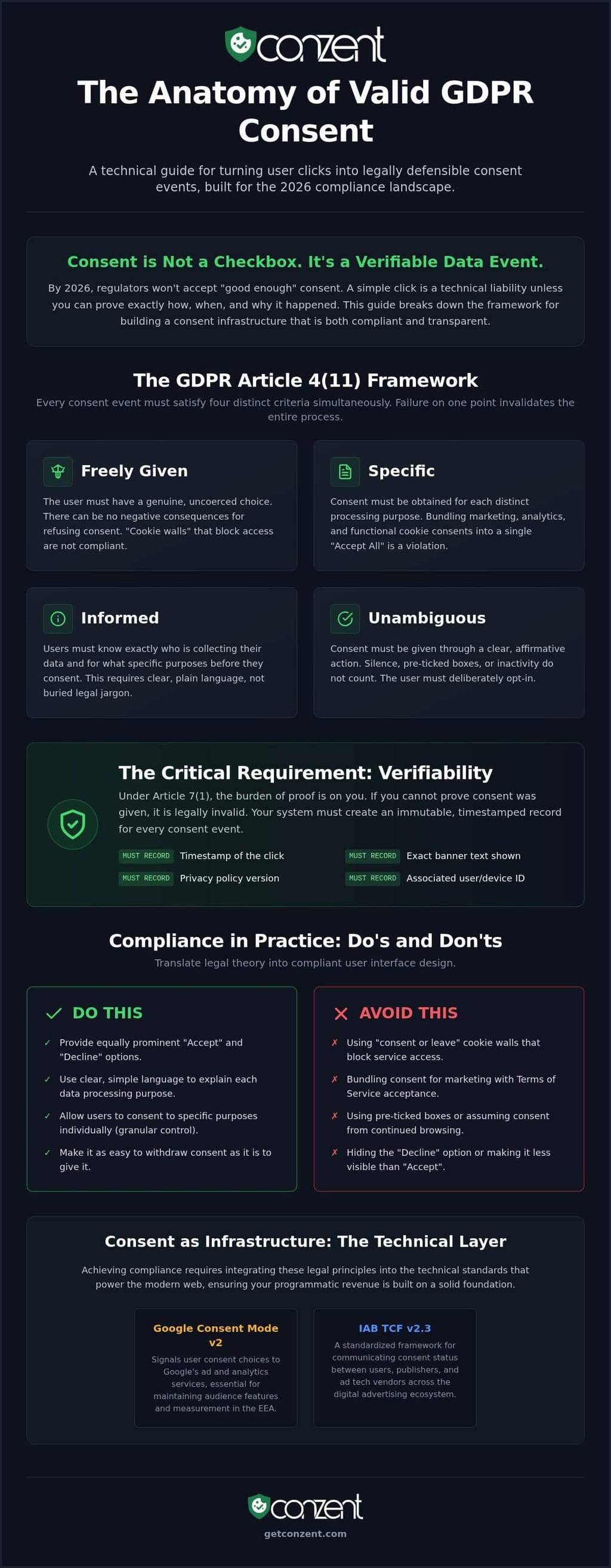
GDPR Article 4(11) is the definitive legal baseline for all data processing within the European Union. It defines consent as any freely given, specific, informed, and unambiguous indication of the data subject's wishes. Validity is an objective test; it is not a subjective feeling or a convenient assumption made by a marketing department. If you cannot demonstrate that a user made a conscious choice, you do not have consent. Many operators fail because they view consent as a checkbox to hide rather than a standard to uphold.
Consent is a clear affirmative action. Silence, pre-ticked boxes, or inactivity do not constitute a legal basis for processing personal data. This is a foundational principle of the General Data Protection Regulation (GDPR). By 2026, the standard has evolved significantly. Regulators no longer accept static privacy policies as sufficient proof of compliance. They require consent to be verifiable in real-time. This means your system must produce a record of the exact moment a user opted in and what they were told at that time.
The 4 Core Elements of Validity
To meet the 2026 compliance standard, every consent event must satisfy four distinct criteria simultaneously. Failing on even one point renders the entire data processing event illegal. This GDPR consent implementation guide prioritizes these elements to ensure your technical setup matches legal reality. Use these as a checklist for your current configuration.
- Freely given: The user must have a genuine choice. If you use "cookie walls" that block access unless a user accepts tracking, the consent is invalid. There must be no negative consequences for saying no.
- Specific: You must name every distinct purpose for processing. Bundling marketing cookies with functional cookies is a violation. Each use case needs its own clear opt-in.
- Informed: Users must know exactly who is collecting their data and for what purpose. Transparency is not an option; it is a requirement.
- Unambiguous: A clear signal of intent is required. This means a deliberate action, such as clicking an "Accept" button that is not visually deceptive or hidden.
Verifiability: The 'Sixth' Hidden Element
Article 7(1) of the GDPR is explicit about the burden of proof. It rests entirely on the data controller. If you cannot prove when and how consent was given, it is legally invalid from the moment of collection. Verifiability is the technical backbone of GDPR compliance. For a deeper dive into specific regulatory requirements, our GDPR compliance overview details how these rules apply to modern web infrastructure. You must record the version of the privacy policy the user saw, the timestamp of the click, and the technical ID associated with the event. Without this immutable trail, your "valid" consent is merely a claim you cannot support.
The Four Pillars: How to Meet Every Requirement
Compliance is not a suggestion. It is a technical standard. This GDPR consent implementation guide focuses on the four pillars that define a valid event. A valid signal is an active choice. It is not an accident of design. By 2026, the margin for error has vanished, and regulators are looking for these specific markers of validity.
Remove "consent or leave" ultimatums immediately. These invalidate your legal basis. Users must have a genuine choice without negative consequences. If your site access depends on tracking consent, you aren't asking; you're coercing. Freely given consent requires that the user can decline and still access your core service.
Do not bundle marketing consent with your terms of service agreement. These are separate legal actions. A user agreeing to your site rules is not automatically agreeing to be tracked across the web. Specificity requires clear boundaries between functional necessity and marketing utility.
Use clear, non-legalese language in your cookie banner. Transparency builds trust while complexity invites regulatory scrutiny. If a user doesn't understand what they are agreeing to, the consent is not informed. You must state exactly who is processing the data and for what purpose.
Design your UI for visual equality. "Accept" and "Decline" buttons must have equal weight. If your "Decline" option is hidden, grayed out, or visually diminished, you are using a dark pattern. Following a robust GDPR consent implementation guide ensures your UI design supports these requirements without manipulating user intent.
Avoiding the 'Tying Prohibition'
Performance of a contract cannot be conditional on consent for unrelated data. This is known as the "tying prohibition." For example, access to a whitepaper shouldn't require consent for tracking cookies. Legally, tied consent is considered coerced and therefore void. This precision is vital for maintaining international data flows under the Data Privacy Framework, where data collection must remain strictly purposeful and limited to the stated objective.
Granularity: The Key to Specificity
Users need control over their data. They must be able to accept some purposes while rejecting others. Your "Accept All" button must be accompanied by a "Manage Preferences" option. This level of detail is a core requirement of the 2026 standard. You can find detailed granularity rules on our GDPR compliance page. Granularity is not just a legal hurdle; it is an ethical commitment to digital rights. You can explore our transparent pricing options to find a managed solution that automates this technical complexity while keeping your revenue streams intact.
Explicit vs. Implicit Consent: Clearing the Confusion
Implicit consent is a relic. It is an assumption, not a fact. In the 2026 regulatory environment, scrolling down a page or navigating to a second URL does not constitute a legal basis for data processing. These passive actions are invisible to the law. A valid event requires a deliberate, outward signal from the user. If your strategy relies on "soft opt-ins" or assumed agreement, your data collection is legally void. This GDPR consent implementation guide prioritizes the transition from passive assumptions to active, verifiable choices.
Most standard website tracking requires "unambiguous" consent. This is a clear affirmative action that leaves no doubt about the user's intent. However, "explicit" consent is a higher standard. It requires a very high level of assurance, often involving a specific statement or a double opt-in mechanism. Mislabeling your consent type is a common cause for regulatory scrutiny. Using an unambiguous signal when the law demands an explicit one creates a gap in your compliance armor that regulators will exploit.
When is 'Explicit' Consent Mandatory?
You cannot rely on standard affirmative actions when handling high-risk data. Explicit consent is mandatory when processing "Special Category" data. This includes information regarding a user's health, religious beliefs, or political affiliations. If your site uses automated individual decision-making, such as profiling that has legal effects on the user, the "explicit" standard applies. Finally, international data transfers to countries without an adequacy decision often require this higher level of confirmed agreement. You can find more details on these high-stakes requirements on our GDPR compliance page.
Designing for Affirmative Action
A clear affirmative action must be a deliberate act. It is a click. It is a toggle. It is not a lack of resistance. Pre-ticked boxes are the leading reason for invalidity in 2026. They represent a choice made by the site owner, not the user. Legally, silence is not consent. Inactivity is not consent. This is why "Opt-out" models are fundamentally incompatible with GDPR. They reverse the burden of action, forcing the user to stop a process that should never have started without their permission.
Your cookie banner must facilitate this active choice without friction. It should empower the user to make a decision, not trick them into one. We believe that technical efficiency and ethical responsibility are two sides of the same coin. By providing a clear path to affirmative action, you protect your users' rights and your own legal standing. If you need assistance configuring these specific triggers, our technical support documentation provides granular steps for implementation.
Technical Proof: Recording and Managing Consent Events
Self-hosting your infrastructure ensures you own this proof. When you rely on third-party vendors, your compliance data lives on their servers. If they change their terms or suffer a service outage, your legal defense is compromised. Owning your infrastructure means owning your evidence. It is the difference between being a tenant of your own compliance and being the landlord. Transparency requires that you can produce these records on demand without relying on an external middleman. In the same way that a property professional might visit WithEasement to verify recorded easements and property data before a sale, a digital operator must have immediate access to their own consent logs to ensure transparency and legal security.
A compliant log is more than a simple database entry. It is a snapshot of a legal agreement. It must include a pseudonymized User ID, a precise timestamp, and the specific version of the privacy policy presented. You must also document the specific UI state the user saw. This usually involves a version ID that maps back to a specific banner design and set of disclosures. Learn how our Open Consent Infrastructure handles verifiable logs to automate this burden of proof while maintaining high performance.
Implementing Easy Withdrawal
The law is clear: withdrawing consent must be as easy as giving it. This is the "One-Click" rule. If a user can accept in one click, they must be able to revoke in one click. A floating Privacy Settings icon is the 2026 industry standard for this accessibility. It keeps the choice visible and reachable at all times. Don't hide the withdrawal button behind three layers of menus or complex account settings. That is a dark pattern that invites fines.
Valid withdrawal must stop all processing immediately. It is not a request that takes 30 days to process. It is a technical kill-switch for tracking scripts. When a user revokes consent, your system must trigger an immediate state change across all integrated tools. Managing these technical events shouldn't be a manual burden. You need a system that balances digital rights with technical efficiency. Explore our managed and self-hosted pricing plans to deploy a compliant infrastructure that automates your record-keeping today.
Consent as Infrastructure: GCM v2, TCF 2.3, and Revenue
Validity is now a technical prerequisite for Google Ads and programmatic revenue. It isn't just about avoiding fines anymore. It's about maintaining the ability to serve ads at all. In 2026, the ecosystem has shifted. Major browsers now block ad signals that lack a verifiable consent string. If your consent event doesn't meet the technical standard, your marketing scripts simply won't fire. Consent is no longer a legal layer on top of your site; it's the infrastructure that supports your entire digital presence.
Google Consent Mode v2 bridges the gap between legal validity and data modeling. It allows you to communicate the consent state of your users directly to Google's tags. When a user denies consent, GCM v2 uses conversion modeling to fill the data gaps. This ensures you don't lose visibility into your campaign performance while remaining strictly compliant. This GDPR consent implementation guide views these tools as essential for any modern publisher who refuses to sacrifice data for compliance.
Why TCF 2.3 is the Global Standard for Validity
IAB TCF 2.3 provides the standardized signals that publishers need to survive. It isn't just a framework; it's a language. It standardizes how informed and specific requirements are communicated to hundreds of vendors simultaneously. Using a certified CMP ensures your signals are recognized and respected by the global ad ecosystem. Without this standardization, your site is an island that ad tech vendors cannot safely interact with. You can read more about our IAB TCF integration to understand how these signals protect your traffic and your revenue.
Optimizing for Revenue without Sacrificing Validity
You don't have to choose between compliance and income. Use consent A/B testing to find the banner design that maximizes valid opt-ins without using deceptive dark patterns. It's a game of technical precision, not manipulation. Monitor your revenue impact analytics to see exactly how compliance affects your bottom line in real-time. By implementing Google Consent Mode v2, you can recover significant portions of your attribution data even when users choose not to be tracked. This technical efficiency is the only way to maintain a sustainable business model in the 2026 privacy landscape.
Future-Proof Your Compliance Infrastructure
The 2026 standard for digital rights is clear. Consent is not a passive agreement; it's a verifiable data event that requires technical precision. This GDPR consent implementation guide has shown that meeting Article 4(11) requirements means moving beyond simple banners. You must own your proof through immutable logs and ensure your withdrawal process is as seamless as your opt-in. Valid signals are the only way to survive in a landscape where browsers and ad networks demand total technical transparency.
Compliance doesn't have to be a drain on your resources or your revenue. By treating consent as foundational infrastructure, you protect your programmatic income while respecting user autonomy. You need a system that offers source-available transparency and is fully IAB TCF 2.3 Certified and Google Consent Mode v2 Ready. Don't leave your legal defense to chance or third-party black boxes that hide your own proof from you.
Start building your verifiable consent infrastructure today. You have the power to turn complex regulatory requirements into a competitive advantage for your brand. It's time to lead with transparency and technical efficiency.
Frequently Asked Questions
Can I use implied consent if the user continues to browse?
No, implied consent is dead. Navigating or scrolling does not meet the "clear affirmative action" standard required by Article 4(11). Your system must wait for a deliberate click before firing any non-essential tags. If you collect data based on a user simply staying on the page, you are processing data illegally. This GDPR consent implementation guide emphasizes that silence is never an agreement.
Is a Reject All button legally required on the first layer of a banner?
Yes, a "Reject All" button is now a functional requirement for legal validity. Regulators and the EDPB have clarified that refusing consent must be as easy as giving it. If your first layer only has an "Accept" button while hiding "Reject" behind a settings menu, your consent is considered coerced. Visual parity between these two choices is the 2026 standard for compliant UI design.
What happens if I cannot prove a specific user gave consent?
If you cannot prove consent, you do not have it. Article 7(1) places the entire burden of proof on you, the data controller. You must be able to produce a timestamped, immutable record showing exactly what the user was told and what they clicked. Without this technical evidence, any data you have collected is a liability. Verifiable logs are the only backbone of a robust compliance strategy.
Does GDPR consent ever expire, or is it valid forever?
GDPR consent does not have a hard-coded expiration date, but it is not permanent. Best practices and local guidelines suggest refreshing consent every 12 to 24 months to ensure it remains "informed." If your data processing purposes change significantly, the old consent becomes void immediately. You must maintain a cycle of re-validation to keep your legal basis current and defensible against potential regulatory audits.
Can I offer a discount or cookie wall in exchange for consent?
You cannot use cookie walls to block access to your content. Consent must be "freely given," which means a user should not face negative consequences for saying no. While some "pay or ok" models exist, they are subject to extreme scrutiny. A valid GDPR consent implementation guide focuses on providing a genuine choice. If a user is forced to accept tracking to read an article, that consent is void.
How often should I ask for consent again if my privacy policy changes?
You must ask for consent again whenever you make a material change to your data processing activities. This includes adding new third-party vendors, changing the purpose of collection, or expanding the types of data you track. Minor grammatical updates to a policy don't require a re-ask, but any shift in how you use personal data invalidates previous agreements. Transparency requires keeping the user's permission aligned with your actual behavior.
Is consent from a child under 16 valid without parental permission?
Consent from a child under 16 is generally invalid without verified parental permission for most digital services. While individual EU member states can lower this age to 13, the default threshold is high. You must implement age-verification measures if your site targets or attracts younger audiences. Processing a minor's data without the correct legal authorization is one of the fastest ways to trigger maximum regulatory fines.
How do I handle valid consent for third-party scripts like YouTube or Maps?
You must block third-party scripts like YouTube or Google Maps until the user provides specific consent for them. These services often drop tracking cookies the moment they load. A compliant setup uses "placeholders" that only activate the script after a user clicks a specific opt-in. Managing these technical triggers ensures that no data leaks to external vendors before you have a valid legal basis to allow it.