
Common Cookie Consent Mistakes to Avoid: The 2026 Compliance Checklist

Your cookie banner might look flawless, but underneath the surface, rogue scripts are likely firing before anyone clicks a button. Real compliance doesn't fail in legal disclaimers; it fails in technical script execution. Spotting the common cookie consent mistakes to avoid in 2026 means auditing your actual network requests, tag triggers, and data signals.
We know how frustrating this gets. Between meeting the strict rules of Google Consent Mode v2, handling IAB TCF v2.3 changes, and watching analytics fracture, preserving data integrity feels exhausting. Fear of regulatory fines shouldn't force you into a broken setup that tanks your hard-earned revenue.
You can run an ethical, transparent consent flow that respects user privacy without flying blind. This guide walks you through the exact technical traps to look for, from pre-consent firing to subtle interface dark patterns. Here is your practical 2026 compliance checklist to audit your infrastructure and keep your tracking reliable.
Key Takeaways
- Discover how pre-consent script leaks occur and how to enforce legitimate prior consent before any tracking tags execute.
- Eliminate manipulative banner designs by aligning button prominence with strict EDPB standards to dodge enforcement actions.
- Spot the common cookie consent mistakes to avoid across Google Consent Mode v2 and IAB TCF v2.3 to safeguard ad revenue and data quality.
- Upgrade compliance logging beyond basic booleans to capture the specific timestamps and parameters required under GDPR Article 7.
- Implement a high-performance compliance checklist that maintains user privacy without sacrificing site speed or Core Web Vitals.
1. Major Technical Blunders: Failing Prior Consent and Script Blocking
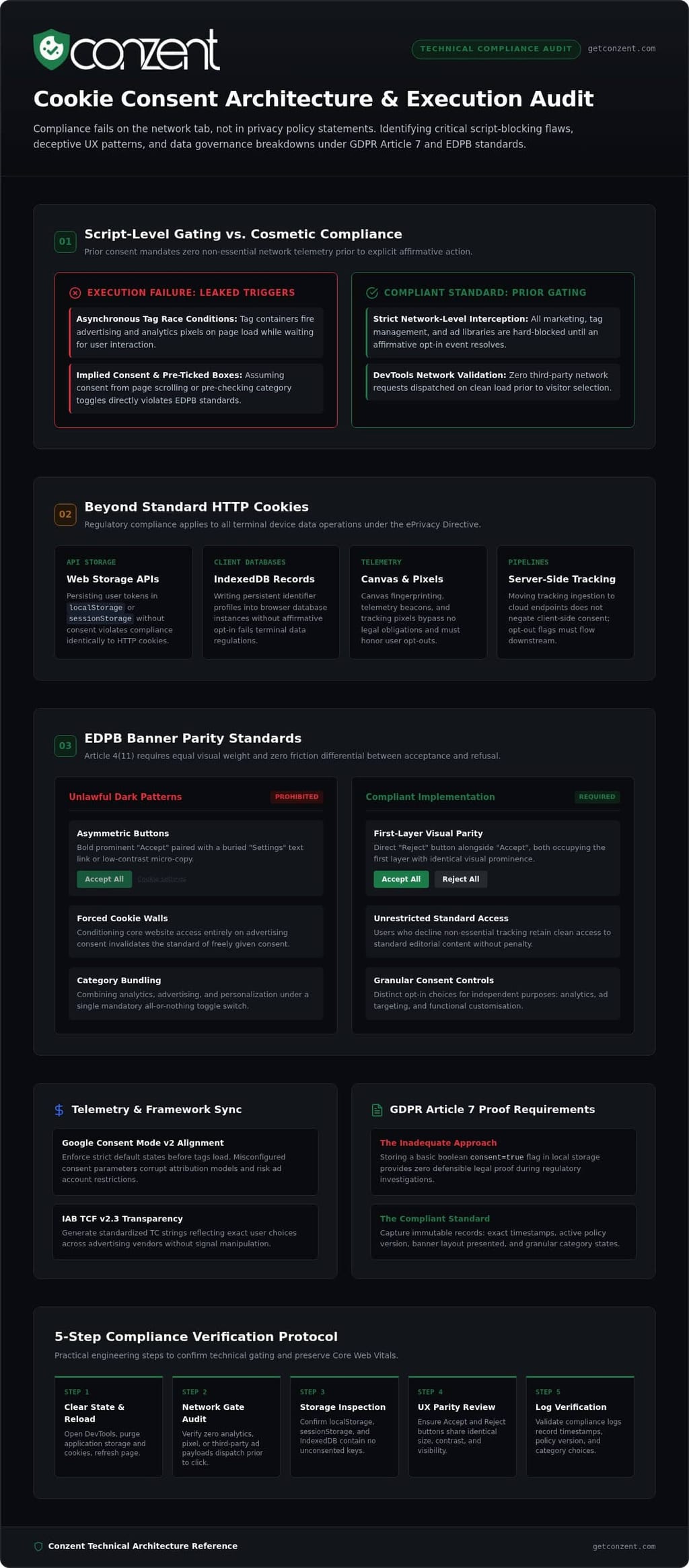
Compliance fails on the network tab, not in your privacy policy. A banner is only as effective as the technical blocking behind it. Loading marketing tags while a consent prompt sits unanswered violates European privacy directives immediately. To protect user trust and prevent enforcement actions, engineering teams must prioritize script-level gating over superficial cosmetic notices.
Firing Trackers Before Explicit Opt-In
The law requires affirmative consent before any non-essential tracker executes. Many teams rely on asynchronous tag management without setting proper blocking triggers, inadvertently causing race conditions. If your tag container dispatches ad pixels on page load while waiting for user input, data leaks out instantly. Test this directly: open your browser developer tools, clear site storage, reload the page, and monitor the Network tab. If third-party requests fire before an interaction, your implementation fails prior consent.
Relying on Implied Consent or Pre-Ticked Boxes
Assuming visitors agree to tracking simply because they scroll or continue browsing is one of the most persistent common cookie consent mistakes to avoid. Regulators have banned passive acceptance. Similarly, pre-selecting categories or toggles constitutes deceptive design and dark patterns under European Data Protection Board standards. Valid consent demands an explicit affirmative action, whether a user visits from desktop or mobile. Check our breakdown of GDPR compliance rules to align your consent flows with current standards.
Ignoring Non-Cookie Storage and Tracking Technologies
Modern compliance extends far beyond standard HTTP cookies. Regulatory requirements govern any reading or writing of terminal device data. Shifting identifiers to modern browser storage mechanisms does not bypass legal requirements:
- Web Storage APIs: Tracking tokens stored in
localStorageorsessionStoragerequire the same prior consent as standard cookies. - Client Databases: Using IndexedDB to persist persistent user states without opt-in violates the ePrivacy Directive.
- Alternative Telemetry: Canvas fingerprinting, tracking pixels, and server-side tracking pipelines ingestion must respect client-side opt-outs.
Maintain an accurate inventory of all client-side data mechanisms. Gating standard cookies while leaving local storage open to third-party scripts remains one of the fastest ways to fail a privacy audit, making it another of the critical common cookie consent mistakes to avoid.
2. Deceptive Banner UX: Dark Patterns That Risk Regulatory Penalties
Manipulating visitors into consenting isn't clever design; it's a direct compliance liability. Cookie banner dark patterns exploit cognitive biases through misleading color hierarchies, buried buttons, and forced choices. European regulators now actively audit visual symmetry alongside network telemetry. Designing deceptive banners represents one of the most visible common cookie consent mistakes to avoid.
Asymmetric Buttons and Obscured Reject Options
A compliant banner demands visual parity. As confirmed in the EDPB Cookie Banner Taskforce report, visitors must be able to reject cookies as easily as accepting them. Hiding a refusal option inside a second-layer "Settings" link or rendering it as low-contrast grey micro-copy next to a bold "Accept All" button violates GDPR Article 4(11). Both choices must sit on the initial layer with identical visual prominence. If your accept action is an obvious button, your reject action must be an equivalent button, not a hidden hyperlink.
Cookie Walls and Forced Consent Traps
Conditioning website access on tracking consent invalidates the legal standard of freely given consent. European watchdogs strictly prohibit blocking user access unless an individual surrenders personal data for advertising. While some publishers run lawful cookie paywalls offering an ad-free paid tier as a fair alternative, blanket consent walls remain unlawful. Visitors who decline non-essential tracking must retain access to standard site content without arbitrary barriers or degraded usability.
Misleading Granular Controls and Category Bundling
Bundling separate tracking purposes into an "all-or-nothing" switch strips users of meaningful choice. You cannot combine analytics, personalization, and programmatic ad trackers into one mandatory category. Under EU law, each distinct processing purpose requires an independent toggle that defaults to an unselected state. Consult our GDPR compliance guide to structure your granular categories accurately.
Ethical design doesn't mean sacrificing conversion data. You can explore our transparent CMP deployment plans to maintain clean user interfaces that respect privacy while sustaining tracking performance.
3. Telemetry and Integration Errors: Google Consent Mode v2 and TCF Flaws
Getting your visual banner right is only half the battle. If your underlying telemetry pipelines broadcast incorrect signals, ad networks will either drop your traffic or log unconsented user data. Flawed consent signals silently destroy campaign attribution and invite regulatory fines. Spotting these telemetry flaws early ranks among the most impactful common cookie consent mistakes to avoid.
Misconfiguring Default Consent States in Google Consent Mode v2
Google Consent Mode v2 requires defining four explicit parameters before any tags run: ad_storage, analytics_storage, ad_user_data, and ad_personalization. Omitting the last two breaks audience remarketing and conversion tracking across the EEA and the UK. Equally dangerous is relying on Advanced mode without realizing that early "cookieless pings" still transmit IP addresses and headers before consent, drawing regulatory scrutiny. Basic mode keeps tags completely dormant until affirmative consent is logged. Review our Google Consent Mode v2 guide to verify your technical parameters.
Trigger Timing Errors in Google Tag Manager
Tag timing determines whether tracking respects user choices. Firing marketing tags on generic "Page View" or "DOM Ready" triggers creates race conditions, executing scripts before the consent state fully resolves. To prevent this, initialize your CMP on the "Consent Initialization - All Pages" event. Fire marketing tags only after receiving a verified consent-update event from the data layer. Use Google Tag Assistant to verify that default parameters register as denied before any tag attempts execution.
Non-Compliance with IAB TCF v2.3 Standards
Publishers monetizing programmatic inventory face immediate revenue drops if their consent strings fail validation under the IAB Europe Transparency and Consent Framework. TCF v2.3 mandates the disclosedVendors segment in every newly generated TC string to eliminate ghost vendors. If your CMP generates malformed strings or omits Google's vendor ID (755), ad servers trigger TCF Error 1.4. This error degrades auctions to Limited Ads, slashing programmatic CPMs by 60% to 80%. Check our breakdown on IAB TCF compliance to ensure your setup generates valid strings and eliminates another of the common cookie consent mistakes to avoid.
4. Governance and Record-Keeping Mistakes: The Missing Proof of Compliance
Proving compliance matters just as much as executing it. Under GDPR Article 7(1), the burden of proof rests entirely on the website operator. If a regulatory authority opens an audit, an aggregated analytics counter won't protect you. Failing to maintain tamper-evident logs and letting third-party tags run unmonitored represent common cookie consent mistakes to avoid that leave businesses completely defenseless.
Failing to Maintain Tamper-Evident Consent Logs
Regulators reject simple boolean values. Storing a flat cookies_accepted: true record in your database proves nothing about what occurred. An auditor requires specific context: an exact UTC timestamp, the specific banner design version displayed, the category-level permissions granted, and a pseudonymized consent identifier. At the same time, you shouldn't log plain IP addresses or personal details inside consent tables. True compliance requires verifiable, cryptographic proof of user choices without collecting unnecessary personal data.
Vendor Drift and Uncataloged Third-Party Scripts
Websites aren't static. Marketing teams frequently deploy conversion pixels, live chat widgets, or embedded forms through tag managers without notifying the engineering team. This tag drift silently destroys your compliance status. When a user consents to five disclosed vendors, but an unlisted sixth vendor fires cookies into their browser, you violate transparency mandates. Scheduled tag auditing routines and automated cookie scanning keep your public vendor declarations perfectly aligned with your active codebase.
Obstructing the Right to Withdraw Consent
Consent isn't a permanent transaction. Under European law, withdrawing consent must be just as effortless as giving it. Burying preference settings inside deep nested submenus or forcing visitors to submit web forms violates core regulatory standards. Implement a persistent floating settings badge or an explicit footer link that reopens granular controls in one click. Treating consent revocation as an afterthought is another of the critical common cookie consent mistakes to avoid.
Consent management is active data governance, not a static cosmetic widget. To protect your organization with verifiable consent logs and automated controls, view Conzent plans and pricing to deploy compliant infrastructure today.
5. The Modern Compliance Checklist: Building an Auditable, High-Performance Setup
Achieving total compliance shouldn't require trading off web performance or revenue visibility. Legacy consent management tools frequently create new problems while trying to solve old ones, bloating codebases and slowing down sites. A modern consent architecture treats privacy as high-performance infrastructure rather than a clunky afterthought. Avoiding common cookie consent mistakes to avoid means treating your CMP as an essential part of your core engineering stack.
Step-by-Step Technical Verification Audit
Before pushing changes to production, run a rigorous verification sequence across your entire stack:
- Audit Tag Execution: Ensure tags for analytics, conversion tracking, and social media remain blocked until opt-in.
- Inspect Network Payloads: Trigger both accept and reject flows in private browser sessions. Verify that zero unapproved requests hit third-party domains when a user clicks reject.
- Validate Telemetry Pipelines: Use revenue impact analysis to monitor conversion modeling and ensure compliant signaling doesn't disrupt reporting accuracy.
Eliminating Banner Latency and Script Bloat
Heavy consent scripts degrade Core Web Vitals. Traditional enterprise CMPs often force browsers to parse multi-megabyte JavaScript bundles, introducing blocking time that hurts your Largest Contentful Paint (LCP) and Interaction to Next Paint (INP). High-performance compliance demands lean execution. Scripts must load asynchronously without holding up the DOM. Leveraging edge caching or self-hosting your consent mechanism slashes latency, delivering instant banner interaction without slowing page speed.
Selecting an Infrastructure That Scales With Transparency
Proprietary black-box vendors lock your data behind opaque systems and rigid pricing tiers. When regional privacy rules change or frameworks update, closed systems leave you waiting on vendor release schedules. Source-available, transparent infrastructure gives your team complete visibility over what scripts execute and why. You eliminate vendor lock-in, streamline tag governance, and retain full ownership of your consent telemetry. To build a setup that balances regulatory rigor with top-tier performance, explore scalable consent platform options tailored for modern web operations.
Reviewing this checklist regularly keeps your data layer clean. Catching script drift and blocking failures early protects user trust, making it easy to steer clear of the most common cookie consent mistakes to avoid.
Take Control of Your Privacy Architecture
True compliance lives in your code, not in fine print. Enforcing strict prior consent, ditching visual dark patterns, and validating telemetry for Google Consent Mode v2 and IAB TCF v2.3 protect your business from costly scrutiny. Eliminating these common cookie consent mistakes to avoid ensures that respecting user privacy never comes at the expense of site speed or tracking accuracy.
You don't have to rely on bloated, black-box tools to satisfy regulators. Built on open, source-available infrastructure, Conzent gives you high-throughput performance with native support for modern compliance frameworks across major CMS ecosystems. Whether you choose self-hosted deployment or our managed cloud platform, you retain complete ownership of your data layer.
Explore transparent, high-performance consent infrastructure plans today. Building an ethical, audit-proof web experience is entirely within your reach, and your visitors will trust you for it.
Frequently Asked Questions
Is it acceptable to fire analytics tags before the visitor interacts with the cookie banner?
No, you cannot fire standard analytics tags before affirmative consent. Under the ePrivacy Directive and GDPR, reading or writing terminal device data requires prior opt-in unless strictly necessary for service delivery. Loading trackers on page load while waiting for a choice violates European regulations. Firing tags early is one of the most widespread common cookie consent mistakes to avoid.
How do dark patterns in cookie banners trigger regulatory fines under the GDPR?
Dark patterns invalidate consent by removing genuine freedom of choice. Regulators penalize interfaces that use visual nudges, such as contrasting a bright "Accept" button against a low-contrast or hidden "Reject" link. Article 4(11) demands that refusing cookies must be just as prominent and straightforward as accepting them. If an interface steers or manipulates the user, European watchdogs consider the resulting consent legally non-existent.
What is the most frequent implementation error with Google Consent Mode v2?
The most common failure is initializing only legacy parameters while omitting ad_user_data and ad_personalization. Implementing Consent Mode v2 without these two parameters disrupts audience remarketing and ad attribution across the European Economic Area. Another widespread issue is firing marketing tags on standard page load triggers instead of waiting for updated consent states from the data layer.
Can our website use a cookie wall that blocks access until visitors accept cookies?
Blanket cookie walls that deny site access without consent are unlawful under EDPB guidelines. Consent must be freely given, which cannot happen if access depends on surrendering personal data. A publisher can offer a legitimate paywall alternative, such as a paid subscription without tracking, but completely locking non-subscribers behind an all-or-nothing tracking wall invites regulatory action.
What specific information must be saved to provide valid proof of consent?
You must record a verifiable audit trail rather than a simple true or false flag. Under GDPR Article 7(1), valid proof requires a UTC timestamp, a pseudonymized consent token, the exact banner layout version shown, and the category-level choices made. If an auditor asks for evidence, an aggregated click counter won't satisfy their evidentiary requirements.
How does an oversized cookie consent script damage website performance and SEO?
Bulky commercial consent scripts add unnecessary JavaScript bloat that blocks the browser's main thread. This delay directly harms Core Web Vitals, increasing Largest Contentful Paint (LCP) and Interaction to Next Paint (INP). Search engines penalize sluggish pages with lower rankings. Deploying lightweight or self-hosted consent infrastructure keeps your consent flow fully compliant while preserving essential page speed.
Why is bundling marketing and analytical cookies into one consent toggle prohibited?
Bundling distinct purposes violates the GDPR requirement for granular, specific consent. Analytics and marketing serve fundamentally different data processing goals. Visitors must have the right to approve audience measurement without being forced into behavioral ad tracking. Grouping these categories together strips visitors of control, making this bundling tactic another of the critical common cookie consent mistakes to avoid.