
Cookie Consent Data Sovereignty, Laws and Data Location

Where consent data lives is only one part of data sovereignty. Cookie consent data sovereignty concerns which jurisdiction’s laws govern consent information and who controls it. Data location alone does not settle either question.
That distinction matters when a website serves people across borders. The EU’s GDPR and ePrivacy rules set requirements for consent to non-essential cookies, while U.S. state privacy laws generally emphasize clear disclosures and opt-out options. Data sovereignty, data residency, and data localization are related concepts, but they are not interchangeable.
It makes sense to look beyond the banner itself. This article explains what data sovereignty means, how consent rules differ by jurisdiction, and how international data transfers fit into the picture. It also shows how consent management tools can help apply user choices, support compliance workflows, and make data handling more transparent, whether you use a managed service or self-hosted infrastructure.
Key Takeaways
- Separate the law governing personal data from the place where a server stores it; each affects a different part of your compliance picture.
- Map cookie rules to the jurisdictions your visitors come from, including whether the rules call for prior consent, clear disclosure, or an opt-out.
- Assess consent tools by how they record user choices and support your operational model, including managed cloud or self-hosted infrastructure.
- Understand how international data-transfer safeguards relate to sovereignty before deciding where consent records and other personal data should be handled.
- Use consent testing and revenue impact analytics to assess how banner choices affect both user control and website performance.
What Laws Require Cookie Consent?
Cookie consent rules depend on the visitor’s jurisdiction and the cookies a website uses. For global websites, consent design, data handling, and user controls need to work together.
Consent rules across privacy laws
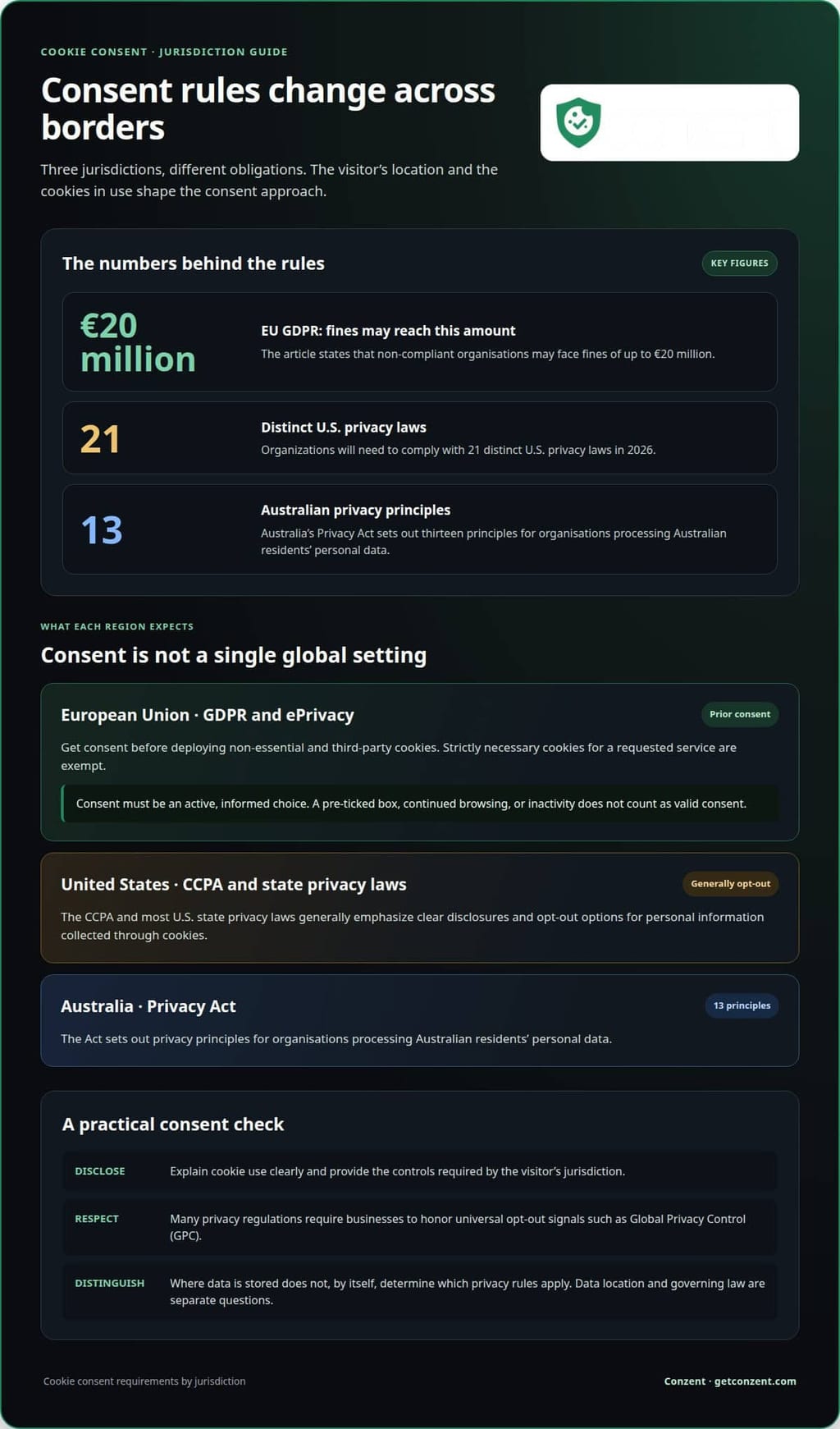
Consent rules determine when websites need permission before collecting information through cookies. The GDPR requires consent before non-essential and third-party cookies are deployed, while strictly necessary cookies for a requested service are exempt. This distinction helps website operators decide which tags can run before a visitor makes a choice.
Under the EU GDPR, non-compliant organisations may face fines of up to €20 million, according to the European Union. A pre-ticked box, continued browsing, or inactivity does not provide valid consent under the GDPR and ePrivacy Directive. Consent must reflect an active, informed choice, not silence or a default setting.
U.S. state privacy laws generally focus on clear disclosures and opt-out options for personal information collected through cookies. The CCPA and most U.S. state privacy laws generally use an opt-out model. There is no single U.S.-wide penalty for cookie violations under state privacy laws; the applicable state statute determines the consequences. In 2026, organizations will need to comply with 21 distinct U.S. privacy laws.
Universal opt-out signals add another layer. Many privacy regulations require businesses to honor mechanisms such as Global Privacy Control (GPC), which communicates a user’s opt-out preference. Australia’s Privacy Act sets out thirteen privacy principles for organizations processing Australian residents’ personal data, according to the Australian Government. Together, these examples show why global coverage can involve different duties, not one worldwide consent rule.
Hosting, consent records, and cross-border flows
Hosting describes where a platform stores data, while cross-border flows describe where that data travels. Cookie consent platforms may store consent records and user data in a cloud provider’s data centers or on an organization’s own infrastructure through self-hosting. The storage location depends on the platform’s deployment and hosting configuration.
International hosting does not remove privacy obligations. The GDPR applies to processing EU residents’ personal data regardless of where processing takes place, and international transfers require appropriate safeguards. Map the data flow from the browser to consent storage, analytics, and other vendors. Then identify each destination and the information transferred.
To audit cookies and trackers, scan the site, record each tag’s purpose and destination, and compare network requests before and after consent. Test rejection and GPC signals, too. Cookie files do not themselves contain viruses or malware, but malicious third parties may access or compromise their data. Include unexpected trackers and cross-border destinations in the same audit.
Cookie consent management tools and plugins
A cookie consent management platform (CMP) connects a website’s consent choices to its tracking and data-processing setup. A plugin can add those controls to a content management system. The right setup depends on the site’s technology and data flows.
These tools can display a banner, record a visitor’s selection, and apply that choice to connected tags. For example, a site can configure analytics tags to wait until a visitor accepts the relevant category. The banner is only the visible layer. The underlying configuration determines whether the website respects the choice.
Useful platform capabilities can include:
- A cookie and tracker inventory that identifies names, purposes, and destinations.
- Consent categories that separate necessary functions from optional tracking.
- A record of the visitor’s selection, including the choice and its timestamp.
- Controls for updating or withdrawing consent and reflecting that change across tags.
These functions support a repeatable review. First, compare the inventory with the scripts active on the site. Next, test the banner’s accept, reject, and preference controls. Then inspect browser requests to see whether optional tags wait for the relevant choice. Repeat the review after adding analytics, advertising, or embedded media, as each can introduce new processing.
Plugins can be convenient for websites built on a supported content management system. A standalone platform may be better suited to sites with several domains, custom scripts, or complex integrations. Either way, check how the tool handles language, accessibility, consent updates, and records. A banner that looks right but fails to control tags leaves a practical gap.
For U.S.-based data hosting, choose a platform whose documented deployment places the relevant consent records and user data in U.S. data centers. Review the full data flow, including backups, support access, and subprocessors. Hosting in the United States describes where data is stored; it does not, by itself, establish which privacy rules apply.
Keep an audit trail of configuration changes. Record when a new tag is added, what purpose it serves, and which consent category controls it. Then test the affected pages in a clean browser session. This connects the cookie inventory to actual site behavior instead of relying on banner settings alone.
Deployment choices shape how a CMP fits your infrastructure and oversight needs. Review consent platform options as part of that assessment, with attention to hosting model and operational fit.
Cookie consent requirements by jurisdiction
A website’s cookie rules depend on the jurisdictions connected to its users and data processing. For an EU website serving visitors abroad, map each relevant law to the choices and disclosures the site presents.
Build a jurisdiction map
Start with the business’s location, the people whose data it processes, and the tracking technologies in use. Then record which privacy framework applies to each audience. An EU business processing personal data in the EU must comply with the GDPR; serving people elsewhere can add other requirements.
The GDPR sets a clear standard for consent. Under Article 4, consent must be freely given, specific, informed, and unambiguous. A single “accept all” action may not communicate the purposes clearly if analytics and advertising involve different choices. Organize the banner’s options around the purposes and processing the site actually uses.
For a UK audience, include both the UK GDPR and PECR in the compliance map. PECR is relevant to cookie disclosure and consent requirements, while the UK’s Data Protection Act was enacted in 2018. These frameworks make the UK a distinct entry in a website’s jurisdiction review, even when its consent interface resembles the EU version.
Brazil’s LGPD is another framework relevant to cookie disclosures and consent. Include Brazil in the review when the site serves people there, then assess the information collected and each tracker’s purpose. Do not assume that a banner designed for EU visitors automatically addresses every local requirement.
In the United States, the California Privacy Rights Act (CPRA) is relevant to cookie consent. State laws differ, so do not treat a U.S. audience as one uniform jurisdiction. Record which states are in scope and connect each applicable rule to the site’s disclosures and preference controls.
Use a compact comparison to make the differences visible:
- European Union: Apply the GDPR consent standard and distinguish cookie purposes.
- United Kingdom: Account for UK GDPR and PECR in the same review.
- Brazil: Include LGPD when assessing disclosures and cookie-related processing.
- United States: Map applicable state laws, including California’s CPRA.
Revisit this map when the audience, tracking setup, or data use changes. For example, adding an advertising tracker can change the purposes described to visitors. A jurisdiction-based review connects each notice and choice to the people affected, rather than relying on one global banner for every case.
Data sovereignty compared with data residency and data localisation
These terms describe different parts of data governance, not interchangeable compliance goals. For cookie consent records, distinguish the governing law from the storage location and transfer rules.
Sovereignty, residency, and localisation distinctions
Data sovereignty concerns which jurisdiction’s laws govern data and who holds authority over it. Data residency describes where data is stored, while data localization means a rule requires storage within a specified territory. This distinction matters because an EU website can store records in one country while processing them under rules tied to another jurisdiction.
Russia’s Personal Data law requires personal data of its citizens to be stored within Russian territory. That is a localization requirement. Residency is a factual question about server location; sovereignty asks which laws may apply. A data subject’s location, the organization’s role, and its processing activities can also shape the legal picture.
Use a data-flow map to keep these concepts distinct. Mark where a visitor’s browser creates a consent record, where the platform stores it, and which services receive it. For example, a record might be stored in an EU data center while a support or analytics process involves another country. Server location alone does not describe every transfer or governing rule.
Cookie rules and data location
The GDPR and ePrivacy directive address privacy and cookie processing, while residency concerns physical storage location. The ePrivacy directive, also called the Cookie Law, protects online communications. The GDPR applies to EU residents’ personal data regardless of where it is processed, so moving a server outside the EU does not by itself remove GDPR obligations.
The GDPR does not explicitly prohibit international transfers, but imposes strict rules and oversight. Article 45 permits transfers based on an adequacy decision, while Article 46 permits them with appropriate safeguards. Article 49 provides derogations for specific circumstances. These transfer mechanisms address legal safeguards, not a blanket promise that data stays in one place.
For a consent platform, assess the full data route, not just the server region. Identify the consent record, hosting location, subprocessors, and any access or transfer across borders. Then distinguish whether the concern is a law governing processing, a required storage location, or safeguards for an international transfer. This helps teams explain their setup clearly and identify which controls need attention.
Cookie settings and infrastructure decisions solve different problems. A consent choice governs whether particular cookie-related processing may proceed; residency records where information is stored. A sovereignty review considers the laws governing data and the authority over it. Treat each as a separate part of the same data map, and connect them through documented flows.
GDPR, ePrivacy, Data Residency, and Sovereignty
Cookie rules govern choices about tracking; data residency concerns storage location. For EU websites, both questions matter, but they address different risks.
The EU ePrivacy directive, also called the Cookie Law, protects online communications. The GDPR governs personal-data processing, including processing linked to cookies. It applies to EU residents’ personal data regardless of where that processing takes place. Moving consent records to another country therefore does not remove the GDPR’s reach.
Separate the questions in your data map. First, identify which cookies and trackers collect personal data and what each one does. Next, note where consent records and related data are stored. Then trace any access or transfer across borders. This makes it easier to distinguish permission to run a tracker, the law governing processing, and the physical location of stored information.
International transfers add a legal layer. The GDPR does not explicitly prohibit transfers, but imposes strict rules and oversight. Article 45 permits transfers based on an adequacy decision. Article 46 permits transfers with appropriate safeguards, and Article 49 provides derogations for specific circumstances. These routes concern transfer conditions, not a general requirement to store every record inside the EU.
Consider an EU website that stores consent records in an EU data center but uses a service that accesses them from outside the region. Storage location is one fact; the access route may raise a separate transfer question. Conversely, hosting data in the EU does not show whether a cookie was properly disclosed or whether a visitor’s choice controls the relevant tracker.
Keep operational records that connect these issues. For each cookie or tag, note its purpose, the data collected, consent category, and destination. For each consent record, document its storage location and any cross-border access. When adding an analytics or advertising service, update both records and test whether the site still follows the visitor’s choice.
- Cookie permission: Is the tracker allowed to run under the visitor’s selected choice?
- Processing law: Which rules govern personal-data use, wherever it occurs?
- Residency: Where does the platform store the record?
- Transfer: What safeguards apply when personal data moves across borders?
That separation makes cookie consent data sovereignty easier to assess: a banner, a server location, and a transfer safeguard each answer a different question. If your setup needs a consent platform aligned with these operational requirements, explore consent platform options.
Conzent: Managed Cloud Consent Platform
Conzent helps websites put consent choices into practice through its Managed Cloud Consent Platform and Self-Hosted Open Consent Infrastructure. Choose the managed option for cloud-based consent management, or self-host the open infrastructure when keeping deployment on your own infrastructure is central to your data governance approach.
Consent A/B Testing and Revenue Impact Analytics help teams assess how banner choices affect user responses and website revenue. These tools support consent operations, but they do not replace legal analysis of which rules apply to your organization.
If you’re deciding how to align consent management with your hosting and data-handling needs, contact Conzent to discuss your setup.
Make your next consent decision part of the design
Cookie consent data sovereignty is not a one-time banner choice. It is an ongoing design decision that should keep pace with changes to your website, tracking setup, and data flows. Make ownership clear by assigning responsibility for reviewing new tags, updating consent settings, and documenting changes. This turns compliance from a launch task into a working practice.
Choose a consent setup that fits how your organization manages infrastructure and user choices. Conzent offers managed and self-hosted options, plus Consent A/B Testing. The right arrangement should support your operational needs without confusing storage location with legal responsibility.
Give your next review a practical starting point: identify who is responsible for consent changes, then decide how your team will record and test them. A clear process makes future updates easier to manage and explain.
Talk with Conzent about your cookie consent setup and take the next step with clarity.
Frequently Asked Questions
What is data sovereignty?
Data sovereignty asks which legal authority and decision-makers govern a dataset. For a consent record, identify the organization that determines its purpose, the platform that holds it, and the services that can access it. Then assign responsibility for retrieving, correcting, restricting, or deleting the record. This ownership map helps teams explain who controls consent information and how they handle it, rather than treating server location as the whole answer.
How do cookie consent laws address data sovereignty in the United States?
In the United States, assess control by considering the data’s purpose, the organizations handling it, and the rights that apply to the people involved. A U.S.-based server alone does not show who can access records or respond to a consumer request. Document which organization decides how consent information is used, which vendors handle it, and who can respond to requests. This gives teams a clearer picture of practical control.
What U.S. state privacy laws require consent before using cookies or tracking technologies?
U.S. state privacy laws generally do not require prior consent simply because cookies process personal data. Still, avoid treating every tracker identically. For each one, record its purpose, the data it collects, and whether applicable state rules call for a particular preference control. This helps teams configure choices around actual tracking activity instead of relying on one broad state label or assuming every cookie serves the same function.
What are the data sovereignty risks of third-party cookies and consent management platforms?
A key risk is losing clear control over who can access cookie-related information. Third-party services may receive identifiers, while a consent platform may hold records of user choices. Limit access to the roles that need it, set retention practices for each record type, and include deletion handling in vendor processes. Review whether removing a tracker also stops its associated data collection, not just the visible cookie.
What steps help make a website's cookie consent and data transfers compliant?
Make consent and transfer reviews part of website change control. Assign a privacy owner and a technical owner, then require each new tag or vendor request to state its purpose, data access, and destination. Test the change in staging before release, including how the consent interface behaves. Keep a dated record of the decision and configuration so teams can trace why a tag was introduced and what changed later.
How do cookie consent requirements differ across U.S. states and between the U.S. and EU?
These differences affect how teams should configure the visitor experience. A site serving both U.S. and EU audiences can use jurisdiction-specific banner settings, wording, and preference controls instead of forcing every visitor through an identical flow. Tie those profiles to the rules the organization applies, and test them with representative regional settings. This makes local choices clearer and reduces the chance that one audience receives controls designed for another.