
DPO Guide to Cookie Consent Rules, Records and Tags

A non-essential cookie or tracking tag should not run before a user gives valid consent. Strictly necessary cookies are the exception. This DPO guide to cookie consent explains the rule behind that distinction and why a banner alone is not enough if tags still fire in the background.
Consent can feel like a legal checkbox, but the real test is what a website does before and after someone makes a choice. In the EU, the framework includes the ePrivacy Directive and the GDPR; rules differ in other markets. This guide explains when cookies may load, what information to give users, and how to record consent and enable withdrawal. It also covers the DPO’s role, the rules affecting cookies in the EU and beyond, and how tag controls and Google Consent Mode can help enforce user choices.
Key Takeaways
- Separate strictly necessary cookies from those that need consent, and make sure non-essential tags respect the visitor’s choice.
- Keep a clear record of consent and provide a straightforward way for users to withdraw it.
- Understand how the ePrivacy Directive and GDPR shape cookie consent across the EU.
- Use data protection authority guidance to assess banner design, user choice and access to services.
- Connect consent signals to tag behaviour so Google Consent Mode and other tags reflect the choices visitors make.
What is a cookie dropped before consent?
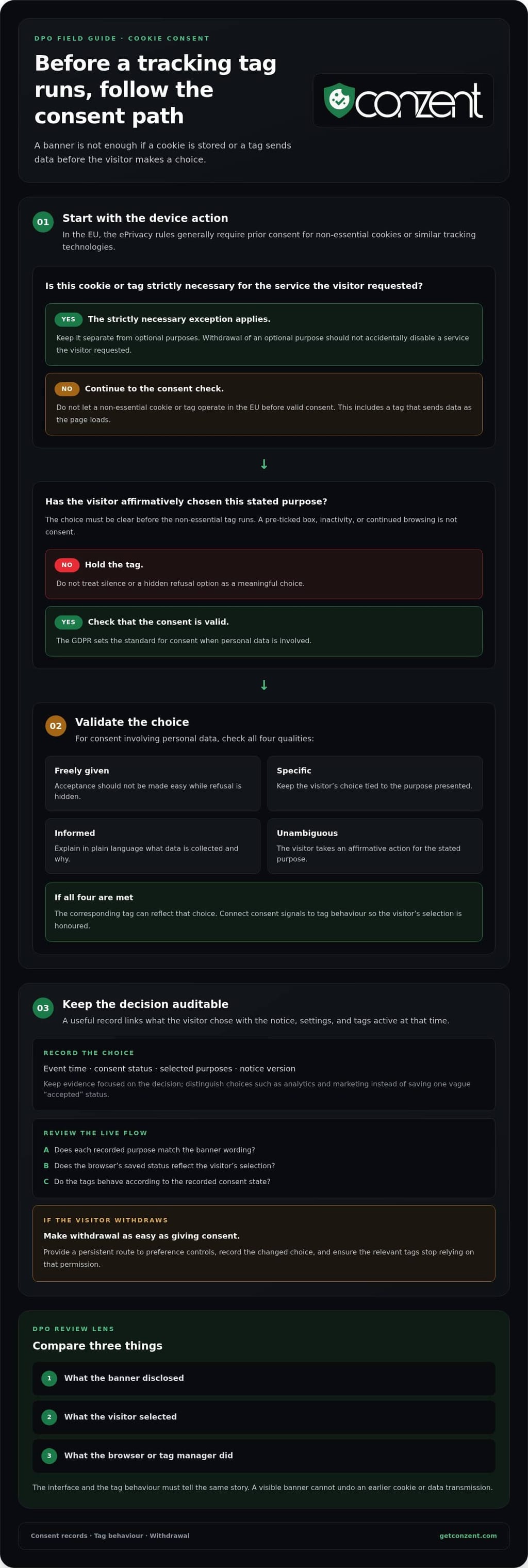
A cookie is set before consent if a website stores or reads it before a visitor agrees. The same concern applies when a tracking tag sends data first. For example, a retargeting tag that activates as a page loads may transmit identifiers before the banner appears. A practical DPO guide to cookie consent starts with this distinction: a visible banner cannot undo an earlier action. The key compliance question is what the browser and connected services do before the visitor chooses.
In the EU, the ePrivacy Directive governs storing information on, or accessing it from, a user’s device. It generally requires consent before non-essential cookies or similar tracking technologies operate. The GDPR, or General Data Protection Regulation, sets standards for valid consent when personal data is involved. Article 7 requires consent to be freely given, specific, informed, and unambiguous. Together, these rules mean a banner must reflect a real choice, not merely announce tracking.
Consent differs across the CCPA, GDPR, and ePrivacy rules. The EU rules generally require prior consent for non-essential device storage or access, while the CCPA focuses on consumer privacy rights, including opting out of the sale or sharing of personal information. According to the California Legislature, the CCPA allows fines of up to $7,500 per intentional violation and $2,500 per unintentional violation.
The United States has no federal cookie law, but state privacy laws such as the CCPA affect cookie-related data practices. Internationally, applicable rules depend on where a business operates and whom it targets. The GDPR can apply to a U.S.-based business offering goods or services to people in the European Economic Area. The ePrivacy Directive and the national laws that implement it also shape cookie consent across EU countries.
A valid banner should explain in plain language what data each cookie collects and why. It should identify relevant purposes and make the available choices clear before non-essential tags run. For example, “analytics” should explain the measurement purpose rather than rely on a technical cookie name. The GDPR also requires withdrawal to be as easy as giving consent, so visitors need a clear way to change their choice later.
Consent is not established by a pre-ticked box, inactivity, or continued browsing. The visitor must take an affirmative action, such as selecting an enabled option for a stated purpose. A banner that makes acceptance easy but hides refusal undermines meaningful choice. DPOs should assess the banner and tag behaviour together, because interface wording alone cannot show whether the site honoured the decision.
Cookie consent practices have prompted formal complaints. In August 2021, noyb filed approximately 400 GDPR complaints against entities whose practices it considered unsatisfactory. That history illustrates why a DPO should treat banner design and tracking behaviour as evidence, not cosmetic details. If a tag fires before consent, preserve the relevant configuration and records, identify its purpose, and assess which users and data flows may be affected.
Consent records and withdrawal
Consent records show what a visitor chose; withdrawal records show when that choice changed. A useful audit trail links both decisions to the consent settings and tags active at the time.
Cookie Consent Records
Cookie consent records document the visitor’s choice, the purposes presented, and the consent notice or settings in effect. They help teams show whether a browser accepted, refused, or changed a particular purpose. For example, a record can distinguish an analytics choice from a marketing choice instead of storing one vague “accepted” status.
Keep records useful without collecting unrelated details. A practical record may include the event time, consent status, selected purposes, and notice version. The ICO advises organisations to retain cookie consent records for an appropriate period. That period should reflect why the evidence is needed and how long it remains relevant.
Audit Trails and Reviews
An audit trail preserves changes to consent settings over time, including the visitor’s initial choice and any later withdrawal. It matters because a browser’s current setting alone may not explain what happened during an earlier visit. If a tag configuration changes, the trail can help compare its behaviour with the consent state recorded at the time.
Review records against the live consent flow. Confirm that each recorded purpose matches the banner wording and that the browser’s saved status reflects the visitor’s selection. When a new tag or purpose is introduced, check that the notice and consent categories still accurately describe the activity. Record the review and any corrective action.
Recordkeeping and Accountability
Recordkeeping supports accountability by giving privacy, marketing, and technical teams shared evidence of decisions. A DPO can use these records to identify who owns each purpose, which tags depend on consent, and what should happen after withdrawal. This is useful during an internal review or when someone asks how their choice was applied.
Assign an owner to maintain the notice, consent categories, and tag mapping. When a visitor withdraws consent, record the change and ensure the relevant tags stop relying on that permission. Keep strictly necessary functions separate from optional purposes, so withdrawal does not accidentally disable a service the visitor requested.
Withdrawal should be as easy as giving consent. Provide a persistent route to the preference controls, then update the saved choice and connected tags when a visitor changes it. Test the flow in a browser: refuse a purpose, revisit the controls, withdraw a previous acceptance, and confirm that the corresponding tag no longer runs under that consent.
Review the recordkeeping model when the notice, purposes, or tracking setup changes. A simple review can compare three things: what the banner disclosed, what the visitor selected, and what the browser or tag manager did. If you’re assessing a consent platform as part of that work, compare the factors behind consent platform pricing alongside its recordkeeping needs.
What Laws Impact Cookies in the EU?
EU cookie rules rely on the ePrivacy Directive and the GDPR, which address access to devices and personal data. Prior consent is required before a non-essential cookie or similar technology stores information on, or reads information from, a user’s device.
EPrivacy Cookie Consent Requirements
The ePrivacy Directive sets the EU baseline for storing information on, or accessing information from, a user’s device. The technology’s operation matters, not just whether it is called a cookie. Similar tracking tools can also fall within the rules on device storage and access.
The directive was passed in 2002 and amended in 2009. EU countries must incorporate its requirements into national law, so implementation and enforcement sit within each country’s legal framework. For a website serving people across several EU countries, the same consent banner may need to account for those national rules.
Strictly necessary cookies are exempt from consent, but users should be told what they do and why they are necessary. By contrast, analytics cookies, including Google Analytics, require prior consent under the ePrivacy Directive. A tool’s familiar name or widespread use does not remove that requirement.
When Prior Consent Is Required
Prior consent is needed when a cookie or comparable technology stores information on, or accesses information from, a device and does not qualify for the strictly necessary exception. This matters before tags run: a banner shown after a tracker has already fired comes too late for that activity.
For example, a marketing tag that reads a device identifier before a visitor accepts has acted before consent. Under the stated EU rule, an analytics tag must also wait for consent, even if it only measures page visits. Separate purposes in the banner so users can make a meaningful choice about each activity.
The ePrivacy Directive and GDPR work together, but they are not interchangeable. The directive addresses device storage and access; the GDPR governs personal data processing and consent standards. A cookie can raise both issues if it accesses a device and the resulting data identifies or relates to a person.
The European Commission withdrew its proposed ePrivacy Regulation in 2025, and the ePrivacy Directive remains in force. The distinction matters: a directive must be incorporated into national law, while an EU regulation becomes binding throughout the EU when it comes into effect.
In late 2025, the European Commission’s Digital Omnibus package proposed folding cookie-consent rules into the GDPR. That remains a proposal, not law. For now, teams should assess the ePrivacy Directive and applicable national rules, rather than treating the proposed solution as an enacted change.
European data protection authority guidance on cookie consent
European data protection authorities focus on whether visitors have a real choice and whether tracking respects it. Their guidance covers banner design, tag behaviour, and the controller’s responsibility for processing.
DPO Responsibilities and Controller Accountability
A DPO advises on data protection risks and compliance, while the data controller remains responsible for operational decisions. GDPR Articles 37-39 set out provisions relevant to the DPO’s role. This distinction matters: the DPO can identify risks in a cookie setup, but the controller must ensure the website and its tags follow the chosen approach.
For a practical review, map each cookie purpose to its tag, the data collected, and the required consent signal. Then record who approves changes to notices or tracking. The ICO says organisations may need a data protection impact assessment when cookies involve personal data. The assessment helps identify risks before a new advertising or analytics tool starts processing information.
Consent for Analytics and Advertising Cookies
Analytics, advertising, and third-party cookies need consent where the rules require it; calling something “analytics” does not create an exemption. Under EU ePrivacy rules, analytics cookies, including Google Analytics, require prior consent. A third-party tag should therefore stay inactive until the relevant choice is given, even if another company operates it.
European authority guidance also rejects consent obtained through pressure or silence. Pre-ticked boxes, inactivity, and implied consent do not meet the active affirmative action required by GDPR standards. The European Data Protection Board considers cookie-wall consent invalid when access depends on accepting cookies. A banner should give users a genuine way to refuse optional purposes.
Choice must work in the interface. In July 2021, France’s CNIL issued formal notices to 40 organizations for failing to let users refuse cookies as easily as accepting them. A DPO can compare the effort required for each action: if accepting takes one click but refusal requires several screens, the design creates friction against refusal.
Coordination matters because cookie practices cross national borders. On 25 September 2021, the European Data Protection Board established a task force to help authorities harmonize banner responses and coordinate work on 422 complaints filed by noyb in August. A consistent review should examine notices, consent controls, and whether tags respect each recorded choice.
Both cookie function and data collection matter. Under UK PECR, device-storage and access rules apply even when cookie data is anonymous. If a cookie involves personal data, the ICO says an organisation may need a DPIA. Assess what each tag collects, its purpose, and whether it shares information with advertising or analytics partners.
Assess device access separately from personal data processing. A business may process personal data with consent or, where applicable, a legitimate interest, but that does not remove ePrivacy consent requirements for device access. A DPO’s review should therefore test both the cookie’s function and the data processing it enables.
Consent enforcement through tags and Google Consent Mode
A consent banner records a choice, but tags must act on it. Enforcement depends on how the consent platform, tag manager, and individual scripts connect. Google Consent Mode communicates consent signals to Google tags, which can adjust their behaviour in response. It does not obtain consent from visitors or automatically make unrelated tags compliant.
Start with an inventory of tags and their purposes. For each tag, identify whether it supports an essential function, analytics, or advertising, and which consent signal should control it. For example, where consent is required, an analytics tag should not run before the visitor grants the relevant permission. A marketing pixel needs its own correct mapping, not an assumption that every script follows the banner.
Then connect each banner choice to the matching tag behaviour. A visitor might accept analytics but refuse advertising. The tag manager should pass that distinction accurately, so one choice does not silently activate another purpose. Google Consent Mode can communicate consent choices to Google tags, but the website’s configuration determines whether the intended signals reach them.
Keep the enforcement chain clear: the banner obtains the visitor’s choice, the consent layer stores and communicates it, and tags respond according to their configuration. If a tag fires before the signal arrives, the sequence fails even if the banner later displays correctly. Check the order of operations on page load, including scripts added by plugins, embedded media, and advertising partners.
Test real visitor journeys, not just the default page state. Open a clean browser session, reject optional categories, and check whether related tags activate. Repeat after accepting a purpose, then change that choice through the preference controls. Compare the consent state with tag activity each time. Testing refusal matters as much as testing acceptance.
Google Consent Mode is a signalling mechanism, not a substitute for the consent interface or tag governance. It can help Google tags respond to consent signals, while other vendors’ scripts may need separate controls. A DPO and technical owner should agree on which purposes each signal represents, who maintains the mapping, and how configuration changes are reviewed.
Use a change process whenever marketing adds a tool or alters a tag. Record its purpose, trigger conditions, and the consent state required before it runs. After deployment, test acceptance, refusal, and withdrawal again. This gives the team a practical way to find mismatches between what the banner promises and what analytics or advertising tags actually do.
If you’re evaluating a platform to manage consent signals and tag behaviour, explore consent platform options for your implementation needs.
Conzent: Managed Cloud Consent Platform
Conzent provides a Managed Cloud Consent Platform for teams managing consent banners and choices. Organizations that prefer to run the infrastructure themselves can use its Self-Hosted Open Consent Infrastructure, which is free to self-host.
Consent A/B Testing helps teams compare banner designs, while Revenue Impact Analytics shows how consent choices relate to revenue. These tools can support organizations reviewing their consent controls alongside measurement needs. Conzent provides consent management tools, not legal representation or website development.
If you’re assessing consent infrastructure for your organization, explore Conzent’s platform and start a free trial.
Make consent part of your operating practice
Cookie compliance works best as an ongoing practice, not a one-time banner project. Give privacy, marketing, and technical teams a shared process for reviewing new tags, changing purposes, and testing consent behaviour. This turns policy into day-to-day decisions and helps teams catch mismatches before they become routine.
Use this DPO guide to cookie consent as a starting point for a focused internal review. Map who owns each decision, how changes reach the website, and how the team records outcomes. Then agree on a review cycle that fits your organisation’s release process. Clear ownership makes the work easier to maintain as tools and business needs change.
For a consent platform that fits your implementation, contact Conzent about your cookie consent needs. A thoughtful process and the right infrastructure can help your team make user choice part of how the website works every day.
Frequently Asked Questions
Are cookie walls allowed under the GDPR?
Generally, no. The European Data Protection Board considers consent invalid when a website makes access conditional on accepting cookies. The key question is whether the person has a genuine choice. Italy’s Garante has described a narrow exception where users have a genuinely equivalent way to access the same content without consenting. A DPO assessing a paywall-style banner should distinguish an equivalent access option from a design that simply blocks refusal.
Are there any exemptions?
Yes. Strictly necessary cookies are exempt from consent when they support a service the user requested, such as keeping a chosen item in a shopping basket. A cookie used solely to transmit a communication over an electronic communications network is also exempt under UK PECR. These exemptions depend on the cookie’s actual function, not its label. A cookie used for an additional analytics or advertising purpose may need separate consent.
Do I have to list every cookie in my policy?
Not necessarily. The UK’s ICO advises that cookie policies describe cookie categories, their purposes, and involved third parties rather than requiring a line-by-line inventory. For example, a policy might explain analytics cookies and name the analytics provider. Keep the explanation aligned with the site’s actual tags: if a new advertising partner or purpose is added, update the relevant policy information so visitors are not misled.
Do the rules still apply if the data is anonymous?
Under UK PECR, device-storage and access rules apply even if the information collected is anonymous. The cookie’s operation matters, not only whether its data identifies someone. For example, an analytics cookie that stores information on a device can still fall under PECR. Separately, consider whether the data becomes personal during later processing, such as when a service combines it with other information.
Is the DPO responsible for their organisation’s cookie compliance?
No. The data controller remains responsible for operational compliance; the DPO advises and monitors. GDPR Articles 37-39 describe provisions relating to the DPO’s role. For example, a DPO can flag that a new analytics tag changes the site’s data processing and recommend a review. The controller must make and implement operational decisions, including whether the tag launches only after the required consent.
What counts as consent?
Consent must be freely given, specific, informed, and unambiguous, with an active affirmative action. A visitor selecting “accept analytics” after learning what analytics does is a clearer signal than continued browsing. A pre-ticked box, inactivity, or simply staying on the page does not show an active choice. Make each purpose understandable so the recorded selection reflects what the person agreed to.
What is a DPO's role in cookie consent compliance?
A DPO advises the organisation, monitors compliance, and helps identify risks in how cookies and tags process data. For example, when marketing proposes a new pixel, the DPO can ask what it collects, who receives the data, and which consent choice controls it. The DPO does not replace the controller’s decisions. The controller remains accountable for putting appropriate controls into practice.
How should websites offer accept, reject, and customize cookie options?
Present choices clearly, making refusal and acceptance comparably easy. Customisation should let visitors choose purposes separately rather than force an all-or-nothing decision about optional cookies. For example, offer distinct controls for analytics and advertising, then apply the saved choices to their respective tags. Keep a route to preference settings available later, so visitors can revise their choices without searching through the policy.