
GDPR Consent Audit Trail: How to Document and Manage Consent Evidence

A timestamp alone can’t explain a consent decision. A useful GDPR consent audit trail connects each choice to the purposes, notice, and banner version a person saw when they made it. Without that context, a record may show that someone clicked, but not what they were asked to agree to.
Capturing consent events is only the first step. The harder part is keeping the evidence meaningful as banners and configurations change, and making sure withdrawal is as easy as giving consent. Clear links between each event and its context make records easier to interpret and maintain.
This guide explains what a proportionate consent evidence model can include and how to build it into your workflow. You’ll learn how to connect choices with the relevant notice and purpose versions, preserve context as configurations change, and manage consent operations consistently. A consent-management platform can help organize banner configurations, testing, integrations, and related workflows, but it can’t guarantee legal compliance on its own. The evidence still needs to reflect how your organization actually collects and manages consent.
Key Takeaways
- Build a GDPR consent audit trail that links each choice to its time, purpose, and the notice or banner shown.
- Keep consent-event evidence distinct from processing records and security logs so each record serves a clear purpose.
- Map consent choices, banner content, and integrations before setting up a repeatable workflow for reviews and updates.
- Use a consent platform to support banner configuration, testing, and integrations while keeping accountability with your organization.
What a GDPR consent audit trail proves, and what it does not
A GDPR consent audit trail is contextual evidence of consent events. It helps an organization explain what choice a person made, when they made it, and the circumstances surrounding that choice. A click or stored preference has limited meaning on its own. Its value comes from connecting the event to the purposes and information presented at the time.
That evidence supports accountability. It can help show how consent was requested and recorded, but it cannot establish that every part of the organization’s processing is lawful. A record of permission for one purpose does not justify using personal data for an unrelated purpose, nor does it prove that every system followed the person’s choice. The General Data Protection Regulation (GDPR) sets a broader framework for personal-data processing, including principles that reach beyond consent records.
Consent evidence is more than an accept-or-reject flag
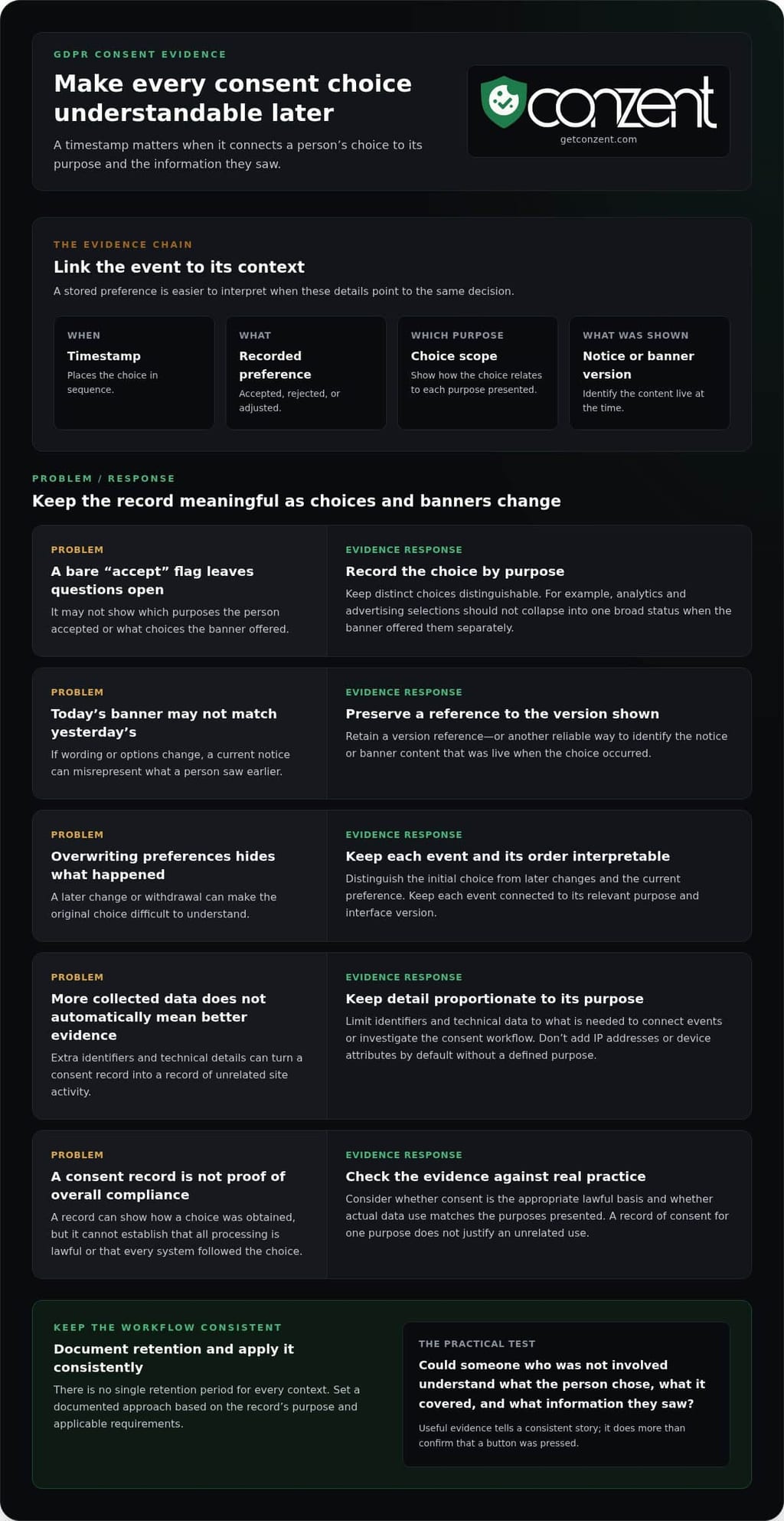
A bare “accept” flag leaves important questions unanswered. Which purposes did the person accept? What did the notice say about them? Which banner or preference interface presented the options? Without this context, someone reviewing the record later may not be able to tell what the choice meant.
For example, an event that records acceptance of analytics cookies should be distinguishable from acceptance of advertising cookies if the banner offered those choices separately. The related notice or banner version helps explain the information available to the person at that moment. These are practical evidence examples, not a universal list of mandatory fields. The right level of detail depends on the processing and how consent is collected.
What GDPR accountability means for consent records
Article 7(1) of the GDPR addresses the controller’s ability to demonstrate that a person consented to processing. In practice, a useful record should let the organization explain the decision, rather than simply point to a stored status. The evidence should be clear enough for someone who wasn’t involved in collecting it to understand what happened.
Consent evidence can show how a choice was obtained; it cannot guarantee that the processing around it complies with the GDPR. Implementation details and legal interpretation depend on the processing context. The organization still needs to consider whether consent is the appropriate lawful basis and whether its actual data use matches the purposes presented. A broader GDPR compliance overview can help place consent within that wider picture.
This distinction keeps the evidence model proportionate. Record enough context to interpret the consent event and explain how it relates to the processing. Don’t treat a log entry as a substitute for reviewing the notice, the purposes, or what the organization does in practice. Evidence is useful when it tells a consistent story, not when it merely confirms that a button was pressed.
Which details make a GDPR consent audit trail interpretable?
A consent record is useful when a reviewer can answer practical questions: When did the event happen? What did the person choose? Which purposes did the choice cover? What information was presented? These are evidence categories to consider, not a universal set of fields required for every implementation. The right record depends on how your site collects consent and what you may need to explain later.
Each detail should serve a clear purpose. Avoid collecting extra personal or technical data simply because it’s available. A proportionate GDPR consent audit trail preserves enough context to explain the event without turning a consent record into a record of every interaction a person has with your site.
Connect the user’s choice to the information shown
Start with the event itself. A timestamp places the choice in sequence, while the recorded preference shows whether the person accepted, rejected, or adjusted an option. Where a banner separates purposes, preserve which purposes appeared and how the person’s choice related to them. A broad “accepted” status can be difficult to interpret if the interface offered distinct choices.
Next, connect the event to the applicable notice or banner version. Retain a version reference or another reliable way to identify the content that was live when the choice occurred. If wording or options change, the record should still point to the earlier version, rather than presenting today’s notice as though it were shown then. Conzent’s customizable cookie consent banners help teams manage the interface and its wording as part of this process.
Record preference changes without losing the sequence
People may revisit or withdraw a preference. Keep later events distinguishable from earlier ones so a reviewer can follow the sequence: an initial choice, a subsequent change, and the current preference. Each event should remain interpretable on its own and connected to the relevant purpose and interface version. Don’t overwrite history in a way that makes the original event impossible to understand.
There’s no single retention period that fits every context. Set a documented approach based on the purpose of the records and applicable requirements, then apply it consistently. Limit identifiers and technical details to what’s needed to connect events and investigate the consent workflow. IP addresses, device attributes, or other data shouldn’t be added by default if they don’t serve a defined purpose.
Vendor or framework details matter when they help explain how consent choices travel through your actual setup. For example, if your implementation uses a consent framework or passes preferences to an integration, documenting the relevant configuration can help explain the event’s path. Don’t add technical labels that no one can interpret or that have no bearing on the processing.
Event context turns a stored preference into an interpretable account of what the person was asked and how they responded. If you’re assessing a consent platform for this workflow, review available platform options alongside your operational needs.
Consent audit trail vs. other GDPR records: where the boundaries sit
Privacy documentation works best when each record answers a distinct question. A consent event record explains a person’s interaction with a consent interface. Other records describe processing activities or help investigate system events. These records can inform one another, but combining their purposes can make the evidence harder to interpret.
| Record type | Purpose | Typical content | Primary audience |
|---|---|---|---|
| Consent-event evidence | Explain a consent interaction | Choice, event time, relevant purposes, and the applicable notice or banner context | Privacy, compliance, and operations teams reviewing consent |
| Records of processing activities | Describe processing activities at an organizational level | Documentation about processing operations, maintained for the organization’s accountability needs | Privacy teams, management, and supervisory authorities where relevant |
| Security logs | Help monitor or investigate technical activity | System events relevant to security monitoring or investigation | Security and technical teams |
Consent events and records of processing activities answer different questions
Consent-event evidence focuses on a specific interaction: what choice was made and in what context. A record of processing activities serves a broader documentation function by describing processing at an organizational level. Neither replaces the other. A consent record cannot describe every processing operation, while broader documentation may not show what a person saw or selected during a particular interaction.
Security logs have a different purpose. They can help technical teams understand system activity, but a log entry is not automatically proof of a person’s informed choice. Keep records connected where useful, but clearly label and manage them for their separate purposes.
Consent evidence is not the same as downstream consent signals
A stored preference and a signal passed to an advertising or analytics system are related, but they are not the same evidence. The first concerns the choice captured through the consent process. The second concerns how a system receives or applies information about that choice. Integrations can support coordination, but they don’t establish by themselves what the person was shown or whether downstream processing matched the preference.
Where a framework is part of the implementation, document how it fits into the consent flow. An IAB TCF 2.3 implementation guide can help explain the framework’s role, but the organization still needs to understand its own configuration and processing.
A consent trail also doesn’t replace the notice presented to people, an assessment of the appropriate lawful basis, or other relevant documentation. Treat it as one part of the evidence picture. For legal interpretation, consult the primary GDPR text, including provisions relevant to your processing. How those provisions apply depends on the facts and context; the comparison above is an operational distinction, not a legal conclusion.
How to build a proportionate GDPR consent audit-trail workflow
Build the process around your live setup, not an idealized diagram. Map how choices appear on the site, where preferences go, and who maintains the configuration. Then test whether the evidence remains understandable as the setup changes.
- Map purposes and choices. Inventory the purposes for which your site requests consent and match each one to the choice a visitor can make. Include the wording and options shown in the banner or preference interface. Note where choices are separate and where a single selection covers more than one purpose.
- Trace the consent flow. Identify the integrations that receive or use consent-related signals, such as analytics or advertising systems. Record how each connects to the relevant purpose and choice. Focus on the actual site configuration, including embedded tools and tags, rather than relying only on a vendor list.
- Define the evidence context. Decide how the workflow will connect a consent event to its time, selected preference, relevant purposes, and the banner or notice version shown. Keep a record of configuration changes so teams can interpret earlier events against the interface and settings that applied then.
- Test the full path. Make representative choices in the live or test environment, including rejecting, accepting, adjusting, and later changing a preference where those options exist. Check that the resulting evidence can be understood against the interface shown, and verify that connected systems respond as intended. Record gaps and assign someone to resolve them.
- Set access, retention, and ownership. Name the role responsible for reviewing the workflow and coordinating responses to requests for consent evidence. Limit access to people who need it for defined work. Set retention practices based on the record’s purpose, risk, and applicable requirements. Don’t assume one period fits every organization.
- Review after changes. Reassess the workflow when purposes, banner content, integrations, or site configuration change. Include periodic reviews even when no change is planned. Confirm that current choices still map to the right purposes and systems, and that older configuration references remain understandable.
Keep the process proportionate. The aim isn’t to capture every technical detail or create a second copy of every operational log. It’s to make consent evidence clear enough for an authorized reviewer to follow the choice and its path through your setup. A consent platform can help organize banner configuration and related workflows, but your team remains responsible for checking that the implementation reflects actual processing.
If managed hosting is part of your platform evaluation, compare managed cloud pricing alongside your workflow and operational needs.
Use a consent platform to make evidence workflows manageable
A consent-management platform can bring banner configuration, preference choices, testing, and connected services into a more consistent operational workflow. It can help teams manage how consent is requested and how related systems are configured. It does not, by itself, establish that a GDPR consent audit trail is complete or that every processing activity is lawful. Your evidence process still needs to reflect the site’s actual setup and the decisions your organization makes.
Match platform operations to the evidence workflow
Start with the consent interface. Conzent’s customizable banners let teams configure how choices are presented. Consent A/B testing helps compare banner variations, while revenue impact analytics provide insight into the relationship between consent choices and revenue. Treat these as operational tools. When a banner changes, make sure your change process preserves the context needed to interpret earlier events.
Integrations also need a clear place in the workflow. Conzent supports IAB TCF v2.4 and Google Consent Mode v2, connecting consent operations with relevant advertising and analytics ecosystems. These integrations can support coordination between the consent interface and connected technologies, but they don’t replace evidence of the choice itself or a review of how each system applies it. Map the integrations you use to the purposes and signals involved.
A managed cloud consent platform can provide a central operational point for banner configuration and related consent workflows. Keep your internal documentation aligned with banner and integration changes that affect your evidence model. A platform’s configuration alone doesn’t explain what a person saw or how your organization used the resulting preference.
Choose an operating model that fits your team
Managed cloud and self-hosting are different operating approaches, not a universal ranking. Conzent’s managed cloud service includes infrastructure maintenance, automatic updates, and cloud-based analytics dashboards. This suits teams that want those infrastructure operations handled as part of the service.
With Conzent’s self-hosted open consent infrastructure, the platform runs on your organization’s infrastructure. That approach can fit teams that prefer to host the system within their own environment. In either model, decide who owns banner changes, integration checks, evidence review, and access controls. Deployment affects how the platform is operated; it doesn’t transfer responsibility for the organization’s consent practices.
Choose the setup your team can govern consistently. Consider how each option fits your infrastructure and the people responsible for maintaining consent operations. To assess the managed cloud option against your needs, explore Conzent pricing.
Make consent evidence part of everyday operations
Make consent evidence part of how your team works, not a file someone searches for only when a question arises. Build shared understanding among the people who manage privacy, product changes, and technical integrations. A clear process helps each person see how their decisions affect the evidence others may need to interpret later.
That shared understanding matters as teams, tools, and responsibilities evolve. Write down the reasoning behind your approach in plain language and make it accessible to the people who maintain it. A GDPR consent audit trail is more useful when your organization can explain not just what it records, but how those records inform responsible decisions.
If you’re evaluating a consent platform to support this work, explore Conzent pricing and choose the operating model that fits your team. A thoughtful process is achievable, and clear decisions help build more accountable privacy practices.
Frequently Asked Questions
Is a GDPR consent audit trail legally required?
Where an organization relies on consent, GDPR Article 7(1) requires the controller to be able to demonstrate that consent was given. It doesn’t prescribe one technical log format or require use of a particular platform. Treat the GDPR consent audit trail as an evidence-design decision: document why your approach fits the way consent is collected, and seek context-specific legal interpretation when the processing or collection method raises questions.
What should a GDPR consent audit trail include?
Choose details that let your team explain the consent process without collecting data just because it’s available. If people can select separate purposes, preserve enough detail to distinguish those selections. If a framework or vendor affects how preferences are handled, note its role in the setup. The appropriate detail depends on the implementation. Avoid adding identifiers or technical attributes unless they serve a defined operational purpose.
How long should consent records be kept under GDPR?
There’s no single retention period that applies to every organization. Set a documented schedule that considers why the records remain useful, how long the related processing continues, and applicable requirements. Define who reviews the schedule and what event prompts that review, such as ending a processing activity or replacing a consent system. Don’t let records accumulate indefinitely simply because no one has assigned responsibility for deletion.
Can a cookie banner screenshot prove consent?
A screenshot can preserve a visual reference, but it may become misleading if it’s detached from the release or configuration it represents. Label interface snapshots clearly so a reviewer can identify which deployment they document. If the site presents different language or layouts across devices or regions, one screenshot may not represent every visitor’s experience. Treat screenshots as supporting material, not a complete record of an individual event.
What is the difference between a consent audit trail and a record of processing activities?
They serve different documentation functions, so don’t merge them into one record or assume one covers the other. A useful operational link is a shared purpose name or internal reference, which helps teams compare related documentation without copying everything into both places. Keep terminology consistent across privacy and technical teams. That makes it easier to spot when a described processing activity no longer matches the way the site is configured.
Does Google Consent Mode create a GDPR consent audit trail?
Google Consent Mode alone shouldn’t be treated as the organization’s complete evidence record. As part of implementation checks, compare expected behavior with actual behavior after a visitor changes a preference, and record relevant configuration changes for your team. This helps investigate discrepancies between the consent interface and connected services. Conzent’s Google Consent Mode v2 guide covers the integration in more detail.
Can a consent management platform guarantee GDPR compliance?
No. A platform can support consent operations, but it can’t decide whether your organization’s purposes, notices, or wider processing choices are appropriate. Before relying on a configuration, assign an owner to review it against the actual site setup and document material decisions. Treat defaults as configuration choices to assess, not as a substitute for your organization’s judgment or context-specific legal review.