
The 2026 Cookie Consent Audit Checklist: Is Your Website Truly Compliant?

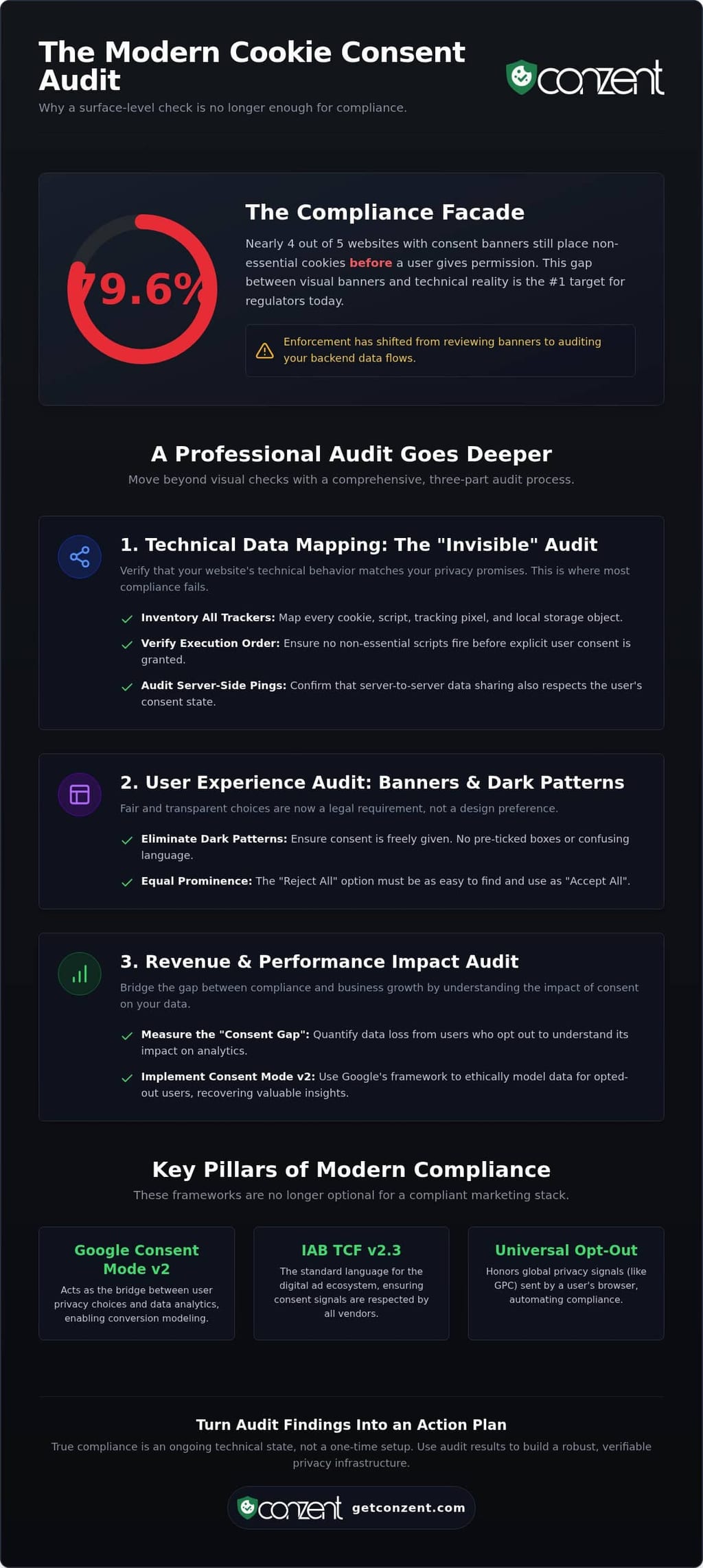
79.6% of websites with consent banners still place non-essential cookies before a visitor even clicks a button. It's a staggering figure that proves most privacy setups are just digital theater. You might have a banner, but if your backend isn't actually listening to it, you're exposed to the same GDPR fines as someone with no banner at all. To fix this, you need a comprehensive cookie consent audit checklist that goes deeper than the user interface.
You've likely felt the frustration of seeing inaccurate data in Google Analytics or watching your bounce rate climb because of an intrusive popup. It shouldn't feel like a choice between following the law and growing your business. Compliance is not a decorative banner. It is a verified data flow that respects both the law and your revenue.
This guide changes that dynamic. We'll show you how to execute a professional-grade privacy audit that ensures your data collection is both legal and optimized for performance. We'll walk through everything from Google Consent Mode v2 integration to honoring Universal Opt-Out Signals. You'll gain a clear path to technical and regulatory transparency.
Key Takeaways
- Shift from surface-level banner presence to deep data flow verification. Regulators now audit technical reality rather than just visual compliance.
- Use a professional cookie consent audit checklist to inventory every script. Ensure no tracking pixels fire before a user grants explicit permission.
- Eliminate dark patterns by making the "Reject All" option as prominent as "Accept All." This aligns your site with 2026 standards for fair user experience.
- Bridge the "Consent Gap" by measuring data loss. Learn how to use A/B testing to recover revenue without compromising ethical standards.
- Turn audit findings into a prioritized action plan. Choose between managed cloud or self-hosted infrastructure to maintain long-term technical compliance.
Why a Surface-Level Audit Is No Longer Enough in 2026
Regulators are done looking at your banner. In 2026, enforcement has moved from the front end to the back end. It's no longer enough to show a "Reject All" button; you have to prove that the button actually stops data from flowing. A 2026 study revealed that 79.6% of websites failed to block trackers before user interaction. This technical failure is exactly what regulators are now targeting. This shift from visual compliance to technical verification is why a standard cookie consent audit checklist must prioritize data mapping over design. If your backend systems don't honor user choices, your banner is just a liability.
Compliance is not a one-time setup. It's a continuous technical state. When you use an HTTP cookie to track user behavior, you're handling personal data. Mismanaging that data leads to more than just fines. It leads to data degradation. Inaccurate signals in your analytics tools make your marketing spend a guessing game. Transparency is now your most valuable trust signal.
The Evolution of Consent Standards
The regulatory environment in 2026 is uncompromising. GDPR and ePrivacy requirements now mandate that consent be specific, informed, and easily withdrawn. This isn't a suggestion. The IAB TCF v2.3 has become the foundational language for the digital advertising ecosystem. It ensures that every vendor in your stack respects the user's signal. Designs that rely on implied consent or pre-ticked boxes are now explicitly non-compliant dark patterns.
Similarly, Google Consent Mode v2 is no longer optional for modern marketing. It acts as the bridge between privacy and performance. Without it, you lose the ability to model data for users who opt out, leaving a massive hole in your reporting. You need a technical audit to ensure these integrations are firing correctly and legally. A failure here means your Google Ads and Analytics data is fundamentally broken.
The Black-Box Risk
Many businesses rely on proprietary, closed-source CMPs. This is a gamble. You can't audit what you can't see. If a CMP processes data in ways you don't understand, you're the one legally responsible. Hidden data processing is a silent killer of compliance. It creates a liability gap that most companies don't realize exists until an audit letter arrives. You shouldn't have to trust a vendor's "trust me" button.
We believe in an egalitarian approach to privacy. Transparency shouldn't be a premium feature. Using source-available or self-hosted infrastructure allows you to inspect the code and verify exactly how data is handled. It turns compliance from a black box into a clear, auditable asset. Moving to Open Consent Infrastructure ensures you own your compliance destiny. You shouldn't have to rent trust from a vendor who hides behind complexity.
Technical Data Mapping: The "Invisible" Audit
A banner that looks compliant but leaks data is a liability, not a solution. The core of a professional cookie consent audit checklist is the technical data map. You must inventory every cookie, tracking pixel, and local storage object your site uses. It's a common failure point; scripts often fire the moment a page loads, regardless of whether a user has clicked "Accept." If your analytics pixels are dropping cookies on the first visit, your compliance is a facade. A proper cookie consent audit checklist ensures your technical reality matches your legal claims.
Verifying script execution order is your first technical priority. Nothing should fire before the "Accept" click. This requires testing for "consent leakage" within third-party integrations. Many marketing tools are designed to be aggressive. They often bypass standard banner signals unless they're explicitly blocked. Technical leakage can be seen as a form of deceptive design, similar to the tactics highlighted in the FTC report on dark patterns. When your backend doesn't match your frontend promises, you aren't just failing a technical test. You're losing user trust.
Auditing server-side tracking vs. client-side signals adds another layer of complexity. Server-side setups are even harder to track because they don't appear in the browser's "Application" tab. You need a way to ensure your server-side pings are also tied to the user's consent state. If you're looking for a way to simplify this technical burden, exploring managed compliance options can help bridge the gap between complex requirements and actual execution.
Script Control and Prior Blocking
You don't need expensive AI tools to find leaks. Browser developer tools are your best friend. Open the "Application" or "Storage" tab and refresh your page without interacting with the banner. If you see cookies appearing, you have a blocking problem. Implementing robust blocking mechanisms is essential for WordPress and custom CMS environments. You can't rely on the "auto-block" features of generic plugins. They often miss sophisticated trackers. For a deeper look at how to handle these technical hurdles, see our technical blocking details.
Google Consent Mode v2 Verification
Google Consent Mode v2 (GCM v2) changed the rules for technical audits. It's no longer just about "on" or "off." You must verify that ad_user_data and ad_personalization signals accurately reflect user choices. Common implementation errors, like sending signals before the CMP has loaded, lead to massive data gaps in your Google Ads reporting. Debugging these signals requires a methodical approach. Our Google Consent Mode v2 technical guide provides the specific parameters you need to monitor to ensure your marketing data remains both legal and useful.
The User Experience Audit: Banners and Dark Patterns
Design is now a regulatory issue. You can't hide the "Reject All" button behind a "Settings" link or a secondary menu anymore. A proper cookie consent audit checklist must evaluate the visual weight of your buttons. If "Accept All" is a bright green button and "Reject All" is a faint grey link, you're using a dark pattern. Regulators in 2026 view these as deceptive practices that invalidate consent. Your goal is moral clarity, not trickery. The choice to opt out should be as frictionless as the choice to opt in.
Accessibility is the second pillar of a compliant interface. Your banner must be navigable by screen readers and keyboard-only users. If a user can't tab through your consent options, they haven't given valid consent. This is a technical requirement that many generic banners ignore. Multi-language support is also mandatory for global traffic. The banner should automatically detect and match the user’s browser language. This ensures they truly understand what they're agreeing to before data collection begins. If your banner doesn't speak the user's language, your audit log won't hold up under scrutiny.
Banner Transparency and Layering
Transparency starts at the first layer of interaction. You must state exactly why you're collecting data before the user clicks anything. Don't bury this in a 50-page document. Use clear, layered disclosures that link to your full privacy policy. For example, the U.S. Department of Education's privacy policy demonstrates how to clearly outline cookie usage for public transparency. Avoiding dark patterns also means no pre-ticked boxes. Every non-essential category must be "off" by default. For more on these specific legal requirements, see our GDPR Compliance Guide.
Optimizing for Choice, Not Confusion
Choice should be granular. In 2026, a single "on/off" switch for all non-essential cookies is insufficient. Users need to toggle categories like "Statistics," "Preferences," or "Marketing" individually. This is known as granular consent, and it's a core requirement for modern compliance. For your audit logs, you should define "unambiguous consent" as: A clear, affirmative action by the user that demonstrates a specific and informed agreement to data processing. Placement also matters. A banner that blocks your entire site's content can increase bounce rates and frustrate users. Aim for a balance that respects both the user's flow and their digital rights. Integrating these UX checks into your cookie consent audit checklist ensures your interface is as robust as your backend systems.
Revenue and Performance Impact Audit
Compliance shouldn't be a tax on your growth. It’s a tool for data accuracy. When you ignore the "Consent Gap," you're making business decisions based on partial truths. Research from 2026 shows that 52% of all website sessions now opt out of statistical tracking. This isn't just a privacy metric; it's a revenue metric. A comprehensive cookie consent audit checklist must measure how much data you're losing and identify where your banner is failing to build trust. If you can't measure the impact of your privacy choices, you can't optimize them.
Trust is the ultimate conversion factor. If your banner feels like a legal hurdle, users will treat it like one. If it feels like a transparent invitation to a secure experience, they're more likely to engage. You can justify your compliance spend by showing stakeholders exactly how improved opt-in rates correlate with better marketing attribution. Ethical data collection is a competitive advantage, not a chore. Ready to optimize your data collection? Explore our managed and self-hosted options here.
Consent A/B Testing Framework
Opt-in rates aren't fixed. They're the result of design choices. Use Consent A/B Testing to experiment with colors, copy, and positioning. The goal isn't coercion; it's clarity. Testing allows you to find the balance where users feel in control without being overwhelmed. This data-driven approach is essential for bridging the gap between privacy and performance. You can evaluate the revenue impact of cookie consent to see how ethical design protects your bottom line while maintaining legal integrity.
Performance Auditing
Privacy shouldn't kill your page speed. In 2026, lightweight scripts are a requirement for SEO. If your CMP script is heavy, it will trigger layout shifts and tank your Core Web Vitals. This directly impacts your search rankings and user experience. During your audit, compare the latency of managed cloud services against self-hosted infrastructure. Self-hosting often provides the lowest latency because you control the delivery environment. A cookie consent audit checklist that ignores performance is incomplete. Your privacy solution should be invisible to the user's browser but transparent to their rights.
Action Plan: Implementing Your Audit Findings
A completed cookie consent audit checklist is only as valuable as the fixes you implement. Once you've identified your technical leaks and UX gaps, you must prioritize your response. Technical leaks, where scripts fire before consent, represent the highest regulatory risk and should be addressed immediately. UX improvements, while critical for trust and revenue, can follow once the data flow is secured. Compliance is a living process; it isn't a one-off project you can forget after deployment.
To maintain your standards, establish a quarterly audit schedule. Website environments are dynamic. New marketing pixels, updated plugins, and changing scripts can easily break your consent logic. Integrating your cookie consent audit checklist into your DevOps or CI/CD pipelines ensures that no new code goes live without a privacy check. This proactive approach prevents compliance regression and keeps your data collection honest. It turns privacy from a hurdle into a standard part of your technical excellence.
The Case for Managed Cloud Compliance
For teams focused on speed and low overhead, managed cloud services are the standard. They remove the burden of infrastructure maintenance. You don't have to worry about server uptime or manual security patches. More importantly, managed platforms handle automatic updates for shifting regulations. When standards like IAB TCF v2.3 evolve, the platform adapts without requiring your developers to rewrite code. It is the most efficient path to high-level compliance for organizations that prioritize agility. You can view managed cloud pricing to see how this fits your resource model.
Self-Hosting for Maximum Auditability
Security-conscious technical teams often prefer a different path. Self-hosting via Open Consent Infrastructure provides unparalleled auditability. You aren't just trusting a vendor; you're inspecting the source-available code. This approach reduces vendor lock-in and improves your overall security posture by keeping consent data within your own infrastructure. It turns privacy into a public good you control rather than a service you rent. It is the ultimate choice for those who believe transparency should be built into the architecture. For a deeper dive into this model, read our guide to self-hosted cookie consent.
Future-Proof Your Data Strategy
Compliance in 2026 is no longer about checking a box. It is about technical integrity. Moving through this cookie consent audit checklist reveals that true privacy requires a bridge between your legal promises and your backend reality. You've seen how unconsented data leaks and deceptive dark patterns erode both user trust and your marketing accuracy. By prioritizing technical transparency and ethical UX, you turn a regulatory burden into a performance-driven asset.
You don't have to tackle these complexities alone. Whether you choose the low-overhead path of managed services or the deep auditability of self-hosting, the goal remains the same: respect the user and protect your revenue. It's time to move beyond superficial banners and implement a system that is IAB TCF v2.3 certified, Google Consent Mode v2 ready, and built on source-available transparency. Secure your 2026 compliance with Conzent managed cloud. You have the tools to lead with transparency. Start building a website that users can actually trust.
Frequently Asked Questions
How often should I perform a cookie consent audit?
You should perform a cookie consent audit checklist at least quarterly. Digital environments are constantly shifting. New marketing pixels, plugin updates, or changes in your ad tech stack can break your existing consent logic. A routine check ensures your technical implementation still matches your privacy policy. It's also best practice to audit your site after any major deployment or whenever you integrate a new third-party service that handles user data.
What are the most common Google Consent Mode v2 errors found in audits?
The most frequent errors involve incorrect signal firing for ad_user_data and ad_personalization. Many sites send these signals before the CMP has fully loaded or registered a user's choice. This creates gaps in your Google Ads and Analytics reporting. Audits also frequently uncover "default" signals that don't reset after a user changes their mind. Verifying these technical pings is a critical step in maintaining accurate, legal marketing data.
Can I use a free cookie banner and still be GDPR compliant?
You can achieve compliance with a free tool, provided it supports granular consent and prior blocking. Many free plugins fail because they don't actually stop cookies from firing before a click. Our self-hosted Open Consent Infrastructure offers a source-available, professional-grade solution for free. It gives you the same IAB TCF v2.3 and Google Consent Mode v2 capabilities as paid platforms without the recurring subscription costs or black-box limitations.
What is the difference between a cookie scan and a data privacy audit?
A cookie scan is a superficial list of trackers found on your site. A data privacy audit is a deep technical investigation into how that data flows. While a scan identifies the existence of a cookie, an audit verifies if your backend honors the "Reject All" signal. It checks for dark patterns, GCM v2 signal accuracy, and whether third-party scripts are leaking data. Scans are for inventory; audits are for verification.
How does a cookie consent audit affect my SEO rankings?
An audit identifies performance bottlenecks that hurt your Core Web Vitals. Heavy consent scripts often cause layout shifts or slow down your Largest Contentful Paint, which are direct ranking factors. By auditing your CMP's impact, you can switch to lightweight infrastructure that protects your SEO. Compliance doesn't have to mean a slow site. Optimized scripts ensure that your privacy solutions don't negatively impact your search visibility or user experience.
Is IAB TCF v2.3 mandatory for all websites in 2026?
IAB TCF v2.3 isn't a legal requirement for every site, but it's a technical necessity for anyone in the digital advertising ecosystem. If you use major ad vendors or monetize through programmatic ads, this framework ensures your consent signals are recognized across the supply chain. Without it, many vendors will simply stop serving ads to your users. It has become the industry standard for communicating transparency and choice at scale.
What happens if my audit reveals scripts firing before consent?
This is a critical compliance failure that requires immediate technical intervention. Scripts firing before consent violate the core principles of the GDPR and ePrivacy Directive. You must implement a robust blocking mechanism to hold these trackers until a clear, affirmative action is taken by the user. Ignoring this "leakage" leaves you vulnerable to fines and regulatory scrutiny. It's the most urgent fix on any cookie consent audit checklist.