
Zero-Knowledge Cookie Management: Reclaiming Data Sovereignty in 2026

A consent banner can record a user’s choice and still expose the data behind it. Can you manage cookie consent without sending users’ IP addresses and preferences to a third-party vendor? Zero-knowledge cookie management starts with a different principle: verify and enforce consent while limiting access to the personal data behind it.
That matters if your consent management platform is another data processor to oversee, a black box you can’t inspect, or a potential source of leaks. The banner alone isn’t the privacy architecture. Where consent data goes, who can access it, and how clearly the system handles user choices matter too.
This article explains how zero-knowledge approaches can reduce those risks, what they do and don’t mean for regulatory compliance, and why self-hosted, source-available infrastructure can give you more control. It also covers how open consent systems support standards such as IAB TCF v2.3 and Google Consent Mode v2, without treating compliance as a reason to collect more data. The aim is practical: clearer control, fewer unnecessary data processors, and consent management you can evaluate.
Key Takeaways
- Learn why a consent manager can introduce its own data-handling and oversight risks.
- Understand how zero-knowledge cookie management can limit a platform provider’s access to consent data.
- Compare proprietary CMPs with source-available infrastructure and see how self-hosting supports data sovereignty.
- Explore how consent signals can work with Google Consent Mode v2 without creating a persistent profile on the CMP side.
- See how Conzent’s Open Consent Infrastructure offers a transparent alternative for managing consent.
The Hidden Liability of Traditional Cookie Management
A consent banner can look reassuring while the system behind it remains opaque. Many traditional consent management platforms (CMPs) are hosted by vendors that receive and store consent records on their own servers. Depending on the setup, those records may sit alongside technical information such as IP addresses, browser details, or identifiers. Ask a practical question when evaluating a CMP: does it need access to all of that information to display a choice and pass along a consent signal?
When a provider processes personal data on your behalf, it may act as a processor under GDPR. That relationship brings contractual and transparency considerations, including the requirements in Article 28. Responsibilities depend on the arrangement and processing involved, so a banner alone cannot settle them. A clear GDPR compliance approach starts with understanding what data the CMP handles, why it handles it, and where it goes.
The Problem with Third-Party Data Processing
A CMP should help enforce user choices, not create an unnecessary trail of them. A centralized service can receive consent events from multiple websites, potentially alongside technical identifiers. That creates a paradox: a privacy tool may gain visibility into user activity across sites, even when cross-site tracking isn’t required for its consent function. Products and configurations differ, so inspect the data flows rather than assuming every CMP behaves the same way.
Centralization also concentrates risk. A breach could expose stored consent records or associated identifiers. A manipulated signal could cause a site or connected service to act on a choice the user didn’t make. These are risks to assess, not evidence that every CMP has suffered a breach or that every consent record is exposed. Map what the vendor receives, how long it retains it, and what safeguards govern access.
Moving Beyond the “Checklist” Mentality
A visible banner is an interface, not proof that the underlying system respects consent. If tags fire before a choice, signals don’t reflect the user’s selection, or records are handled in ways the site owner can’t inspect, the banner can give a false sense of control. Compliance depends on the actual data flow and implementation, not just the presence of a notice.
That’s why zero-knowledge cookie management shifts attention from the banner to the architecture. In a zero-knowledge model, a service can verify a fact without learning the underlying information. A zero-knowledge proof describes this broader cryptographic idea. Applied carefully, the principle encourages systems to process consent with less provider access instead of collecting extra data by default.
There’s a business risk, too. When compliance logic lives inside a proprietary black box, the organization depends on a vendor’s implementation and continued access to its platform. Changes to pricing, features, or service can make that dependency harder to unwind. A more inspectable approach makes data flows visible, reduces unnecessary processing, and keeps infrastructure under the organization’s control where practical. A banner asks for a choice. The system behind it must honor that choice.
Defining Zero-Knowledge Cookie Management
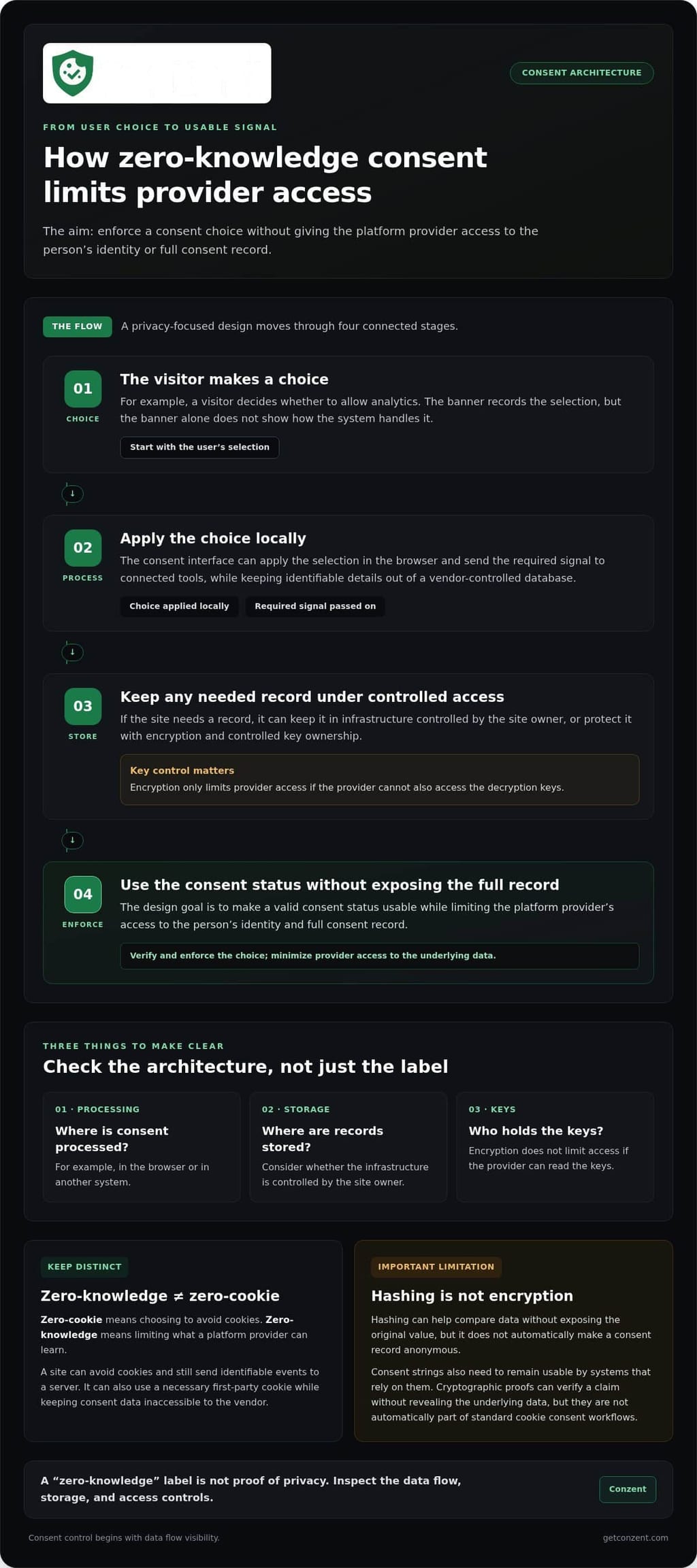
Zero-knowledge cookie management aims to let a platform facilitate compliance without giving its provider access to which individual user made a particular consent choice. The goal isn’t to hide whether a site has valid consent. It’s to make that status usable without giving the platform provider access to the person’s identity or full consent record.
That distinction depends on architecture, not terminology. A platform can process consent in the browser, store it in infrastructure controlled by the site owner, or encrypt data so the provider cannot read it. The right design depends on what the system needs to do. A managed service that can inspect readable records wouldn’t meet the strictest version of this model simply because it calls itself zero-knowledge.
How Zero-Knowledge Architecture Works
Consider a visitor choosing whether to allow analytics. The site’s consent interface can apply that choice locally and send the required signal to connected tools, while keeping identifiable details out of a vendor-controlled database. If the site needs a record, it can store it within its own infrastructure or protect it from vendor access through encryption and controlled key ownership.
Hashing can help compare data without exposing the original value, but it isn’t encryption and doesn’t automatically make a consent record anonymous. Consent strings also need to remain usable by systems that rely on them. Cryptographic proofs can verify a specific claim without revealing the underlying data, but they aren’t automatically part of standard cookie consent workflows.
Zero-Knowledge Is Not Zero-Cookie
“Zero-cookie” describes a choice to avoid cookies; “zero-knowledge” describes limits on what a platform provider can learn. A site can avoid cookies and still send identifiable events to a server. It can also use a necessary first-party cookie while keeping consent data inaccessible to the vendor. These terms address different questions, so assess the data flow and storage rather than treating either label as proof of privacy.
The Core Pillars of a Zero-Knowledge CMP
A sound design makes three things clear: where consent is processed, where records are stored, and who holds the keys. Encryption at the browser or system edge can protect signals in transit or at rest, but it only limits access if the vendor can’t also access the decryption keys. Separating IP addresses from consent choices can reduce the chance that a choice is directly tied to a visitor.
Auditability matters just as much. Source-available code lets technical teams examine how the platform handles consent, identifiers, and integrations. It doesn’t prove that every deployment is secure, but it gives reviewers something concrete to inspect instead of asking them to trust a black box. Conzent’s Open Consent Infrastructure supports managed cloud and self-hosted deployments, so organizations can choose an operating model that fits their privacy and infrastructure requirements. Teams weighing these approaches can compare available platform options.
Use these questions to assess an implementation: Can the vendor read stored consent records? Are IP addresses kept apart from consent choices? Who controls encryption keys? Can your team inspect the relevant code? Clear answers turn zero-knowledge from a label into an architecture you can evaluate.
SaaS Black Boxes vs. Open Consent Infrastructure
A consent platform isn’t just a feature you switch on. It’s infrastructure that affects who can inspect the system, where data is handled, and how much work your team owns. Proprietary SaaS can offer a quick setup, but its internal logic may be hidden from customers. Source-available Open Consent Infrastructure (OCI) makes the code inspectable, giving technical teams a clearer basis for review and adaptation.
Transparency and control aren’t the same thing. Reviewing source code can show how a platform is designed, but it doesn’t prove how a live deployment is configured or managed. Self-hosting puts infrastructure under your organization’s control; a managed cloud service shifts operational responsibility while relying on the provider’s implementation. The right balance depends on your security requirements, technical capacity, and appetite for operational work.
The Case for Self-Hosted Compliance
Self-hosting gives an organization direct control over deployment and data location. That can matter in high-security environments where infrastructure policies are strict or teams need to manage data residency closely. It may also reduce the CMP vendor’s role in processing consent data. Whether it changes a particular contractual obligation depends on the actual data flows and services involved, so assess the deployment rather than assuming self-hosting settles every legal question.
There’s a trade-off: your team takes responsibility for hosting, access controls, monitoring, backups, and updates. Consent systems also need maintenance as integrations and standards change. For technical teams evaluating that model, Conzent’s self-hosted consent infrastructure provides an approach built around infrastructure ownership.
Managed Cloud: Less Operations, Open Foundations
Not every organization has the capacity or desire to operate its own consent infrastructure. A managed cloud platform can reduce the internal hosting burden, while source-available code provides visibility into the system’s design. These are separate benefits, not automatic proof that a cloud provider can’t access data. Understand what the service processes and stores, and how access is controlled.
Standards such as IAB TCF v2.3 can evolve, so consent implementations need ongoing attention. A managed service can make platform maintenance easier, but updates don’t remove the need to understand changes to your integrations. Clear release information and a review process help teams keep integrations aligned with their requirements.
Compare Total Ownership, Not Just Subscription Price
A useful cost comparison looks beyond a monthly fee or per-user charge. Include internal engineering time, infrastructure, maintenance, vendor costs, and the effort required to review changes. Usage-based pricing can make expenses harder to forecast as traffic grows; self-hosting can avoid some vendor charges but still requires people and infrastructure. Neither model is automatically cheaper over time.
- Choose self-hosting when infrastructure control and internal technical capacity are priorities.
- Consider managed cloud when reducing operational work matters, while keeping transparency and data handling central to evaluation.
- Review the full cost model before comparing a fixed subscription with usage-based charges or internal hosting.
Zero-knowledge cookie management isn’t defined by whether a platform runs in the cloud or on your servers. It depends on what the provider can access, how the system handles consent, and whether your team can verify those claims. Open infrastructure makes those questions easier to examine.
Integrating Zero-Knowledge with Google Consent Mode v2
Google Consent Mode v2 depends on consent signals reaching Google so its tags can adjust their behavior. That creates a design challenge: the site must communicate the user’s choice to Google without making the CMP a second place where that person’s activity is tracked or profiled.
A zero-knowledge approach separates those jobs. The CMP can collect the choice and set the relevant consent signals in the browser, while avoiding a persistent, identifiable profile in its own systems. The signal still needs to reach Google for Consent Mode to work. Zero-knowledge doesn’t mean suppressing required signals; it means limiting what the consent platform itself can learn or retain.
Configuration matters. A category mapped to the wrong signal, a tag that fires before consent state is applied, or a default that doesn’t match the site’s intended behavior can undermine the setup. Treat implementation as a data flow to verify, not a checkbox.
Verify Signals Without Unnecessary CMP Logs
Test the full path from a visitor’s choice to the behavior of Google tags. Use browser developer tools or a tag-debugging workflow to inspect which consent states are set and when they change. Compare the result for visitors who accept, reject, or haven’t chosen yet. Review CMP-side logs and stored records at the same time to confirm they don’t retain identifiers or event histories the platform doesn’t need.
Google’s 2026 updates make accurate mapping especially important: ad_storage controls the flow of advertising data from Google Analytics to Google Ads, while a later update is planned to make ad_personalization the sole control for Analytics data used in remarketing. Check Google’s current implementation guidance as settings evolve. Consent signals can also support modeling, but no architecture can promise a particular revenue result.
Maintain Revenue with Privacy-Respecting UX
Optimization doesn’t require weakening a visitor’s choice. A/B tests can compare clear banner wording, layout, or button presentation while keeping options equally accessible and honoring each selection consistently. Conzent’s Consent A/B Testing supports evidence-based decisions about consent experiences. Keep the test focused on the interface, not on collecting extra personal data or steering people toward acceptance.
Performance deserves the same scrutiny. A lightweight implementation that avoids unnecessary scripts and network requests can reduce work in the browser, but zero-knowledge design alone doesn’t guarantee better Core Web Vitals. Measure page performance before and after changes, and check that consent signals still reach the right tags at the right time.
Keep Consent Interoperable
For publishers using the IAB Transparency and Consent Framework, the consent string must represent the visitor’s choices in a form that participating systems can interpret. IAB TCF v2.3 integration can support that interoperability; it doesn’t replace testing the actual string, vendor configuration, and tag behavior. Prefer an implementation built around open standards and inspectable behavior rather than relying on a certification label alone.
To assess how these integrations fit your setup, review the IAB TCF integration details, then explore platform options for managing consent alongside Google signals.
Future-Proofing with Conzent’s Open Infrastructure
Consent requirements and integrations change. A platform built around open standards and inspectable code gives teams a clearer way to review those changes than a proprietary system whose internal logic they can’t examine. Conzent’s source-available Open Consent Infrastructure (OCI) reflects that approach: privacy controls should be visible and practical, not hidden behind a black box.
OCI offers two routes. Teams with the technical capacity can self-host and manage their own deployment. Organizations that prefer less infrastructure work can use Conzent’s managed cloud consent platform. The choice is about operational responsibility, not whether privacy matters. Both routes use open infrastructure as the foundation for managing consent.
A Principled Approach to Privacy
Privacy shouldn’t depend on an organization’s ability to pay for a proprietary system or accept its hidden processes. OCI is designed to make consent infrastructure more accessible, while Conzent’s managed cloud model lowers pricing as sponsorships increase. That describes the pricing model, not a promise that every customer’s costs will fall or remain fixed.
For a transparent cost comparison, review the pricing information alongside your expected usage and internal operating needs. Include hosting, maintenance, and review work if you self-host. Compare like with like, not just the platform fee.
Plan a Careful Transition
Moving from a legacy CMP to a zero-knowledge cookie management approach starts with understanding what the current setup does. Map the data it receives, the records it stores, the tags it controls, and the consent signals it sends. Then document which parts must keep working, such as analytics or advertising integrations, before changing the implementation.
- Inventory data flows: Identify information sent to the CMP, where it is stored, and who can access it.
- Choose an operating model: Compare self-hosting with managed cloud based on your team’s capacity and infrastructure requirements.
- Test before switching: Check banner behavior, consent records, and connected tags in a controlled environment.
- Review after launch: Confirm the new configuration still applies user choices as intended and revisit it when integrations change.
This sequence helps avoid treating a platform migration as a banner swap. It gives technical and privacy teams a shared view of what changes, what must be preserved, and how they’ll verify the result.
Conzent’s Open Consent Infrastructure connects these paths through a source-available foundation. Start by assessing your current CMP and deciding how much infrastructure your organization wants to operate. Then compare the managed cloud and self-hosted approaches against that assessment. The aim is not to trust a new label. It’s to build consent management your team can understand, evaluate, and maintain.
Make Privacy a Design Decision
The next step is to make data access a deliberate part of your consent strategy. Decide which systems truly need consent information, who should be able to read it, and how your team will review those boundaries as your site changes. That turns zero-knowledge cookie management from an architectural idea into a standard you can apply to future decisions.
Conzent brings a Danish privacy engineering perspective to open consent infrastructure, with a source-available foundation and support for IAB TCF v2.3 and Google Consent Mode v2. Your team can assess the platform against its technical and operational needs, then choose a managed cloud or self-hosted approach.
Build a consent setup your organization can understand and oversee. Explore the Managed Cloud Consent Platform and find a practical next step for your privacy strategy.
Frequently Asked Questions
What exactly is a zero-knowledge consent management platform?
A zero-knowledge consent management platform is designed to manage consent without giving the platform provider access to identifiable user choices. In practice, check which components process the choice, where records are stored, and who controls any encryption keys. The term alone doesn’t prove that a system follows this design. For zero-knowledge cookie management, assess the actual data flows and configuration, not just the provider’s description.
Is zero-knowledge cookie management more expensive than traditional SaaS?
Not necessarily. Costs depend on the operating model and the work your team takes on. Conzent’s self-hosted platform can be used without a software fee, but your organization still handles hosting and operations. Its managed cloud platform has subscription fees, with pricing that drops as sponsorships increase. Compare the full operational effort as well as platform charges before deciding.
Does a zero-knowledge CMP still work with Google Ads and Analytics?
Yes, it can work with Google Ads and Analytics when it correctly sends the consent signals those services use. Conzent supports Google Consent Mode v2. After setup, test each relevant choice in a browser and confirm that Google tags respond as intended. A privacy-focused CMP doesn’t remove Google’s role in receiving signals needed for its services; it limits what the CMP itself handles or retains.
Can I self-host a zero-knowledge cookie banner for free?
Conzent’s Self-Hosted Open Consent Infrastructure can be self-hosted on your own infrastructure without a software fee. “Free” doesn’t mean there’s no operating work: your team remains responsible for hosting, updates, access controls, and testing. Before moving a banner, map its current integrations and check that the replacement continues to apply each visitor’s selection across your site.
How does zero-knowledge architecture affect website loading speed?
It doesn’t guarantee a faster website. Performance depends on the banner, scripts, network requests, and configuration, not just the privacy architecture. For a practical comparison, measure Core Web Vitals before and after deployment, then inspect browser activity for added requests or delayed tag behavior. A lighter implementation may reduce unnecessary browser work, but confirm the impact on your own pages rather than assuming.
Do I still need a GDPR Data Processing Agreement if I use a zero-knowledge CMP?
Possibly. The answer depends on whether the CMP provider processes personal data for your organization and on the service arrangement. A zero-knowledge design may limit what the provider can access, but the label alone doesn’t establish that no processing occurs. Document the data flows and review the relevant contract with your privacy or legal team before deciding what agreements are needed.
Is Conzent’s platform fully IAB TCF v2.3 certified?
Conzent supports IAB TCF v2.3 integration. Integration and certification are distinct: integration concerns how a platform works with the framework, while certification is a separate status. For your implementation, verify that the consent string and vendor configuration behave as required in the tools you use, and distinguish those technical checks from certification.
What happens to the consent data if I stop using the service?
It depends on how you run the platform. With a self-hosted deployment, your organization controls the infrastructure and must decide how to retain, migrate, or remove its records. For a managed cloud service, review the applicable service terms and data-handling process before ending use. Plan for export or migration where needed, and test that the replacement continues to recognize existing consent choices.