
Zero-Knowledge Cookie Management: Reclaiming Data Sovereignty in 2026

What if the tool you trust to protect user privacy is actually your biggest data leak? Most traditional consent managers operate as proprietary black boxes. They sit between you and your users, collecting IP addresses and consent signals while locking your data behind a vendor's wall. This isn't just a performance bottleneck. It's a significant risk for any organization trying to implement privacy by design cookie consent in 2026. You shouldn't have to trust a third party with the very keys to your regulatory safety.
We agree that treating your consent manager as a separate data processor creates more problems than it solves. True compliance requires a shift from mere documentation to technical enforcement. In this article, you'll learn how zero-knowledge architecture eliminates the privacy risks of traditional managers while keeping you fully compliant with the latest CPRA and Google Consent Mode v2 requirements. We'll explore how open infrastructure allows you to reclaim data sovereignty, remove vendor lock-in, and maintain a lightweight, high-performance site.
Key Takeaways
- Stop treating your consent manager as a trusted third party when it's actually a data liability. Learn why every proprietary CMP is a new data processor you must disclose under GDPR.
- Shift to privacy by design cookie consent by using zero-knowledge architecture that prevents vendors from ever seeing your users' sensitive signals.
- Compare the transparency of Open Consent Infrastructure against traditional SaaS black boxes to find the right fit for your security requirements.
- Master Google Consent Mode v2 integration without compromising on privacy or creating persistent user profiles on external servers.
- Explore how self-hosting and source-available codebases give you full control over your compliance data and eliminate vendor lock-in.
The Hidden Liability of Traditional Cookie Management
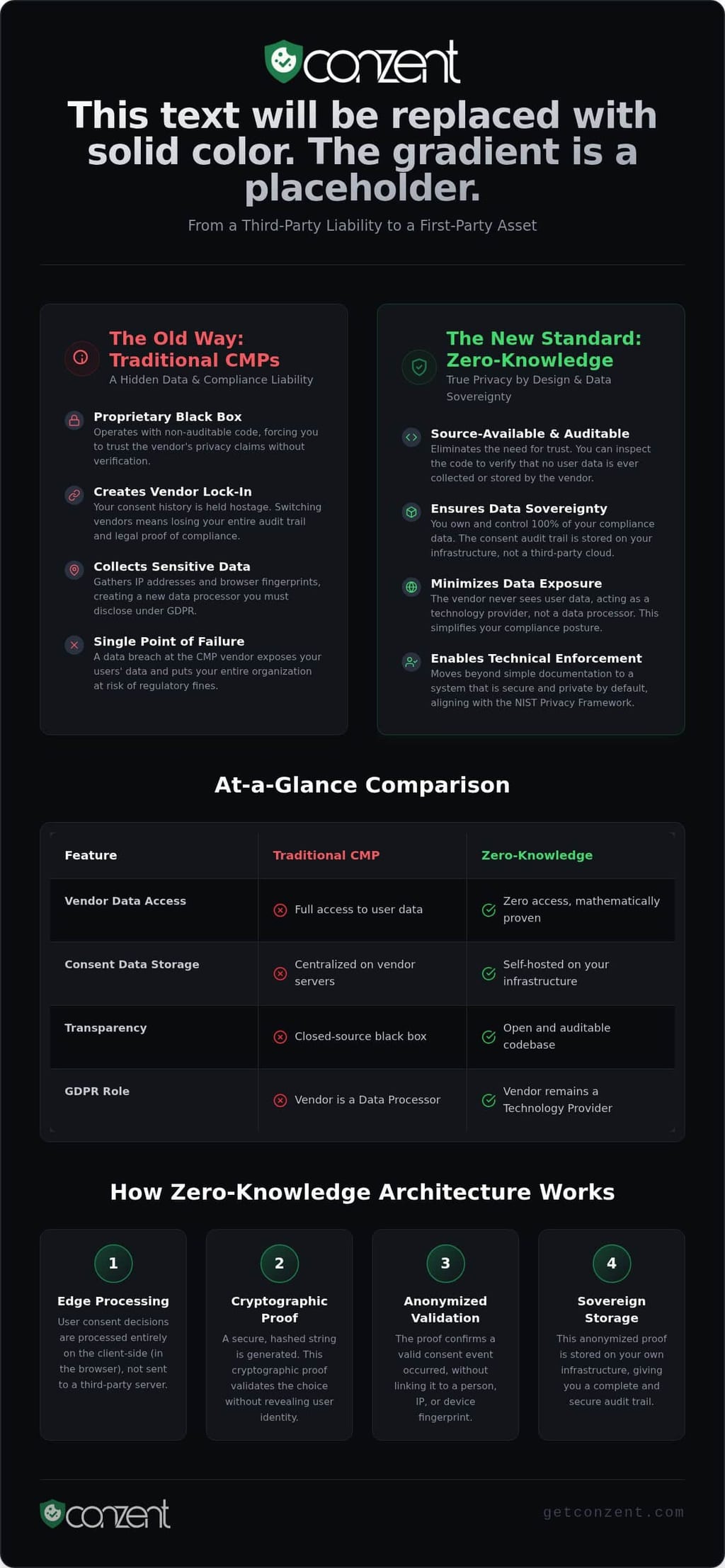
Traditional cookie management is broken. Most companies believe a visible banner equals safety. It doesn't. Most Consent Management Platforms (CMPs) operate as proprietary black boxes. They capture your users' consent signals and store them on their own servers. This creates a hidden liability. You're handing over sensitive data to a third party you can't audit. This centralized storage creates a single point of failure for your entire compliance strategy.
Every third-party CMP you add is a new data processor. Under GDPR Article 28, you must disclose this relationship and ensure they maintain high security standards. It's a paradox. You use a privacy tool, but that tool often tracks your users across multiple websites to optimize its own services. These vendors often prioritize their own data collection over your users' digital rights.
The Problem with Third-Party Data Processing
Traditional CMPs often see more than they need to function. They collect IP addresses and browser fingerprints to validate consent choices. In 2026, this centralized approach is a massive liability. If a major CMP database leaks, your users' data is exposed. Consent spoofing is a growing threat; attackers can manipulate these centralized signals to bypass your security layers. You lose control the moment the data leaves your server.
You're also facing dangerous vendor lock-in. If you want to leave a proprietary vendor, your consent history often stays with them. You lose your audit trail. This dependency isn't just a technical hurdle; it's a legal risk. Relying on a proprietary black box for legal compliance means you're only as safe as their last security update. If they fail, you're the one facing the regulatory fines. To understand how proactive IT support can mitigate these broader security risks, read more about managed services.
Compliance isn't a checkbox. A banner is a UI element, not a security protocol. To achieve real Privacy by Design, you must integrate privacy into the technical architecture of your site. It isn't an add-on. It's a foundational requirement. Implementing privacy by design cookie consent means ensuring the system is secure by default, rather than relying on a third-party script to fix things later.
Enterprise environments are shifting toward data sovereignty. They want infrastructure-level privacy. This means owning the consent data. It means ensuring no third party can access user choices. Principled engineering focuses on technical enforcement rather than just policy documentation. Regulators in 2026 are no longer accepting written policies as proof of compliance. They're actively testing implementation. You don't need a middleman to store your user data. You need a system that respects choices without leaking data to an external cloud. This is why Open Consent Infrastructure is becoming the new standard for ethical businesses.
Defining Zero-Knowledge Cookie Management
Zero-knowledge is more than a technical buzzword. It's a fundamental shift in how we handle user signals. Traditional systems require you to trust the vendor. Zero-knowledge systems make trust unnecessary through math and architecture. Zero-knowledge cookie management is a system where the vendor facilitates compliance without ever knowing the individual user. It ensures the platform provider cannot access the consent data of your users, even if they host the infrastructure.
Don't confuse this with "Zero-Cookie" architectures. A zero-cookie site might avoid local storage but still track users via server-side fingerprinting or URL parameters. Zero-knowledge is different. It focuses on the vendor's inability to see the data. Aligning with the NIST Privacy Framework, this approach prioritizes data minimization and technical safeguards over mere policy promises. It moves the burden of privacy from the user's behavior to the system's design.
How Zero-Knowledge Architecture Works
The magic happens at the edge. In a privacy by design cookie consent model, the consent decision is processed client-side. Instead of sending a raw "User X said Yes" to a central server, the system generates a secure, hashed consent string. This cryptographic proof validates the choice without exposing the identity. Source-available code is a prerequisite here. You shouldn't have to guess if a vendor is secretly logging data. You should be able to audit the repository yourself. This transparency is the only way to prove that the vendor is truly blind to the data.
The Core Pillars of a Zero-Knowledge CMP
Three core pillars support this model. First, encryption of consent signals at the edge prevents interception by third parties. Second, the system decouples Personally Identifiable Information (PII) from the consent database. Your choices and your identity never live in the same place. Third, auditability ensures you can verify the specific code handling your user data. This is not a luxury for high-security firms. It's a necessary standard for anyone who values digital rights. If you're ready to move away from black-box tracking, you can check our flexible pricing plans for managed and self-hosted options.
SaaS Black Boxes vs. Open Consent Infrastructure
Proprietary SaaS is a wall. You pay for access, but you don't own the process. Most traditional CMPs hide their logic behind closed codebases, making it impossible to verify how they actually handle user signals. Open Consent Infrastructure (OCI) is the opposite. It's a source-available blueprint that allows you to see, audit, and control every line of code. This level of transparency is essential for privacy by design cookie consent. You shouldn't have to take a vendor's word for it. You should be able to prove your compliance through technical evidence.
The financial side of compliance matters too. Many proprietary vendors charge a "compliance tax." They price their services based on clicks, pageviews, or user counts. This model penalizes your growth. OCI shifts the focus back to infrastructure value. By moving away from per-user pricing, you avoid artificial costs that scale with your success. It's a more egalitarian approach to digital rights. Privacy should be a standard feature of the web, not a luxury billed by the volume of your traffic.
The Case for Self-Hosted Compliance
Self-hosting is the gold standard for data sovereignty. In high-security sectors like finance and healthcare, data residency isn't a suggestion; it's a requirement. By hosting the infrastructure yourself, you keep all consent logs within your own cloud perimeter. This eliminates the need for a complex Data Processing Agreement (DPA) with an external CMP vendor. You are the processor. You own the logs. Self-Hosting Your CMP gives your DevOps team the control they need to ensure that user data never leaves your controlled environment. It removes the "black box" risk entirely.
Managed Cloud: Privacy Without the DevOps Burden
Not every organization has the capacity to manage its own servers. Managed cloud offers a bridge. It provides the convenience of SaaS without sacrificing the security of a zero-knowledge architecture. You get the ease of a managed platform while maintaining the moral clarity of open-source standards. This model ensures you stay compliant with shifting regulations like IAB TCF v2.3 through automatic updates. It's a way to implement privacy by design cookie consent without the heavy lifting of server maintenance. You get the benefits of community-driven code and professional management in one package.
Integrating Zero-Knowledge with Google Consent Mode v2
Google Consent Mode v2 (GCM v2) redefined the rules for digital advertising. As of June 15, 2026, Google Ads relies solely on the ad_storage signal from your CMP to govern data collection. The "backstop" previously provided by Google Signals in Google Analytics is gone. This makes your CMP the single point of control for your ad data. The technical challenge is significant. You must send specific signals to Google's servers without allowing your CMP vendor to create a persistent profile of your users. It's a matter of technical sovereignty.
Zero-knowledge architecture solves this through stateless signal passing. It facilitates the handshake between the user's browser and Google without logging the interaction on the CMP's own infrastructure. In a privacy by design cookie consent framework, the CMP acts as a transparent conduit, not a storage vault. You maintain full revenue impact analytics while strictly respecting the zero-knowledge principle. Verification is straightforward. You can audit network calls to ensure signals move correctly without any CMP-side tracking or persistent ID creation.
Maintaining Revenue with Privacy UX
Privacy is not a barrier to growth. It's a foundation for it. You can use Consent A/B Testing to optimize opt-in rates without compromising data integrity. It's about finding the balance between clear communication and technical enforcement. A zero-knowledge architecture also improves site performance. By reducing script bloat and eliminating unnecessary database lookups, you protect your Core Web Vitals. For deeper growth strategies, check our guide on the Revenue Impact of Cookie Consent. Efficiency and ethics can coexist in the same stack.
Compliance with IAB TCF v2.3 Standards
Compliance is a technical requirement, not a legal suggestion. The IAB TCF v2.3 standard ensures your consent strings are valid across the entire digital advertising ecosystem. It's not enough to have a banner. You need a certified system that supports open standards and total transparency. Using a certified CMP ensures that your privacy by design cookie consent strategy remains interoperable with major ad tech players. This transparency builds trust with both regulators and users. Read our IAB TCF 2.3 Certified CMP Guide to understand the requirements for modern publishers. If you're ready to implement a high-performance, compliant solution, view our pricing and integration options.
Future-Proofing with Conzent’s Open Infrastructure
Conzent didn't build another walled garden. We built a source-available infrastructure because proprietary SaaS models thrive on obscurity while we thrive on scrutiny. Implementing privacy by design cookie consent isn't just a technical choice; it's a moral one. By choosing a source-available model, we ensure that you aren't just buying a service; you're adopting a transparent standard that any developer can audit. This accountability is the only way to guarantee that your consent signals remain private and your compliance remains absolute.
The mission of the Open Consent Infrastructure (OCI) is to lower the cost of compliance globally. We don't believe that digital rights should be a luxury for elite corporations. Privacy is a public good. Our community sponsorship model allows us to scale this mission effectively. When organizations sponsor the codebase, it drives down the operational costs of the managed cloud platform for everyone else. It's an egalitarian approach to software that prioritizes technical efficiency over corporate gatekeeping.
A Principled Approach to Privacy
Legacy vendors often charge for the complexity they create. They use per-click or per-user pricing that penalizes your growth. Conzent is different. Our pricing is transparent and infrastructure-based. We don't tax you for having a successful website. This transparency makes it easier to justify the move away from legacy black box CMPs. Transitioning your privacy by design cookie consent strategy from a legacy system to an open architecture is a direct path to reclaiming your data sovereignty. You move from a position of dependency to a position of control.
The transition path is flexible. Many organizations start with self-hosted OCI to maintain total control over their initial deployment. As they scale, they often move to our Managed Cloud Consent Platform to reduce the maintenance burden on their internal DevOps teams. This shift doesn't mean sacrificing security. Because the underlying code is the same, you keep the zero-knowledge benefits while gaining the convenience of a managed service. You get the best of both worlds: open-source integrity and professional management.
Next Steps for Your Compliance Strategy
Your first step is an audit. Look at your current CMP and identify the hidden black box risks. Ask where your users' IP addresses are stored and who has the encryption keys. If you can't answer those questions, you have a liability. You can start addressing these risks today by setting up a trial of our Managed Cloud Consent Platform. It's a risk-free way to see how zero-knowledge architecture performs in your specific environment. Join the community of developers and ethical business owners who are building a more transparent, secure, and open privacy infrastructure for the future.
Reclaiming Control Over Your Compliance Infrastructure
The black box era of cookie management is ending. We've seen how traditional vendors create unnecessary risks by acting as centralized data processors. By shifting to a privacy by design cookie consent model, you remove the vendor as a point of failure. You move from trusting a policy to trusting an architecture. Zero-knowledge systems ensure that your users' choices remain their own, encrypted and processed at the edge without persistent tracking.
Whether you choose to self-host or use our managed services, the goal is data sovereignty. You gain the benefits of Danish privacy engineering and a source-available codebase that invites scrutiny. Our tools are IAB TCF v2.3 and GCM v2 ready. This ensures your revenue stays protected while your ethics remain intact. Compliance isn't a burden you should carry alone; it's a technical standard we can build together.
It's time to stop treating privacy as a luxury and start treating it as a public good. Explore Managed Cloud Pricing to see how transparent, open infrastructure can transform your compliance strategy. Let's build a more secure web together.
Frequently Asked Questions
What exactly is a zero-knowledge consent management platform?
It's a system where the vendor never sees or stores user identity or raw consent data. It uses client-side processing to handle signals. This is a core part of privacy by design cookie consent, ensuring that the platform provider remains blind to individual user behavior. Unlike traditional CMPs, it doesn't create a centralized database of user IP addresses or browser fingerprints. You keep the keys to your own data.
Is zero-knowledge cookie management more expensive than traditional SaaS?
No, it is often more cost-effective because it eliminates the compliance tax of per-user pricing. Conzent uses a community sponsorship model to lower costs for everyone. While traditional vendors charge based on traffic volume, our Open Consent Infrastructure focuses on technical efficiency. You can self-host for free or choose our managed cloud service where pricing scales down as more organizations support the mission. It's a more egalitarian approach to compliance.
Does a zero-knowledge CMP still work with Google Ads and Analytics?
Yes, it integrates fully with Google Consent Mode v2. The system passes the necessary ad_storage and analytics_storage signals directly from the browser to Google's servers. It acts as a transparent conduit rather than a storage vault. You maintain your ad revenue analytics and measurement capabilities without allowing the CMP vendor to build a persistent profile of your website visitors. Technical enforcement happens at the edge, protecting both your revenue and your users.
Can I self-host a zero-knowledge cookie banner for free?
Yes, the Self-Hosted Open Consent Infrastructure is available for free. We believe that privacy tools should be accessible as a public good. You can deploy the source-available codebase on your own servers to maintain total data sovereignty. This approach is ideal for DevOps teams in high-security industries who want to eliminate third-party data processors entirely while keeping their compliance costs at zero. You gain full control without the proprietary lock-in.
How does zero-knowledge architecture affect website loading speed?
It typically improves performance by reducing script bloat and eliminating external database lookups. Traditional CMPs often slow down sites by syncing data with their proprietary clouds. Zero-knowledge systems process decisions locally in the user's browser. This lightweight approach helps you maintain better Core Web Vitals and a faster user experience, proving that ethical privacy by design cookie consent is also a technical advantage for your site. Speed and privacy are no longer a trade-off.
Do I still need a GDPR Data Processing Agreement if I use a zero-knowledge CMP?
If you self-host, you remove the third-party CMP as a data processor, which simplifies your legal requirements. If you use our Managed Cloud Consent Platform, a DPA is still standard practice, but the relationship is more transparent. Because we don't have access to the encryption keys of your user data, the risk profile is significantly lower. We facilitate compliance without actually seeing or storing the sensitive personal data of your end-users.
Is Conzent’s platform fully IAB TCF v2.3 certified?
Yes, our platform is fully integrated with IAB TCF v2.3 standards. This certification ensures that your consent strings are valid across the digital advertising ecosystem. We combine IAB requirements with our commitment to Danish Privacy Engineering and open infrastructure. This allows publishers to remain compliant with industry standards while still benefiting from the transparency of a source-available, zero-knowledge architecture. It's the standard for modern, ethical digital advertising and technical compliance.
What happens to the consent data if I stop using the service?
You own your data, so you take it with you. Because our infrastructure is source-available, you don't face vendor lock-in. If you move from our managed cloud to a self-hosted setup, you keep your configuration and audit trails. Unlike proprietary black boxes that hold your compliance history hostage, Conzent ensures you have full sovereignty over your logs and settings at every stage. We build for the community, not for platform dependency.