
TYPO3 GDPR Compliance: A Technical Guide to Privacy and Consent in 2026

In 2026, privacy compliance isn't a legal document buried in your footer; it's a real-time technical audit of your server's behavior. You've likely felt the pressure of balancing TYPO3 GDPR compliance with the need for accurate marketing data. It's a common frustration. You want the security of TYPO3 v14 LTS, but the technical complexity of integrating IAB TCF v2.3 or Google Consent Mode v2 often feels like a choice between legal safety and revenue. It doesn't have to be a trade-off. Compliance is not a luxury for those with massive budgets; it's a standard for everyone.
This guide shows you how to master the technical and legal requirements of modern privacy while protecting your tracking performance and user experience. You'll learn how to build a transparent consent layer that satisfies the strict demands of the EU AI Act and the latest digital regulations. We'll explore the shift from "paper-based" policies to "technical truth" and how infrastructure-aware consent keeps your data sovereignty intact. It's time to stop fearing fines and start building a more ethical, high-performing digital presence that respects your users.
Key Takeaways
- Understand why TYPO3's built-in security features don't automate cookie consent and how to bridge the gap between core CMS functionality and legal requirements.
- Learn how to audit your extensions for data minimization and move from static privacy policies to dynamic, verifiable transparency.
- Master the technical implementation of Google Consent Mode v2 and IAB TCF v2.3 to protect your marketing performance in the 2026 regulatory environment.
- Compare the maintenance overhead and performance impact of native TYPO3 extensions versus infrastructure-first consent platforms.
- Discover a principled approach to TYPO3 GDPR compliance that prioritizes data sovereignty through source-available, self-hosted infrastructure.
The TYPO3 Privacy Paradox: Core Security vs. Consent Management
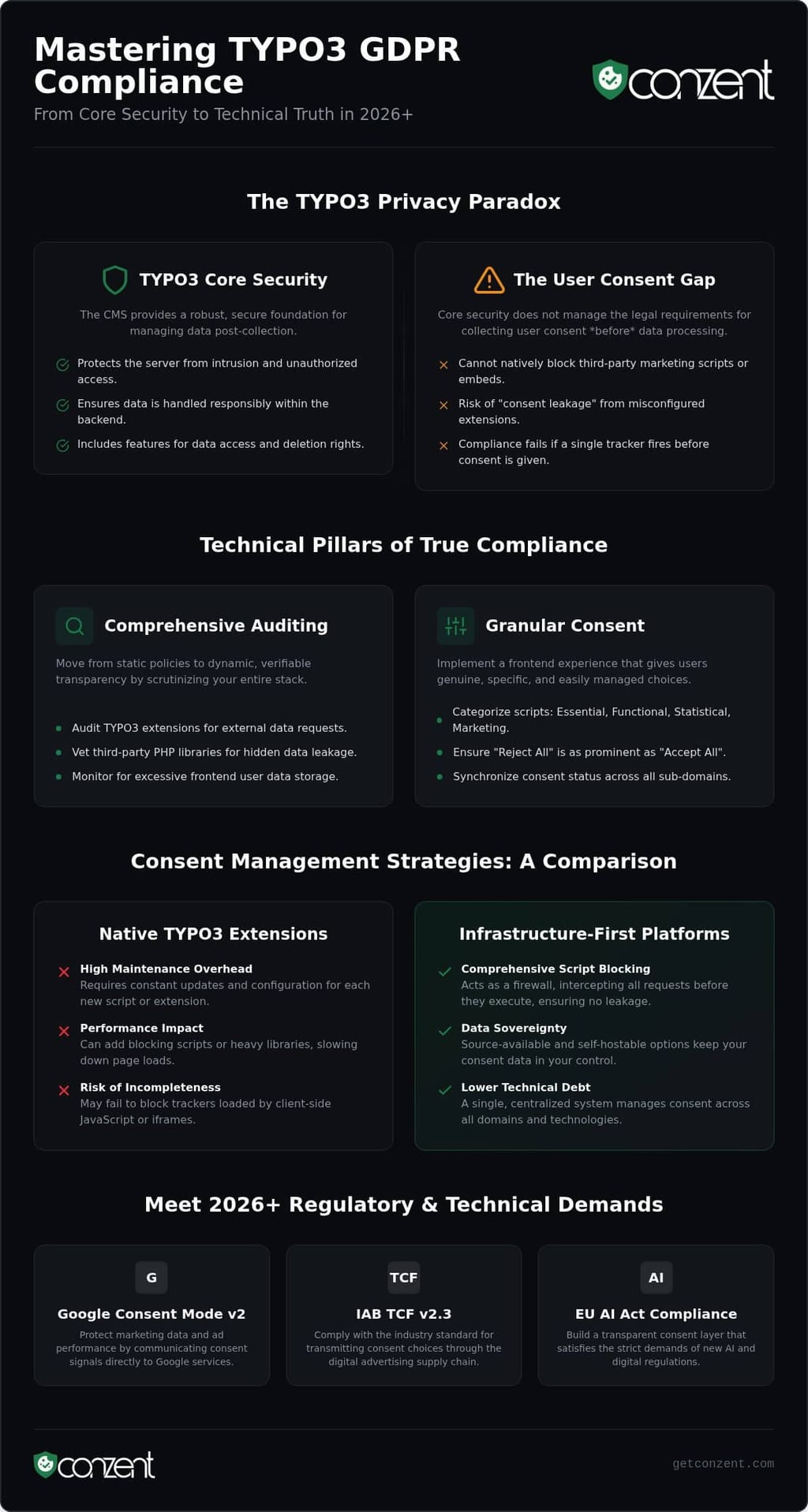
TYPO3 is often marketed as compliant out-of-the-box. This is a dangerous half-truth. While the core architecture is secure, achieving true TYPO3 GDPR compliance requires more than a hardened backend. Core security protects the server from intrusion. A consent layer protects the user's right to digital self-determination. These are distinct technical challenges. The General Data Protection Regulation (GDPR) demands that consent be granular, informed, and easily withdrawn. TYPO3's "Privacy by Design" philosophy ensures the CMS itself handles data responsibly, but it doesn't stop a third-party marketing script from firing before a user clicks "Accept."
TYPO3 Core Features for GDPR Readiness
TYPO3 v13 and v14 provide a robust foundation for privacy. The core uses SameSite cookie attributes by default to prevent cross-site request forgery and handles session data securely. You can also leverage built-in IP anonymization for system logs and common extensions. For user rights, TYPO3 includes workflows for data access and deletion. These features handle the backend of compliance. They ensure that once you have data, you manage it ethically. They don't solve the problem of how you capture that data legally.
The Consent Gap: Why the CMS Needs an External Layer
A CMS is designed to deliver content; it isn't a firewall for tracking scripts. It cannot natively block external pixels or YouTube embeds before a visitor grants permission. This creates a risk of "consent leakage" in complex enterprise installations. Managing consent across dozens of site trees and multiple languages is a massive technical hurdle. Compliance fails if a tracking script fires on a sub-domain because of a misconfigured extension. You need an infrastructure-aware layer to intercept these scripts before they execute.
In 2026, regulators use automated scanning to verify that backend behavior matches frontend promises. Valid consent must be specific to the purpose. It's not enough to have a "Global Accept" button. Users need the ability to toggle analytics while keeping functional cookies active. If your site uses third-party extensions for maps or ads, those must be mapped to your TYPO3 GDPR compliance strategy. Relying on manual blocks is a recipe for technical debt and legal exposure. True compliance is a technical truth, not a legal theory.
Technical Pillars of TYPO3 GDPR Compliance
Technical pillars turn legal theory into digital reality. To achieve TYPO3 GDPR compliance, you must look beyond the CMS core and scrutinize every layer of your stack. This starts with data minimization. If you don't need the data, don't collect it. It's a simple principle that often fails in practice when third-party extensions are involved. You should refer to the ICO's Guide to the GDPR to understand how these principles apply to your specific data processing activities. Transparency is equally vital. Your privacy policy should be a dynamic reflection of your actual script usage, not a static template that hasn't been updated in years.
Auditing Your TYPO3 Extension Ecosystem
Auditing your TYPO3 extension ecosystem is a non-negotiable step. Popular plugins for forms, maps, or analytics often trigger external requests before a user even interacts with the page. You can use the TYPO3 backend to monitor database growth and identify extensions that store excessive frontend user data. Vetting third-party PHP libraries is equally critical. A secure CMS doesn't protect you if a library in your vendor folder is leaking visitor IPs to a third-party server without your knowledge. Monitoring these processes ensures your backend behavior matches your frontend promises.
Implementing Granular Consent in the TYPO3 Frontend
Granular consent is the only valid consent. Your frontend must categorize scripts into essential, functional, statistical, and marketing buckets. In 2026, regulatory bodies demand that the "Reject All" option be just as prominent as its counterpart. There is no room for dark patterns. If you run a multi-domain setup, synchronizing these consent states is vital for a seamless user experience. A visitor shouldn't have to re-consent just because they moved from your main site to a sub-domain. This level of technical cohesion builds trust and keeps your data clean.
Security by default is your baseline. Enforce HTTPS and implement strict secure headers like Content Security Policy (CSP) to prevent unauthorized script execution. Finally, automate the Right to be Forgotten. Manual deletion is a liability. Use TYPO3's scheduler tasks to prune old frontend user data and anonymize form submissions automatically. This reduces your attack surface and keeps your database lean. For teams looking to scale these technical standards across multiple projects, exploring transparent pricing models for infrastructure-first tools can simplify the transition. True compliance is an ongoing technical state, not a one-time setup.
Consent Management Strategies: Native Extensions vs. Managed Platforms
Choosing a consent strategy for TYPO3 GDPR compliance often starts with a fundamental fork in the road: do you build it into the CMS or layer it on top? Many developers reach for native TYPO3 extensions. It feels aligned with the open-source ecosystem. However, the maintenance overhead of home-grown solutions is a hidden tax on your development team. Every time the General Data Protection Regulation (GDPR) evolves or a browser updates its cookie policy, your custom code needs an audit. This isn't just about legal safety; it's about performance. Local PHP-based blocking often introduces latency that kills your Core Web Vitals. Modern compliance should be a lightweight script, not a heavy backend process.
The Case for Source-Available Infrastructure
Transparency is a requirement, not a feature. If you can't see the code powering your consent logic, you can't truly verify your compliance. This is why Self-Hosted Cookie Consent Managers have become the standard for enterprise DevOps teams. By linking your consent platform directly to your own infrastructure, you eliminate the "black box" problem. You own the data. You own the uptime. You own the technical truth. This level of control is essential for passing rigorous legal audits where "trust us" isn't an acceptable answer from a vendor. It aligns perfectly with the data sovereignty values of the TYPO3 community.
Managed Cloud vs. Self-Hosting for TYPO3
Deciding between Managed Cloud Consent Platforms and self-hosted setups depends on your resources. Managed solutions excel at scaling privacy across hundreds of sites without increasing your internal compliance overhead. They also offer tools that native extensions lack. For example, using A/B testing on your consent banners can significantly recover lost opt-in rates. You should be able to measure the Revenue Impact of Cookie Consent directly within your TYPO3 analytics. Compliance that ignores performance is a failure. Your strategy should treat user rights as a performance metric, not just a legal hurdle to clear. True TYPO3 GDPR compliance is about finding the balance between principled data protection and functional marketing.
Advanced Implementation: Google Consent Mode v2 & TCF 2.3 in TYPO3
Google Consent Mode v2 (GCM v2) is no longer a recommendation; it's a hard requirement for any TYPO3 site running Google Ads in 2026. If you don't implement it, you lose access to remarketing and ad personalization features in the EU and EEA. This isn't just about following Google's rules. It's about maintaining TYPO3 GDPR compliance while ensuring your marketing spend isn't wasted. Similarly, the IAB TCF 2.3 became mandatory on February 28, 2026, for publishers using programmatic advertising. These frameworks allow your TYPO3 setup to signal a user's choice directly to the ad tech stack. It's a technical bridge between user rights and revenue.
Step-by-Step: GCM v2 for TYPO3 Developers
Developers must map TYPO3 consent categories to specific Google parameters like ad_storage, analytics_storage, and the newer ad_user_data and ad_personalization fields. A proper Google Consent Mode v2 Implementation ensures that tags behave according to the user's opt-in status. You have two choices: Basic or Advanced mode. Basic mode prevents tags from firing entirely until consent is granted. Advanced mode sends "pings" without cookies. For strict GDPR adherence, Basic mode is the principled choice. It eliminates the risk of accidental data collection. Always test your configuration using Google Tag Assistant and monitor browser console logs to verify that no cookies load before the banner is cleared.
Optimizing for Ad Revenue and Compliance
Compliance shouldn't come at the cost of your business viability. Using a TCF 2.3 certified CMP is essential for publishers to maintain access to premium ad networks. If your consent string is invalid, your inventory value drops. You can actively recover lost opt-in rates by implementing Cookie Consent A/B Testing to find the banner design that resonates best with your audience. Don't guess which layout works. Use data to prove it. This is how you protect your performance without sacrificing your principles.
Monitoring the revenue impact directly through your consent analytics dashboard allows you to see the real-world consequences of your privacy settings. It transforms compliance from a legal burden into a performance optimization tool. If your opt-in rates are low, you can refine your messaging or design without compromising on transparency. For teams ready to integrate these advanced standards into their workflow, exploring our flexible pricing options is the next logical step. High-performance privacy is a technical standard every TYPO3 site can achieve.
Conzent: The Principled Consent Choice for TYPO3
Open source is about more than just free software. It's about data sovereignty and technical independence. Conzent mirrors this philosophy. It provides an egalitarian approach to enterprise-grade consent that respects the developer as much as the end user. Achieving TYPO3 GDPR compliance doesn't require you to outsource your ethics to a black-box vendor. With Conzent, your consent layer becomes a transparent part of your own infrastructure. We don't hide our logic behind proprietary walls. We invite scrutiny because transparency builds trust. It is the voice of a knowledgeable peer helping you protect your users.
Why Conzent Fits the TYPO3 Ecosystem
Performance is a core value in the TYPO3 community. Conzent uses infrastructure-level blocking that minimizes latency and preserves your Core Web Vitals. It's built for TYPO3 Integrations, ensuring that your consent logic scales seamlessly with your site tree. Our "Open Consent Infrastructure" mission is simple: we make high-level compliance accessible to everyone. It's not a premium luxury for the few. It's a necessary standard for the many. Whether you're a small non-profit or a global enterprise, the standard of protection remains the same. You get the same robust features regardless of your resource level.
Getting Started with Conzent for TYPO3
You have full control over your deployment. Choose the free, self-hosted Open Consent Infrastructure (OCI) for total data sovereignty. This option is ideal for DevOps teams who demand full infrastructure control. Alternatively, opt for our managed cloud service to offload the maintenance burden while keeping the same transparent code. Setting up your first Cookie Banner takes minutes. We provide TYPO3-specific templates that match the professional aesthetic of your portal. You don't need to be a legal expert to get it right. Our documentation and enterprise support teams are ready to help you navigate complex multi-language deployments.
Scaling privacy shouldn't be a headache. Conzent grows with you. From a single-site setup to a massive global portal, the logic remains consistent and verifiable. You get access to revenue impact analytics and A/B testing without sacrificing your principles. It's time to treat consent as a public good and a technical standard. Join the community of developers who prioritize transparency, speed, and ethical responsibility. True TYPO3 GDPR compliance is about finding the balance between principled data protection and functional growth.
Future-Proof Your TYPO3 Privacy Strategy
Compliance in 2026 is a matter of technical truth, not just legal theory. You've seen that a secure CMS core is only the beginning. True TYPO3 GDPR compliance requires a consent layer that is as robust and transparent as the site it protects. By integrating standards like Google Consent Mode v2 and auditing your extension ecosystem, you move beyond simple "box-checking." You build trust. You protect your performance. You ensure that your marketing data remains accurate while respecting every user's digital rights.
Privacy shouldn't be a black box or a hidden tax on your development time. It should be a principled part of your infrastructure. Whether you demand the total sovereignty of self-hosting or the streamlined efficiency of a managed cloud service, your consent strategy must reflect your values. You have the technical roadmap to balance user privacy with revenue growth. It's time to lead with transparency.
Conzent provides the IAB TCF 2.3 Certified and Google Consent Mode v2 Ready infrastructure your enterprise needs. Our source-available infrastructure ensures your compliance is always verifiable and under your control. Start your GDPR-compliant TYPO3 journey with Conzent today. You're ready to build a faster, more ethical web.
Frequently Asked Questions
Is TYPO3 naturally GDPR compliant without any extensions?
No. While TYPO3 core provides strong security features like IP anonymization and user rights management, it does not include a frontend consent management layer. You need an external tool to block third-party scripts and cookies before a user grants permission. Relying solely on core features leaves your site vulnerable to non-compliance for any external integrations, marketing pixels, or embedded third-party content.
How do I implement Google Consent Mode v2 on a TYPO3 website?
To implement Google Consent Mode v2, you must map your site’s consent states to Google’s required parameters like ad_user_data and analytics_storage. For TYPO3 GDPR compliance, use a CMP that integrates with the GCM v2 API. This setup allows your Tag Manager to adjust its behavior dynamically based on user choice. Always verify the implementation using browser console logs to ensure no unauthorized data is transmitted.
What is the best cookie consent extension for TYPO3 in 2026?
The best choice is a platform that offers source-available code and infrastructure-level control. Native TYPO3 extensions often carry high maintenance burdens and can slow down your site performance. A modern, infrastructure-first platform like Conzent provides a principled alternative to proprietary "black box" solutions. It allows you to maintain high opt-in rates through A/B testing while ensuring your compliance logic is transparent, verifiable, and fully integrated.
Can I self-host my cookie consent manager on my TYPO3 server?
You can definitely self-host your consent manager. Conzent provides an Open Consent Infrastructure specifically for this purpose. This allows TYPO3 developers to maintain full data sovereignty by running the consent logic on their own hardware. Self-hosting eliminates reliance on external cloud vendors and ensures that your visitor's consent data never leaves your controlled environment. It is the most ethical approach for teams prioritizing privacy and control.
Does TYPO3 support IAB TCF 2.3 for ad compliance?
TYPO3 requires an external integration to support IAB TCF 2.3. This framework is essential for websites that rely on programmatic advertising, as it standardizes how consent strings are passed to ad vendors. Since February 28, 2026, the updated TCF 2.3 version has been mandatory for maintaining access to premium ad networks. Integrating a certified CMP with your TYPO3 installation ensures you meet these requirements without disrupting your revenue streams.
How does a cookie banner affect TYPO3 site performance and Core Web Vitals?
A poorly optimized cookie banner can negatively impact Core Web Vitals, specifically your Largest Contentful Paint (LCP) and Cumulative Layout Shift (CLS). Many PHP-based extensions add unnecessary latency to the initial page load. To prevent this, use a lightweight script that executes asynchronously. An infrastructure-first approach ensures that the consent layer doesn't block the rendering of your content, allowing your TYPO3 site to remain fast and responsive.
What happens if a TYPO3 site fails a GDPR compliance audit?
Failing a GDPR audit in 2026 often results in immediate fines and mandatory remediation orders. Regulatory bodies now use automated scanners to detect "technical lies" where a site's frontend policy doesn't match its backend behavior. Beyond the financial impact, a public failure destroys user trust and can lead to the loss of ad personalization features. Ensuring your site meets TYPO3 GDPR compliance standards is a necessary safeguard.
Is there a free open-source cookie consent solution for TYPO3?
Conzent offers a free, source-available Self-Hosted Open Consent Infrastructure. This solution is designed to make enterprise-grade privacy accessible to the entire open-source community. You get access to the same core logic as the managed cloud version, including support for Google Consent Mode v2 and IAB TCF 2.3. It is a principled choice for developers who want a high-performance, transparent solution without the recurring costs of proprietary platforms.